Stable Diffusion vs GAN: Two Eras of AI Image Generation

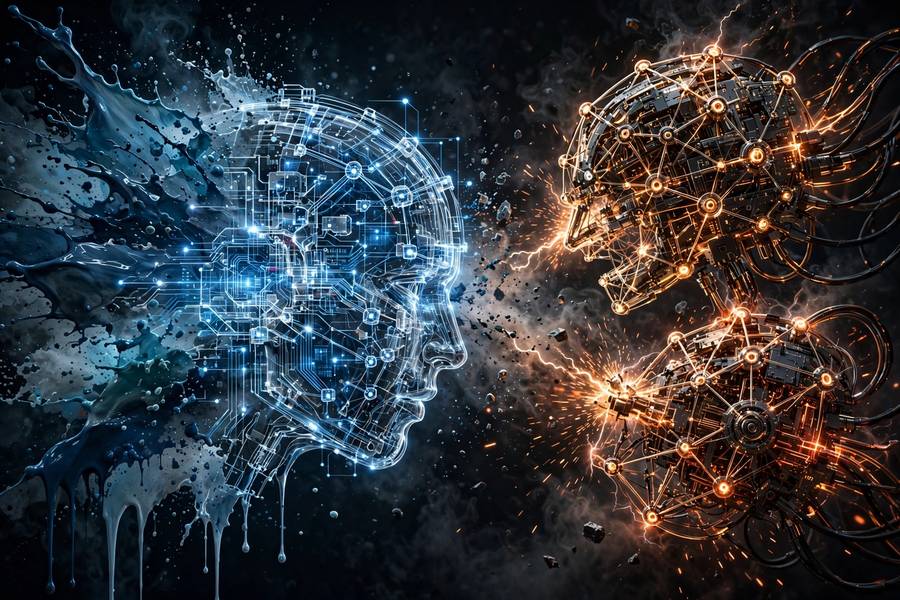
Before diffusion models took over the world, GANs — Generative Adversarial Networks — were the reigning champions of AI image generation. If you saw a freakishly realistic AI face in 2019, that was a GAN. Then diffusion arrived, and within about two years, GANs went from state-of-the-art to historical footnote for most image work. Understanding why is understanding something deep about how AI progress actually happens: not always the cleverest idea winning, but the most scalable one.
This guide compares the two approaches — how each works, what each was good at, and why diffusion won so decisively. For the diffusion side in detail, see how Stable Diffusion works.
Table of Contents
- The One-Paragraph Version
- How GANs Work: The Forger and the Detective
- How Diffusion Works: Sculpting From Noise
- Training: Where GANs Suffered
- Quality and Diversity: The Decisive Gap
- Controllability: Why Text-to-Image Needed Diffusion
- Speed: The One Place GANs Still Win
- Where GANs Still Live On
- What Diffusion Borrowed From GANs
- Frequently Asked Questions

The One-Paragraph Version
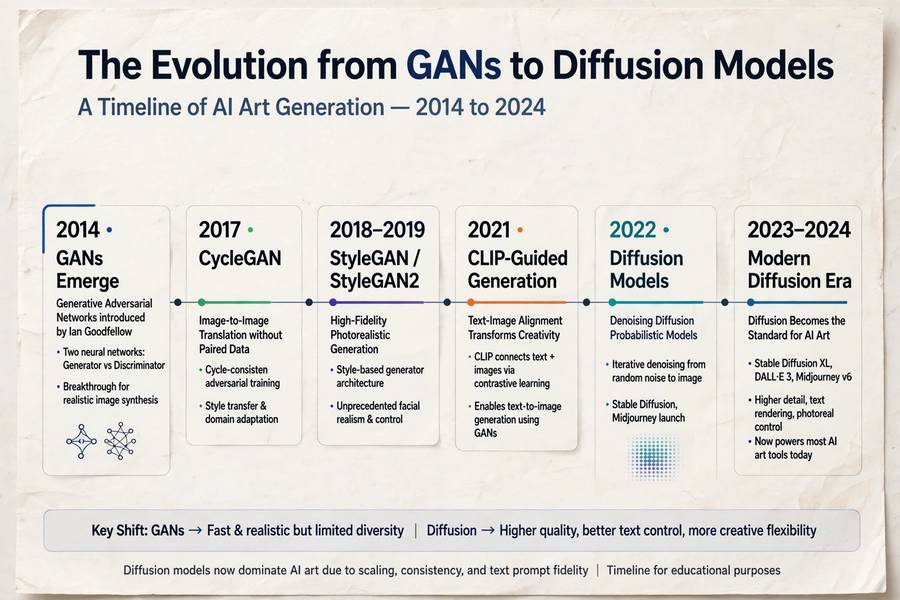
GANs generate images through competition: a generator network tries to fool a discriminator network, and both improve through rivalry. Diffusion models generate images through gradual refinement: starting from random noise and iteratively denoising toward a coherent image guided by text. GANs train unstably and are hard to control; diffusion trains stably, scales beautifully, and takes text guidance naturally. Diffusion won on quality, diversity, and controllability — GANs retain only a speed advantage for real-time use.
How GANs Work: The Forger and the Detective
The GAN concept, introduced in 2014, is genuinely elegant. Two neural networks train against each other:
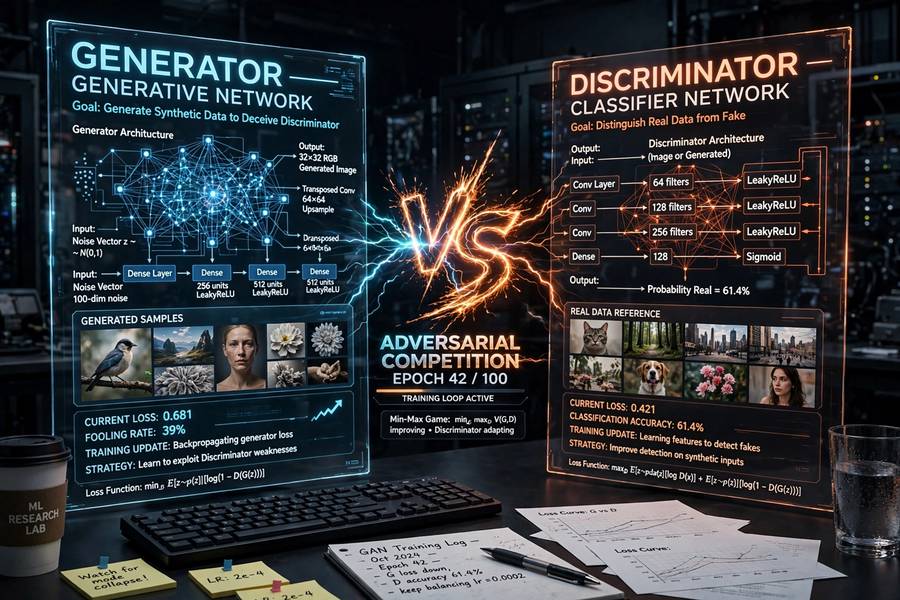
The generator creates images from random noise, trying to make them look real. The discriminator looks at images — some real (from training data), some from the generator — and tries to tell which is which. The generator improves by fooling the discriminator; the discriminator improves by catching the generator. They’re locked in an arms race, and the theory says they converge on a generator that produces indistinguishable-from-real images.
It’s a beautiful idea — adversarial training as an engine of improvement. And it worked: by 2018–2019, GANs (StyleGAN especially) produced faces so realistic they launched the “this person does not exist” phenomenon. For a few years, GANs were the best image generators on Earth.
The catch was always in the training dynamics. Getting the forger-detective rivalry to converge instead of collapse was black art — more on that below.
How Diffusion Works: Sculpting From Noise
Diffusion takes a completely different path. Instead of competition, it’s restoration: the model learns to reverse a process of adding noise to images. Training shows the model an image, adds noise progressively until it’s pure static, and teaches the network to predict the noise at each step — learning, in effect, how to un-noise any image.
Generation runs this in reverse: start with pure random noise, and iteratively remove predicted noise, guided by a text prompt, until a coherent image emerges. Twenty to fifty small steps, each one slightly less noisy, gradually sculpting meaning from static.
The metaphor I like: a GAN is a forger trying to pass inspection; diffusion is a sculptor revealing a figure from marble, chip by chip. Both produce statues. The sculptor’s process is just more reliable — and, crucially, easier to guide with words at every step. The full mechanics are in my how Stable Diffusion works guide.
Training: Where GANs Suffered
This is where the war was actually lost. GAN training is notoriously unstable:
Mode collapse. The generator discovers a few images that fool the discriminator and just… keeps making those. Infinite variations of the same face. The detective gets lazy, the forger gets repetitive, and diversity dies. Fighting mode collapse consumed enormous researcher effort.
Non-convergence. The adversarial game doesn’t have to settle — the networks can oscillate forever, each undoing the other’s progress. Training a GAN felt like balancing a broom: possible, but requiring constant attention and luck.
Hyperparameter sensitivity. Tiny changes in learning rates or architectures could mean the difference between stunning results and garbage. Reproducing someone else’s GAN results was famously difficult.
Diffusion training, by contrast, is almost boringly stable. The objective — predict the noise — is a straightforward regression task with a clear gradient signal at every step. It converges reliably, scales predictably with more data and compute, and reproduces cleanly. In the scaling era of AI, where the winning move is “make it bigger and train longer,” stability isn’t a nice-to-have — it’s everything. Diffusion could scale; GANs couldn’t, at least not gracefully. This is the same scaling story behind how AI models are trained generally: the trainable architecture wins.
Quality and Diversity: The Decisive Gap
Once both approaches were scaled up, diffusion pulled ahead on the metrics that matter:
Image quality. Modern diffusion models produce sharper, more detailed, more coherent images than the best GANs. The iterative refinement process naturally produces fine detail; GANs’ single-pass generation struggled with it.
Diversity. Diffusion models cover the full distribution of their training data — ask for varied outputs, get varied outputs. GANs, haunted by mode collapse, tended toward narrower output ranges even when well-trained.
Resolution. Diffusion scales to high resolutions naturally (generate at 1024×1024 natively in SDXL). High-res GANs required elaborate multi-stage architectures.
The turning point was around 2022: papers showed diffusion beating GANs on the standard benchmarks, and the field moved almost overnight. It was one of the fastest paradigm shifts in ML history — a testament to how decisive the advantages were.
Controllability: Why Text-to-Image Needed Diffusion
Here’s the underappreciated reason diffusion conquered text-to-image specifically: the iterative process gives you dozens of intervention points. At each denoising step, you can inject text guidance, and the model adjusts. It’s like giving directions during a road trip — continuous course correction.
A GAN generates in essentially one forward pass. Guiding that single pass with complex text is much harder — there’s no journey during which to steer, just a destination you must specify perfectly upfront. Conditional GANs existed and worked for simple conditioning (image-to-image translation, class labels), but free-form text prompting never clicked the way it did with diffusion.
This is why the text-to-image revolution is a diffusion revolution. The architecture and the application fit each other: iterative generation meets iterative guidance. Understanding what an AI model is at the architectural level makes these affinities clearer — different architectures have different natural strengths.
Speed: The One Place GANs Still Win
Credit where due: GANs generate in a single forward pass — milliseconds. Diffusion needs dozens of iterative steps — seconds. For real-time applications (video calls, live filters, games), that speed gap matters enormously.
This is why GANs survive in latency-critical niches: real-time face filters, live video effects, some mobile applications. Distilled diffusion models (Turbo, Lightning) have narrowed the gap, but a GAN is still faster per image.
The trade-off is fundamental: iterative refinement buys quality at the cost of speed. For offline creative work, nobody cares about seconds. For real-time, milliseconds are everything. Different jobs, different tools.
Where GANs Still Live On
GANs aren’t dead — they’re specialized:
- Real-time generation — filters, avatars, live effects where milliseconds matter
- Image-to-image translation — still competitive for tasks like photo→sketch, day→night
- Data augmentation — generating synthetic training data, where speed matters more than beauty
- Research — adversarial training ideas live on in other contexts (adversarial robustness, GAN-inspired losses)
And historically, GANs deserve enormous credit: they proved neural networks could generate photorealistic images at all, pioneered latent-space manipulation (the “smile vector” era), and their conceptual elegance influenced everything after. Diffusion stands on GANs’ shoulders — it just walks further.
The broader lesson: in AI, the architecture that scales wins. GANs were cleverer; diffusion was more scalable. Clever loses to scalable with remarkable consistency in this field — worth remembering whenever the next paradigm debate erupts.
What Diffusion Borrowed From GANs
The “diffusion killed GANs” story is true but incomplete — diffusion’s victory lap runs on ideas GAN researchers pioneered. The most important: latent space. GANs showed that neural networks organize images into a smooth, navigable space where directions mean things — the famous “smile vector” that could make any generated face smile. Stable Diffusion works in a latent space too (that’s the “latent” in latent diffusion), and the whole practice of prompt-travel, interpolation, and seed-walking descends directly from GAN-era latent manipulation.
Classifier-free guidance — the mechanism that makes your prompt actually steer generation — also has roots in GAN-era conditional generation research. And the evaluation culture (FID scores, the benchmarks diffusion used to dethrone GANs) was built by GAN researchers measuring their own progress.
I find this worth saying because AI discourse loves “X is dead” narratives, and they’re usually wrong in the interesting ways. GANs didn’t fail — they solved the problems they could solve, hit their architectural ceiling, and handed their best ideas to the next paradigm. If diffusion someday loses to a new architecture, expect the same: not a burial, a handoff. Progress in this field is a relay, not a duel — and knowing that makes you a better judge of whatever comes next.
Frequently Asked Questions
GANs generate images through adversarial competition between a generator and discriminator network in a single pass. Stable Diffusion is a diffusion model that iteratively denoises random noise into an image over many steps. Diffusion produces higher quality, more diverse, more controllable results.
Three reasons: diffusion training is far more stable (no mode collapse), it scales better with data and compute, and its iterative process accepts text guidance naturally — making it ideal for text-to-image. GANs remain faster per image but lost on quality and controllability.
Yes, in niches where speed matters: real-time filters, live video effects, mobile applications, and image-to-image translation. GANs generate in milliseconds versus seconds for diffusion, which is decisive for real-time use.
Generative Adversarial Network — introduced in 2014. Two networks (generator and discriminator) train against each other: the generator tries to create realistic images while the discriminator tries to detect fakes, driving both to improve.
No. Stable Diffusion is a diffusion model, a completely different architecture. It works by learning to reverse a noise-adding process, then generating images by iteratively denoising random noise guided by text prompts.
Keep reading: