

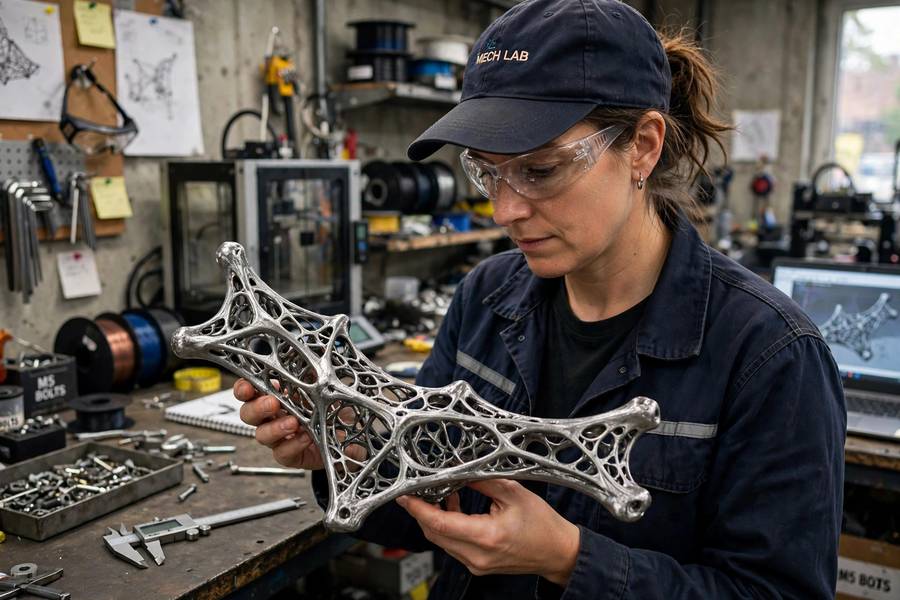
What if instead of designing one chair, you told a computer your goals — “hold 300 pounds, use minimal material, look good” — and it showed you a thousand chairs you’d never have imagined? That’s generative design: AI exploring a vast space of possibilities that human designers can’t reach alone.
I’ve followed this field from manufacturing labs to architecture studios, and it’s one of the most practical, least-hyped applications of AI I know. Here’s how it works and where it’s actually being used.
Table of Contents
- The Short Answer
- How Generative Design Differs From Regular Design
- How It Works: Goals In, Designs Out
- The Human’s Job in the Loop
- Real Examples Across Industries
- Generative Design vs. Generative AI: Don’t Confuse Them
- Limitations Worth Knowing
- How to Get Started
- Frequently Asked Questions
The Short Answer
Generative design is an AI-assisted design approach where you define goals and constraints (strength, weight, cost, materials), and software explores thousands of possible designs that meet them — often producing organic, unexpected shapes no human would draw. The designer then picks, refines, and finalizes. It’s collaboration: human judgment sets the direction, AI explores the possibilities.
How Generative Design Differs From Regular Design
Traditional design is iterative: a human creates a design, tests it (physically or in simulation), improves it, repeats. Each iteration costs time, so you explore maybe dozens of options.
Generative design is exploratory: the human defines the problem space, and the AI explores thousands of options within it. Instead of refining one idea, you’re choosing among hundreds.
The analogy I like: traditional design is hiking one trail carefully. Generative design is sending out a thousand drones to map every trail, then hiking the best one.
This doesn’t replace designers — it changes what they do. Less time drawing variations, more time defining good problems and judging results. The designers who thrive with these tools are the ones with the best judgment, not the fastest hands.
How It Works: Goals In, Designs Out
The process has four stages:
1. Define
You tell the software everything that matters:
– Goals — minimize weight, maximize strength, reduce cost
– Constraints — must fit in this space, must connect at these points, must be manufacturable this way
– Loads and forces — where will stress hit? How much?
– Materials — what’s allowed? What does each cost?
This is the most important step and the most human one. Garbage goals in, garbage designs out. Experienced users spend most of their time here.
2. Generate
The software explores the design space using optimization algorithms and AI. It tries thousands of variations — adding material where stress is high, removing it where it isn’t, testing each against your constraints via simulation.
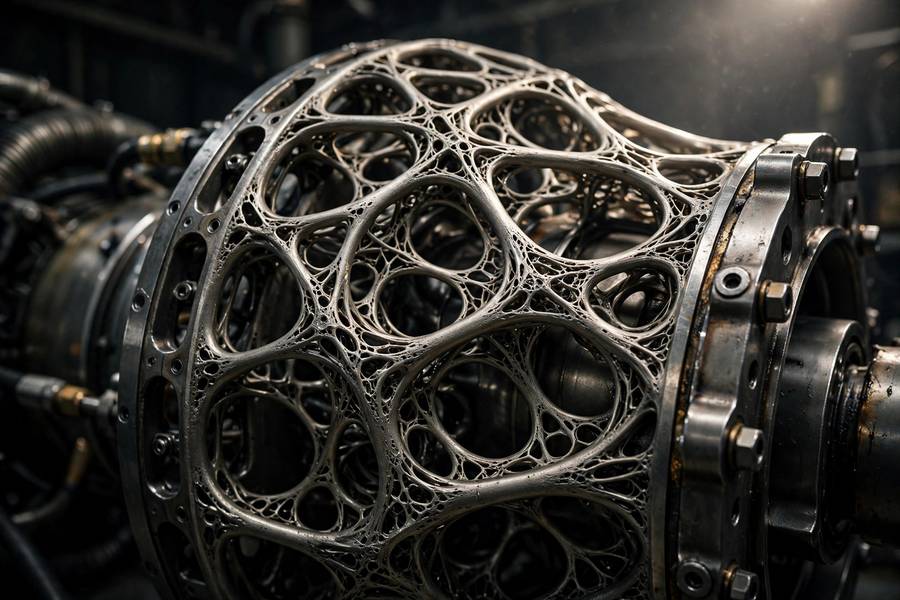
The results often look organic — bone-like structures, flowing forms, lattices. That’s because the algorithms converge on the same solutions nature found: material only where it’s needed. A generative-designed bracket looks like it grew, not like it was drawn.
3. Evaluate
You review the options. Good software ranks them by your goals and shows trade-offs: this one is lightest, that one is cheapest, this one is strongest. You can filter, compare, and inspect any design’s simulated performance.
4. Refine
Pick promising candidates and refine them — smoothing, adjusting for manufacturing realities, adding the human touches (brand identity, aesthetics, ergonomics) that algorithms don’t understand. Then validate with real testing.
The Human’s Job in the Loop
Let me be clear about what the AI does and doesn’t do, because the marketing oversells:
The AI does: Explore vast option spaces tirelessly, optimize against defined criteria, find non-obvious solutions, handle the computational heavy lifting.
The human does: Define the actual problem (the hardest part), set meaningful goals and constraints, judge aesthetics and brand fit, consider manufacturability and cost realities, take responsibility for the final design.
I’ve seen teams fail with generative design for one reason: they defined the problem badly. “Make it lighter” without constraints produces unmanufacturable art. “Make it 30% lighter, keep these mounting points, must be machinable, budget is X” produces useful designs. The quality of your constraints is the quality of your output.
Real Examples Across Industries
Automotive. Car companies use generative design for lightweight structural parts — brackets, engine mounts, chassis components. Less weight means better efficiency, and the organic shapes are often stronger than traditional designs. Some production cars already contain generative-designed parts you’d never notice.
Aerospace. Where every gram costs money, generative design shines. Aircraft brackets, drone frames, and satellite components get dramatically lighter. One famous example: a partition for an airplane cabin redesigned to be 45% lighter while meeting all safety requirements.
Architecture. Firms explore building layouts, facades, and structural systems against goals like daylight, energy use, and cost. The AI proposes hundreds of configurations; architects curate and refine.
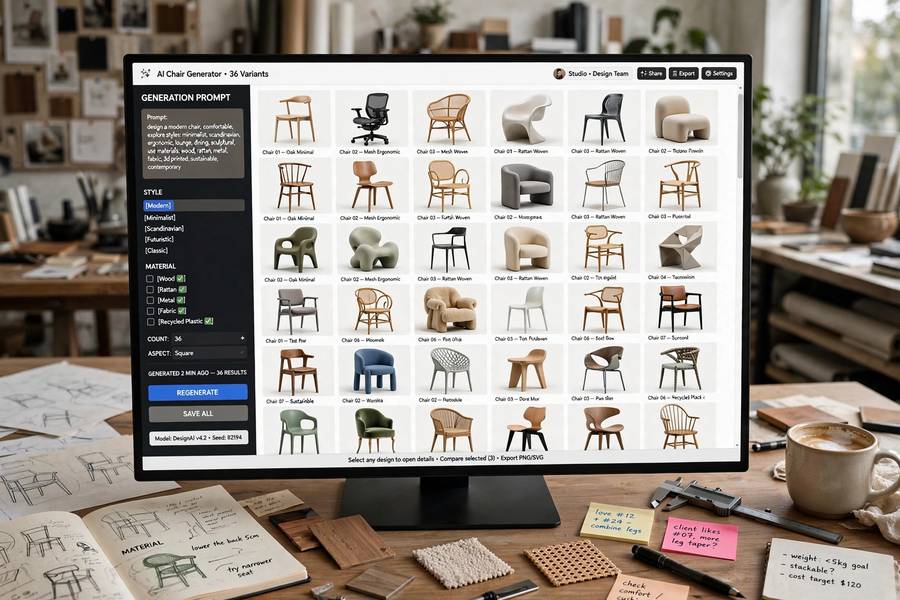
Furniture and products. The famous AI-designed chair — developed with a major furniture maker — looks like something from nature: branching, organic, using minimal material. It’s a showpiece, but the method behind it is now routine in product design.
Medical devices. Implants designed to match bone structure, prosthetics optimized for individual patients. The personalization angle — designs tuned to one person’s body — is powerful.
Chip design. AI-designed chip layouts now outperform human ones in some metrics. The designs look alien — no human would route wires that way — but they work better.
Generative Design vs. Generative AI: Don’t Confuse Them
The names are confusingly similar. Quick distinction:
- Generative design = AI-assisted engineering/design optimization. Goals and constraints in, optimized designs out. About solving a defined problem.
- Generative AI = AI that creates content (text, images, code). Prompt in, novel content out. About creating something new.
They overlap — you might use generative AI to brainstorm design concepts, then generative design to optimize them. But they’re different technologies solving different problems. If someone uses the terms interchangeably, they don’t understand either.
For the broader landscape of creative AI, my guide to AI tools covers where generative AI fits.
Limitations Worth Knowing
It’s only as good as your simulation. The AI optimizes against simulated physics. If the simulation is wrong — and simulations are always simplifications — the “optimal” design can fail in reality. Physical testing remains essential.
Manufacturing constraints are hard. A beautiful organic shape might be impossible to machine or prohibitively expensive to print. The best tools incorporate manufacturing methods as constraints, but it’s an active area of improvement.
Aesthetics and brand. Algorithms optimize numbers. They don’t understand that your product needs to look like your brand, feel right in the hand, or evoke an emotion. Human designers own this completely.
Compute cost. Exploring thousands of designs with full simulation is computationally expensive. It’s getting cheaper, but it’s not free.
The learning curve. Defining good goals and constraints is a skill. Teams typically need training and several projects before they get real value.
How to Get Started
If you’re curious:
- Learn the concepts first. Understand optimization, constraints, and simulation basics before touching software.
- Start with a real but bounded problem. A bracket, a mount, a simple part — not a whole product.
- Use accessible tools. Several CAD platforms now include generative design features; some have free tiers for learning.
- Partner constraints with testing. Simulate, then physically test. Trust the process, verify the results.
- Study the examples. The published case studies (automotive brackets, the famous chair) are excellent teachers.
Generative design won’t replace designers. But designers using it will replace designers who aren’t — because exploring a thousand options beats refining three, every time. (Curious how the AI side actually learns? Here’s how AI models are trained.)

Frequently Asked Questions
Generative design is an AI-assisted approach where you define goals and constraints (strength, weight, cost, materials), and software explores thousands of possible designs meeting them — often producing organic, unexpected shapes. The designer then selects, refines, and finalizes. It’s human judgment plus AI exploration.
Four stages: Define (set goals, constraints, loads, materials), Generate (AI explores thousands of variations via optimization and simulation), Evaluate (review and compare options by your criteria), Refine (pick winners, adjust for manufacturing and aesthetics, physically test). The definition stage is the most important and most human.
Generative design optimizes engineering solutions against defined goals — it’s about solving a specific problem. Generative AI creates novel content (text, images, code) from prompts — it’s about creating something new. They can complement each other but are different technologies.
Lightweight automotive brackets and engine mounts, aerospace parts (45% lighter cabin partitions), AI-designed furniture with organic branching structures, patient-specific medical implants, optimized chip layouts, and architectural facades optimized for daylight and energy use.
No — it changes their role. AI handles exploring thousands of options; humans define problems, set constraints, judge aesthetics and brand fit, and take responsibility. Designers with good judgment become more valuable, not less. But designers who don’t adopt these tools will be outpaced by those who do.
Key limits: it’s only as good as its simulation (physical testing still essential), organic shapes can be hard to manufacture, algorithms don’t understand aesthetics or brand, exploration is computationally expensive, and defining good constraints requires skill and training.