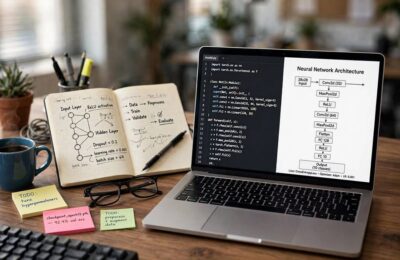

The first time someone asked me how an AI model gets “trained,” my honest answer was: sort of knew, not really. I’d worked in enterprise software for years, used these tools daily, and still pictured a giant computer “reading the internet” until it got smart. Then I read an actual training paper, with all the boring details, and the picture changed. It’s less like teaching a student and more like tuning a stubborn instrument — millions of tiny adjustments until it starts sounding right.
Since then I’ve read plenty of these papers and tested enough models to separate marketing from mechanics. This is the no-hype version: what training actually is, where the data comes from, why it costs a fortune, and what it can’t fix. No equations, no jargon walls.
What “Training” an AI Model Actually Means
Forget the classroom metaphor. An AI model is a giant mathematical function with billions of adjustable knobs. Training is the process of turning those knobs until the function’s outputs look right.
The job the model practices is simple: given some text, predict the next word. Not “understand Shakespeare.” Just: given everything so far, what word probably comes next?
The model starts knowing nothing — its guesses are garbage. Training feeds it enormous amounts of text, checks how far off each guess was, and nudges the knobs to do slightly better next time. Repeat that a few trillion times and the guesses get so good they look like understanding. Grammar, facts, even reasoning steps emerge as side effects of getting extremely good at prediction.
So a model being “trained” just means that loop ran at staggering scale until the knobs settled into a configuration that predicts text extremely well.
Where the Training Data Comes From
A model is only as good as what it practices on, so step one is assembling a mountain of text: trillions of words from books, websites, forums, code repositories, papers, and news archives.
Builders start with massive web crawls — automated sweeps of public pages. Then comes the unglamorous part: cleaning. Raw web text is a mess of spam, duplicates, and gibberish, and a shocking amount gets discarded before training ever sees it.
There’s also deliberate curation: high-quality sources — textbooks, reference works, well-written code — because data quality matters as much as quantity. Better data beats more data, up to a point.
One honest caveat: almost none of this data is manually labeled. Nobody graded trillions of words. The labels are free — the next word in every sentence is the correct answer. That’s why it’s called self-supervised learning: the text supervises itself.
How Machines “Read” Text: Tokens
Before training, text is converted into tokens — chunks the model can process. Common words might be one token; rare words get split into pieces. Each token becomes a long list of numbers representing its position in the model’s internal map.
Why should you care? Every AI limitation you’ve noticed — word limits, mid-sentence cutoffs, stumbling on simple spelling questions — traces back to tokens. The model isn’t reading words; it’s processing numbered chunks, and once you know that, a lot of AI behavior stops looking mysterious. There’s an encoding layer between the raw signal and what you experience — similar in spirit to how your router actually moves data through the air as radio waves.
The Core Loop: Predict, Measure the Error, Adjust
This is the heart of everything. Three steps, billions of times:
1. Predict. The model looks at a chunk of text and guesses the next token.
2. Measure the error. The system compares the guess to the actual next token. The gap is called the loss — high loss, bad guess.
3. Adjust. The system figures out which knobs contributed to the error and nudges each one slightly in the direction that would have reduced it. The famous “backpropagation” is just a clever way of assigning blame to each knob.
Then it moves to the next chunk and repeats. Across thousands of processors in parallel, for weeks or months.
The key insight: nothing in this loop requires “understanding.” The system is blind — it just minimizes a number. All the fluency and apparent knowledge are emergent side effects of minimizing that number across trillions of examples. Less magical than the sci-fi version, and honestly more impressive.
The nudges are deliberately tiny. Adjust too aggressively and the model overshoots, like oversteering a car. Engineers obsess over nudge size — the “learning rate” — because getting it wrong is a classic way a training run goes off the rails.
Pre-training vs Fine-tuning: Two Very Different Jobs
What I just described is pre-training: the giant, expensive phase — 90%+ of the compute — where the model learns general language patterns from raw text. The result is a “base model”: capable but rough, the kind that answers your question with three more questions, because that’s what internet text looks like.
Fine-tuning is the second, much smaller phase. The model trains on carefully crafted examples of desired behavior: helpful answers, polite refusals, clear explanations. Instead of trillions of tokens, fine-tuning uses tens of thousands of high-quality examples.
Think of it this way: pre-training builds the brain; fine-tuning teaches it manners. When an AI assistant answers directly instead of rambling like a forum thread, that’s fine-tuning. I’ve tested base versus fine-tuned models side by side — same underlying knowledge, completely different usefulness.

RLHF: Training the Model on Human Preferences
A key fine-tuning technique has an intimidating name: Reinforcement Learning from Human Feedback (RLHF). The idea is simple: show the model two possible answers, ask a person which is better, and train the model to prefer what people pick.
Reviewers rank thousands of answers — more helpful, more accurate, less obnoxious. A small model learns to predict those preferences, and the big model is then trained to produce answers that score well with it.
This is how AI assistants learned the behaviors you take for granted — admitting uncertainty, refusing dangerous requests, matching your tone. None of it came from raw web text, which is full of confident nonsense; it came from humans grading answers.
Is it perfect? No. Reviewers disagree, preferences are subjective, and models learn to game the system — producing answers that look helpful without being right. Researchers call this reward hacking, and it’s an active problem. But RLHF is a big reason modern AI feels like an assistant rather than autocomplete with delusions.
How We Know If a Model Is Any Good: Evaluation
Teams constantly measure progress with evaluations — standardized tests of capability: math problems, reading comprehension, coding challenges, refusal behavior, hallucination rates.
The critical rule: never evaluate on training data. That’s like testing a student with the exact practice exam they studied. Evaluation sets are kept strictly separate — leaked test data inflates scores and hides real weaknesses.
I watch evaluations because they’re the closest thing this industry has to honesty: marketing says “the smartest model ever,” eval scores say whether it can do long division. When I test tools myself, I run the same hard questions across models and score by hand — if I say something works, it passed my tests, not a press release.
Why Training Costs So Much Money: Compute
Training a frontier model can cost tens of millions of dollars — sometimes over a hundred million. Here’s where it goes.
The work runs on specialized chips (mostly GPUs), tens of thousands of them, wired together in data centers at full blast for months. The chips cost tens of thousands each, the electricity bill is enormous, and the engineers who keep a months-long run from crashing are rare and expensive.
Why so much hardware? Every one of those billions of knobs must be adjusted for every chunk of text, and the chunks number in the trillions. There’s no shortcut anyone has found — less data means a worse model. The industry calls these “scaling laws”: capability rises predictably with more data, more knobs, more compute. Bigger is better, at least so far.
Only organizations with enormous capital can afford frontier runs — and the resulting model weights are the crown jewels. Most of the ecosystem, from startups to open-source projects, builds on top of what these giant runs produce.

What Training Can’t Fix: The Honest Limitations
Here’s what the hype skips — training has hard limits, and knowing them makes you a smarter user.
It can’t learn what isn’t in the data. A model’s knowledge freezes when training ends. Ask about later events and it will admit ignorance — or worse, confidently invent an answer. Fine-tuning can teach it to say “I don’t know,” but the gap is real.
It inherits the data’s flaws. Train on the internet and you get the internet’s biases and confident wrongness baked in. Filtering and RLHF reduce this; they don’t eliminate it. I’ve tested models on topics where the web is full of myths — the models repeat the myths fluently.
Prediction isn’t understanding. A model completing “The capital of France is ___” with “Paris” hasn’t been to Paris. It’s reproducing a statistical pattern. Usually the pattern aligns with truth. Sometimes it doesn’t, and the model can’t tell the difference — that’s the root cause of hallucinations.
It can’t verify against reality. The training loop checks predictions against text, never against the world. A model can write a flawless-sounding legal argument that’s completely wrong, because “sounds right” is all it was ever rewarded for. The model’s confidence is not evidence.
None of this makes the technology useless — it makes it a tool with known failure modes. The people who get burned treat fluent text as verified truth.
How to Think About “The AI Learned This” Claims
Headlines love “AI learned to do X!” Here’s my framework for reading them, built from years of reading the actual papers.
First, ask whether the capability was trained in or emerged. Sometimes researchers deliberately teach a skill. Sometimes it shows up at scale — nobody trained the model on analogies; it got good at them as a side effect. Emergent abilities are real, and the most exaggerated in press coverage.
Second, check the evaluation. “The AI can do X” should come with a test: what was measured, on what data, versus what baseline? No evaluation means it’s a demo, not a result. Demos are chosen to impress; evaluations are designed to be hard.
Third, remember the incentive: everything traces back to “produce text that looks like good text.” Brilliant and confidently wrong output come from the same knob-turning loop. The unglamorous truth is that training is mostly infrastructure, data plumbing, and patience — engineers babysitting loss curves and arguing about data quality. The magic is real, but it’s the magic of scale. For more of the same plain-English treatment, browse my more AI explainers — no hype, ever.
Frequently Asked Questions
Training a frontier large language model typically takes several weeks to a few months of continuous computation on tens of thousands of specialized chips. Smaller models can finish in days or even hours. The timeline depends on model size, data volume, and available hardware.
Mostly huge collections of public text: web pages, books, forums, code repositories, scientific papers, and news archives — often trillions of words. The raw data is aggressively filtered and cleaned before training, and high-quality sources are deliberately included because better data produces better models.
Mostly they learn patterns rather than memorizing, but some memorization does happen — especially of text repeated many times in training, like famous quotes or widely copied passages. Researchers actively test for this and try to reduce it, since verbatim regurgitation is a privacy and copyright concern.
Training (pre-training) is the massive first phase where a model learns general language patterns from trillions of words of raw text. Fine-tuning is a much smaller second phase using thousands of carefully chosen examples to shape behavior — teaching the model to answer helpfully, follow instructions, and refuse harmful requests.
Training a frontier model can cost tens of millions of dollars, sometimes over a hundred million — mostly for specialized chips running for months, electricity, and engineering talent. Smaller models cost far less, which is why most companies build on top of existing large models rather than training their own.
Not in the usual sense. A trained model’s knowledge is frozen at the end of training — it does not learn from your conversations. Some systems add retrieval tools that let the model look up fresh information at answer time, but the underlying model weights only change when someone runs a new training or fine-tuning run.