

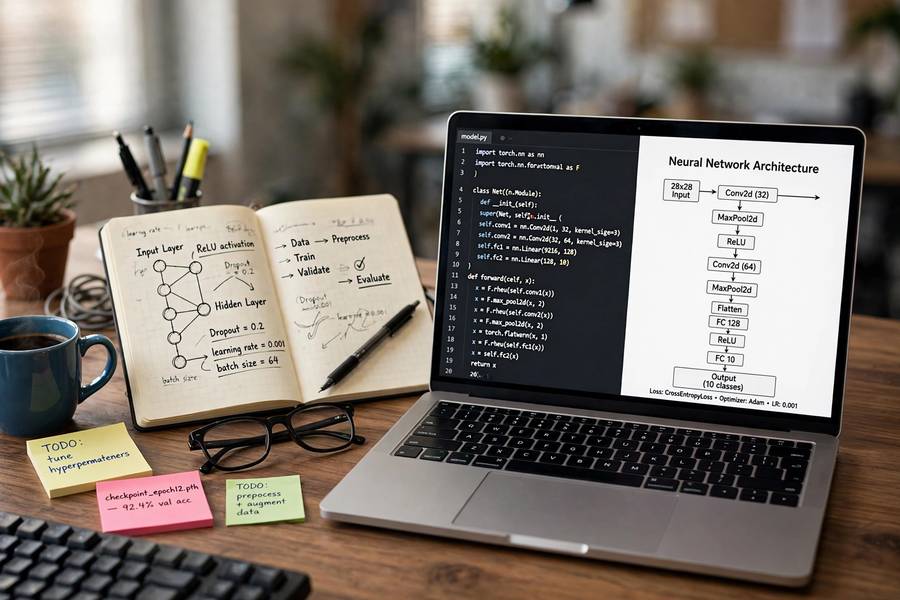
“AI model” gets thrown around constantly — in product announcements, news headlines, job postings — and most explanations either drown you in math or wave their hands so hard nothing is actually said. Here’s the straightforward version: an AI model is a piece of software that has learned to recognize patterns in data, and then uses those patterns to make predictions or generate new content.
That’s it. Everything else is elaboration. Let’s elaborate well.
In This Guide
- The Simplest Definition
- How an AI Model Is Different From Regular Software
- The Main Types of AI Models
- What “Parameters” Mean
- Training vs. Using a Model
- What AI Models Are Good At (and Bad At)
- Where You Already Use AI Models Daily
- Frequently Asked Questions

The Simplest Definition
Think of a spam filter. Years ago, someone had to write explicit rules: “if the email contains THIS word, mark it as spam.” That was regular software — human-written rules.
An AI model works differently. Instead of being given rules, it’s shown millions of examples of spam and non-spam emails and figures out the patterns itself. The result — the learned patterns, stored as numbers — is the model. When a new email arrives, the model compares it against what it learned and predicts: spam or not spam.
So: a model is the learned knowledge extracted from data, packaged so a computer can use it to handle new, unseen inputs. The training process that creates it is a whole topic of its own — I walk through it step by step in my guide to how AI models are trained.
How an AI Model Is Different From Regular Software
Regular software follows instructions a programmer wrote: if X happens, do Y. Every behavior was explicitly specified by a human. If the programmer didn’t anticipate a situation, the software has no idea what to do.
An AI model was never given explicit instructions for the task. It was given examples and a learning procedure, and it derived its own internal “rules” — except those rules aren’t readable like code. They’re millions or billions of numerical weights: settings that nudge the model’s output one way or another.
This difference explains both the magic and the frustration of AI. The magic: models can handle situations nobody explicitly programmed for — a chatbot can discuss a topic it was never specifically taught. The frustration: nobody can fully explain why a model produced a particular output, because its “reasoning” is distributed across billions of numbers no human can read.
Programmers write software. Data trains models. That one sentence captures the whole paradigm shift.
The Main Types of AI Models
AI models come in families, each suited to different jobs:
Language models process and generate text. ChatGPT, Claude, and Gemini are built on these. They predict plausible sequences of words — which, at sufficient scale, produces everything from essays to code to poetry.
Image models generate or analyze pictures. Midjourney and DALL-E create images from text descriptions; others can look at a photo and describe what’s in it, or spot defects on a factory line.
Recommendation models predict what you’ll like. Netflix suggestions, YouTube’s autoplay queue, Amazon’s “customers also bought” — all driven by models trained on behavior patterns of millions of users.
Speech models handle voice: converting speech to text (your phone’s dictation), text to speech (voice assistants), and increasingly, translating between languages in near real time.
Specialized models do one narrow job extremely well: detecting tumors in scans, predicting protein structures, forecasting weather, flagging fraudulent transactions. These rarely make headlines but quietly do enormous amounts of useful work.
Most consumer products you think of as “AI” are actually applications built on top of one or more of these model types — the distinction I break down further in my overview of AI tools explained.

What “Parameters” Mean
You’ll hear that a model has “70 billion parameters” or “1.8 trillion parameters.” Parameters are the adjustable numbers inside the model — the weights it learned during training. More parameters generally mean the model can capture more complex patterns, like a bigger brain having more neurons.
But parameter count isn’t everything. A smaller, well-trained model can outperform a larger, sloppily trained one on specific tasks. And the largest models are enormously expensive to run, which is why there’s a whole engineering discipline around making models smaller and faster without losing capability. When someone brags about parameter count, treat it like megapixels on a camera — relevant, but far from the whole story.
Training vs. Using a Model
Two phases, very different costs:
Training is the expensive part. It means feeding the model massive amounts of data and adjusting its parameters over and over until its predictions improve. Training a frontier model can cost tens of millions of dollars in computing power and take months. Only large organizations do this.
Inference (using the model) is the cheap part. Once trained, running the model on your question — generating an answer — takes seconds and fractions of a cent. This is why you can chat with a model trained at enormous expense for free: you’re only paying the inference cost, which the provider absorbs or subsidizes.
This split also explains the business model of the whole AI industry: a few companies bear the training cost, then sell inference to everyone else through APIs and apps.
What AI Models Are Good At (and Bad At)
Genuinely good at: pattern recognition in large datasets, generating fluent text, summarizing long documents, translating languages, writing boilerplate code, classifying images, personalizing recommendations, and handling the “long tail” of unusual inputs that would break rule-based software.
Genuinely bad at: knowing when they’re wrong (they state falsehoods with total confidence), true reasoning about novel situations, understanding the real world beyond their training data, maintaining consistency over long interactions, and anything requiring genuine accountability. A model can draft your contract, but it can’t take responsibility for it.
The practical takeaway: use models for drafts, summaries, brainstorming, and pattern-finding — tasks where a human reviews the output. Be cautious using them for final decisions, factual claims, or anything where an error has real consequences.
Where You Already Use AI Models Daily
You probably interact with dozens of AI models before lunch: the spam filter on your email, the autocomplete in your search bar, the face unlock on your phone, the traffic predictions in your maps app, the fraud check that approved your coffee purchase, the noise reduction on your video call, the playlist your music app made for your morning.
None of these announce themselves as “AI.” The best-deployed models are invisible — they just make things work slightly better. The chatbots get the attention, but the quiet models do most of the work.
An AI model, stripped of hype, is learned patterns from data, encoded as numbers, used to predict or generate. That definition won’t impress anyone at a dinner party, but it will protect you from about 90% of AI nonsense — because once you know what a model is, you can ask the only question that matters about any AI claim: what data was it trained on, and is that data actually relevant to what it’s being asked to do?

Frequently Asked Questions
An AI model is software that learned patterns from large amounts of data instead of being programmed with explicit rules. It’s the learned knowledge — stored as millions or billions of numbers called parameters — that lets a computer make predictions or generate content for new inputs it hasn’t seen before.
AI is the broad field of making computers perform intelligent tasks. An AI model is a specific trained artifact within that field — the actual file of learned parameters. An app like ChatGPT is a product built around an AI model, with interfaces, safety systems, and infrastructure added on top.
Parameters are the adjustable numerical weights inside a model, learned during training. They encode the patterns the model discovered in its training data. Larger models have more parameters (billions to trillions), which generally allows more complex pattern recognition — though training quality matters as much as size.
Training means feeding the model massive datasets and repeatedly adjusting its parameters to reduce prediction errors — a process requiring enormous computing power, often costing millions of dollars for frontier models. Once trained, using the model (called inference) is comparatively cheap and fast.
Yes, frequently — and confidently. Models generate plausible-sounding outputs, not verified truths. They can hallucinate facts, reflect biases in their training data, and fail on situations unlike anything they were trained on. Always verify important outputs and keep humans in the loop for consequential decisions.