

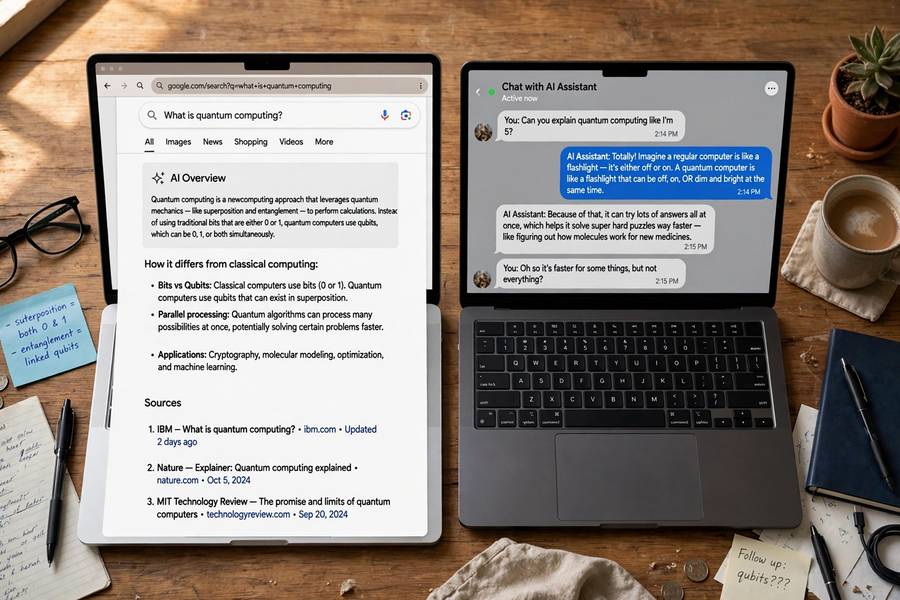
A friend recently asked me, with complete sincerity, whether ChatGPT and Google’s AI Mode were “basically the same thing now.” I understood the confusion — you type a question into a box, an AI writes an answer, and the interfaces are converging fast. But under the hood they’re built for different jobs, and using the wrong one for your task is like using a hammer to turn a screw. It sort of works, and then it doesn’t.
I’ve spent the last two years using both daily — AI search for research, chatbots for thinking and creating — and the difference in results when you pick correctly is dramatic. This guide draws the line: what each one is, how they work differently, when to use which, and the mistakes people make by treating them as interchangeable. For the full background, see what AI search is.
Table of Contents
- The One-Sentence Difference
- What AI Search Actually Is
- What a Chatbot Actually Is
- How They Work Differently Under the Hood
- The Conversation Difference
- When to Use AI Search
- When to Use a Chatbot
- Where the Lines Blur
- Common Mistakes From Mixing Them Up
- Frequently Asked Questions

The One-Sentence Difference
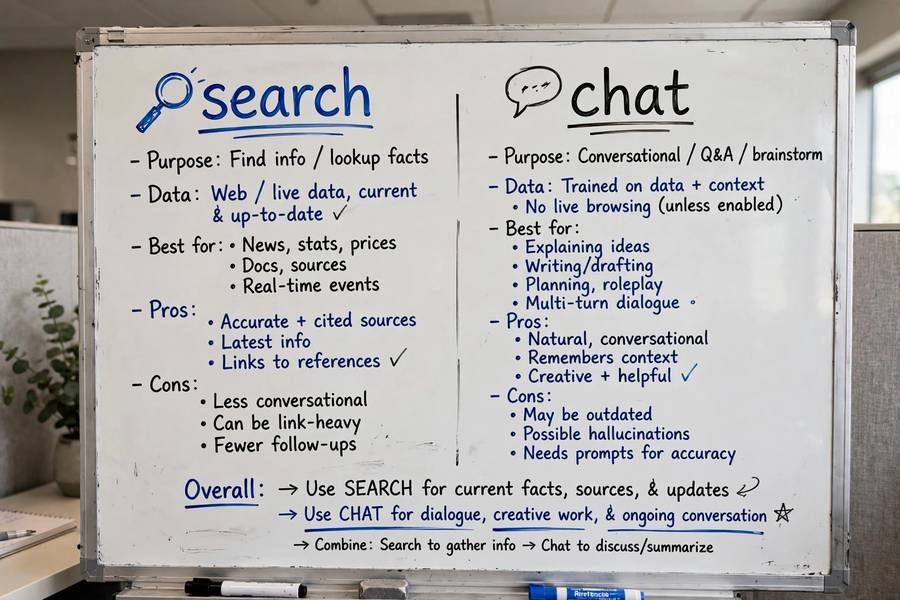
AI search finds answers in the world’s information. Chatbots generate responses from a conversation.
That’s it. AI search is fundamentally a retrieval system with a language model bolted on to summarize what it found. A chatbot is fundamentally a language model with tools (sometimes including search) bolted on to help it converse. The center of gravity is different, and everything else follows from that.
When you ask AI search “what caused the 2008 financial crisis,” it goes and reads sources, then tells you what they say. When you ask a chatbot the same question, it composes an explanation from its training — possibly checking sources, possibly not, depending on the tool and the mode. Same question, different machinery, and subtly different failure modes.
What AI Search Actually Is
AI search — Google AI Mode, Perplexity, Bing Copilot’s search mode, You.com — starts with your query and treats it as an information need. The pipeline is: understand the query, retrieve relevant pages from the web, read them, synthesize an answer, cite the sources.
The retrieval step is the soul of the product. These tools maintain or access a web index, rank documents against your query, and the language model works from those documents. That’s why AI search answers come with citations and why they’re generally current: the knowledge comes from the live web, not from frozen training data.
The interaction model is question-and-answer. You ask, it answers, done. Follow-ups are supported, but each exchange is still oriented around resolving an information need. The tool doesn’t remember you across sessions (mostly), doesn’t develop a working relationship with your project, and doesn’t particularly care about your goals beyond the query in front of it.
Strengths follow from the design: current information, cited sources you can check, good coverage of factual questions, and answers grounded in real documents rather than pure model generation.
What a Chatbot Actually Is
A chatbot — ChatGPT, Claude, Gemini in chat mode — starts with your message and treats it as a turn in a conversation. The pipeline is: understand the message in the context of the whole conversation, generate the most helpful response, optionally call tools (search, code execution, image generation) along the way.
The conversation is the soul of the product. The model maintains context across turns, builds on earlier messages, adapts to your level and style, and can pursue a goal with you over dozens of exchanges. How ChatGPT works underneath is a story about predicting helpful continuations of a dialogue — search is an accessory, not the foundation.
The interaction model is collaborative. You can brainstorm, draft, revise, role-play, debug, plan, and think out loud. The chatbot remembers what you said three messages ago, notices when you’ve changed direction, and asks clarifying questions. It’s a thinking partner, not an answer machine.
Strengths follow: sustained multi-step work, creative tasks, personalized explanations that adapt to your follow-ups, and handling ambiguous requests by conversing until the real need surfaces.
How They Work Differently Under the Hood
The architectural difference is worth understanding because it predicts the failure modes.
AI search: retrieve, then generate. The quality ceiling is set by retrieval. If the index lacks good pages on your topic, or the ranking step surfaces junk, the answer will be junk — politely synthesized junk, but junk. Hallucination is constrained because the model is working from documents, but “constrained” isn’t “eliminated”: it can still misread, merge, or overconfidently fill gaps.
Chatbot: generate, optionally retrieve. The quality ceiling is set by the model’s training and reasoning. Without browsing enabled, it’s working from frozen knowledge with a cutoff date — confident, fluent, and potentially years out of date. With browsing, it can check facts, but browsing is a tool call the model decides to make, not the default pipeline. It might not bother for a question it feels sure about — which is exactly when it should bother.
This is why the same question can get a better answer from one or the other depending on the day, the topic, and the tool’s mood about using its search tool. Neither is universally superior; they’re superior at different things.
The Conversation Difference
The most underrated difference is conversational memory and its consequences.
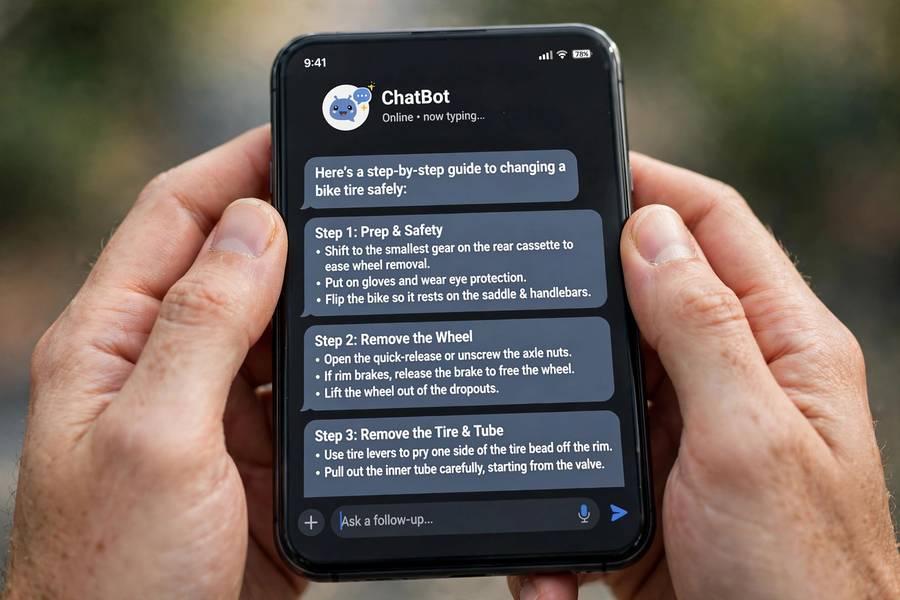
Ask AI search a vague question and you get the model’s best guess at what you meant — one shot. Ask a chatbot a vague question and it can ask what you actually need, then tailor everything after. Over a five-turn exchange, the chatbot’s answers get dramatically better as context accumulates. AI search’s answers stay at turn-one quality because each query is largely fresh.
This compounds for complex tasks. Planning a trip, debugging code, writing a report, learning a subject — these are conversations, not queries. The chatbot’s ability to hold the thread, remember your constraints (“vegetarian,” “under $2000,” “no jargon”), and build on partial results makes it the right tool. AI search would make you re-explain the constraints every single time.
Conversely, for “what’s the current price of X” or “when did Y happen,” conversation is overhead. You don’t need a thinking partner; you need a fact. AI search’s directness wins.
When to Use AI Search
Reach for AI search when:
- You need current facts. News, prices, recent events, product specs — anything where the answer lives on the live web and has a date on it.
- You want sources to check. The citations are the feature. If verification matters, start where verification is built in.
- The question is self-contained. One question, one answer, no follow-up needed. “What year was the Eiffel Tower built?” doesn’t need a conversation.
- You’re researching a topic’s landscape. “What are the main approaches to X?” AI search’s synthesis across sources gives you the map quickly.
- You don’t trust your own ability to spot model errors. The citations give you something to check against, which matters most exactly when you’re out of your depth.
When to Use a Chatbot
Reach for a chatbot when:
- The task spans multiple steps. Writing, planning, coding, analyzing — anything where step three depends on step one.
- The request is ambiguous. If you’re not sure what you’re asking, a chatbot’s clarifying questions will get you to the real question faster than ten refined searches.
- You need personalization. “Explain this like I’m a smart 15-year-old” or “given my background in biology” — the conversation carries your context.
- You’re creating, not just finding. Drafts, ideas, designs, code, stories. Search finds what exists; chatbots help make what doesn’t.
- You want to think out loud. Working through a decision, stress-testing an argument, exploring a what-if. The back-and-forth is the point.
And yes — learn how to get better answers from ChatGPT if this is your daily driver, because most people use about 20% of what it can do.
Where the Lines Blur
Honest caveat: the products are converging, and the distinction is blurrier than this guide makes it sound.
ChatGPT now browses the web and cites sources. Perplexity now holds conversations and remembers context. Google’s AI Mode handles follow-ups. Every product team is bolting the other side’s strengths onto their core, because users keep asking “why can’t it also do the thing the other one does?”
The convergence is real but incomplete. A chatbot with browsing is still a conversationalist that sometimes searches; an AI search with follow-ups is still a retrieval system that tolerates conversation. The center of gravity — the thing the product was built around — still predicts behavior at the margins, especially failure behavior. When things go wrong, each reverts to its nature: the chatbot confabulates fluently, the search tool retrieves thinly.
My prediction, for what it’s worth: in five years the distinction will be mostly about interface mode rather than product category — you’ll toggle between “answer me” and “work with me” in one tool. Until then, knowing which engine you’re actually using keeps you from expecting conversation from a search box.
Common Mistakes From Mixing Them Up
Using a chatbot as a fact database. Asking a non-browsing chatbot for current facts, statistics, or citations is the single most common error. It will answer — fluently, confidently, and possibly wrongly. If you need facts, use the tool built for facts.
Using AI search as a writing partner. Pasting a draft into Perplexity and asking for line edits technically works, but you’re fighting the tool’s design. It has no memory of your project, no investment in your voice, and every follow-up starts near zero.
Trusting chatbot citations blindly. When chatbots do browse and cite, verify the citations actually support the claims. The citation feature on a chatbot is newer and less battle-tested than on a purpose-built search product.
Expecting either to know what you meant. Vague query into AI search gives you a vague answer’s best guess. The fix differs by tool: with search, refine the query; with a chatbot, have the conversation.
Frequently Asked Questions
AI search retrieves information from the web and synthesizes a cited answer — it’s built around finding. A chatbot generates responses in an ongoing conversation — it’s built around collaborating. Use AI search for current facts with sources; use chatbots for multi-step tasks, creation, and thinking through ambiguous problems.
Not primarily. ChatGPT is a conversational chatbot that can browse the web as one of its tools, but its core design is dialogue, not retrieval. For pure fact-finding with reliable citations, a dedicated AI search tool like Perplexity or Google AI Mode is usually the better choice.
For brainstorming, explanations, and multi-step work, yes. For current facts, verifiable claims, or anything where you need to check sources, use AI search or traditional search instead — chatbots without browsing work from frozen training data and can state outdated or invented facts confidently.
AI search is generally more accurate for factual questions because it retrieves live web documents and cites them, constraining hallucination. Chatbots excel at reasoning, explanation, and creative tasks where there isn’t a single factual answer to retrieve.