


For 25 years, “search” meant the same thing: type keywords, get a list of blue links, click around until you find your answer. AI search breaks that contract. Instead of links, you get an answer — synthesized, conversational, and sourced (sometimes) from across the web.
I’ve tested every major AI search product as they’ve launched, and the shift is real — but so are the problems. Here’s what’s actually happening, how the technology works, and what it means for how you find information.
Table of Contents
- The Short Answer
- Traditional Search vs. AI Search
- How AI Search Works Under the Hood
- The Main AI Search Products Right Now
- Where AI Search Is Genuinely Better
- Where It Falls Apart
- What This Means for Websites and Publishers
- How to Use AI Search Well
- Frequently Asked Questions
The Short Answer
AI search uses large language models to understand your question and generate a direct answer — often with citations — instead of just returning a list of links. It combines traditional web retrieval with AI synthesis: find relevant sources, read them, and write you an answer.
The trade: you get answers faster, but you lose the ability to easily judge sources yourself, and the AI sometimes gets things wrong with total confidence.
Traditional Search vs. AI Search
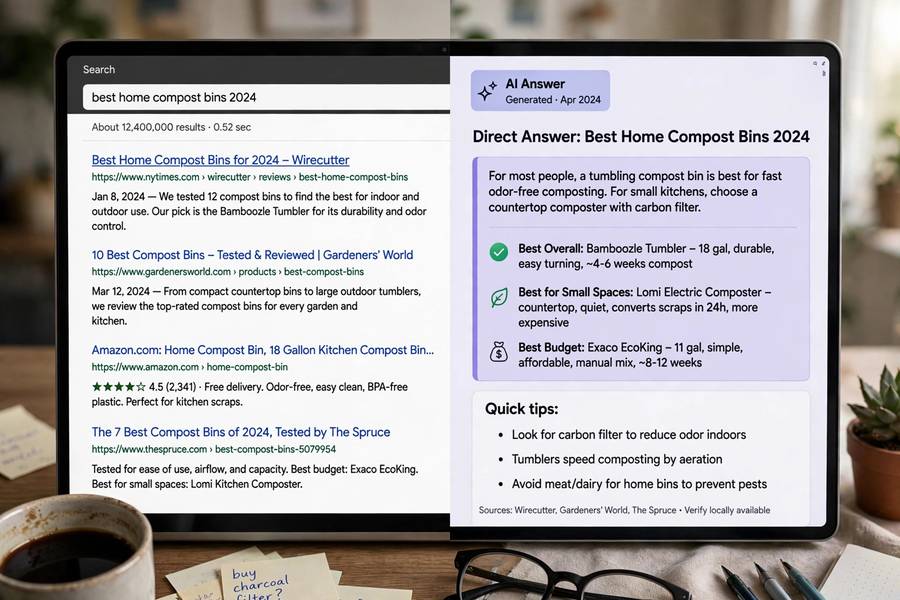
Let me make the difference concrete with an example. You ask: “Is it cheaper to fly to Tokyo in March or April?”
Traditional search (classic Google) returns: airline sites, travel blogs, a “People also ask” box, maybe a featured snippet. You open 4-5 tabs, compare, and decide. It takes 10 minutes but you see where everything came from.
AI search returns: “April is typically 15-20% cheaper for Tokyo flights because March coincides with cherry blossom season…” with little citation numbers. It takes 10 seconds. But did it actually check current prices? Is that 15-20% figure real or plausible-sounding fiction? You’d have to click through to find out — which most people don’t.
That’s the fundamental tension. Traditional search is a tool for finding sources. AI search is a tool for getting answers. Answers are more convenient; sources are more trustworthy. The right choice depends on what happens if the answer is wrong.
For background on the classic model, my guide to how a search engine works covers crawling, indexing, and ranking — the machinery AI search builds on top of.
How AI Search Works Under the Hood
Most AI search products use a pattern called retrieval-augmented generation (RAG). Here’s the pipeline:
-
Understand the query. The AI interprets what you’re really asking — including intent, not just keywords. “Cheaper to fly to Tokyo in March or April” becomes a comparison task, not a keyword match.
-
Retrieve sources. Behind the scenes, it runs something very much like traditional search: find relevant web pages, often 5-20 of them.
-
Read and synthesize. A language model reads those sources and writes an answer, weaving in citations.
-
Present with citations. You get the synthesized answer plus links to sources — in theory.
The quality of the whole thing depends on both halves: bad retrieval means the AI synthesizes from bad sources; a weak model means good sources get misread. When I test these products, I always check the citations — that’s where the truth lives.
Some systems add extra steps: breaking complex questions into sub-questions, running multiple searches, or using an agent loop to dig deeper. The fancier the pipeline, the better the answers tend to be — and the slower and more expensive each query gets.
The Main AI Search Products Right Now
The landscape is crowded and shifting, but the main approaches are:
AI-native search engines. Built from scratch around the answer-first model. They tend to be fast and clean, with heavy emphasis on citations. Their weakness is index depth — they don’t crawl as much of the web as Google.
Big-tech AI search. Google and Microsoft grafting AI answers onto their existing search engines. The advantage is the massive existing index and user base. The disadvantage is the awkward hybrid — AI answers sitting on top of a link-list interface designed for a different era.
Chatbots with browsing. General AI assistants (AI tools like the big chatbots) that can search the web when needed. Convenient if you’re already chatting, but search isn’t their primary design.
Vertical AI search. Specialized search for shopping, research papers, code, or legal documents. Often the best experience in their niche because they can tune retrieval for one domain.
I won’t name winners — this space changes quarterly. But the pattern to watch is convergence: everyone is adding everyone else’s features.

Where AI Search Is Genuinely Better
Credit where it’s due. AI search is meaningfully better at:
Complex, multi-part questions. “Plan a 5-day Tokyo itinerary for a vegetarian who loves jazz” — traditional search makes you assemble this from 20 tabs; AI search drafts it in one shot.
Summarization. “What are the main arguments in this debate?” or “Summarize these reviews” — synthesis is what language models are for.
Conversational follow-up. “Now make it cheaper” / “What about with kids?” — refining without retyping the whole query is genuinely pleasant.
Low-stakes quick answers. Definitions, conversions, “what’s the capital of…” — faster than clicking through.
Overcoming the keyword barrier. You don’t need to guess the right search terms. Describe your problem in plain language.
Where It Falls Apart
Now the honest part — where I’ve watched AI search fail:
Hallucinated citations. The AI sometimes cites sources that don’t support its claims, or worse, sources that don’t exist. Always click through on anything important.
Recency blindness. The model’s training data has a cutoff, and even with live retrieval, it can mix stale training knowledge with fresh search results. “Current” information deserves skepticism.
Source laundering. An AI answer citing three sources feels authoritative. But if all three are thin content farms saying the same wrong thing, the citations are theater. Traditional search at least shows you the domains upfront.
The confidence problem. AI search presents uncertain information with the same polish as certain information. There’s no equivalent of seeing a sketchy-looking site in the results and adjusting your trust.
Shopping and local. “Best plumber near me” is still better served by maps, reviews, and local results than by a synthesized paragraph.
When you’re wrong about what to ask. Traditional search’s link lists sometimes surface things you didn’t know to look for. AI search’s direct answers can narrow your view — you get what you asked for, not what you needed.
What This Means for Websites and Publishers
Since I run a content site, I think about this a lot. The honest assessment:
AI search sends less traffic to websites — if the answer is in the AI’s response, fewer people click through. This is already measurable and it’s accelerating.
But it also creates new rules for visibility: being cited by AI search is the new ranking. That means clear, factual, well-structured content with original information — the stuff AI can’t synthesize from thin air. Opinion, experience, original data, and genuine expertise become more valuable, not less.
The publishers who survive will be the ones AI needs to cite. The ones who die will be the ones whose content was already just reworded commodity information.
How to Use AI Search Well
My tested workflow:
- Use AI search for exploration, traditional search for verification. Get the lay of the land fast, then verify important claims at the source.
- Always click citations on anything that matters. If the citation doesn’t support the claim, the answer is unreliable.
- Ask for sources explicitly. “Cite your sources” improves citation quality noticeably.
- Cross-check numbers. Prices, statistics, dates — AI search mangles these more than anything. Verify independently.
- Know when to go traditional. Shopping, local services, breaking news, anything where source quality varies wildly — use classic search.
The models behind these products are trained the way I describe in how AI models are trained — understanding that helps you understand their limits.

Frequently Asked Questions
AI search uses large language models to understand your question and generate a direct, synthesized answer — often with citations — instead of just returning a list of links. It typically works by retrieving relevant web pages and then having an AI read and summarize them into an answer.
Traditional search (classic Google) is a tool for finding sources — you get links and judge them yourself. AI search is a tool for getting answers — faster and more convenient, but you lose easy source judgment and the AI sometimes states wrong things confidently. Use AI search for exploration and traditional search for verification.
Often, but not reliably. Common failure modes include hallucinated citations (sources that don’t support the claim), mixing stale training data with fresh results, and presenting uncertain information with full confidence. Always click through citations and independently verify numbers, prices, and dates.
RAG is the technique behind most AI search: the system retrieves relevant documents (like traditional search), then a language model reads them and generates an answer with citations. Quality depends on both halves — good retrieval with a weak model, or a strong model with bad sources, both produce poor answers.
It’s reshaping search rather than fully replacing it. AI answers are taking over quick questions and research synthesis, but traditional search remains better for shopping, local services, breaking news, and any task where judging source quality matters. Expect a long hybrid period, not a clean switchover.
Being cited by AI search is becoming the new ranking. That rewards clear, factual, well-structured content with original information — experience, opinions, original data, and genuine expertise. Commodity content that AI can synthesize from thin air loses value; content AI needs to cite gains value.