


I have a confession that will surprise no one who knows me: I barely use traditional search anymore for the first pass on a question. AI search ate that habit in about three months. But I also keep a traditional search tab open right next to it, because about once a week AI search tries to sell me something that isn’t true, and the old blue links are where I catch it.
That’s the honest shape of the tradeoff. AI search is the biggest upgrade to finding information in twenty years, and it has failure modes that traditional search never had. Most “pros and cons” lists about it are either marketing or panic. This one is neither — it’s two years of daily use, distilled. If you’re new to the concept, start with what AI search is, then come back for the balanced view.
Table of Contents
- The Pros: What AI Search Gets Right
- Pro: Instant Synthesis
- Pro: Answers Instead of Homework
- Pro: Handles Messy, Human Questions
- Pro: Lower Barrier for Complex Topics
- The Cons: Where It Falls Short
- Con: Confident Errors
- Con: The Source Diet Gets Worse
- Con: No Serendipity
- Con: Privacy and Data Questions
- The Balanced Verdict
- Frequently Asked Questions

The Pros: What AI Search Gets Right
Let’s start with what’s genuinely better, because the advantages are real and large.
Pro: Instant Synthesis
The core win: AI search reads ten pages so you don’t have to. For “what are the main causes of the French Revolution,” the old workflow was opening five tabs, skimming each, and assembling the picture yourself — fifteen minutes of competent work. AI search does it in fifteen seconds, usually well.
This isn’t laziness; it’s leverage. The synthesis step was always mechanical — extract the consensus, organize it, present it. Automating the mechanical part frees your attention for the part machines can’t do: judging, deciding, thinking. I’ve written entire research briefs where AI search did the gathering and I did the thinking, and the output was better than either of us alone.
The time savings compound. If you research as part of your job, AI search probably gives you back an hour a day. That’s not a feature; that’s a lifestyle change.
Pro: Answers Instead of Homework
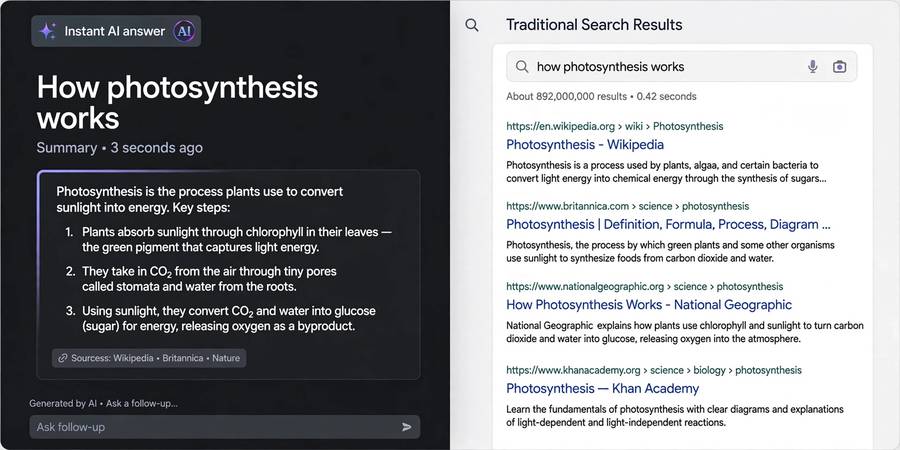
Traditional search gives you a reading list. AI search gives you an answer. That sounds like a small difference until you notice how much of traditional searching was actually unpaid labor: clicking through SEO-optimized filler, closing popups, scrolling past the answer buried in paragraph twelve.
AI search skips the homework. You ask, it reads the filler so you don’t have to, and it hands you the substance. For straightforward factual questions — the majority of searches — this is pure improvement. Nobody ever enjoyed the reading list; we endured it because there was no alternative.
There’s a subtle benefit too: it democratizes good research technique. The average person never learned to evaluate sources, cross-reference claims, or synthesize across documents. AI search does a decent version of that automatically, which means the median quality of answers people walk around with has gone up, not down.
Pro: Handles Messy, Human Questions
Traditional search needed keywords. AI search understands questions the way people actually ask them — rambling, imprecise, full of context the asker doesn’t realize they’re providing.
“My sourdough keeps coming out dense and gummy in the middle, I live somewhere humid, what am I doing wrong?” Try that as keywords in 2015. AI search parses the actual problem: over-hydration for a humid climate, probably under-baked, maybe weak starter. It handles the long tail of human confusion that keyword search never could.
This matters most for people who don’t know the vocabulary of their problem yet — which is most people, most of the time. You no longer need to know the term “cold start problem” to get a good explanation of why your new app has no recommendations. You can describe the symptom and get a clear answer. That’s a genuine expansion of who can find what.
Pro: Lower Barrier for Complex Topics
Related to the last point: AI search is a phenomenal on-ramp to hard subjects. Ask it to explain quantum computing “like I’m smart but never studied physics” and you get a genuinely good first lesson — structured, paced, jargon-light.
The old path into a complex topic was brutal: textbooks assumed prerequisites, Wikipedia assumed you already knew the vocabulary, experts were busy. AI search meets you where you are and walks you in. I’ve watched non-technical friends develop real understanding of AI, economics, and medicine-adjacent topics (from proper sources, I should add) through sustained AI search conversations.
This is the pro I’m most enthusiastic about. Anything that lowers the cost of curiosity is, on balance, good for the world.
The Cons: Where It Falls Short
Now the other side, because the failure modes are real and under-discussed.
Con: Confident Errors
The big one. AI search presents wrong answers with the same serene authority as right ones. I’ve spent a month systematically fact-checking AI answers — the short version: roughly 8% of answers in my testing were seriously wrong, and I only caught them because I was checking.
The danger isn’t the error rate; it’s the error invisibility. Traditional search showed you sources and let your skepticism engage with them. AI search hands you a finished product, and finished products don’t invite inspection. The errors that survive are the ones that sound most plausible — which are exactly the ones you’d repeat to other people.
Mitigation exists — check citations, cross-check key claims — but it requires discipline, and discipline is the first thing to go when a tool is fast and usually right.
Con: The Source Diet Gets Worse
Here’s a subtle harm: AI search narrows what you read. Traditional search exposed you to sources — their tone, their depth, their biases, their about pages. You developed, over years, a feel for which sites to trust. AI search interposes itself between you and the sources. You read the synthesis, not the source.
Over time, this atrophies source literacy. If you never visit the underlying pages, you never learn which publications are careful and which are sloppy. You become dependent on the model’s judgment about sources — judgment that is statistical, opaque, and occasionally wrong.
There’s also a diversity cost. The model’s synthesis converges on consensus, which means minority views, heterodox arguments, and genuinely new ideas get smoothed out. Traditional search would surface the weird blog with the interesting objection on page two. AI search gives you the average of page one. Averages are useful, but they’re not where insight lives.
Con: No Serendipity
Some of the best things I’ve ever learned came from the third page of search results, or from a sidebar link on an article I opened for a different reason. Traditional search was a landscape you wandered; AI search is a tube you ride.
The synthesized answer is efficient, and efficiency is the enemy of discovery. You get what you asked for, nothing more. But half of learning is finding out about the thing adjacent to your question — the related concept, the historical context, the “wait, that’s interesting” detour. AI answers don’t detour.
I now deliberately do a traditional search after an AI search when I’m exploring rather than answering — not because the AI was wrong, but because I want the landscape, not just the destination.
Con: Privacy and Data Questions
Every query to an AI search tool is data: what you’re curious about, what you’re worried about, what you’re planning. Traditional search had the same issue, but AI search queries are more revealing — they’re full sentences about your actual problems, not keyword fragments.
The business models are also murkier. With traditional search, the deal was legible: free search, ad targeting. With AI search, the monetization is still being figured out, which means your data’s future is uncertain. Queries used for model training, retained conversation logs, data shared with partners — the policies exist, but they’re longer and vaguer than most users realize.
This isn’t a reason to avoid AI search. It is a reason to think for ten seconds before pasting your company’s unreleased financials or your medical symptoms into the box. The tool is a service run by a company, not a confidant.
The Balanced Verdict
So where does that leave us? With a tool that is simultaneously the best research assistant most people have ever had and a machine for generating plausible falsehoods at scale. Both things are true. The people who insist it’s only one or the other are selling something.
My working rules, refined over two years:
- AI search for the first pass, traditional search for verification and exploration. Let the AI do the gathering; keep the old tools (how a search engine works) for checking and wandering.
- Match the tool to the stakes. Low stakes, enjoy the speed. High stakes, verify. This never changes.
- Click through sometimes. Deliberately visit the cited sources, especially when learning a new domain. Keep your source literacy alive.
- Stay curious about what you’re not seeing. The synthesis is the consensus. The interesting stuff is often in the dissent.
Used that way, AI search is the biggest upgrade to human curiosity in a generation. Used lazily, it’s a very fast way to become confidently wrong about things. The difference, as usual, is the user.

Frequently Asked Questions
Instant synthesis across multiple sources, direct answers instead of link lists, understanding of natural messy questions, and a much lower barrier to learning complex topics. For research-heavy work it can save an hour or more per day.
Confident errors that are hard to spot (around 8% seriously wrong in testing), narrowed source exposure that weakens your own judgment of sources, loss of serendipitous discovery, and open questions about how your detailed queries are stored and used.
For getting a quick synthesized answer, yes. For verifying claims, exploring a topic broadly, discovering unexpected sources, and judging source quality yourself, traditional search still wins. Most experienced users now use both: AI for the first pass, traditional search for checking and exploring.
Trust but verify, scaled to the stakes. It’s right most of the time on established facts, but wrong often enough — and confidently enough — that anything you’ll act on deserves a quick check of the citations and a cross-check of the key claim.