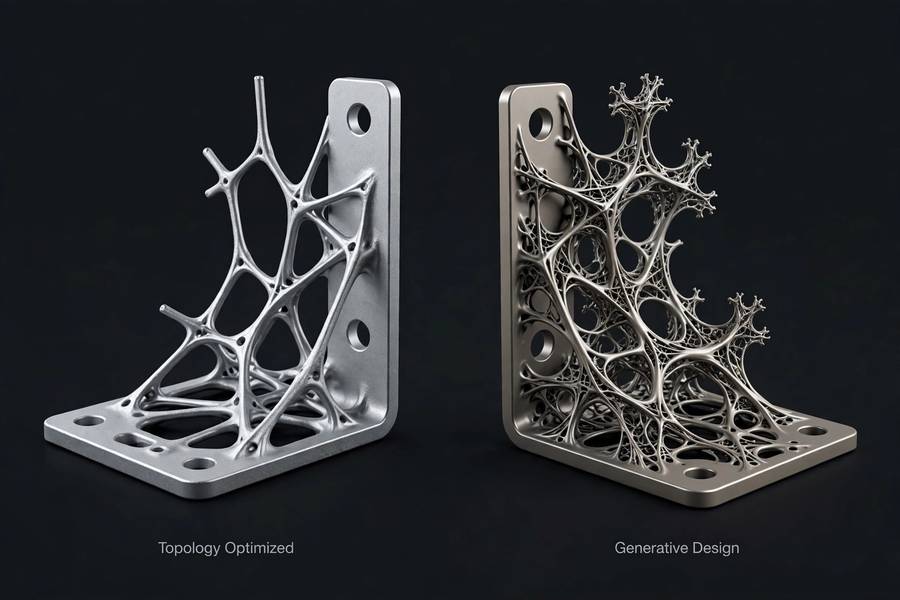
If you’ve ever watched two engineers argue about whether something is “generative design” or “topology optimization,” you know the tone: precise, slightly heated, and incomprehensible to everyone else in the room. The confusion is partly the software industry’s fault — vendors use the terms interchangeably when it suits them — and partly genuine, because the two methods overlap heavily in practice. Here’s the honest version: topology optimization is the older, narrower mathematical technique; generative design is the broader workflow that often uses it. For the big picture, start with what generative design is.
Table of Contents
- Topology Optimization in Plain Language
- Generative Design in Plain Language
- The Core Technical Difference
- One Problem Many Answers vs One Problem One Answer
- Inputs Compared: What Each Method Needs
- Outputs Compared: What You Actually Get
- Where Each One Wins
- Why Vendors Blur the Line
- Frequently Asked Questions
Topology Optimization in Plain Language
Topology optimization starts with a block of material — a design space — and asks: given these loads, these supports, and this much material, where should the material go? The algorithm iteratively removes material from low-stress regions and adds it where stresses are high, converging on a structure that carries the loads with minimum material. The results are the famous organic, skeletal forms: struts and voids that look grown rather than drawn.
The method is mathematically mature — the foundations date to the late 1980s (Bendsøe and Kikuchi’s homogenization work) — and it solves one well-defined problem extremely well: material distribution for structural performance. It’s a single-objective optimizer at heart. You give it a design space, loads, and constraints; it gives you back the stiffest or lightest structure it can find within that space. One problem, one answer (mostly — more on that below).
The catch is that the answer is a concept, not a part. Topology optimization outputs a rough, mesh-like form that needs interpretation: smoothing, rebuilding, detailing, and validation. It tells you where material wants to be. It does not hand you a manufacturable CAD model. That gap — between the optimized concept and the buildable part — is where the real engineering work lives.
Generative Design in Plain Language
Generative design is the bigger tent. It typically starts the same way — loads, constraints, materials, manufacturing methods — but it explores more broadly: multiple materials, multiple manufacturing processes, multiple design variants, and often multiple objectives simultaneously (weight, cost, stiffness, thermal performance). Instead of converging to one answer, it produces a population of candidates ranked against your goals.
If topology optimization is a mathematician solving one equation, generative design is a studio running a design competition: many entries, many trade-offs, a shortlist at the end. The evolutionary and AI-driven methods under the hood — genetic algorithms, and increasingly machine-learning-accelerated solvers — are built for breadth. The point isn’t the single optimal structure; it’s the set of good options and the trade-offs between them.
This is also why generative design tooling tends to include manufacturing awareness: it can generate variants for 3D printing, milling, casting, or combinations, because real decisions involve how the thing gets made, not just how it performs. Topology optimization, in its classical form, doesn’t care how you manufacture the result. Generative design usually does.
The Core Technical Difference
Strip away the marketing and the difference is scope. Topology optimization solves a specific mathematical problem: distribute material in a design space to optimize a structural objective. It’s a technique — a solver. Generative design is a workflow — a way of framing and exploring a design problem that may use topology optimization as one of its engines, alongside evolutionary search, parametric variation, and increasingly, learned surrogate models.
An analogy: topology optimization is a very good calculator; generative design is the engineering process that decides what to calculate. You can run topology optimization without any generative design around it — plenty of engineers do, treating it as an analysis-driven concept tool. And you can run generative design studies where topology optimization is only one of several methods generating candidates.
The history of artificial intelligence mirrors this pattern: narrow, rigorous techniques mature first, and broader frameworks that orchestrate them arrive later. Topology optimization is the 1980s technique; generative design is the 2010s workflow that put it to work at scale.
One Problem Many Answers vs One Problem One Answer
This is the practical difference you’ll feel in the software. Run a topology optimization study and you get a result: the optimized structure. Run it again with the same inputs and you get the same result (deterministic solvers converge the same way). It’s a single answer to a single question.
Run a generative design study and you get a gallery: dozens or hundreds of candidates, ranked, with different materials, different manufacturing methods, different trade-offs. Run it again and you may get a different gallery — evolutionary methods have randomness in them. The generative study is a conversation starter; the topology optimization result is a conclusion.
Neither is universally better. The single answer is exactly what you want when the problem is well-defined and you trust the setup. The gallery is what you want when the problem has competing objectives and you’re not sure which trade-off is right. Most real projects need both at different stages: the gallery early, when exploring; the single rigorous answer late, when refining.

Inputs Compared: What Each Method Needs
Topology optimization needs: a design space (the block of material), loads and boundary conditions, a volume fraction or mass target, and optionally symmetry or manufacturing constraints. That’s it. The input burden is low, which is why it’s such a good concept tool — you can set up a study in an afternoon.
Generative design needs all of that plus: material options, manufacturing method options, cost models, multi-objective definitions, keep-out and preserve regions in more detail, and often a clearer statement of what “better” means across competing goals. The input burden is higher because the exploration is broader. Garbage in, garbage out applies to both, but it applies harder to generative design — a vague objective function produces a gallery of beautifully optimized wrong answers.
The common failure mode for both is identical: wrong loads. If your load cases don’t represent reality, the optimizer will diligently produce a structure optimized for a fantasy. The fancier the method, the more confidently it will be wrong. Every experienced user has a story about this.
Outputs Compared: What You Actually Get
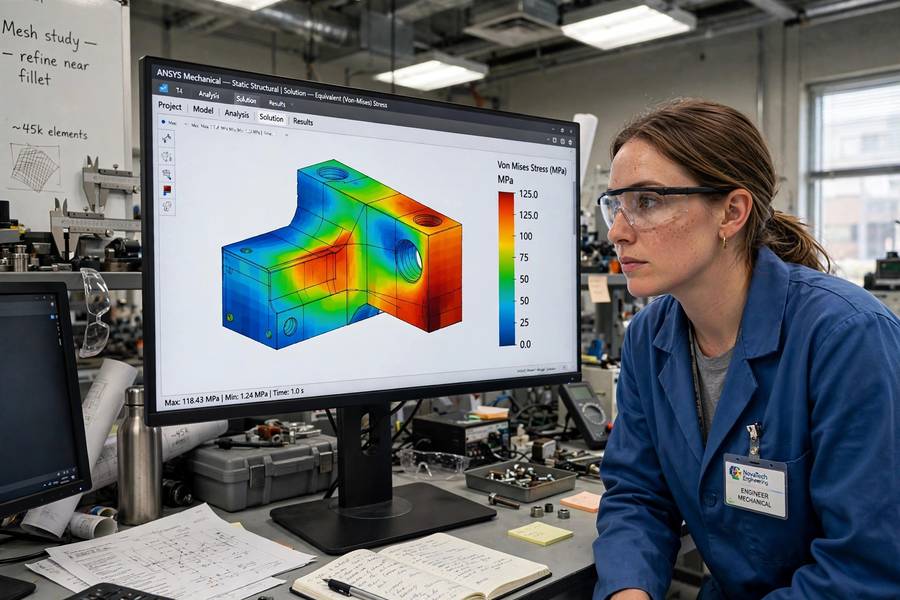
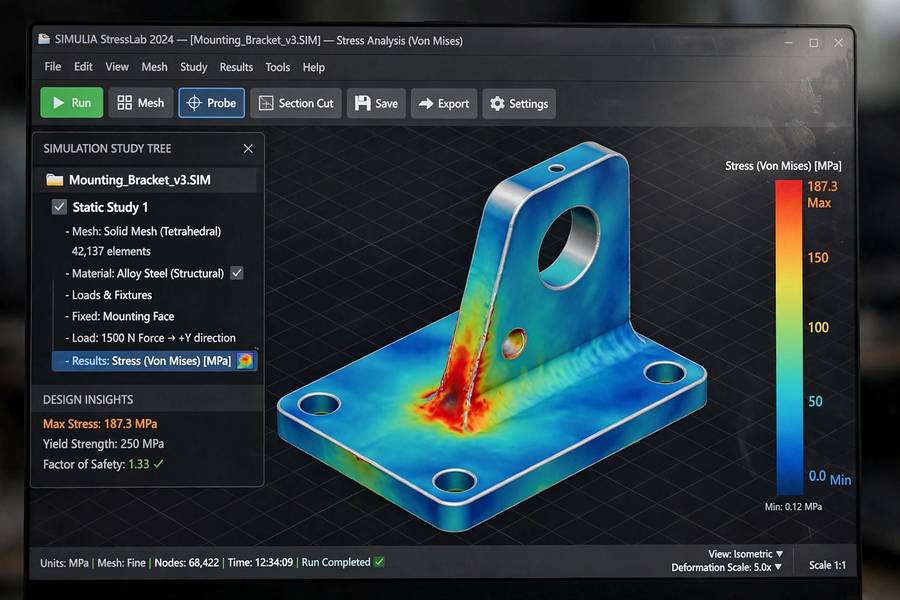
Topology optimization outputs a density field or mesh: a rough concept showing where material should go. It’s not CAD. It’s not manufacturable as-is. Turning it into a part requires interpretation — smoothing the form, rebuilding it as solid geometry, adding manufacturing details (draft angles, fillets, fastener interfaces), and re-validating with FEA. The output is a starting point, and an expert one.
Generative design outputs ranked candidates, often closer to manufacturable: the study considered manufacturing methods, so the candidates respect them. But “closer” isn’t “done.” The candidates still need detailing, validation, and usually a parametric rebuild for production. The gallery is a better starting point than the single concept — more options, more context on trade-offs — but it’s still a starting point.
Anyone who tells you either method produces finished parts is selling software. Both produce informed starting points. The engineering happens after.
Where Each One Wins
Topology optimization wins when: the problem is structurally well-defined, you need the lightest or stiffest concept fast, you’re doing early-stage exploration of load paths, or you’re working in a domain where the physics is the whole story (brackets, mounts, structural nodes). It’s the sharper, faster tool for structural questions.
Generative design wins when: the problem has multiple competing objectives, manufacturing method is an open question, you need to compare materials, or the design space includes non-structural considerations (cost, aesthetics, assembly). It’s the broader tool for messier, real-world design problems.
In practice, the winning workflow uses both: generative study to explore the space and find the promising region, topology optimization (or a refined generative run) to nail the structural details, parametric rebuild to make it manufacturable. The methods aren’t competitors; they’re stages. The engineers who argue about the terminology are usually arguing about which stage they’re standing in.
Why Vendors Blur the Line
Let’s be candid. “Generative design” sounds like the future; “topology optimization” sounds like a math class. Software vendors have every incentive to label their topology optimization tools as generative design, and many do — which is why you’ll see “generative” features that produce exactly one answer with no gallery, no materials comparison, and no manufacturing options. That’s topology optimization wearing a trendier name.
The test is simple: does the tool explore broadly (many candidates, many trade-offs, many manufacturing options) or converge narrowly (one optimized result)? Broad is generative; narrow is topology optimization. The name on the button doesn’t matter. And when the marketing starts invoking how Midjourney works style AI magic for what is fundamentally a structural solver, take it with the appropriate amount of salt. The math underneath is rigorous and decades old; the magic is in how it’s packaged.
Frequently Asked Questions
Topology optimization is a mathematical technique that distributes material in a design space for optimal structural performance, producing one answer. Generative design is a broader workflow that explores many candidates across materials, manufacturing methods, and objectives, producing a ranked gallery of options.
Often, yes. Many generative design workflows use topology optimization as one of their engines, alongside evolutionary search and other methods. But topology optimization can also be used standalone as a concept tool without any generative workflow around it.
Both produce lightweight parts. Topology optimization is faster and sharper for pure structural weight reduction. Generative design is better when weight competes with cost, manufacturing method, or other objectives that need to be traded off against each other.
Neither produces finished parts directly. Topology optimization outputs a rough concept needing interpretation and rebuild. Generative design outputs candidates that respect manufacturing constraints but still need detailing, validation, and usually a parametric rebuild for production.
Marketing. “Generative design” sounds more modern than “topology optimization,” so vendors label optimization tools as generative. The real test is whether the tool explores broadly with many candidates (generative) or converges to one optimized result (topology optimization).