

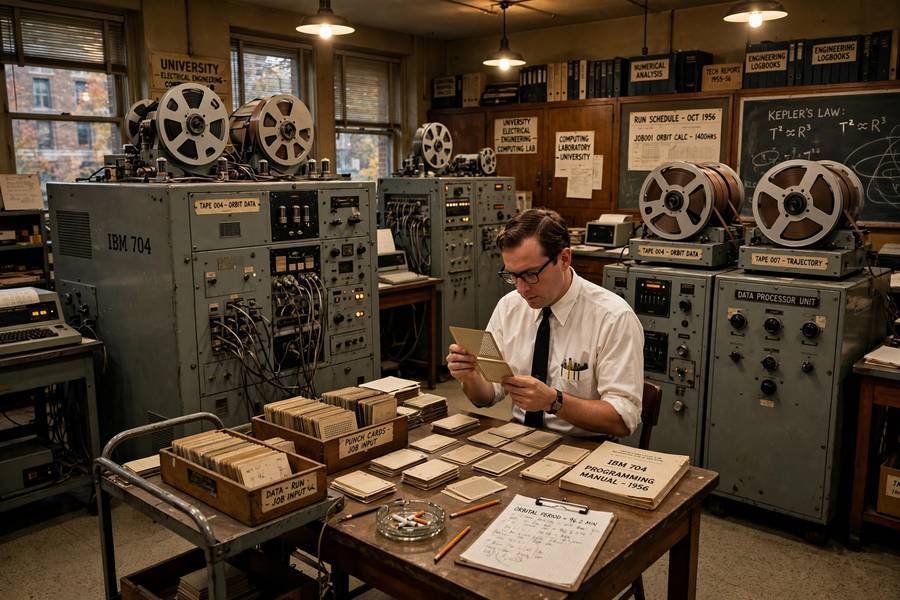
Everyone talks about AI like it appeared out of nowhere in 2022. It didn’t. I’ve spent years reading the actual papers and testing the actual tools, and the real story is far more interesting than the overnight-success version. The history of artificial intelligence is really a story of big promises, long winters, and a few stubborn researchers who refused to quit.
If you want to understand where AI is going, you need to know where it’s been. Not the sci-fi version — the real one.
Contents
- 1950: Turing Asks the Question
- 1956: The Dartmouth Workshop Coins “AI”
- 1960s–1970s: Early Wins and the First Winter
- 1980s: Expert Systems and the Second Winter
- 1997–2011: The Quiet Comeback
- 2012: Deep Learning Changes Everything
- 2017–2022: Transformers and the Generative Boom
- 2023–2026: AI Goes Mainstream
- What the History Teaches Us
1950: Turing Asks the Question
Long before anyone said “artificial intelligence,” Alan Turing published a paper called “Computing Machinery and Intelligence.” His proposal was disarmingly simple: instead of asking whether machines can think — a philosophical rabbit hole — ask whether a machine can imitate a human well enough to fool another human in conversation. That became the Turing Test.
What I find remarkable, having read the original paper, is how practical Turing was. He wasn’t dreaming about robot overlords. He was asking an engineering question: what would it take, mechanically, to produce intelligent-seeming behavior? That engineering mindset is the thread that runs through the entire history of AI.
1956: The Dartmouth Workshop Coins “AI”
In the summer of 1956, a young mathematician named John McCarthy organized a workshop at Dartmouth College. He coined the term “artificial intelligence” for the proposal — partly, historians say, to avoid association with cybernetics and partly to stake out fresh territory.
The attendees were wildly optimistic. Herbert Simon reportedly said machines would beat humans at chess within ten years (it took forty). Marvin Minsky thought the problem of intelligence would be “substantially solved” within a generation. This optimism wasn’t foolish — the early results genuinely looked promising. Programs could already prove math theorems and solve algebra word problems. When your first attempts work that well, it’s natural to assume the rest is just scaling up.
It wasn’t.
1960s–1970s: Early Wins and the First Winter
The 1960s produced real achievements. Joseph Weizenbaum’s ELIZA (1966) could hold a surprisingly convincing conversation as a mock psychotherapist — mostly by reflecting the user’s words back as questions. Shakey the robot (1966–1972) could navigate rooms and move objects. Early neural networks, called perceptrons, could recognize simple patterns.
But then researchers hit walls. Machine translation — a flagship goal — produced comical garbage. A famous (possibly apocryphal) story claims “the spirit is willing but the flesh is weak” was translated to Russian and back as “the vodka is good but the meat is rotten.” Whether or not that exact story is true, the quality really was that bad.
In 1969, Minsky and Seymour Papert published Perceptrons, showing mathematically that single-layer neural networks couldn’t solve simple problems like XOR. Funding dried up. In 1973, the UK’s Lighthill Report concluded AI research had failed to deliver, and British funding collapsed. This was the first AI winter — a period where the money and the credibility evaporated.
The lesson I take from this era: AI progress has never been a straight line. It’s been a series of sprints followed by long, quiet periods where the real work happened out of the spotlight.
1980s: Expert Systems and the Second Winter
AI came roaring back in the 1980s on the back of expert systems — programs that encoded human expertise as thousands of if-then rules. DEC reportedly saved tens of millions of dollars with a system that configured computer orders. Japan launched the ambitious Fifth Generation Computer Systems project. For a while, every big company needed an AI lab.
The problem with expert systems was brittleness. They were brilliant inside their narrow domain and helpless outside it. Maintaining the rule bases became enormously expensive — every new situation needed a human to hand-write new rules. By the late 1980s, the specialized Lisp machines that ran these systems were being undercut by cheaper workstations, the funding bubble popped, and AI entered its second winter.
Having worked in enterprise software, I recognize this pattern intimately. Every decade has its “this changes everything” technology that turns out to change some things, slowly, expensively, and only after the hype dies down.

1997–2011: The Quiet Comeback
The period most histories skip is the one that matters most. While nobody was watching, AI researchers went back to fundamentals — and started winning.
In 1997, IBM’s Deep Blue beat world chess champion Garry Kasparov. It was brute force more than intelligence, but it proved that machines could master complex domains. Around the same time, researchers quietly revived neural networks with better training methods, more data, and — critically — faster hardware. Graphics cards (GPUs), built for video games, turned out to be perfect for the parallel math that neural networks need.
By the late 2000s, machine learning was eating the world behind the scenes: spam filters, product recommendations, speech recognition on your phone. Nobody called it “AI” in marketing materials — it was just software that worked. I’ve always thought this was AI’s most productive era precisely because the hype was gone and the engineers could just build.
2012: Deep Learning Changes Everything
The turning point has a specific date: September 2012. A neural network called AlexNet, built by Alex Krizhevsky, Ilya Sutskever, and Geoffrey Hinton, demolished the ImageNet image-recognition competition — cutting the error rate nearly in half compared to the runner-up.
I’ve read the AlexNet paper, and what’s striking is how simple the core idea was: a big neural network, lots of data, GPUs, and a few clever training tricks. No magic. Just scale and engineering discipline applied to ideas that had been sitting around since the 1980s.
After AlexNet, deep learning took over computer vision, then speech, then translation. Money flooded back in. Google, Facebook, and others hired every neural network researcher they could find. The winter was definitively over.
2017–2022: Transformers and the Generative Boom
In 2017, Google researchers published “Attention Is All You Need,” introducing the transformer architecture. The title was a flex — they were saying you could throw away the previous approaches entirely. They were right.
Transformers scaled beautifully. GPT-2 (2019) could write eerily coherent paragraphs. GPT-3 (2020), with 175 billion parameters, could write essays, code, and poetry from a short prompt. Then came the image generators: DALL-E, Midjourney, and Stable Diffusion (2022) put startling creative tools in everyone’s hands.
I tested these tools as they came out, and the honest assessment is: astonishingly fluent, frequently wrong, and genuinely useful if you verify the output. That three-part description has held true through every generation since.
2023–2026: AI Goes Mainstream
ChatGPT’s launch in late 2022 did what seventy years of research hadn’t: it made AI a dinner-table topic. Within two months it had 100 million users — the fastest-growing consumer product in history at the time.
What followed was a land rush. Every tech company shipped an AI assistant. Open-source models caught up with surprising speed. AI moved into coding, medicine, law, customer service, and creative work — sometimes brilliantly, sometimes embarrassingly.
Where are we now, in 2026? The honest version: AI is genuinely transformative for specific tasks — drafting, summarizing, coding assistance, data analysis — and genuinely unreliable for others. The companies making money with AI are the ones that figured out which is which. The hype cycle is cooling into something more useful: infrastructure.
What the History Teaches Us
After tracing this whole arc, a few patterns stand out:
Winters follow hype, reliably. Every boom has been followed by a bust when promises outran delivery. The current boom will cool too — the question is only whether it cools into a winter or a plateau of steady usefulness. My money is on plateau: this time the technology actually works for enough real tasks.
The breakthroughs were old ideas plus scale. Neural networks date to the 1940s. Backpropagation to the 1980s. Transformers recombined existing concepts. What changed was data, compute, and engineering patience — not conceptual magic.
Usefulness arrived quietly. The most impactful AI of the 2000s — spam filters, recommendations, voice typing — succeeded precisely because nobody hyped it. The lesson for evaluating today’s AI claims: ignore the demos, watch what people actually rely on daily.
Skepticism is a feature. Every era’s confident predictions were wrong in interesting ways. The researchers who lasted were the ones who kept testing against reality instead of defending their forecasts.
The history of artificial intelligence isn’t a story of machines getting smarter on their own. It’s a story of humans — optimistic, stubborn, frequently wrong, occasionally brilliant — grinding away at a hard problem for seventy years. Understanding that is the best preparation for whatever comes next.
Frequently Asked Questions
The term “artificial intelligence” was coined in 1956 at the Dartmouth workshop, but the field’s foundations go back to Alan Turing’s 1950 paper on computing machinery and intelligence. Practical AI research began in the mid-1950s.
The AI winter refers to two periods (mid-1970s and late 1980s–1990s) when AI funding and interest collapsed after early promises failed to materialize. Research continued at a smaller scale, and many key breakthroughs were developed during these quiet years.
Most researchers point to the 2012 AlexNet deep learning breakthrough and the 2017 transformer architecture as the two turning points that made modern AI possible. Both combined old ideas with massive data and computing power.
John McCarthy, who coined the term “artificial intelligence” and organized the 1956 Dartmouth workshop, is most often called the father of AI. Alan Turing is considered the father of computer science and laid AI’s theoretical foundations.
History suggests cycles: rapid progress followed by plateaus. Current AI excels at specific tasks but still struggles with reliability and reasoning. Expect continued steady improvement rather than a straight line to human-level intelligence.