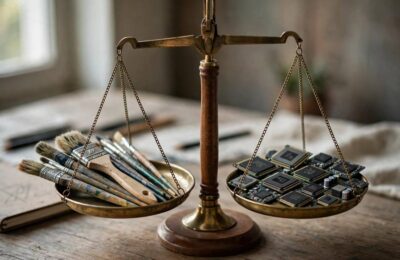
People use “AI art” and “digital art” interchangeably, and they’re not the same thing — though the line between them gets blurrier every month. I know digital painters who now start pieces with AI-generated bases, and AI artists who finish generations with hours of manual painting. The categories are colliding in real workflows while the terminology lags behind. So let’s get precise: what each one is, how they’re actually made, where they differ, and where they’re merging. The philosophical backdrop is can AI make art; this is the practical comparison.
Table of Contents
- Definitions: What Each Term Means
- How Digital Art Is Made
- How AI Art Is Made
- Skill and Learning Curve Compared
- Control and Precision
- Speed and Iteration
- Ownership and Rights
- The Convergence: Hybrid Workflows
- Which Should You Learn?
- Frequently Asked Questions
Definitions: What Each Term Means
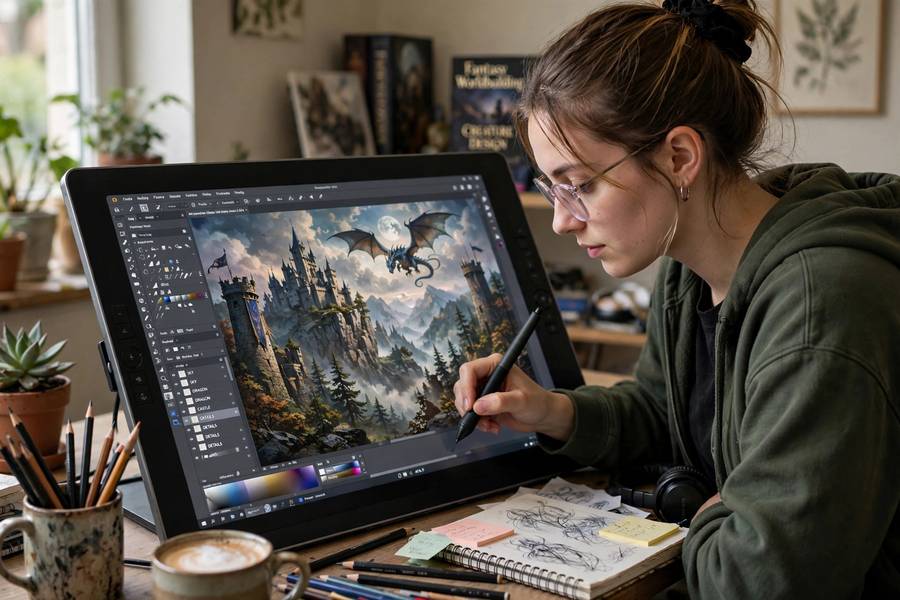
Digital art is art made with digital tools where a human directly creates the marks: drawing with a stylus in Photoshop, painting in Procreate, modeling in Blender, compositing photographs. The computer is the medium — like canvas or clay — and the human hand (via stylus, mouse, or tablet) makes every stroke, even if software assists with layers, undo, and effects.
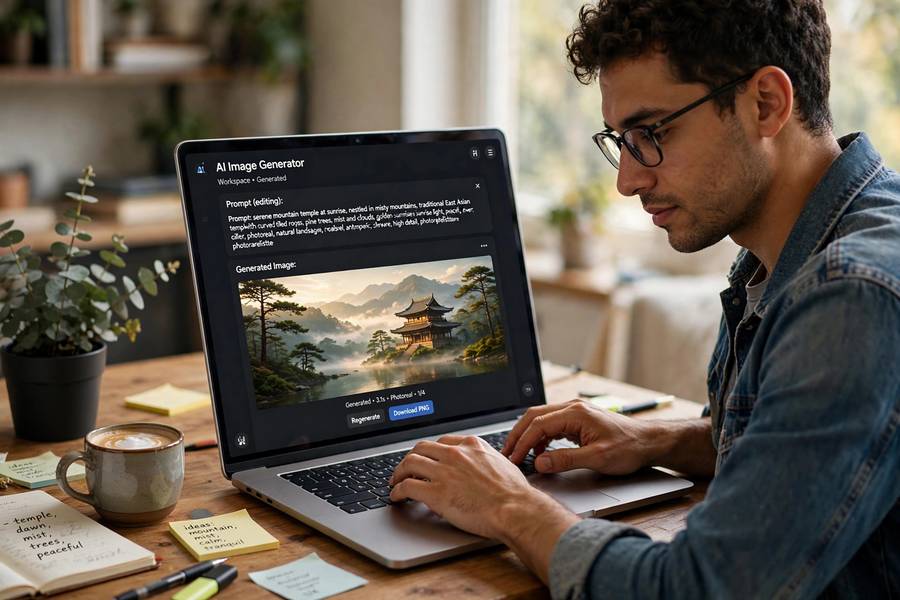
AI art is imagery produced by generative models from text prompts (or other inputs): you describe what you want, the model synthesizes pixels. The human directs and curates; the machine executes the mark-making. The computer is the maker, and the human is the director.
The distinction that matters: who puts down the marks. In digital art, the human does — stroke by stroke. In AI art, the model does — guided by human direction. Everything else (tools, file formats, screens) is shared territory.
This is also why “AI art is just digital art” is wrong but understandable: both live on screens, both produce JPEGs, both get posted identically. The difference is in the process, invisible in the final file.
How Digital Art Is Made
A digital painting workflow, concretely:
- Sketch. Rough composition with a stylus — digital pencil, fully human, fully manual.
- Structure. Refined linework, perspective, anatomy — built stroke by stroke, with the artist’s trained hand-eye coordination doing the work.
- Color and light. Blocking in values, choosing palettes, rendering form — every gradient placed deliberately.
- Detail pass. Textures, highlights, refinements — hours of accumulated micro-decisions.
- Polish. Color grading, effects, final adjustments.
Tools: Photoshop, Procreate, Clip Studio Paint, Krita for 2D; Blender, ZBrush for 3D; a drawing tablet with pressure sensitivity. The learning curve is measured in years — draftsmanship, color theory, anatomy, composition — the same fundamentals as traditional art, translated to a screen.
The key experiential fact: digital artists feel the work the way traditional artists do. There’s resistance (a stroke that won’t behave), flow states, happy accidents from the hand, and the direct satisfaction of a mark landing right. The undo button changes the economics of mistakes, not the nature of making.
How AI Art Is Made
An AI art workflow, concretely:
- Concept. The human decides what to make — subject, mood, purpose. (This step is shared with all art.)
- Prompting. Translating the concept into words: subject, style, details, parameters. The craft here is linguistic and aesthetic — knowing which words produce which visuals.
- Generation. The model synthesizes images — typically a grid of variations — in seconds to minutes. How Midjourney works details the diffusion mechanics.
- Curation. The human reviews, selects, rejects. Taste is the primary skill — recognizing the good one among the options.
- Iteration. Refining prompts, adjusting parameters, regenerating — steering toward the vision through successive approximations.
- Post-work (sometimes). Upscaling, manual touch-ups, compositing — the step where AI art often becomes hybrid.
Tools: Midjourney, DALL-E, Stable Diffusion and its interfaces, Firefly. The learning curve is measured in weeks for competence, months for mastery — prompting vocabulary, parameter knowledge, aesthetic judgment, iteration strategy.
The key experiential fact: AI artists direct rather than execute. The satisfaction is curatorial — the thrill of the good roll, the craft of steering. It’s closer to art direction or photography (finding the shot among possibilities) than to painting.
Skill and Learning Curve Compared
The honest comparison, no flattery either way:
| Digital Art | AI Art | |
|---|---|---|
| Time to first decent result | Months of practice | Minutes |
| Time to mastery | Years (like any craft) | Months of deep practice |
| Core skill | Draftsmanship + visual fundamentals | Prompting + curation + taste |
| Transferable from traditional art | Directly — same fundamentals | Partially — taste and composition transfer; execution doesn’t |
| Ceiling | As high as human skill goes | Bounded by model capability + human direction |
The “AI art takes no skill” claim is wrong — prompting well and curating well are real, learnable, unequally distributed abilities. But the “it’s just as hard” claim is also wrong — the floors differ enormously, and the ceilings differ in kind. Digital art’s ceiling is human mastery; AI art’s ceiling is (currently) the model’s capability multiplied by the director’s vision.
What I tell beginners: learning digital art teaches you to see — fundamentals that transfer everywhere, including to AI art direction. Learning AI art teaches you to direct — a rarer skill than people think, and increasingly valuable.
Control and Precision
This is where the two diverge most sharply in practice:
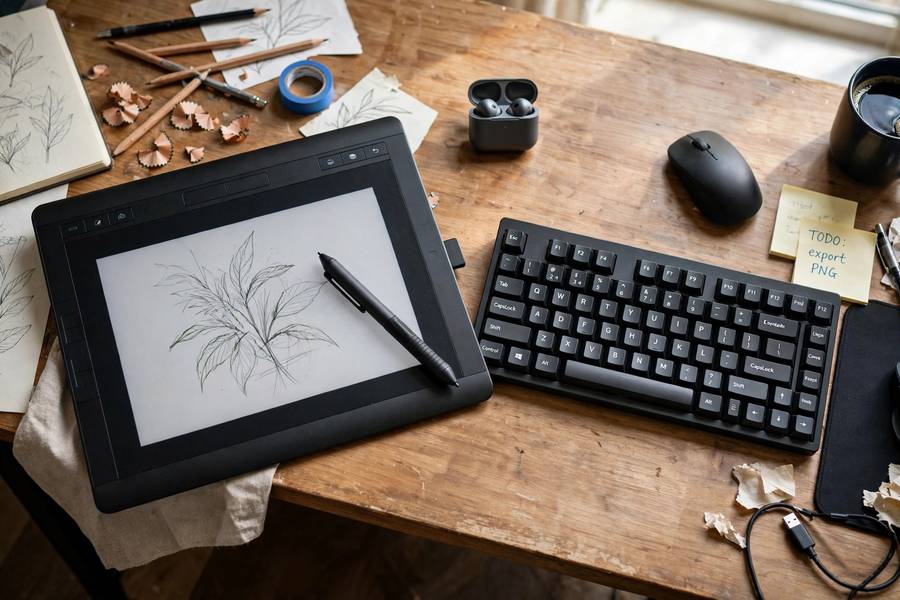
Digital art: total control, pixel by pixel. Want the character’s left eye exactly 3 pixels higher? Move it. Want that specific shade of teal? Pick it. Every element is addressable because the human placed it. Precision is the medium’s native language.
AI art: statistical control, direction by description. You steer with words, and words are imprecise instruments. “Make the eye slightly higher” might work, might change the whole face, might be ignored. Control is probabilistic — you influence distributions, you don’t place pixels. Techniques like inpainting, control nets, and reference images (what Stable Diffusion is covers the open-source tooling) narrow the gap, but the fundamental asymmetry remains: digital art is deterministic craft; AI art is guided chance.
Practical consequence: for work requiring exactness — logos, UI assets, precise character sheets, anything with text — digital art (or hybrid workflows) wins. For work rewarding exploration — concepting, mood pieces, style experiments — AI’s looseness is a feature.
Speed and Iteration
The tradeoff that defines when to use which:
AI art is explosively fast at the start. Dozens of directions explored in an hour. For ideation, mood-boarding, and concepting, nothing touches it — it’s like having an infinitely patient junior artist who works at superhuman speed.
Digital art is faster at the finish. Once the concept is locked, executing precise revisions by hand beats regenerating and hoping. “Move that mountain left” takes a digital painter seconds and an AI artist an uncertain number of regenerations.
Iteration economics differ. AI iteration is cheap per attempt but unpredictable — you might nail it in three tries or thirty. Digital iteration is expensive per attempt (it’s manual labor) but perfectly predictable — each stroke does exactly what you intend.
Smart workflows exploit both: AI for the divergent phase (explore widely, fast), digital craft for the convergent phase (refine precisely). This is the hybrid pattern the industry is converging on, and it’s the subject of the next section.
Ownership and Rights
A practical difference with real consequences:
- Digital art you made is straightforwardly yours — full copyright in the human-authored work, standard artist rights, no ambiguity.
- AI-generated imagery sits in murkier water: in the US, purely AI-generated images likely can’t be copyrighted (no human authorship), which affects exclusivity even when commercial use is permitted by the platform’s terms.
For client work, this matters: a client buying digital illustration gets standard IP transfer; a client buying AI-generated illustration gets… something less exclusive, which should be disclosed and priced accordingly. The rights gap is one of the under-discussed practical differences between the two — and it’s entirely in digital art’s favor for now.
The Convergence: Hybrid Workflows
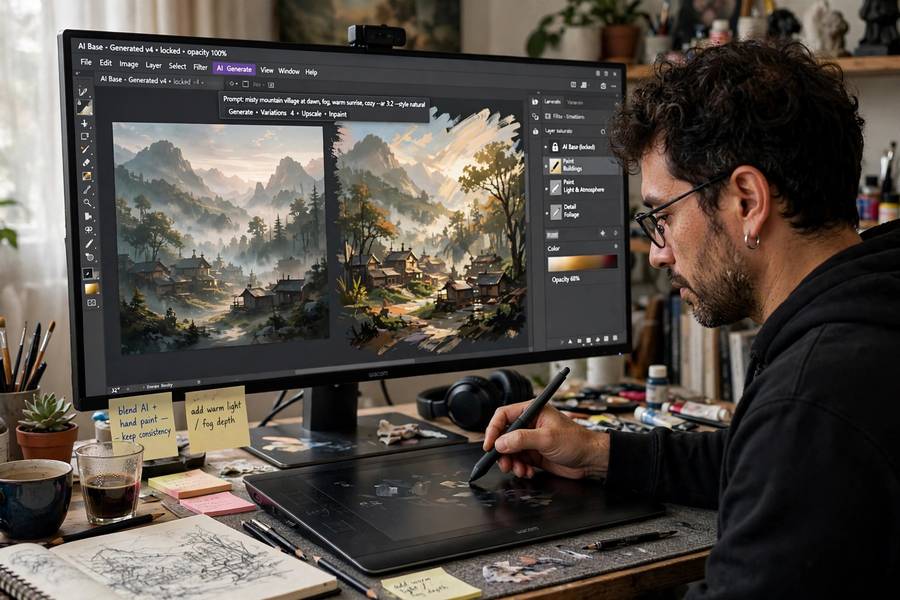
Here’s the thing the “versus” framing obscures: the boundary is dissolving in professional practice. The emerging standard workflow in concept art, illustration, and design:
- AI for ideation. Generate dozens of directions, pick the strong ones.
- Human curation and compositing. Assemble the best elements — often from multiple generations — into a coherent base.
- Digital overpainting. A skilled artist paints over the AI base: fixing anatomy, refining details, unifying lighting, adding the human touch that makes it theirs.
- Final polish in standard digital tools. Color grading, effects, delivery formats.
The result is neither “pure” AI art nor “pure” digital art — it’s a hybrid where each technology does what it’s best at. Studios increasingly expect artists to work this way: AI literacy plus fundamental craft, not either/or.
This convergence also resolves some ethical tension: substantial human transformation over an AI base strengthens both the artistic claim and the copyright position. The hybrid isn’t a compromise — it’s arguably the most capable workflow either technology enables alone.
Which Should You Learn?
It depends on your goal:
- Learn digital art if: you want deep craft, precise control, a portable lifelong skill, full ownership of your work, or a career in illustration/animation/game art. It’s the longer road and the more fundamental one.
- Learn AI art if: you want to visualize ideas fast, you have strong taste but limited drawing ability, you work in concepting/direction/marketing, or you want to multiply the output of existing creative skills.
- Learn both if: you’re serious about visual creation as a career. The industry is converging on hybrid; the artists thriving in five years will likely be the ones fluent in both languages — the hand and the prompt.
My own path: I came from writing into AI art out of curiosity, then found myself studying composition and color theory — digital art fundamentals — because they made my AI direction dramatically better. The “versus” turned out to be a “both, in sequence.” Taste turned out to be the common root: it grows in either soil and transfers to both.
Frequently Asked Questions
In digital art, the human creates every mark directly with digital tools (stylus, tablet) — the computer is the medium. In AI art, a generative model creates the marks from text prompts — the human directs and curates while the machine executes. The key difference is who puts down the marks.
The floor is much lower — decent AI results take minutes versus months of practice for digital art. But AI art has its own real skills (prompting, curation, iteration), and digital art offers total precision control that AI can’t match. They differ in kind, not just difficulty.
Increasingly, yes. The emerging professional workflow is hybrid: AI for rapid ideation and exploration, then human curation, compositing, and digital overpainting for precision and finishing. Studios increasingly expect fluency in both.
Digital art you create is straightforwardly copyrightable. Purely AI-generated images likely cannot be copyrighted in the US (no human authorship). Substantial human transformation of AI output — like detailed overpainting — can create protectable human authorship.
Learn digital art for deep craft, precise control, and fundamental visual skills; learn AI art for speed, ideation, and directing visuals without drawing ability. For a creative career, learn both — the industry is converging on hybrid workflows.