
“Can AI make art?” I’ve been asked this by artists, engineers, philosophers, and my uncle at Thanksgiving. Everyone wants a yes or no. The honest answer is: it depends what you mean by “art” — and unpacking that is more useful than any soundbite.
I’ve generated thousands of images with these tools and spent time with working artists who use them, fear them, or both. Here’s where I’ve landed: AI can produce images that function as art, move people, and win competitions. Whether that’s “making art” is a question about humans, not machines.
Contents
- What AI Image Generators Actually Produce
- The Case for Yes
- The Case for No
- What Artists Actually Think (It’s Complicated)
- The Skill Question: Is Prompting Art?
- Where Humans Still Win Decisively
- My Honest Synthesis
- AI Art and the Money Question
What AI Image Generators Actually Produce
Let’s be precise about what’s happening. When you prompt an image model, it doesn’t “imagine” anything. It runs a diffusion process — starting from noise, iteratively refining toward patterns its training associated with your words. The result is a novel arrangement of learned visual patterns.
Is the output original? Technically yes — it’s not a copy of any training image. Is it creative? It produces combinations no human arranged before. I’ve generated images that genuinely surprised me — juxtapositions I wouldn’t have conceived.
But here’s the thing I keep coming back to: the model has no intention. It doesn’t want to express grief or joy or wonder. It has no experience of anything. It’s an extraordinarily sophisticated pattern engine producing images that look like the product of intention. Whether that distinction matters is the whole debate.
The Case for Yes
The strongest arguments that AI output qualifies as art:
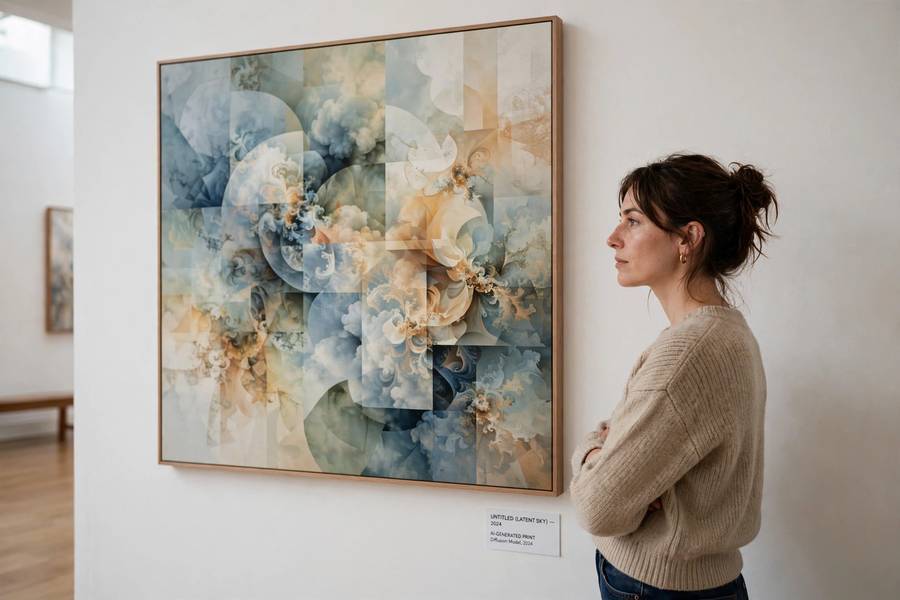
The output can move people. I’ve seen AI-generated images that are genuinely beautiful, haunting, or thought-provoking. If art is defined by its effect on the viewer, some AI images clear the bar. An image that makes you feel something is doing what art does, regardless of its origin.
Photography faced the same argument. When cameras arrived, painters said it wasn’t art — just mechanical reproduction. Now photography is unquestionably art. Every new tool goes through this: the tool is “cheating” until a generation grows up with it and the question sounds quaint.
Human curation is real creative work. The best AI art I’ve seen involved hundreds of iterations, careful prompt engineering, selection, and post-processing. The human’s taste, vision, and persistence shaped the result. Dismissing that as “just typing” undervalues how much of traditional art is also selection and judgment.
A competition was already won. In 2022, an AI-generated image won a digital art prize at the Colorado State Fair, to considerable controversy. Whatever you think of the ethics, judges evaluating the work as art found it worthy.
The Case for No
The strongest counterarguments:
No lived experience. Art, in the richest sense, is a human communicating human experience — grief, love, rage, wonder — through form. An AI has experienced nothing. It can simulate the forms of emotional expression with stunning accuracy, but there’s no one home behind them. When I look at a Rothko, I’m meeting another consciousness. With AI images, I’m meeting statistics.
No intention or risk. Human artists make choices — brave ones, costly ones. They risk failure, embarrassment, and years of work on a vision. An AI risks nothing and intends nothing. Some philosophers of art argue that intention is constitutive of art, not incidental to it.
It’s remix, not creation. However novel the outputs, they’re recombinations of patterns from training data — which was made by humans. The model is, in a real sense, standing on the shoulders of every artist whose work it was trained on, mostly without consent or compensation.
The ease problem. Part of what we value in art is the difficulty overcome — the years of practice visible in a masterful brushstroke. When something beautiful takes ten seconds, it can feel like the achievement has been hollowed out, even if the image itself is lovely.
What Artists Actually Think (It’s Complicated)
I’ve talked with working artists across this spectrum, and “artists hate AI” is far too simple:
- Some are furious — particularly illustrators and concept artists watching entry-level commercial work evaporate. Their anger is economic and legitimate, not just philosophical.
- Some are enthusiastic adopters — using AI for ideation, mood boards, and exploration, then finishing by hand. They describe it as the best brainstorming partner they’ve ever had.
- Most are ambivalent — impressed by the technology, worried about the economics, annoyed by the hype, and getting on with their work.
The pattern I notice: artists secure in their distinctive voice tend to be curious; artists doing interchangeable commercial work tend to be scared. That tells you the technology’s real impact is economic stratification, not the death of art.
The Skill Question: Is Prompting Art?
“Prompt engineering” as an art form — I’ve gone back and forth on this. My current view:
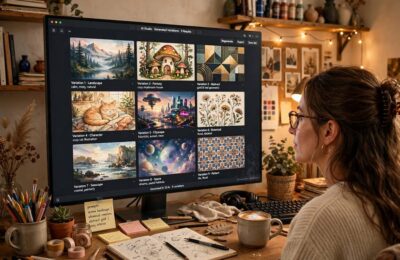
Writing a good prompt is a real skill. Getting a specific vision out of these models — consistent characters, precise compositions, particular moods — takes knowledge, iteration, and taste. I’ve spent hours coaxing models toward a specific image, and the skill ceiling is higher than skeptics admit.
But it’s a different skill from traditional artistry — closer to art direction or curation than to painting. The prompt artist directs; the model executes. That’s a genuine creative role (film directors don’t operate cameras either), but let’s not pretend it’s the same as the hand skills it bypasses.
Where Humans Still Win Decisively
For all the impressive outputs, humans remain irreplaceable at:
- Art with something to say. The most powerful art comes from a point of view forged by living. AI can simulate provocation but not conviction.
- Cultural participation. Art movements are conversations between people in a time and place. AI isn’t part of any culture; it samples all of them shallowly.
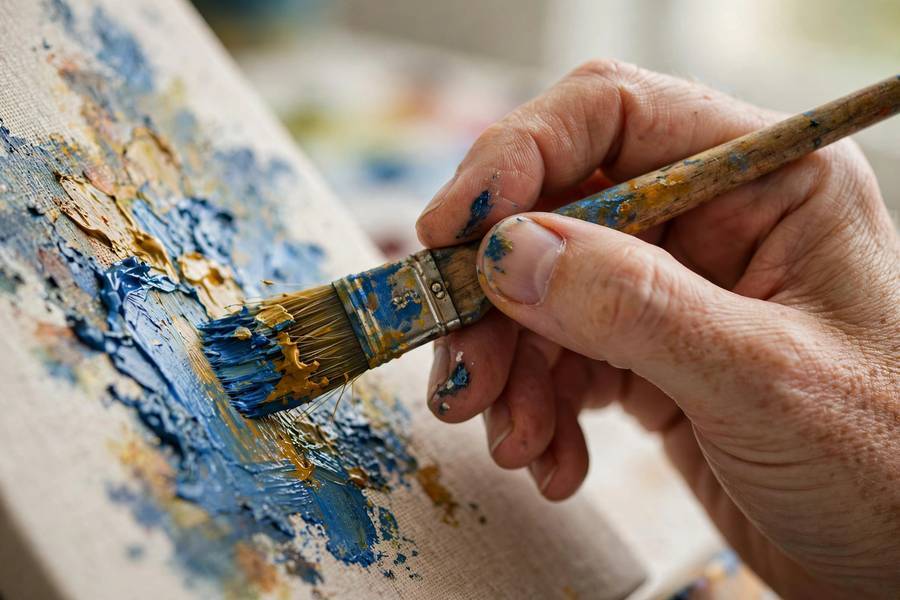
- Physical craft. The texture of oil paint, the grain of wood, the presence of a sculpture in space — embodiment matters, and screens flatten it.
- Taste as identity. An artist’s distinctive way of seeing, developed over years, is the scarcest thing in the visual world. AI can imitate styles but not have one.
My Honest Synthesis
After all the testing and thinking, here’s where I land:
AI can produce images that function as art — that move viewers, win prizes, and sell. In that functional sense, yes, AI “makes art.”
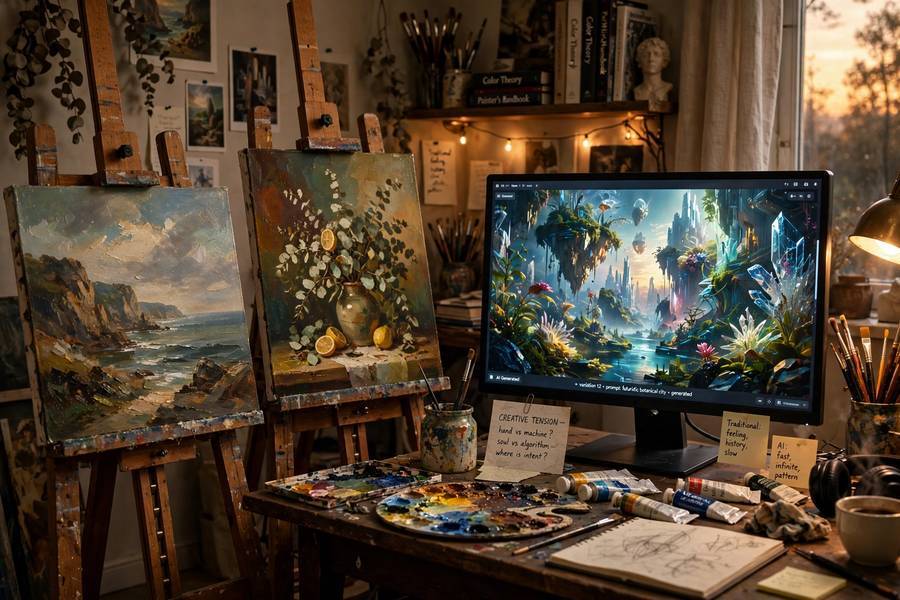
But art in the fuller sense — human experience transformed through intention, skill, and risk into form that meets another consciousness — remains human territory. The machine simulates the output; it doesn’t participate in the activity.
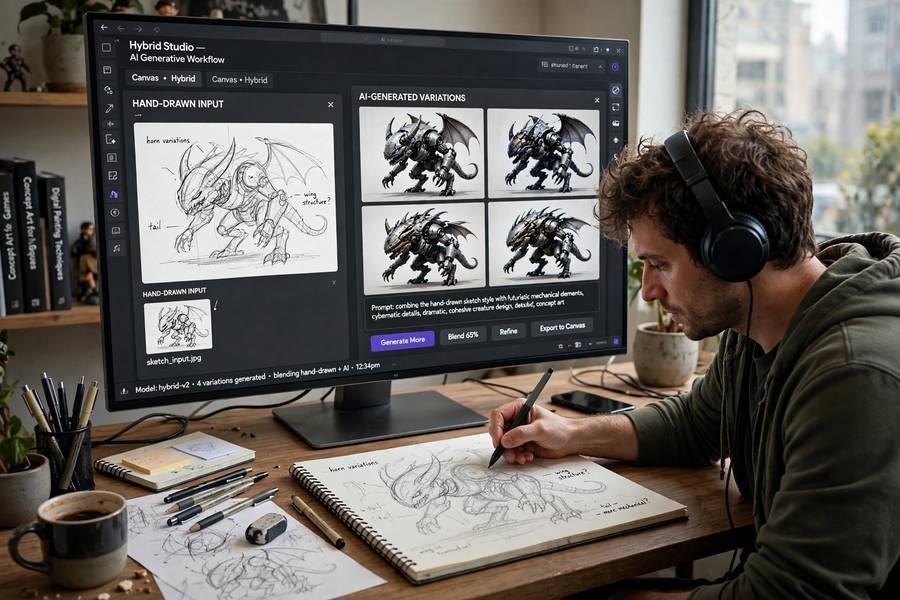
The most interesting work happening now isn’t “AI art” or “human art” — it’s the hybrid: artists using these tools the way photographers use cameras, as instruments in service of human vision. The tool doesn’t make the artist. But a real artist with a powerful new tool can make remarkable things.
So: can AI make art? It can make images that do what art does. Whether that counts is up to us — the humans doing the experiencing, which is the part no model can do for us.
For a deeper dive, see our guide to an ai model.
AI Art and the Money Question
Let me get practical, because philosophy doesn’t pay rent. If you’re an artist, or thinking of becoming one, here’s how the economics are actually shaking out.
What’s getting displaced: stock-style illustration, generic concept art, basic commercial graphics — the interchangeable visual work. If your income came from producing competent-but-generic imagery fast, AI does that now for pennies. I’m not sugarcoating this; I’ve watched it happen to working illustrators.
What’s holding value: distinctive style, art direction, and the human relationship. Clients still pay premium rates for artists with a recognizable voice — AI can imitate styles but can’t be anyone. The artists thriving right now are the ones whose work you’d recognize blind.
The new opportunities: AI art direction is becoming a real discipline — professionals who combine prompting, curation, and traditional finishing skills. Studios are hiring “AI artists” who’d be better described as hybrid creatives. The pay is real, and the skill set (taste + technical fluency + traditional fundamentals) is genuinely rare.
My advice to working artists: learn the tools — refusing to is like a photographer refusing digital cameras in 2005. But compete on what AI can’t do: your perspective, your relationships with clients, your physical craft, your cultural participation. The artists I see struggling are the ones competing with AI on speed and price. Don’t. Compete on vision, and use the tools to execute it faster.
Frequently Asked Questions
AI can generate images that function as art — moving viewers and even winning competitions. However, AI has no lived experience, intention, or consciousness; it recombines learned visual patterns. Whether that counts as “making art” depends on whether you define art by its effect on viewers or by the human creative act behind it.
AI-generated art is imagery created by machine learning models (like Stable Diffusion, Midjourney, or DALL-E) from text descriptions. The model starts with random noise and iteratively refines it into an image matching the prompt, drawing on patterns learned from billions of training images.
This is actively debated. Supporters point to photography’s similar controversy and argue the output’s effect on viewers is what matters. Critics argue art requires human intention, experience, and risk. The emerging consensus favors hybrid human-AI collaboration as the most meaningful path.
AI is already displacing some interchangeable commercial illustration work, but artists with distinctive voices are largely using it as a tool rather than being replaced by it. Art rooted in human experience, cultural participation, and physical craft remains irreplaceable.
Ownership is legally unsettled. In the US, the Copyright Office has generally held that purely AI-generated works without human authorship can’t be copyrighted. Commercial use also sits in a gray area given ongoing lawsuits over training data. The law is still catching up.