

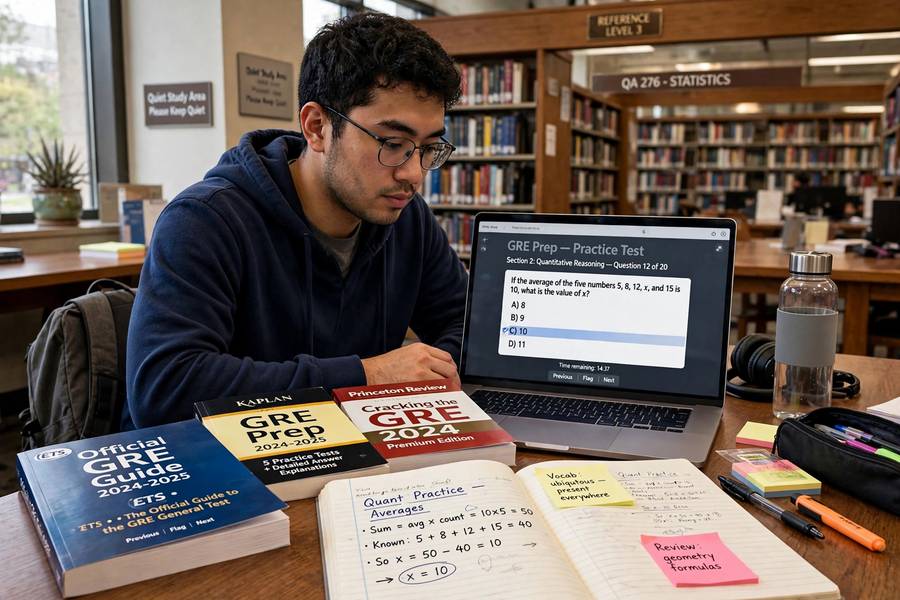
The GRE sits at a strange intersection: it matters enormously for graduate admissions, yet nobody teaches you how to take it. Students walk in having “studied” by vaguely reviewing math they half-remember from high school, then wonder why their score does not reflect their ability.
Here is the truth I share with every GRE student I tutor: this test is a game with learnable rules. The Verbal section recycles the same logic patterns. The Quant section tests a finite set of concepts. The Writing section has a formula. Learn the game, and your score will follow your effort — reliably.
Table of Contents
- GRE Format: What You Are Facing
- Study Timeline: 10-Week Plan
- Verbal Reasoning Strategy
- Quantitative Reasoning Strategy
- Analytical Writing Strategy
- Practice Tests Done Right
- Test Day Execution
- Frequently Asked Questions
- GRE Scoring Scales, Explained
- Question Types, with a Worked Example Each
- Two More Timelines: The 4-Week Sprint and the 12-Week Deep Build
- Official vs Third-Party Materials: Where to Spend Your Time and Money
GRE Format: What You Are Facing
The current GRE is shorter than the old version — under 2 hours:
- Analytical Writing: 1 essay (“Analyze an Issue”), 30 minutes.
- Verbal Reasoning: 2 sections, 27 questions total (~41 minutes). Text completion, sentence equivalence, reading comprehension.
- Quantitative Reasoning: 2 sections, 27 questions total (~47 minutes). Arithmetic, algebra, geometry, data analysis — plus the infamous Quantitative Comparison format.
- Scoring: 130–170 per section (Verbal + Quant). Writing scored 0–6 separately.
The test is section-adaptive like the SAT: your first-section performance sets the difficulty (and score ceiling) of the second. Module one accuracy is everything.
We break down how to prepare for sat step by step in a separate guide.
Before you start, know your target programs’ average scores. A 320 means different things for engineering PhDs versus education master’s programs. Your prep intensity should match your actual target.
Study Timeline: 10-Week Plan
Weeks 1–2: Baseline and Foundations
Take an official ETS practice test cold-ish. Then rebuild foundations: for most students, that means high-school math fluency (fractions, exponents, basic algebra, geometry formulas) and academic vocabulary roots. Do not skip this — advanced strategies built on shaky foundations collapse.
Weeks 3–6: Section Skills
Alternate Verbal and Quant focus days. Learn each question type’s mechanics: how Text Completion logic works, how Quantitative Comparison traps function, how to dissect dense passages. Drill by type, untimed at first, then with pacing pressure.
Weeks 7–8: Integration
Full timed sections, mixed review. Build your pacing map: you have roughly 90 seconds per Verbal question and 105 seconds per Quant question. Practice the adaptive mindset — treat section one like the most important 20 minutes of the test, because it is.
Weeks 9–10: Peak and Polish
Two to three full practice tests with full error autopsies. Light review of formulas and high-frequency vocabulary. Taper before test day — cramming the night before costs more than it gains.
Verbal Reasoning Strategy
GRE Verbal is not a vocabulary test wearing a costume — it is a logic test wearing a vocabulary costume.
- Text Completion: The sentence contains the answer. Look for structural clues: contrast words (however, although), continuation words (moreover, indeed), and definitional phrases. Predict your own word for the blank before looking at choices — then match.
- Sentence Equivalence: You need TWO synonyms that both fit. If you can only find one, you do not understand the sentence yet. The pair must produce sentences with the same meaning.
- Reading Comprehension: Read for structure, not details — what is the author’s argument, and what is each paragraph doing? Most questions ask about function and inference, not recall. For long passages, jot a 5-word summary per paragraph.
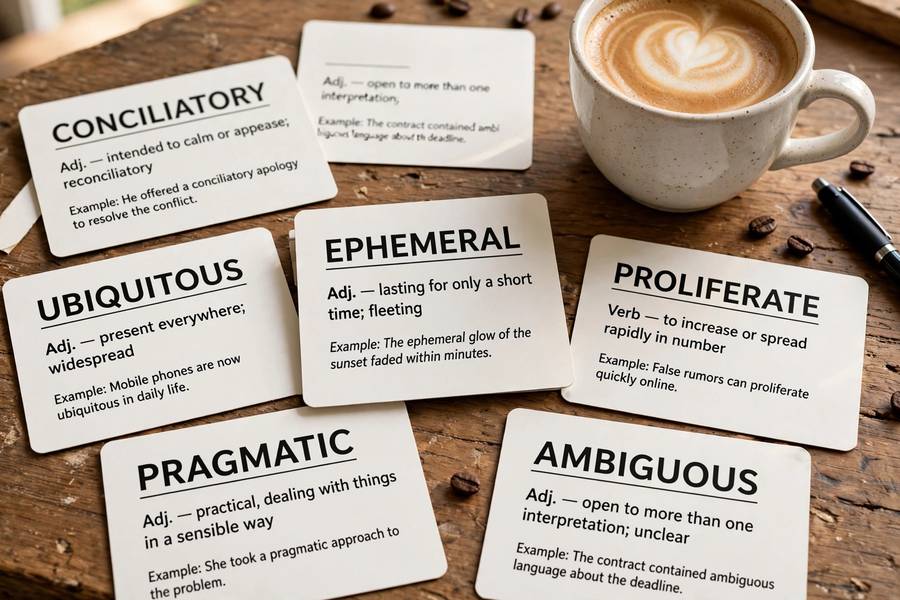
- Vocabulary: Learn high-frequency GRE words in context (sentences, not lists), prioritizing roots and affixes. 300 well-learned words beat 1,000 half-learned ones.

Quantitative Reasoning Strategy
GRE Quant tests reasoning with math more than math itself. The concepts rarely exceed high-school level; the trickery is in the presentation.
- Quantitative Comparison: Your new best friend or worst enemy. The four answer choices never change — master the plug-in strategy: test positive, negative, zero, fraction, and large values. If different values give different winners, the answer is “cannot be determined.”
- Know the greatest hits: Exponent rules, quadratic factoring, special right triangles, circle geometry, standard deviation conceptually, combinations/permutations basics, and weighted averages. These recur endlessly.
- Data Interpretation: Slow down. Most errors come from misreading charts, not bad math. Check units, check what the question actually asks, estimate before calculating.
- Calculator: The on-screen calculator is clunky by design — use it for ugly arithmetic only. If you are reaching for it constantly, you are missing the elegant (intended) solution.
If the math feels rusty, repair foundations first — fluent arithmetic and algebra make every GRE Quant strategy work better.
Analytical Writing Strategy
One 30-minute “Analyze an Issue” essay, scored 0–6. Graders reward structure and reasoning, not beautiful prose:
- Template it: Intro (restate + thesis) → 2–3 body paragraphs (each: point, example, analysis) → concession paragraph (acknowledge the other side, then rebut) → conclusion. This structure alone lifts most writers a full point.
- Examples beat adjectives. Specific, concrete examples (historical, current events, personal observation) score; vague hand-waving does not.
- Address counterarguments. The prompt explicitly asks you to consider other views. A paragraph that steelmans the opposition then answers it is the hallmark of a 5+.
- Length correlates (up to a point). Well-developed 450–600 word essays outscore 250-word ones — but only because development takes words. Do not pad.
Practice Tests Done Right
Use official ETS PowerPrep tests — third-party tests misjudge the adaptive algorithm and difficulty curve. Protocol:
- Full test, timed, realistic conditions (including the essay — stamina matters).
- Within 24 hours: redo every missed question from scratch before reading explanations.
- Log errors by type: content gap, misread, time pressure, trap. Your study plan for the next week comes from this log, not from vibes.
- Save one fresh official test for the final week.
Test Day Execution
- Section order strategy: You choose the order (after Writing). Many students do their stronger section first for confidence — but never leave your weakest for last when fatigue peaks. Experiment in practice.
- The 90-second rule: Any question passing ~2 minutes gets your best guess and a move-on. The GRE punishes perfectionism harder than wrong answers.
- Use breaks fully: Stand, stretch, snack, reset. The test is a marathon of sprints.
- Mindset on difficulty: A brutal second section means section one went well — the algorithm thinks you are strong. Take it as encouragement.
For those eyeing research careers beyond the master’s, it is worth understanding what a doctoral dissertation actually entails — the GRE is just the doorway.

GRE Scoring Scales, Explained
If you are going to spend weeks preparing for this test, you should understand exactly what the numbers mean. Most students walk in with a vague “I want a 320” without knowing what a 320 actually represents. Let me fix that.
Verbal Reasoning and Quantitative Reasoning are each scored on a 130–170 scale, in 1-point increments. Your total is the two sections added together, so the composite range is 260–340. There is no penalty for wrong answers, and your scaled score comes from your raw performance run through the section-adaptive algorithm — which is why two students with the same number of correct answers can land on slightly different scaled scores.
Roughly, here is how Verbal and Quant score bands are usually read by admissions:
| Score band | What it generally signals |
|---|---|
| 165–170 | Elite. At or above the median for top programs in most fields. |
| 160–164 | Strong. Competitive for the majority of selective programs. |
| 155–159 | Solid. Meets or beats the published averages of many good programs. |
| 150–154 | Average band. Fine for some programs, light for competitive ones. |
| 145–149 | Below average. Limits options at selective schools. |
| 130–144 | Significant work needed before applying with this score. |
One caution: official percentiles shift a little from year to year as the test-taking population changes, so do not chase a percentile number you saw on a forum. Chase your target programs’ published average scores instead — that is the only number that actually decides anything.
Analytical Writing is scored separately on a 0–6 scale, in half-point increments. Two trained readers score your essay holistically, and ETS publishes the score-level descriptors they use:
| Score | Descriptor | What it means in plain English |
|---|---|---|
| 6 | Outstanding | Insightful, well-organized, essentially flawless command of language. |
| 5 | Strong | Well-developed analysis with only minor lapses. |
| 4 | Adequate | Competent analysis; the “no problems here” line for most programs. |
| 3 | Limited | Some competence, but clear weaknesses in analysis or organization. |
| 2 | Seriously flawed | Major problems in reasoning, development, or language control. |
| 1 | Fundamentally deficient | Almost no evidence of the ability to develop an argument. |
| 0 | — | Off-topic, blank, or not in English. |
Most programs treat a 4.0 as the “fine” line and 4.5+ as strong. Humanities and writing-heavy programs may weigh it more; engineering programs mostly check that you cleared the bar. Either way, it is the cheapest section to prepare for — the formula I described above gets most students to a 4.0+ with a weekend of practice.
Question Types, with a Worked Example Each
Strategy advice is useless without seeing the machinery. Here is every major GRE question type with one worked example — the kind of walkthrough I do on a whiteboard with students. Study the logic, not just the answer.
Text Completion. One to three blanks; the sentence always contains the logic you need. Example: “The new director’s management style was anything but ___: she answered every hard question with disarming candor.” The colon tells you the second half defines the first. “Disarming candor” means striking frankness — and “anything but” flips it. So predict your own word before looking: secretive, evasive. Then match: among (A) transparent (B) evasive (C) methodical (D) abrasive (E) diplomatic, the answer is (B) evasive. Notice the trap: “transparent” describes her actual behavior, which is the opposite of what the blank asks for.
Sentence Equivalence. One blank, six choices, and you must pick the TWO that complete the sentence with the same meaning. Example: “The guest lecture was ___, holding even the 8 a.m. section’s attention for the full hour.” The clue is “holding attention.” You need a synonym pair: “riveting” and “gripping.” The discipline here: if you can only find one word that fits, you do not understand the sentence yet. Never settle for a single.
Reading Comprehension. Passages are dense, but the questions are structural, not factual. Example passage (condensed): “Historians long blamed the city’s decline on a single drought. But recent sediment cores show water levels recovering decades before the population rebounded, suggesting the drought was a trigger, not the cause — the deeper failure was political.” Question: “The author mentions the sediment cores primarily in order to…” Answer: challenge the traditional explanation — not to describe geology. Read for what each paragraph does (introduces theory, presents counter-evidence, proposes revision), and these questions answer themselves.
Quantitative Comparison. Compare Quantity A and Quantity B: A is greater, B is greater, they are equal, or the relationship cannot be determined. Example: Given x > 0 — Quantity A: (x + 2)². Quantity B: x² + 4. Expand A: x² + 4x + 4. Since x > 0, the 4x term is positive, so A is always larger. Answer: Quantity A is greater. The trap is picking (D) “cannot be determined” out of caution — but the condition x > 0 settles it completely. Always test the boundary of the given condition.
Problem Solving (multiple choice). Standard math, but the GRE dresses it up. Example: “If 3a · 3b = 310 and a − b = 2, what is the value of a?” Adding exponents: a + b = 10. Now you have a + b = 10 and a − b = 2. Add the equations: 2a = 12, so a = 6. The lesson: GRE algebra problems are almost always systems in disguise. When you see two equations’ worth of information, write both down.
Data Interpretation. Questions attached to a chart or table; the math is easy, the reading is the test. Example: “A bar chart shows a company’s annual sales in thousands: 2020: 40, 2021: 55, 2022: 50, 2023: 70, 2024: 65. By what percent did sales increase from 2022 to 2023?” Percent change = (70 − 50) / 50 = 0.40, so 40%. The classic trap is dividing by the wrong year (the new value instead of the old). Circle the “from” year in the question before you touch the numbers.
Work through these six until the logic feels automatic, then drill each type in batches. Recognition speed — seeing a QC problem and immediately knowing which comparison technique applies — is half the battle on test day.
Two More Timelines: The 4-Week Sprint and the 12-Week Deep Build
The 10-week plan above is the middle path. But not everyone has 10 weeks — and some people have more. Pick the timeline that matches your calendar and your score gap, not the one that sounds most impressive.
The 4-Week Sprint (for when the test date is already booked; expect 2–3 focused hours daily):
- Week 1: Triage. Take a diagnostic immediately, then rebuild only your weakest foundations — the two or three math topics costing you the most points, plus high-frequency vocabulary roots. No perfectionism; you are stopping bleeding.
- Week 2: Mechanics. Question-type logic, untimed: Text Completion clue-reading, QC comparison techniques, essay formula. Drill by type.
- Week 3: Timed integration. Full timed sections daily. Build your pacing map now — roughly 90 seconds per Verbal question, 105 per Quant — and practice treating section one as the most important 20 minutes of the test.
- Week 4: Polish. Three full practice tests with complete error autopsies, light formula and vocab review, then taper. No new material in the final 48 hours.
An honest note: four weeks works for score gaps under about 8 points. If you are starting 20 points below your target, the brave move is rescheduling, not cramming — a later test date costs a fee, a bad score costs an application cycle.
The 12-Week Deep Build (about 6–8 hours per week; best for big score gaps, rusty math, or full-time workers):
- Weeks 1–3: Foundations. Rebuild math fluency topic by topic and build a real vocabulary system (roots, word groups, spaced repetition) instead of memorizing lists.
- Weeks 4–8: Section skills. Same mechanics as the 10-week plan’s middle phase, but with room to actually master each question type before moving on.
- Weeks 9–10: Integration. Timed sections, pacing maps, adaptive mindset.
- Weeks 11–12: Peak and polish. Four to five full tests, error autopsies, taper.
The 12-week danger is not laziness but burnout — schedule one full rest day every week and protect it. Slow, consistent weeks beat heroic weekends that leave you fried.
Official vs Third-Party Materials: Where to Spend Your Time and Money
Not all prep material is created equal, and this is where students waste the most money. There are two categories, and they serve different purposes.
Official ETS materials — written by the people who make the test, so the logic, wording, and difficulty match the real thing:
- The Official Guide to the GRE General Test. Real retired questions with ETS’s own explanations. This is the single best source of authentic practice, and it should be the backbone of your prep.
- PowerPrep Online. ETS’s free practice software, including two free full-length practice tests scored by the actual adaptive algorithm. Non-negotiable: take both under strict timed conditions. Nothing else predicts your score this well.
- ScoreItNow! Online Writing Practice. ETS’s paid essay-scoring service. Worth it if you want an honest AWA score before test day instead of guessing.
Third-party materials — written by prep companies, best used for volume and teaching:
- Manhattan Prep’s 5 lb. Book of GRE Practice Problems. The drill king: thousands of problems organized by topic. Ideal when you have identified a weak area and need 100 repetitions of it.
- Magoosh. Strong video explanations and a clean online platform; popular with self-studiers who learn by watching.
- Kaplan and Princeton Review. The established course providers — structured programs with instructors, best if you need external accountability.
- Gregmat+. A subscription platform known for strategy-focused video lessons, popular for its low price and practical walkthroughs.
Here is the honest hierarchy I give my students: official materials for calibration, third-party for volume. Use third-party books to drill your weak question types into the ground, then use official PowerPrep tests to find out where you actually stand. The one thing third-party material can never fully replicate is ETS’s adaptive scoring and exact question logic — so never let a third-party “score” decide whether you are ready. Only an official test gets that vote.
Frequently Asked Questions
Ten weeks at 6–10 hours per week suits most students: 2 weeks foundations, 4 weeks section skills, 2 weeks integration, 2 weeks polish. Adjust based on your diagnostic — strong quant students can compress; rusty ones should extend foundations.
It depends entirely on your target programs — check their published averages. Roughly: 300 is average nationally, 310–320 is competitive for many programs, 325+ opens selective doors. Verbal/Quant balance matters more than the total for most departments.
The content is more advanced (especially vocabulary depth and quantitative reasoning tricks), but you are also older and more experienced. Students who prepped well for the SAT often find GRE prep familiar in structure.
An on-screen calculator is provided for the Quant sections, but it is deliberately clunky. Use it only for messy arithmetic — most questions are designed to be solved faster with reasoning than with calculation.
Less than Verbal/Quant for most programs, but a very low score (below ~3.5) raises red flags. A structured, well-argued essay following the standard template reliably scores 4.0–5.0, which clears the bar everywhere.
If you are more than a few points below your target programs’ averages and you can identify fixable weaknesses from your score report, retaking after targeted prep usually pays off. Most schools consider your highest score.
Two full-length tests, available free through ETS’s PowerPrep Online software. They use the real adaptive scoring algorithm, so they are the most accurate score predictors you can get. Take both under timed conditions during your prep.
For practicing question types, decent ones are fine. For score prediction, no — only ETS’s PowerPrep uses the actual adaptive algorithm. Treat third-party scores as rough estimates and official scores as the real signal.