

Here’s something my students find deeply unfair: the first page of your research paper is often the last thing you should write. After years of teaching academic writing, I’m convinced most bad introductions happen because students write them before they know what their paper actually says.
I’m Rachel Kim, and I teach students how to write research papers from first draft to final submission. The introduction is where I see the most panic, and it’s almost never about talent. It’s about structure.
In this guide, I’ll show you the three-part structure I teach every semester, five opening hooks that actually work, a real student before-and-after rewrite, and the mistakes that kill a good paper on page one.
What Your Introduction Has to Do (Three Jobs)
Every research paper introduction, from a five-page undergrad paper to a graduate thesis, has the same three jobs. Miss one and your reader feels it immediately.
Job 1: Earn the reader’s attention
Your professor will read your paper. But you should write as if they might not — as if you have to convince a smart, busy stranger that this topic deserves ten minutes of their life. One sharp opening sentence does that. Three paragraphs of throat-clearing doesn’t.
Job 2: Give the background your reader needs
Once you have their attention, orient them. What conversation are you joining? What does the reader need to know to understand your argument? This is the funnel: start broad, narrow steadily toward your specific question. Think of it as zooming in — from the general topic down to your exact focus.
Job 3: State your thesis and map the paper
End the introduction with your thesis statement and, briefly, a roadmap of how the paper will prove it. Your reader should finish page one knowing exactly what you claim and how you’ll get there. If you haven’t nailed your thesis yet, read my guide on how to write a thesis statement first — everything here builds on it.

The 3-Part Structure I Teach Every Semester
I call it Hook, Funnel, Thesis. It works for every research paper I’ve ever graded.
Part 1: The Hook (1–3 sentences)
Open with something that makes the reader look up. Not a dictionary definition — never a dictionary definition. A surprising statistic, a brief anecdote, a provocative question, or a striking quotation. We’ll go through five proven hook types in a moment.
Part 2: The Funnel (2–4 paragraphs in a typical paper)
This is your background section, and it moves from broad to narrow. If your paper is about sleep deprivation and teen drivers, you might move from traffic safety in general, to young drivers, to drowsy driving specifically, to the gap your paper addresses. Each paragraph narrows the lens one click.
Part 3: The Thesis Statement (1–2 sentences)
The last sentence or two of your introduction states your claim — the argument your research supports — plus a sentence mapping your paper’s structure. “This paper argues X. First, it examines A; then B; finally, it shows C.” That roadmap sentence is the difference between a good introduction and a great one.
How Long Should a Research Paper Introduction Be?
The rule of thumb I give students: roughly 10% of the paper’s total length. A five-page paper gets about half a page of introduction. A twenty-page paper earns two pages. The funnel expands with the paper; the hook and thesis stay short no matter what.
The most common length mistake is the bloated background — students dump everything they know in the introduction because they’re afraid of forgetting it. Save it. If a fact doesn’t set up your thesis, it belongs in the body.
5 Hooks That Actually Work (With Examples)
These are the five opening moves I see working in real student papers, year after year. Pick the one that fits your topic.
1. The surprising statistic
“Nearly 70% of college students report getting less than eight hours of sleep on weeknights — and drowsy driving causes an estimated 100,000 crashes a year in the US alone.” Numbers wake readers up. Just make sure every statistic is cited; an uncited number in the first sentence destroys credibility instantly.
2. The brief anecdote
“In 2019, a high school junior in Ohio fell asleep at the wheel after a week of 5 a.m. practices and late-night homework.” A true, specific story — even in two sentences — pulls the reader in emotionally. Keep it short; the anecdote is a doorway, not a room.
3. The provocative question
“If teenagers need more sleep than adults, why do we schedule their school days to start first?” Questions work when the paper genuinely answers them. A rhetorical question nobody asked, followed by a shrug of an answer, does not.
4. The striking quotation
A short quote from a recognized expert can frame the whole paper — but only if you engage with it. Dropping a famous quote and moving on looks decorative. Quote it, then explain why it matters to your argument.
5. The bold claim
“School start times are a public health policy disguised as a scheduling decision.” A confident, slightly contrarian statement signals that you have a real argument. Then your paper has to deliver on it — which is exactly the point.
The one hook to never use
“Webster’s dictionary defines research as…” Every teacher has read this opening. It’s filler wearing a suit. Delete it and start with something you actually want to say.
How to Write It Step by Step
Remember my opening confession: write the introduction last. Here’s the order that works:
- Write the body first. You can’t introduce a paper you haven’t written. Draft your argument, then come back.
- Draft the thesis. Boil your argument down to one or two sentences. If you can’t, your paper isn’t finished yet — and that’s useful information.
- Write the funnel backwards. Start from your thesis and ask: what does the reader need to know to understand this? Write those paragraphs, broad to narrow.
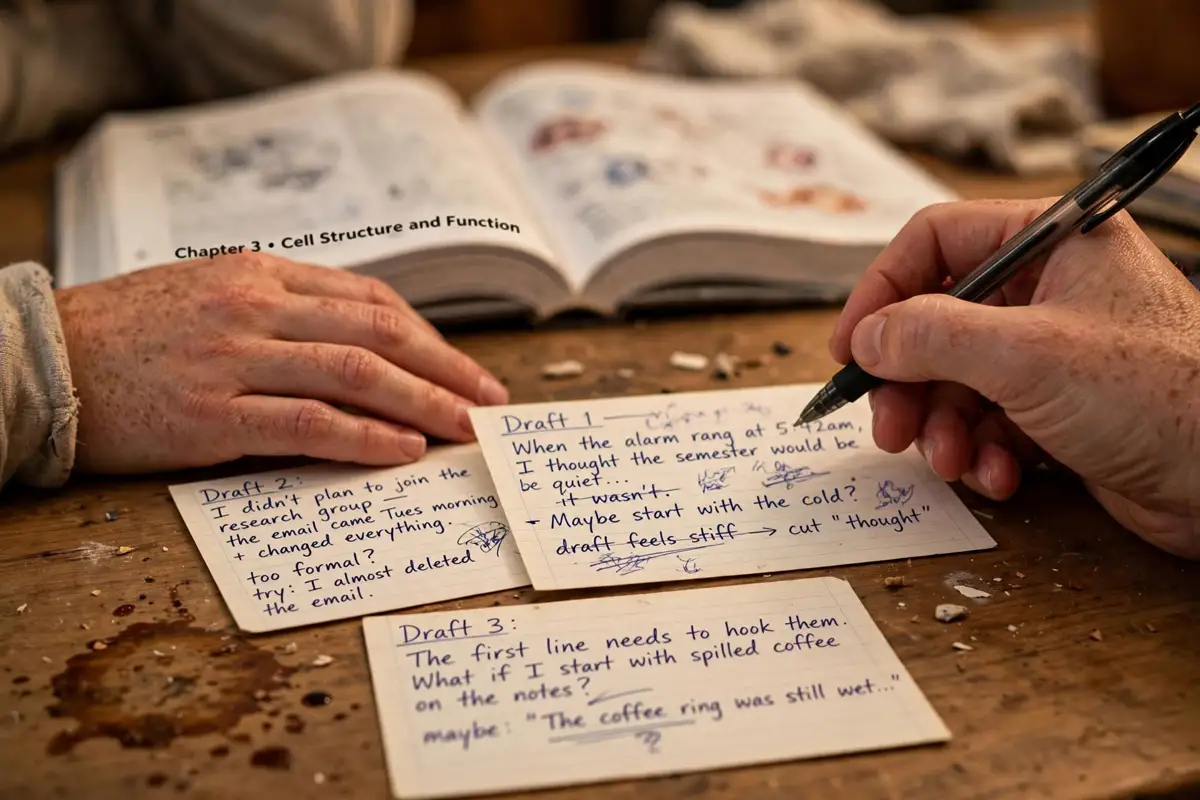
- Add the hook last. Now that you know exactly what the paper says, you can pick an opening that genuinely leads into it. Students who hook first almost always end up rewriting the hook anyway.
- Add the roadmap sentence. One sentence after the thesis: “This paper first reviews the evidence on X, then analyzes Y, and finally argues Z.”
- Read it aloud. If you stumble, your reader will too. Introductions should sound confident — read until yours does.
This write-last approach also makes studying for finals easier, by the way: the roadmap sentence doubles as an outline you can memorize for essay exams.
Before and After: A Real Student Opening
One of my students, Daniel, gave me permission to share his rewrite. His paper was about the effects of social media on teen sleep.
Before: “Social media is a very popular thing among teenagers today. Many teenagers use social media every day. This paper will talk about social media and sleep and how they are related.”
Three problems: it states the obvious, it announces instead of arguing, and “this paper will talk about” wastes the thesis slot.
After: “Teenagers who scroll social media after midnight get an average of 45 fewer minutes of sleep than their peers — and the blue light is only half the story. While researchers have documented the link between screen time and sleep loss, few studies examine how the emotional content of late-night feeds — arguments, FOMO, comparison — keeps teens wired long after the screen goes dark. This paper argues that the psychological stimulation of social media, not just its light, drives teen sleep loss.”
Same student, same research, same topic. The difference is structure: hook, funnel, thesis. Daniel’s grade went from a C+ draft to an A- final, and the introduction was the biggest single change.
Mistakes That Kill an Introduction
The dictionary definition. Covered above. It’s never worked. It will never work.
The history-of-everything opener. “Since the dawn of time, humans have communicated…” Your paper is about one thing. Start there.
Citing nothing. Introductions carry claims — statistics, background facts — and every claim needs a source. Uncited background is the fastest way to lose a teacher’s trust on page one.
The disappearing thesis. Some students write a beautiful hook and funnel, then forget the thesis entirely. Read your introduction and ask: does the last paragraph say what I claim? If not, add it.
For the bigger research picture — choosing topics, finding sources, structuring the full paper — the Purdue OWL’s guide to writing research papers is the reference I point students to, and this guide follows the same principles.

You Already Know How to Do This
Think about how you explain an interesting article to a friend: you start with the surprising part, give them the backstory, then tell them your take. That’s a hook, a funnel, and a thesis. You already have the instinct — this structure just gives it a name.
So write the body first, then build the introduction backwards: thesis, funnel, hook, roadmap. And if your introduction still feels shaky, check whether the thesis is the real problem — students eyeing longer academic projects can also see what a doctoral dissertation involves to understand how this same structure scales up.
Start with a hook — a surprising statistic, brief anecdote, provocative question, striking quotation, or bold claim — then narrow from broad background to your specific topic, and end with your thesis statement plus a one-sentence roadmap of the paper.
Last. You cannot introduce a paper you have not written yet. Draft the body first, distill your thesis, build the background funnel backwards from the thesis, and add the hook at the very end.
About 10% of the total paper length: roughly half a page for a five-page paper, up to two pages for a twenty-page paper. The background funnel expands with the paper; the hook and thesis stay short.
Your thesis statement, followed by a roadmap sentence outlining the paper’s structure. The reader should finish the introduction knowing exactly what you claim and how the paper will prove it.
It depends on your instructor and discipline. Many teachers now accept first person for stating your argument (“This paper argues…”), but check your assignment guidelines first. When in doubt, ask.
The funnel method structures background information from broad to narrow: start with the general topic, then narrow through subtopics until you reach your specific thesis. Each paragraph zooms the lens in one click closer to your argument.