

Every fall, I get emails from parents who pulled their kids out of school — or are about to — and feel like they’re standing at the edge of a cliff. “Where do I even begin?” is the question, and it always comes with a side of panic. Take a breath. Learning how to start homeschooling is far less complicated than the internet makes it look, and most of the complexity is optional.
I’ve guided families through this transition for years, and the ones who do best follow the same pattern: handle the legal paperwork first, give everyone a breather, then build a simple routine and refine it. Here’s the plan.
Table of Contents
- Step 1 in How to Start Homeschooling: Learn Your State’s Legal Requirements
- Step 2: Officially Withdraw (If Your Child Is Enrolled)
- Step 3: Take a Breather and Deschool First
- Step 4: Choose Your Homeschooling Style
- Step 5: Pick Curriculum Without Losing Your Mind
- Step 6: Set Up a Simple Daily Rhythm
- Step 7: Keep Records and Plan for Assessment
- Frequently Asked Questions
Step 1 in How to Start Homeschooling: Learn Your State’s Legal Requirements
This is step one because it’s the only step with real consequences if you get it wrong. Homeschooling law is state law, and states range from “file a one-page affidavit and you’re done” to “submit a curriculum plan, teach specific subjects, and test annually.”
The reliable sources for your state’s rules:
- Your state department of education website (the actual statutes, not a blog’s summary)
- HSLDA (Home School Legal Defense Association), which maintains a state-by-state legal summary
Typical requirements you’ll encounter: a notice of intent to homeschool, minimum days or hours of instruction per year, certain required subjects, and some form of annual assessment or portfolio review. Read the actual requirements — not the Facebook group’s interpretation of them — and you’ll probably find they’re more manageable than you feared.
If you’re starting mid-year, check whether your state has filing deadlines or waiting periods. Most don’t, but a few do, and this is the kind of detail that matters.
Step 2: Officially Withdraw (If Your Child Is Enrolled)
If your child is currently in public school, send a written withdrawal letter to the school (and in some states, the district). Keep a copy. This is the step families forget, and it can lead to truancy letters — which are frightening but usually resolved with paperwork.
The letter doesn’t need to be elaborate: your name, the child’s name and grade, the date of withdrawal, and a statement that the child will be homeschooled (include your homeschool registration number if your state assigns one). Send it by email and certified mail if you want to be thorough. You don’t need the school’s permission — you’re notifying them, not asking.
If your child is in private school, check your contract for withdrawal notice periods so you don’t pay for months you don’t use.
Step 3: Take a Breather and Deschool First
Here’s the advice most new homeschoolers skip, and then wish they hadn’t: don’t start schoolwork on day one. Take a deschooling period — typically one month per year the child spent in traditional school, up to a few months.
Deschooling isn’t vacation from learning. It’s a deliberate reset: let your child read what they want, build things, explore, ask questions, decompress. The child who left school anxious, bored, or burned out needs time to remember that learning is something they do naturally, not something done to them.
I’ll be honest with you: this period feels unproductive, and parents panic about “falling behind.” You’re not falling behind. You’re building the foundation that makes the next step work. The families who skip deschooling are the ones who end up with power struggles by October. The ones who take it are the ones still happily homeschooling in year three.

Step 4: Choose Your Homeschooling Style
New homeschoolers often think they have to pick a philosophy before buying anything. It helps to know the landscape, but you don’t have to marry one approach — most families blend. The main styles:
- Traditional / school-at-home: Textbooks, structured lessons, a schedule that mirrors school. Familiar and thorough; can feel rigid if your child left school to escape rigidity.
- Charlotte Mason: Short lessons, “living books” (real literature instead of textbooks), nature study, narration instead of worksheets. Gentle and rich in language.
- Classical: The trivium — grammar, logic, rhetoric stages. Rigorous, Latin-friendly, great for families who love structure and great books.
- Montessori-inspired: Hands-on materials, child-led within a prepared environment. If this appeals to you, our guide to the Montessori method explains the principles behind it.
- Unschooling: Child-led learning through life — interests drive the curriculum. Powerful for self-directed kids; requires the most trust from parents.
- Online/virtual programs: Structured classes delivered digitally, from full-time accredited academies to single-subject courses. Good for working parents and for subjects you don’t want to teach yourself (hello, high school chemistry).
My practical advice: start with whatever feels most natural, observe your child for a month, and adjust. The method serves the child, not the other way around.
Step 5: Pick Curriculum Without Losing Your Mind
Curriculum choice is where new homeschoolers drown. There are thousands of options, every one with five-star reviews and a passionate Facebook group. Here’s how I tell families to narrow it down:
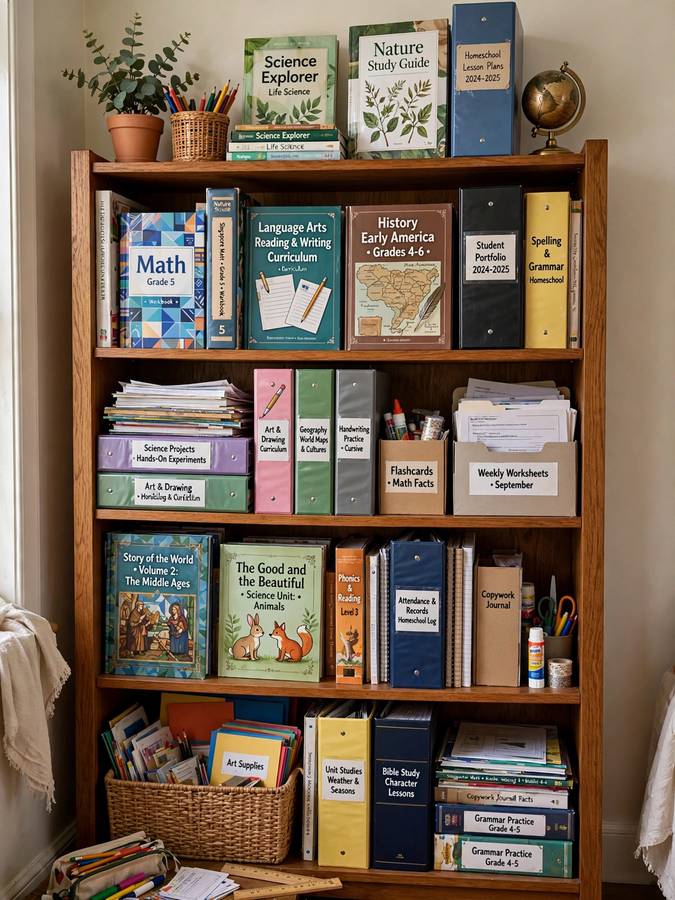
Start with the core four: math, language arts, science, and history/social studies. Everything else — art, music, foreign language, PE — can be lighter, interest-driven, or outsourced.
Match the curriculum to your child, not to your ideals. The “best” math program is the one your child will actually do. A struggling reader needs a phonics-based program, not the prettiest one. A kid who hates worksheets needs a hands-on or video-based option. Be honest about who your child is, not who you wish they were.
One subject at a time is fine. You don’t have to buy a whole boxed curriculum on day one. Start with math and reading, add subjects as you find your rhythm. Many families discover that a boxed “all-in-one” doesn’t fit — buying per subject gives you better matches.
Budget realistically. Homeschooling can cost almost nothing (library + free online resources) or thousands (accredited programs, co-op fees, tutors). Set a budget before you browse, because curriculum shopping is dangerously fun. Free resources worth knowing: your public library (many have educator cards with extended loans), Khan Academy, and your state’s virtual school options.
Give it six weeks. A curriculum that looks wrong in week one often looks different in week six. Resist the urge to switch constantly — curriculum-hopping is the homeschool equivalent of diet-hopping, and it has the same results.
Step 6: Set Up a Simple Daily Rhythm
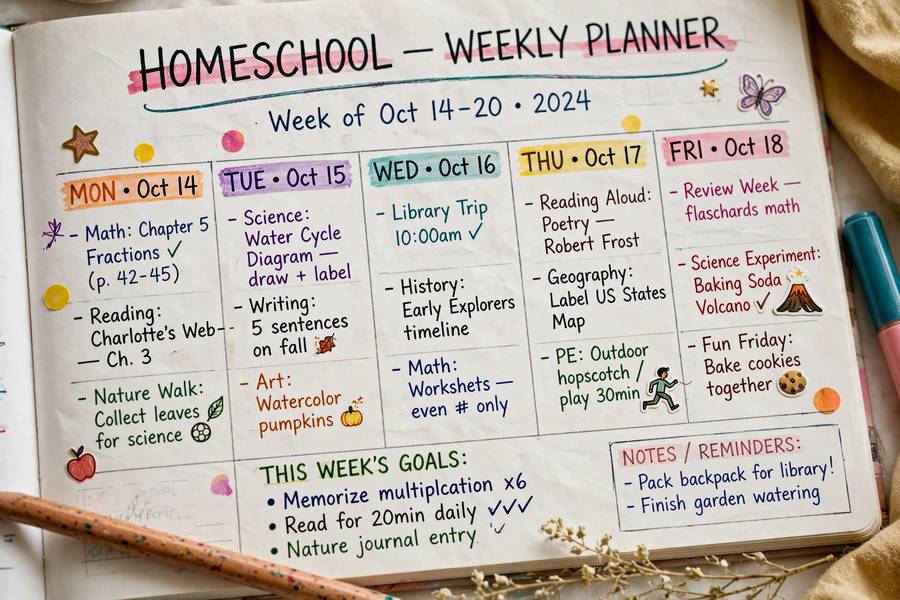
Forget the 8-to-3 school schedule. Homeschooling’s superpower is efficiency: one-on-one instruction means most families finish academics in 2–4 hours a day for elementary ages, 4–5 for high school. Here’s a sample rhythm for a new family:
Essay writing is a core homeschool subject, and learning to write a thesis statement is where strong academic writing begins.
- Morning: Core subjects (math + language arts) while brains are fresh — 60 to 90 minutes total
- Mid-morning: Reading, science or history — another hour
- Afternoon: Interest-led time, outdoor play, co-op classes, music, chores (yes, chores count as life skills)
A few rhythm rules that save sanity:
- Same order, flexible timing. Routines work; rigid clocks backfire. “We do math, then reading, then lunch” is better than “math at 9:00 sharp.”
- Build in movement. Kids who sit for three straight hours learn less than kids who take a 20-minute break to run around. This isn’t a concession — it’s strategy.
- Protect one day a week for errands, appointments, field trips, or catch-up. You’ll need it.
- Teach independence early. Even young kids can check off a visual schedule. The goal is a child who can work through a list, not a child who needs you hovering.
And here’s the truth experienced homeschoolers will tell you: the “perfect” schedule doesn’t exist. You’ll rebuild it three times in the first year. That’s normal, not failure.
Step 7: Keep Records and Plan for Assessment
Even in low-regulation states, keep records. You’ll thank yourself later — for transcripts, for college applications, for the day your child asks “what did I actually learn in third grade?”
What to keep: a simple attendance log (days or hours), a list of curriculum and resources used per subject, samples of work (a few per subject per term is plenty), and any test scores or evaluation reports. A binder or a cloud folder both work — pick the one you’ll actually maintain.
Assessments: Some states require annual standardized testing or portfolio reviews. Even where they don’t, a yearly check-in is good practice. Options include standardized tests (many can be administered at home), portfolio evaluations by a certified teacher, or — my favorite for new families — simply having your child show a relative what they learned. If you can’t explain it, you don’t know it, and the same testing skills help later when they need to study for final exams in any setting.
The socialization question. You’ll be asked about it constantly, so let’s settle it: homeschooled kids are not isolated unless their parents isolate them. Co-ops, sports leagues, scouts, church groups, library programs, part-time classes, and neighborhood friendships provide plenty of social life. The research consistently shows homeschooled students socialize fine — often with a wider age range than school peers, which is arguably healthier.
One last thing: connect with other homeschoolers. A local group or co-op is worth more than any curriculum. They’ll tell you which evaluator is kind, which co-op has the good science teacher, and — most importantly — they’ll normalize your bad days. Every homeschooler has them. The community is what keeps you going.
Frequently Asked Questions
Learn your state’s legal requirements first — filing a notice of intent, required subjects, and assessment rules vary widely. Check your state department of education and HSLDA for the actual statutes.
It ranges from nearly free (library resources and free online programs) to several thousand dollars for accredited programs and co-ops. Most families spend a few hundred dollars a year on curriculum for the core subjects.
Most families finish academics in 2–4 hours a day for elementary ages and 4–5 hours for high school, thanks to efficient one-on-one instruction. A flexible daily rhythm works better than a rigid clock schedule.
No state requires parents to hold a teaching degree. A few states require a high school diploma or equivalent, and some require specific qualifications for certain assessment methods — check your state’s rules.
Through parent-prepared transcripts, standardized test scores, portfolios, and sometimes community college credits. Colleges are very familiar with homeschool applicants, and many actively recruit them.
Deschooling is a transition period (often one month per year spent in traditional school) where formal academics pause so the child can decompress and rediscover natural curiosity. It isn’t legally required, but experienced homeschoolers strongly recommend it.