
A few years ago, I was tutoring a seven-year-old named Priya, and her mom sat me down with a question I’d heard a dozen times before: “We’re thinking about switching her to a Montessori school. But honestly, Rachel — what is the Montessori method? Is it just… kids playing with wooden blocks?”
For a deeper dive, see our guide to the cornell notes method.
I laughed, because I used to wonder the same thing. From the outside, a Montessori classroom can look almost suspiciously calm. No rows of desks. No teacher lecturing at the front. Just small children, working quietly, choosing their own activities like tiny, focused adults. It doesn’t look like school. And that’s exactly the point.
Here’s the thing nobody tells you: the Montessori method isn’t a curriculum you can buy in a box. It’s a philosophy about how children actually learn. This guide explains what it really is, how it works day to day, what the research says, and how to tell whether it’s right for your child.
What Is the Montessori Method, in Plain English?
The Montessori method is an educational approach built around one radical idea: children learn best when they’re free to explore at their own pace, with their hands, in a carefully prepared environment — not when they’re lectured at in rows.
It was developed in the early 1900s by Dr. Maria Montessori, an Italian physician and one of the first female doctors in Italy. She started out working with children in a poor neighborhood of Rome, in a school called the Casa dei Bambini — the Children’s House. She watched. She took notes. She noticed that children, left with the right materials, would teach themselves astonishing things — craving order and repetition, and concentrating for remarkably long stretches when nobody interrupted them.
Related: our guide on early decision vs early action.
Everything she built came from observation, not theory — reverse-engineered from watching real kids, not designed in a university office.
The 5 Core Principles
Strip the Montessori method down to its skeleton and you get five ideas:
1. The absorbent mind. Montessori believed young children (roughly birth to six) learn like sponges — effortlessly and constantly. A three-year-old doesn’t study language; she soaks it up. So the classroom fills those years with rich, hands-on experiences: sensory materials, real tools, things to pour, sort, and arrange.
2. Sensitive periods. Children pass through windows when they’re intensely interested in particular things — order, language, movement, tiny details. During one, a child will repeat an activity dozens of times with total joy; miss the window, and the same skill takes real effort later. The teacher’s job is largely spotting these windows and offering the right material at the right moment. I’ll be straight with you: this is where traditional schooling, teaching every child the same thing at the same time, gets it most wrong.
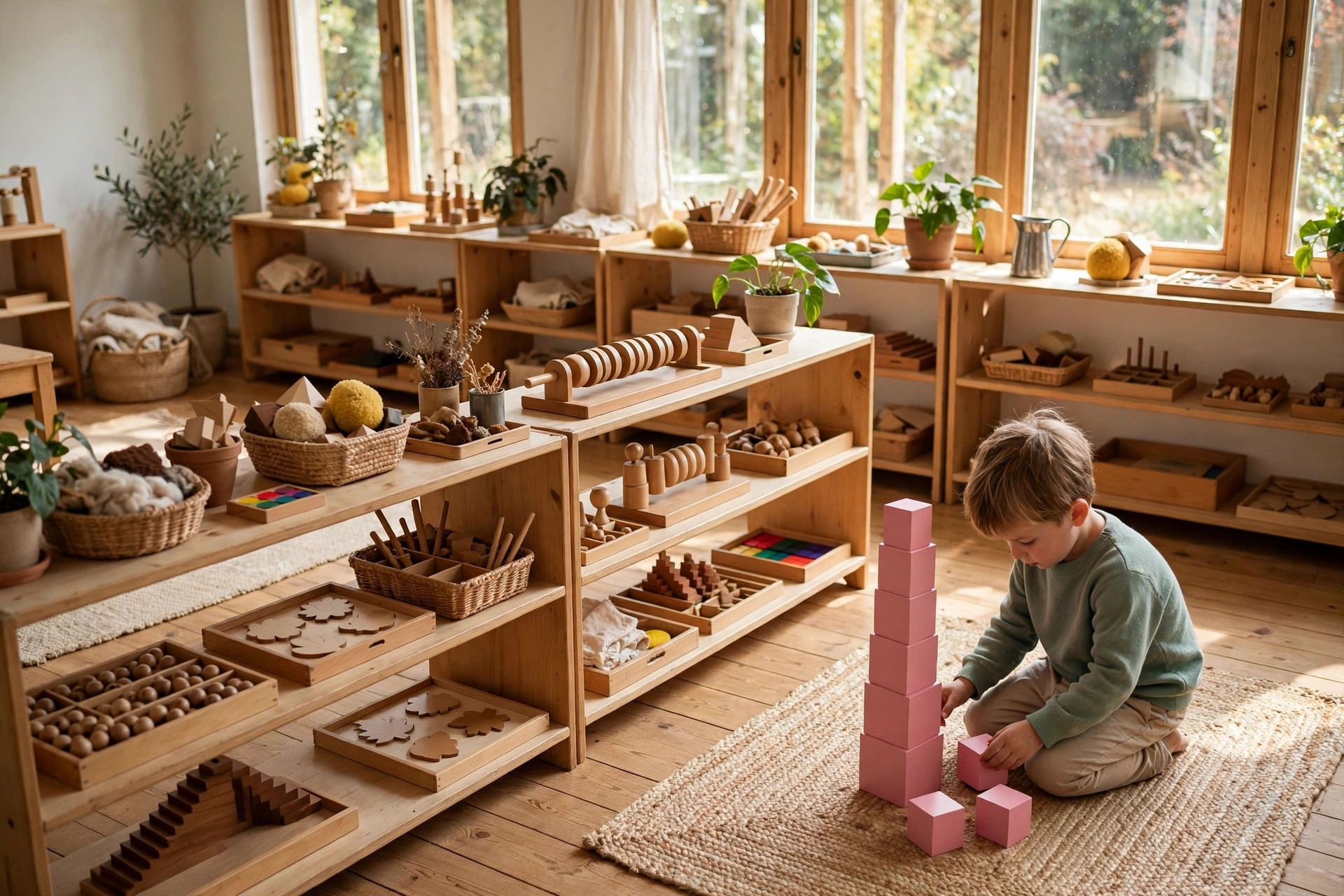
3. The prepared environment. The classroom isn’t decorated — it’s engineered. Everything is child-sized: chairs, tables, shelves, even the pitchers for pouring water. Materials sit on low shelves, arranged simple to complex, left to right. The room is ordered, calm, and beautiful, because Montessori believed an orderly environment helps children develop an orderly mind.
4. Auto-education (self-teaching). This is the showstopper. Montessori materials have a built-in “control of error” — the material itself tells the child when something’s wrong. Stack the pink tower blocks in the wrong order and the tower visibly wobbles. No red pen, no “wrong, try again.” The child corrects herself, which builds something deeper than the right answer: the habit of self-checking, and genuine confidence.
5. Respect for the child. Underneath everything is a stance: the child isn’t an empty vessel to fill, but a person to respect. No interrupting a concentrated child — even to praise her. No forcing her to stop an absorbing activity because the schedule says so. It sounds soft; it isn’t. It asks the teacher to observe more and talk less.
What a Montessori Classroom Actually Looks Like
Forget rows of desks. Here’s what you’d actually see during the morning work period.
Mixed-age groups. Ages three to six learn together (or six to nine, or nine to twelve). Younger children learn by watching older ones; older ones solidify their learning by helping. It mirrors a family more than a grade level — and quietly eliminates most of the “am I ahead or behind?” anxiety.
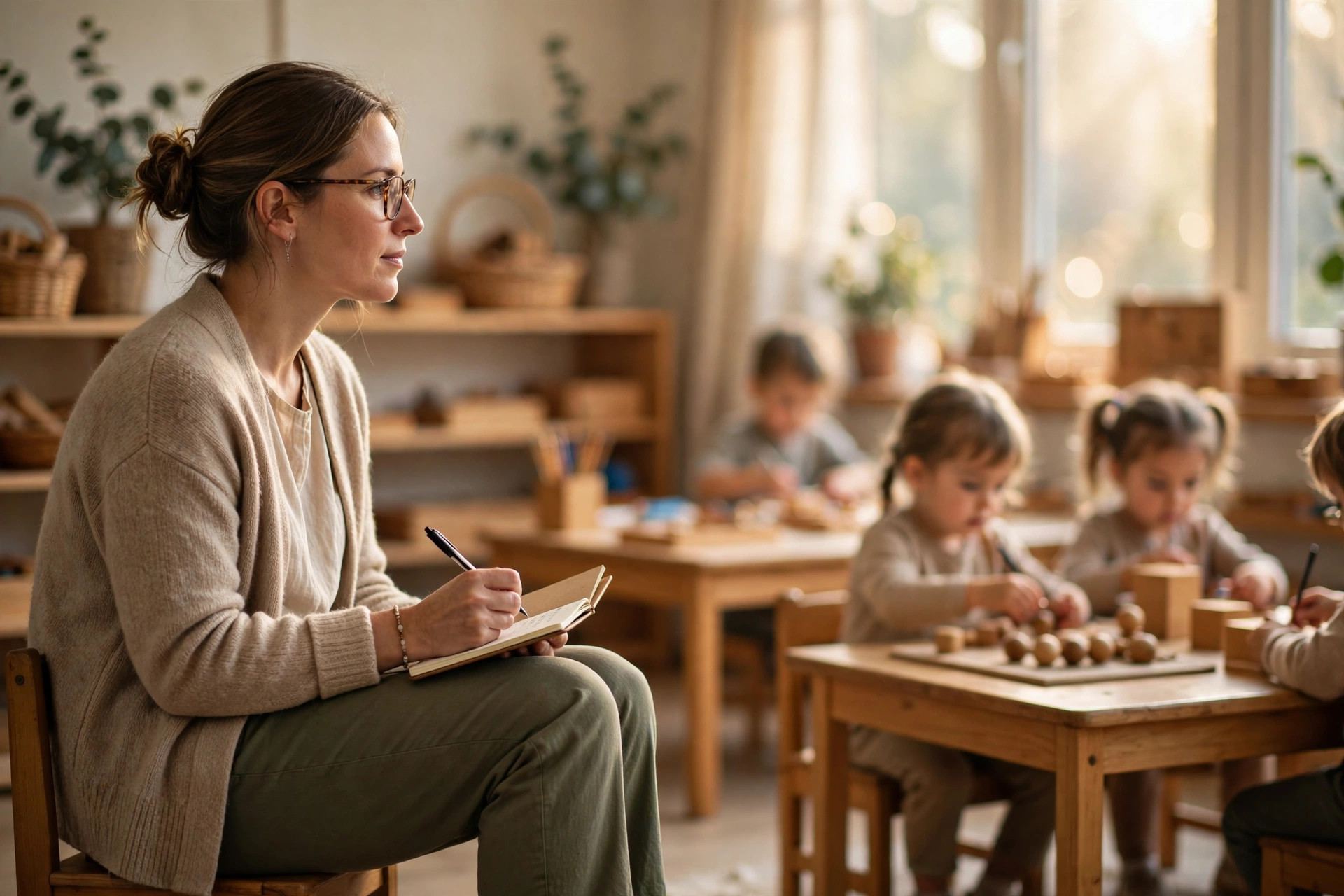
The guide, not the teacher. The adult is called a guide, deliberately. She doesn’t lecture thirty kids at once; she gives short individual presentations of new materials, then gets out of the way. Most of her work is observation — watching which child is ready for what.
Uninterrupted work time. Mornings typically have a two-to-three-hour block with no bells and no rotating subjects every forty minutes. A child chooses a material, works as long as she likes, puts it back, and chooses the next. That famous Montessori concentration? It’s not that these kids are born focused. It’s that nobody keeps breaking their focus.
Hands before abstraction. A child learning addition doesn’t start with a worksheet. She starts with golden beads — physical units, tens, hundreds she can hold. She feels that ten units make a ten-bar before she ever writes “10.” Real understanding first, memorization never.

Montessori vs Traditional School
Parents always ask for the side-by-side. Here’s the honest version:
- Pace: Traditional school moves the whole class together; Montessori lets each child move at her own speed.
- Motivation: Traditional school leans on grades and gold stars. Montessori deliberately avoids external rewards, betting that curiosity and mastery are stronger fuel. (The part that makes parents nervous — “but how will she learn to work hard?” In practice, the kids work harder, because the drive comes from inside.)
- Teacher’s role: Lecturer and evaluator vs. observer and guide.
- Assessment: Tests and grades vs. observation, portfolios, and one-on-one check-ins.
One thing I want to be clear about: “different” doesn’t mean “better for your child.” Some children genuinely thrive on clear structure and the energy of a traditional classroom. The question isn’t which system is superior. It’s which one fits the kid in front of you.
What the Research Actually Says
The most-cited study is by Angeline Lillard and Nicole Else-Quest, published in Science in 2006. Comparing Montessori and non-Montessori children in Milwaukee, they found the Montessori kids performed better on several measures — academic achievement, social understanding, and a stronger sense of community. A 2012 follow-up found similar patterns, and other research links Montessori students to strong executive function — planning, focus, juggling tasks — which makes sense given how much self-direction the method requires.
Now the honest part, the part a Montessori brochure won’t emphasize: the research has real limitations. Studies struggle to separate the method from the families who choose it — Montessori parents tend to be educated, involved, and able to pay tuition, and those factors matter enormously. And “Montessori” isn’t a trademark, so quality varies wildly between schools.
My take after years of working with students from every kind of school: the core insights — follow the child’s readiness, protect concentration, let kids learn by doing — are solid. But the implementation matters more than the label on the door.
The Criticisms, Honestly
“It’s too unstructured.” Fair. A child who struggles with self-regulation can flounder with free choice. Good guides scaffold these children carefully; a weak school might let them drift.
“It’s expensive.” True in most places — usually private, with tuition reflecting low ratios and specialized materials. Public Montessori programs exist but are rare, with waitlists.
“Not enough pretend play.” Montessori favors real, purposeful work over fantasy play — real pitchers, real plants. Some educators argue young children need more imaginative play. It’s a genuine philosophical difference worth knowing about.
“The name isn’t protected.” Anyone can call a school “Montessori.” Look for AMI or AMS accreditation — and observe a classroom yourself. A real Montessori room has an unmistakable calm hum of busy, independent children.
Montessori at Home: 5 Things You Can Steal
You don’t need a Montessori school to use Montessori ideas:
- Make things child-accessible. A low shelf with a few activities she can reach and choose. Cups on a low shelf she can reach herself. Independence starts with access.
- Offer real tools, not toys. A small real pitcher, a (dull) vegetable peeler, a small broom. Children can tell the difference, and they vastly prefer the real thing.
- Rotate, don’t flood. Five or six activities out, the rest stored, rotated weekly. Fewer choices, deeper engagement. (This one surprises parents every time.)
- Don’t interrupt concentration. If your child is deeply absorbed — even in “just” stacking cups — let her finish. Protecting focus is one of the highest-value things a parent can do.
- Let her do it herself, even when it’s slower. Yes, you can tie the shoes in ten seconds. Letting her takes five minutes. Take the five minutes.
And if you’re juggling all of this alongside work — because parenting doesn’t pause for the job — you’re not alone. Finding a rhythm that protects both your child’s independence and your own sanity is one of the hardest parts, and it’s worth reading about how to balance work and personal life without burning out on either end.

Is Montessori Right for Your Child?
No universal answer — but a good process. Observe a classroom. Any good school will let you watch a work period. Are the children genuinely engaged or wandering? Is the guide calm and observant or frazzled? Trust what you see over the brochure. Ask about teacher training. Authentic guides complete specialized AMI or AMS training — a full year or more. “We use Montessori materials” is not the same as “our guides are Montessori-trained.” Know your child. Does she thrive with independence, or need more guidance to start? No wrong answer — but the honest answer points to the right school.
And remember: Montessori is a beginning, not a destiny. Plenty of children do Montessori for preschool and transition beautifully into traditional elementary schools — the independence and focus travel well. If you’re curious about the far end of the education journey, I’ve written about what a doctoral dissertation actually involves — the longest, most independent learning project of all, and in a funny way, the ultimate test of everything Montessori tries to build.
Frequently Asked Questions
The Montessori method is an educational approach where children learn at their own pace through hands-on activities in a carefully prepared classroom, guided rather than lectured by a teacher. It emphasizes independence, self-correction, and following each child’s natural developmental readiness instead of a fixed curriculum schedule.
Montessori programs typically serve children from infancy through age 12, organized in multi-age groups: 0–3, 3–6 (primary, the most common), 6–9, and 9–12. Some Montessori high schools exist, but they’re rare.
Generally, no traditional grades and little to no homework in the early years. Montessori schools assess progress through teacher observation, portfolios of the child’s work, and one-on-one conferences with parents. The philosophy is that external rewards like grades can undermine the child’s intrinsic motivation to learn.
It depends on the child and the school. Some children with attention difficulties thrive with hands-on materials and freedom of movement; others struggle without more external structure. Talk candidly with the school about your child’s specific needs before deciding.
Costs vary widely by location, but private Montessori preschool tuition commonly runs several thousand to well over ten thousand dollars per year. Public Montessori programs exist and are tuition-free, but they’re relatively rare and often have long waitlists.
Yes — this is very common, especially after preschool or kindergarten. Most children transition well; the independence, concentration, and self-direction built in Montessori tend to serve them in any setting. There can be a short adjustment period around timed tests and whole-class lessons, but it’s usually brief.
The Bottom Line
The Montessori method, stripped of the mystique, is this: respect the child, prepare the environment, and get out of the way. Watch what children do when they’re free to choose meaningful work, and build the school around that instead of around the convenience of adults.
It’s not magic, and it’s not for every child. But its core insights — children learn with their hands, concentration deserves protection, a child who corrects her own mistakes grows stronger than one who waits to be corrected — hold up whether or not you ever set foot in a Montessori classroom.
If you want to keep exploring how learning works at every stage, browse more of our education guides. Learning shouldn’t feel like a punishment — at three, at thirteen, or at thirty. My job is to keep making it feel possible.