

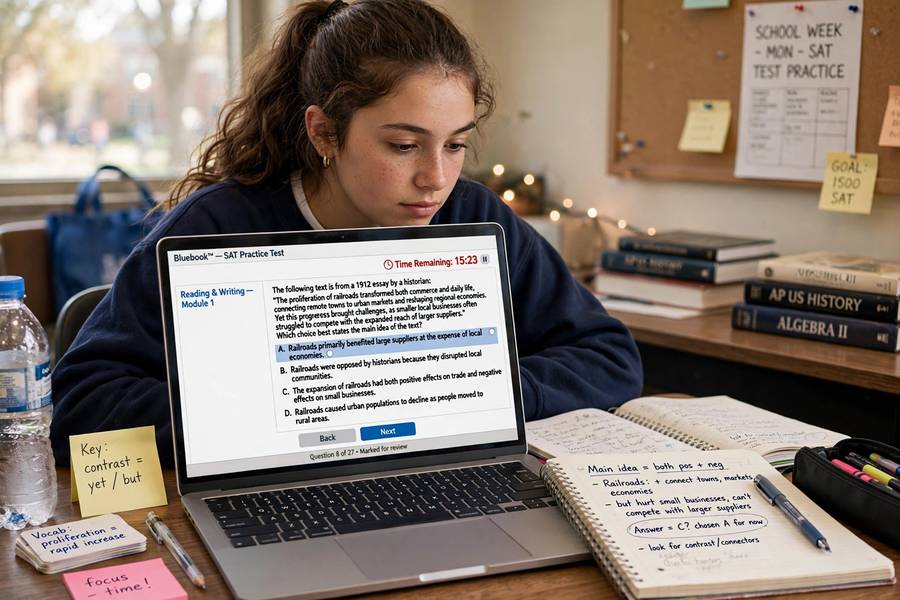
The SAT feels like a monster because it tests years of accumulated skills in one three-hour sitting. But here is what I tell every student I tutor for it: the SAT is one of the most learnable tests in existence. It is standardized, which means it is predictable. Predictable means preparable. Students who follow a structured plan routinely gain 100–200+ points — not because they got smarter, but because they learned the test.
This guide covers the digital SAT as it exists now: the format, a week-by-week study plan, section-by-section strategies, and the unglamorous logistics that separate good scores from great ones.
Our article on getting good grades covers this in more detail.
Table of Contents
- Understanding the Digital SAT Format
- Your Study Timeline: 8-Week Plan
- Reading and Writing Section Strategy
- Math Section Strategy
- Practice Tests: How to Use Them Right
- Test-Day Logistics and Mindset
- Frequently Asked Questions
- Adaptive Modules: How the Routing Actually Works
- Pacing Math: Your Minutes, Worked Out
- The Bluebook Practice Test Plan
- Desmos on Test Day: The Built-In Calculator

Understanding the Digital SAT Format
The SAT went fully digital, and the format changed meaningfully:
- Total time: ~2 hours 14 minutes (shorter than the old paper version)
- Reading and Writing: 2 modules, 32 minutes each, 27 questions each. Short passages (25–150 words) with one question per passage — vocabulary in context, grammar, and rhetoric.
- Math: 2 modules, 35 minutes each, 27 questions each. Algebra, problem-solving, advanced math, geometry/trigonometry. Calculator allowed throughout.
- Adaptive: The second module of each section adapts to your first-module performance — do well and you get the harder (higher-scoring-ceiling) second module.
Key implication: every question in module 1 matters enormously, because it determines your module 2 difficulty — and your score ceiling. There is no “warming up.”
Scores run 400–1600 (200–800 per section). Most competitive colleges publish middle-50% ranges — know your target schools’ numbers before you start, so your prep has a destination.
For a deeper dive, see our guide to transfer colleges.
Your Study Timeline: 8-Week Plan
Weeks 1–2: Diagnose
Take a full official practice test under timed conditions. Score it by section and question type. Your error pattern — not your total score — is the real diagnostic. Are you missing vocabulary-in-context? Systems of equations? Time pressure? This determines everything that follows.
Weeks 3–5: Targeted Skill Building
Work your weakest areas first, using the strategies below. Drill by question type in short sessions. This is also the time to memorize the core grammar rules and math formulas the test recycles endlessly.
Weeks 6–7: Integration and Timing
Shift to mixed timed sections. Practice the adaptive-module mindset: module 1 accuracy is everything. Build your pacing instincts — know exactly how long per question you can afford.
Week 8: Polish and Peak
Two full practice tests, thorough error review, light review of formulas and rules. Taper: no heavy studying the day before. Sleep is part of the plan.
Short on time? A focused 4-week version works: 1 week diagnosis, 2 weeks targeted drilling on your top 3 weak areas, 1 week of timed practice tests. It is not ideal, but it beats unfocused months.
Reading and Writing Section Strategy
The digital format’s short passages changed the game — this section now rewards precision reading more than endurance.
- Read the question first, then the passage. With one question per passage, knowing what you are hunting for saves enormous time.
- Vocabulary in context: The SAT tests high-utility academic words. Learn roots and common affixes — they unlock dozens of words at once. When stuck, plug each answer choice into the sentence and pick what fits the logic, not what “sounds smart.”
- Grammar rules to master: Subject-verb agreement, pronoun clarity, verb tense consistency, parallel structure, modifier placement, and punctuation (commas, colons, dashes). These few rules cover most “Standard English Conventions” questions.
- Rhetoric questions: For “which choice best accomplishes X” questions, match the choice to the stated goal literally — students lose points picking true-but-irrelevant answers.
- Pacing: ~71 seconds per question. If a question takes more than 90 seconds, guess strategically and move on — module 1 completion matters.
Build your vocabulary and precision with active recall flashcards rather than passive word lists.

Math Section Strategy
The math section is the most improvable part of the SAT for most students, because it tests a finite, learnable skill set.
- Know the formula sheet cold. The test provides some formulas, but fluency (not just access) saves minutes. Memorize area/volume formulas, special right triangles, and exponent rules.
- Plug in numbers. When algebra gets tangled, substitute simple numbers for variables and test the answer choices. This “backsolving” technique cracks a huge fraction of SAT math.
- Watch for the classic traps: Units (minutes vs hours), “NOT” and “EXCEPT” in question stems, and answer choices that match an intermediate step rather than the final answer.
- Calculator strategy: The built-in Desmos graphing calculator is powerful — learn it. Graphing a function beats algebra-bashing on many questions. Practice with the exact calculator interface before test day.
- No penalty for guessing. Never leave a question blank. Eliminate what you can, guess among the rest.
If your foundations feel shaky, a solid math foundation covers the repair work that makes SAT math click.
Practice Tests: How to Use Them Right
Official College Board practice tests (on the Bluebook app) are the gold standard — third-party tests do not replicate the adaptive algorithm well. Rules for using them:
- Always timed, always realistic. Untimed practice builds skills; only timed practice builds scores.
- Review every error within 24 hours. Redo each missed question from scratch. Classify: content gap, careless error, or time pressure? Each type gets a different fix.
- Track by question type. A spreadsheet of error types over 3–4 tests reveals your true weak spots — study those, not “math” generally.
- Do not burn all tests early. Save 2–3 for the final weeks when your skills are sharpest.
Test-Day Logistics and Mindset
The unglamorous stuff that costs real points when ignored:
- Tech check: Fully charged laptop/tablet, charger, and know the Bluebook app login. Test it the week before, not the morning of.
- What to bring: Admission ticket, photo ID, approved calculator (backup), snacks and water for the break.
- Sleep: Two good nights before beat one. Do not study late the night before — light review, then rest.
- Mindset: The adaptive format means module 2 might feel hard — that is good news, it means module 1 went well. Do not panic at difficulty; it is the test telling you that you are earning a high ceiling.
- Guessing: Answer everything. On hard questions, eliminate obvious wrong answers first — even eliminating one choice meaningfully improves your odds.
These habits generalize: the same preparation discipline helps across all your classes, and with any standardized test you face later.

Adaptive Modules: How the Routing Actually Works
Most guides say “the SAT is adaptive” and move on. That undersells it — the routing is the single most important strategic fact about the digital test, and understanding it changes how you spend your time.
Each section — Reading and Writing, and Math — has two modules. Everyone sees a module 1 of mixed difficulty. Your performance there routes you: do well and module 2 is the harder version; struggle and module 2 is the easier version. Your section score (200–800) comes from the combination of both modules — and here is the part most students miss: the difficulty of your module 2 sets your score ceiling.
Why this matters — two illustrative examples. Imagine two students who each miss 8 Math questions total. Student A misses 2 in module 1 (and is routed to the hard module 2), then misses 6 there. Student B misses 6 in module 1 (routed to the easy module 2), then misses 2 there. Student A will score meaningfully higher — because harder questions carry more weight, and the easy module 2 simply cannot reach the top of the scale no matter how perfectly you answer it. The exact conversion formula is proprietary — the College Board does not publish it — but the principle is well established: module 1 accuracy is the highest-leverage accuracy on the entire test.
The practical consequences: there is no warm-up period and no throwaway question in module 1. Budget your sharpest focus for the first module of each section. Do not “save time” by rushing module-1 questions — every point you drop there costs you twice, once in the module and once in the routing. And if module 2 feels brutally hard, take it as good news: it means module 1 went well.
Pacing Math: Your Minutes, Worked Out
Time pressure on the digital SAT is real but entirely manageable — once you do the arithmetic instead of guessing.
- Reading and Writing: 32 minutes ÷ 27 questions ≈ 71 seconds per question.
- Math: 35 minutes ÷ 27 questions ≈ 78 seconds per question.
Turn those into checkpoints you can actually check mid-module. In Reading and Writing, when 16 minutes remain you should be around question 14; at 8 minutes left, around question 21. In Math, at roughly 17 minutes left you should be near question 14; at 9 minutes, near question 21. Write these on your scratch paper before each module starts — glancing at a checkpoint is faster than doing division under pressure.
Use the two-pass method. First pass: answer everything you can solve in under about a minute, and flag the rest. Second pass: return to flagged questions with your remaining time. This works because questions are not ordered by difficulty within a module — question 24 might be a 30-second grammar fix hiding behind a 3-minute monster at question 18. The two-pass method guarantees you bank every easy point before spending time on hard ones.
A worked example of the cost of stubbornness: spending 2 full minutes on one Reading and Writing question borrows roughly 49 seconds from another question. Do that three times and you have effectively deleted one question from your test. When a question passes the 90-second mark with no path forward, flag it and move — that discipline alone is worth 20–40 points for most students.
Two final notes: the student-produced responses (grid-ins) at the end of each Math module get the same time budget as multiple choice, so do not rush them — and since there is no guessing penalty, a flagged question you never return to should still get a guess in the final 30 seconds.
The Bluebook Practice Test Plan
Bluebook — the College Board app you will take the real test in — ships with official full-length practice tests. Six of them, built from real digital SAT forms. These are the single most valuable resource you own: real questions, real adaptive routing, real timing, in the exact interface you will see on test day. Here is how to schedule them across the 8-week plan.
- Test 1 — Week 1, the diagnostic. Full conditions: timed, no pauses, same device you will test on. This score is your baseline and your study plan’s raw material.
- Tests 2–3 — Weeks 4–5, mid-plan checks. Take these after your skill-building phase. Watch for the routing change: as your module-1 accuracy improves, you should start seeing the harder module 2 — that is progress, even when it feels worse.
- Tests 4–5 — Weeks 7–8, dress rehearsals. Same start time as your real test, same room setup if possible, timed breaks exactly as Bluebook gives them. You are rehearsing the day, not just the questions.
- Test 6 — keep one in reserve. Save it for the final weekend before the test, or for a retake cycle if you end up testing again.
Three rules govern all six. One: review within 24 hours, while your reasoning is still fresh — log every miss in an error journal with the question type and the trap you fell for. Two: never retake a test you have already seen and treat the score as real; familiarity inflates it. Three: if you burn through all six and want more questions, the College Board also publishes a linear (nonadaptive) paper practice test on its website — useful for extra reps, though it will not rehearse the adaptive routing.
One more thing students skip: take at least one practice test on the actual device you will use on test day. Bluebook runs on managed Chromebooks, Windows, Macs, and iPads, and the Desmos calculator and annotation tools feel slightly different on each. Eliminate interface surprises before they cost you points.
Desmos on Test Day: The Built-In Calculator
Every Math module in Bluebook includes a built-in Desmos graphing calculator — no setup, no batteries, always there. You are also allowed to bring an approved handheld calculator, but Desmos is more powerful than any handheld most students own, and it is worth learning properly.
Four tactics worth practicing until they are automatic:
- Graph to solve. System of two equations? Graph both and read the intersection instead of doing algebra. Quadratic with messy coefficients? Graph it and read the zeros. If a problem can be drawn, Desmos can solve it.
- Substitute to verify. Solved algebraically and want certainty? Plug your answer back into the original equation in Desmos. Ten seconds, and it catches the sign errors that cost the most points.
- Shade inequalities. Desmos graphs inequalities with shading, which makes “which region satisfies the system” questions visual instead of logical puzzles.
- Trace key features. Vertex, intercepts, zeros, intersection points — click and read them off the graph instead of computing by hand. For “what is the y-intercept” style questions, this turns 60 seconds of algebra into 10 seconds of clicking.
Two warnings from someone who has watched students misuse it. First: do not reach for Desmos for arithmetic you can do faster mentally — graphing 2 + 3 is slower than thinking it, and every interface second counts. Second: practice with the built-in Bluebook version before test day. It runs the same engine as desmos.com, but the panel layout and input behavior differ slightly — you want your first encounter with those differences to be in week 3 of prep, not in module 2 of the real test.
Frequently Asked Questions
Eight weeks of structured prep (5–8 hours/week) works well for most students. Start with a diagnostic test, spend the middle weeks on weak areas, and finish with timed practice tests. A focused 4-week plan can work if time is short.
It depends on your target schools — check their published middle-50% ranges. Nationally, 1050 is roughly average; 1200+ is strong; 1400+ is competitive for selective schools. Set your target from real admissions data, not vibes.
It is shorter with shorter passages, which most students prefer. The adaptive format makes module 1 accuracy critical since it sets your score ceiling. Content difficulty is comparable — the skills tested are the same.
Yes — there is no guessing penalty. Never leave a question blank. Eliminate obviously wrong choices first to improve your odds, then commit and move on.
Yes, calculators (including the built-in Desmos graphing calculator) are allowed on the entire math section. Learn the Desmos interface before test day — graphing functions directly solves many questions faster than algebra.
Four to six full official practice tests is the sweet spot: one diagnostic, 2–3 during skill building, and 2–3 in the final weeks. Always timed, always followed by thorough error review within 24 hours.
Your module 1 performance in each section routes you to a harder or easier module 2. The harder module 2 has a higher score ceiling, so strong module 1 accuracy is the highest-leverage part of the test. The exact conversion formula is proprietary, but the routing principle is confirmed.
Approved handheld calculators are allowed on the entire Math section, and Desmos is built into Bluebook regardless. Many students find it simplest to practice with Desmos alone, since it is always available and more powerful — but either option is legitimate.