


The ACT isn’t a test of how smart you are. It’s a test of how well you take the ACT — and that’s good news, because test-taking is a learnable skill. I tutored students through this exam for years, and the ones who improved most weren’t the “naturals.” They were the ones with a plan.
Here’s the plan I gave my students: what the test actually measures, how to study each section, a realistic timeline, and the test-day strategies that squeeze out extra points.
Table of Contents
- What the ACT Actually Tests
- How Much Time Do You Need
- English: Grammar at Speed
- Math: Know What’s Tested
- Reading: The Time Crunch
- Science (Optional): It’s Not Really Science
- The Writing Section (Optional)
- The Practice Test Method
- Test Day Strategy
- Frequently Asked Questions
What the ACT Actually Tests
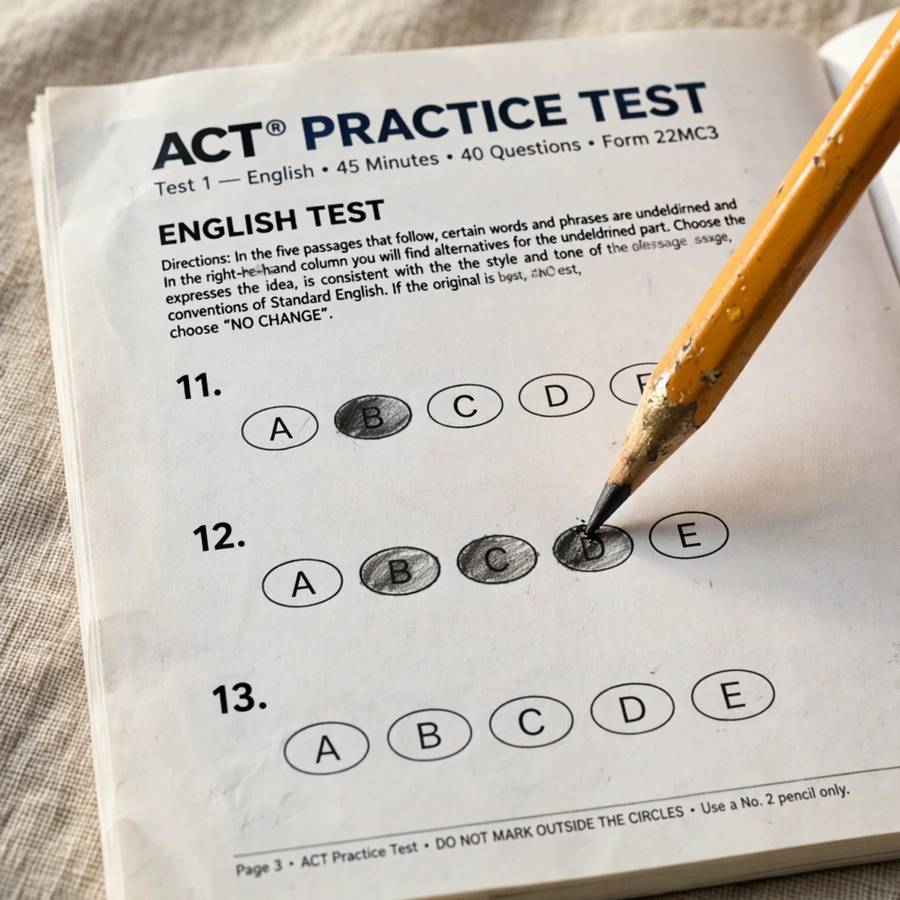
Quick orientation. The ACT has three required sections (English, Math, Reading), plus optional Science and Writing:
We break down how to improve reading comprehension step by step in a separate guide.
| Section | Questions | Time | What it measures |
|---|---|---|---|
| English | 50 | 35 min | Grammar, punctuation, rhetorical skills |
| Math | 45 | 50 min | Algebra, geometry, trig, stats basics |
| Reading | 36 | 40 min | Comprehension under time pressure |
| Science (optional) | 40 | 40 min | Data interpretation, reasoning |
Plus an optional Writing section (one essay, 40 minutes). Scoring: each section gets 1-36, and your composite is the average of English, Math, and Reading only — Science no longer counts toward it.
Here’s what I tell every student first: the ACT is a speed test wearing a knowledge costume. Most students who struggle aren’t missing knowledge — they’re running out of time. That reframes everything: preparation is about pace and strategy as much as content.
How Much Time Do You Need
Honest answer: it depends on your starting score and target. But here’s the framework I used:
- 8-12 weeks is the sweet spot for most students — enough for real improvement without burnout
- 3-5 hours per week of focused study (not “sitting near a textbook”)
- 4-6 full practice tests minimum, under real timed conditions
Starting 2 weeks before? You can still gain points with strategy work (below), but content gaps won’t close. Starting 6 months before? You’ll burn out — intensity matters more than duration.
The diagnostic first. Before studying anything, take one full timed practice test. This is your baseline. Your prep plan should target your weakest sections — that’s where points come cheapest. Going from 22→27 in Reading is easier than 32→35 in English.
English: Grammar at Speed
50 questions in 35 minutes — 42 seconds per question. You don’t have time to deliberate; you need pattern recognition.
What to study: The ACT tests a narrow set of grammar rules repeatedly: subject-verb agreement, pronoun clarity, comma/splice rules, apostrophes, verb tense consistency, and parallelism. Learn these cold — they cover the majority of questions.
Rhetorical skills (about a third of the section): adding/deleting sentences, paragraph order, main idea. Strategy: read for purpose, not perfection. Ask “why is this sentence here?”
My top tactics:
– Read the full sentence, not just the underlined part — context determines the answer
– “No change” is correct about 20-25% of the time. Don’t fear it.
– Shorter is usually better when all else is equal (conciseness is tested)
– Don’t pick answers that add new meaning the passage doesn’t support
Math: Know What’s Tested
45 questions in 50 minutes — just over a minute per question, the most generous timing on the test. Note: math now has four answer choices, not five. The content:
- Pre-algebra & elementary algebra (~40%): the fundamentals. If these aren’t automatic, everything else suffers.
- Intermediate algebra & coordinate geometry (~30%): functions, quadratics, lines, systems.
- Plane geometry & trigonometry (~25%): triangles (so many triangles), circles, basic trig ratios.
- A few advanced topics (~5%): matrices, complex numbers, logs — know the basics, don’t obsess.
Strategy: Questions go roughly easy→hard. Don’t get stuck — a hard question costs the same as an easy one. I told my students: if you’ve spent 90 seconds, guess, mark it, move on. You can come back with fresh eyes.
Calculator: Know what yours can do before test day. Graphing features help on coordinate geometry. But don’t become calculator-dependent — most questions are faster by hand.
Reading: The Time Crunch
36 questions, 40 minutes, four passages. This is where most students bleed points — not from comprehension, but from the clock.
Passage order matters. Do your strongest passage types first (many students find natural science or social science easier than prose fiction or humanities). Bank confidence and points early.
The method that works: Spend 3 minutes reading actively (not skimming — reading, with purpose), then attack questions. For detail questions, go back to the passage — never answer from memory alone. For main-idea questions, trust your overall sense.
What doesn’t work: Reading questions first (you’ll forget them), reading every word slowly (you’ll run out of time), or panicking on the fiction passage (it’s just a story — treat it like one).
Build speed separately. Read challenging material daily — news analysis, science articles, opinion pieces. Reading speed is trainable, but it takes weeks, not days.
Science (Optional): It’s Not Really Science
The best-kept secret of the ACT: the Science section barely tests science knowledge. Note: Science is now optional and doesn’t count toward your composite — only take it if your target colleges ask for it. It tests reading graphs and tables under time pressure.
You’ll see passages with experiments, charts, and conflicting viewpoints. The questions ask: what does this graph show? What would happen if X changed? Which hypothesis does this data support?
You don’t need to have taken the class. I’ve watched students ace this section who’d never taken physics, because it’s really a logic-and-data test wearing a lab coat.
Strategy:
– Go straight to the questions for data-heavy passages — most answers are in the figures
– For conflicting-viewpoints passages, actually read — you need to understand each position
– Don’t overthink. The answer is in front of you more often than you’d expect.
– Same timing discipline: 40 minutes, 40 questions. Move.
The Writing Section (Optional)
Only take it if your target colleges require it. If they do:
- It’s one prompt asking you to evaluate perspectives on an issue and present your own
- Structure: intro with clear thesis, body paragraphs engaging the given perspectives, conclusion
- Graders reward clear organization and specific examples over fancy vocabulary
- 40 minutes: 5 to plan, 30 to write, 5 to proofread
Don’t let it drain energy from the main sections — it’s scored separately and matters less.
The Practice Test Method
Practice tests are where scores actually improve — but only if you do them right:
- Full, timed, realistic conditions. Saturday morning, desk, no phone, exact timing. Your brain needs to practice under pressure.
- Score it the same day. While it’s fresh.
- Error log. For every wrong answer, write: what I chose, why I chose it, what the right answer is, and what I’ll do differently. This is the single highest-value study activity I know.
- Pattern hunt. After 2-3 tests, your error log reveals patterns: “I rush the last 10 math questions,” “I misread ‘except’ questions.” Fix patterns, not individual questions.
- Re-do missed questions a week later. If you get them right now, the lesson stuck.
For broader study habits that support this, see my guide on how to study for final exams — the principles overlap heavily.
Test Day Strategy
The week before:
– Taper. Light review only. No cramming — it doesn’t work and it spikes anxiety.
– Sleep. Two good nights matter more than any last-minute studying.
– Logistics. Know the route, pack everything (ID, ticket, calculator, snacks) the night before.
Test day:
– Eat real breakfast. Your brain burns glucose. This isn’t wellness fluff — it’s fuel.
– Pacing > perfection. Every section: keep moving. A guessed answer has a 25% chance (four choices per question); a blank has 0%.
– Between sections: reset. Stand, stretch, breathe. Don’t replay the last section — it’s done.
– Bubbling strategy. Bubble as you go (not all at the end — running out of time with blank bubbles is tragic). Every 10 questions, check you’re on the right row.
Mindset: the ACT is a game with learnable rules. You’ve prepared. Trust the preparation.
Frequently Asked Questions
8-12 weeks at 3-5 focused hours per week is the sweet spot for most students, including 4-6 full timed practice tests. Start with a diagnostic test to find your baseline, then target your weakest sections — that’s where points come cheapest.
It depends on your target colleges. The national average is around 19-20. A 24+ is above average, 28+ is competitive for many strong schools, and 32+ opens doors at highly selective colleges. Check the middle 50% scores for your specific target schools — that’s the number that matters.
It’s less about science knowledge than it looks — it’s primarily reading graphs, tables, and experimental data under time pressure. And remember: Science is now optional and doesn’t affect your composite score — check whether your colleges require it before spending prep time on it. Students who’ve never taken physics can do well because it’s really a logic-and-data test. Go straight to the questions for data-heavy passages; most answers are in the figures.
Yes — always. There’s no penalty for wrong answers, so a guessed answer has a 25% chance (four answer choices) while a blank has zero. If you’ve spent 90 seconds on a question, guess, mark it, and move on. You can return with fresh eyes if time permits.
Both are accepted everywhere. The ACT is faster-paced with more straightforward questions (science is now an optional add-on); the SAT gives more time per question with trickier phrasing. Take a practice test of each under timed conditions and choose the one that fits your style — most students have a clear preference.
Read challenging material daily (news analysis, science articles, opinion pieces) — reading speed is trainable over weeks. On the test: do your strongest passage types first, read actively for 3 minutes rather than skimming, and go back to the passage for detail questions instead of answering from memory.