
History has a PR problem. Students treat it as a memorization subject — a giant pile of dates and names to cram — then wonder why it feels both boring and impossible. But history exams rarely reward memorization alone. They reward understanding: why things happened, how events connect, and what it all means.
I have tutored students who went from dreading history to genuinely enjoying it, and the transformation always came from the same shift: stop memorizing the story, start understanding the argument. Here is the complete strategy.
Table of Contents
- Why History Feels Hard (and Isn’t)
- Build the Framework First: Timelines
- Master Cause and Effect Chains
- Learn People as Characters, Not Names
- Active Study Methods for History
- Writing History Essays That Score
- The Final Week: Review Plan
- Frequently Asked Questions
Why History Feels Hard (and Isn’t)
History feels hard for two reasons, both fixable:
- It is taught as trivia. If your class is “memorize these 200 facts,” no wonder it feels impossible — human brains are bad at isolated facts and great at stories and patterns.
- Students study it like vocabulary. Flashcards for dates produce fragile knowledge. Understanding why the date matters produces durable knowledge — and the date comes along for free.
The students who excel at history think like this: every event has causes, every cause has context, and every exam question is really asking “do you understand the story?” Memorization supports understanding; it does not replace it.
Build the Framework First: Timelines
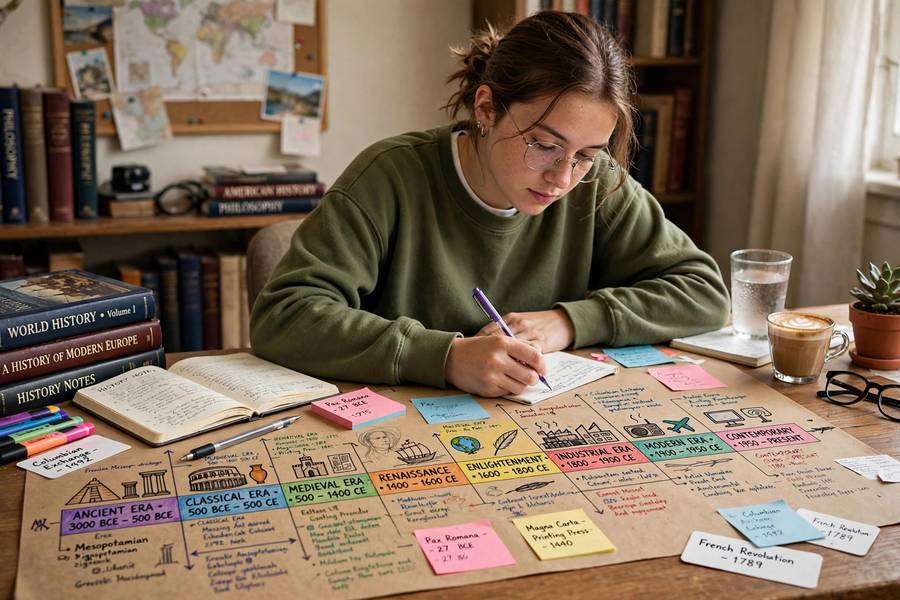
Before studying details, build the skeleton:
- Draw a master timeline of the period — just major events in order, on one page. This takes 20 minutes and pays for itself ten times over.
- Chunk it into eras with names you invent: “The Buildup,” “The Crisis,” “The Aftermath.” Named chunks are memorable; undifferentiated sequences are not.
- Hang details on the timeline as you study. Every new fact gets a home — “oh, this happened right after the treaty, during the instability.”
Without a timeline, facts float disconnected and evaporate. With one, each fact reinforces the others. This is the single highest-leverage thing you can do for any history exam.
Master Cause and Effect Chains
Exams love “why” and “what were the consequences.” For every major event, build the chain:
Long-term causes → short-term triggers → the event → immediate effects → long-term consequences.
Example structure (apply to your topic): economic conditions created tension over years; a specific incident ignited it; the event unfolded in phases; the settlement redrew the map; the resentment seeded the next conflict.
Practice by covering the middle of your chain and reconstructing it. If you can build cause-effect chains from memory, you can answer almost any essay question — because essays are just chains written in paragraph form.
Learn People as Characters, Not Names
“Metternich” as a vocab word is forgettable. Metternich as the conservative diplomat who spent his career trying to put the revolutionary genie back in the bottle is memorable. Give every key figure:
- A one-line identity: who they were in plain language.
- A motivation: what did they want?
- A signature action: the one thing they did that mattered most.
- A relationship: who were they allied with or against?
Characters stick. Names on a list do not. This is also why historical films and novels (used critically) can help — narrative is memory’s native format.

Active Study Methods for History
The Blank Timeline Test
Draw your timeline from memory — no notes. Then check and correct in a different color. Repeat until clean. This is active recall applied to history, and it is devastatingly effective.
Teach the Era
Explain the period aloud as a story: “So basically, after the war, everyone was broke and angry, which is why…” If you can narrate it coherently, you understand it. Where you stumble is where to study.
Create Your Own Exam Questions
Write 10 questions you would ask if you were the teacher — then answer them. Focus on “why” and “how” questions, comparisons (“compare the causes of X and Y”), and significance (“why does this matter?”). You will be shocked how often your questions resemble the real ones.
Debate Both Sides
For controversial events, argue each perspective for two minutes. This builds the analytical depth that separates A essays from C essays — and it is genuinely fun once you get into it.
Use Maps
History happened somewhere. Sketch rough maps showing where events occurred, borders moved, and armies marched. Spatial memory is powerful and almost entirely untapped by most students.
Writing History Essays That Score
Most history exams include essays. The formula:
History papers demand solid research skills, and mastering research paper introductions will lift every essay you write.
- Thesis in the first paragraph. Take a clear position that answers the question directly. “While X mattered, Y was the decisive factor because…” — a thesis with tension scores higher than a list.
- One idea per paragraph, each anchored by specific evidence (names, dates, events). Vague essays (“many things caused the war”) fail; specific essays (“the naval arms race after 1906…”) succeed.
- Analysis, not just narrative. Do not just tell what happened — explain why it mattered and how it connects. Every paragraph should contain the word “because” (literally or in spirit).
- Acknowledge complexity. The best essays note counterarguments (“Admittedly, economic factors played a role, but…”). Nuance signals understanding.
- Conclude by answering “so what?” Why does this still matter? The significance paragraph is what separates good from excellent.
Time management: spend 10% planning (thesis + paragraph topics), 80% writing, 10% checking that every paragraph supports the thesis.
History essays live or die by their argument — start with writing a strong thesis statement before you write a word.
The Final Week: Review Plan
- 7 days out: Master timeline + cause-effect chains from memory. Identify weak spots.
- 5 days out: Essay practice — outline 3–4 likely questions fully, write 1–2 completely.
- 3 days out: Blank-timeline tests and self-quizzing on weak areas only. No new material.
- 1 day out: Light review of timelines and thesis statements. Sleep early — memory consolidation is real.
This plugs into a broader system — see how to study for final exams for the full framework — and strong textbook reading habits make every chapter stick better in the first place. Juggling multiple subjects? A faster language-learning system uses the same retrieval techniques, so the methods reinforce each other.
Using Primary Sources
Exams reward students who engage with sources, not just textbooks. When studying an event, read one short primary source — a letter, speech excerpt, or diary entry from the period. Ask: who wrote this, why, and what does it reveal that the textbook smooths over? Even one primary source per topic deepens your essays noticeably, because you can cite specific voices instead of generalizations. Most are freely available through library digital collections.
Frequently Asked Questions
Build a master timeline first, learn cause-and-effect chains (not isolated facts), treat historical figures as characters with motivations, and test yourself with blank-timeline recall. Focus on understanding why things happened — essays reward analysis over memorization.
Anchor dates to a timeline rather than memorizing them in isolation. Learn the sequence and the story first; dates attach naturally to events you understand. For stubborn ones, use vivid associations or link them to dates you already know.
Lead with a clear thesis that takes a position, devote one paragraph per idea with specific evidence (names, dates, events), explain why each point matters, acknowledge counterarguments, and conclude with the historical significance.
Usually because it is approached as memorization. Human brains are bad at isolated facts but excellent at stories and patterns. Shift to understanding causes, connections, and narratives, and history becomes dramatically easier.
Start building timelines and chains 1–2 weeks out, with active self-testing throughout. The final week should be review and essay practice, not first-time learning. Cramming timelines the night before rarely works.
No — prioritize understanding sequences, causes, and significance. Know the major turning-point dates cold; for the rest, approximate placement on your timeline matters more than exact days. Check your teacher’s emphasis for guidance.