
A student I once tutored had been “learning Spanish” for three years and still froze when a waiter asked a simple question. Three years of daily app use. She wasn’t lazy — she was doing exactly what the app told her to do. The method was just wrong for the goal.
That story captures the problem with language learning advice: most of it is designed to keep you using a product, not to make you fluent. I’ve spent years studying how people actually learn — not just languages — and the research is surprisingly clear. Faster and slower ways exist; the difference isn’t talent. It’s method.
This guide is the tactics guide: the highest-return-per-hour methods — how input actually works, the vocabulary 80/20, speaking practice that works from day one, the tools worth using, and how to measure progress so you don’t quit. No “fluent in 30 days” promises. Just what works.
The long game — the stages of fluency, honest hour benchmarks, the daily routine that carries you through them, and how to break plateaus — is in our companion guide, how to become fluent in a language. Tactics are how you use your hours; that roadmap is how you plan them.
The “Faster” Truth: What Speed Is Actually Realistic
First, calibrate expectations — unrealistic timelines are the number-one reason people quit.
Language institutions have studied this extensively, and the headline is simple: there are no shortcuts past the hours — roughly 600+ of quality study for languages similar to English, far more for very different ones. The full breakdown of hour benchmarks by language and what each stage of the journey looks like is in our companion guide to the long game, how to become fluent in a language.
Do the math: 30 minutes a day is ~180 hours a year. At that pace, conversational Spanish takes three to four years; an hour a day, under two. Not meant to discourage — meant to free you. My student wasn’t failing; she was on a plan that mathematically couldn’t get her there. Once she saw the real timeline, she adjusted effort instead of blaming herself.
“Faster” means two things: the highest return per hour, and sustained daily effort. No shortcuts past the hours — but most people waste half their hours on low-value activities. That’s the half we can win back.

How Languages Get Learned: Input and Output
The core mechanic — everything in this guide hangs on it: you learn a language through comprehensible input and meaningful output.
Input — listening and reading. Your brain is a pattern-matching machine: given enough understandable examples, it unconsciously extracts grammar, vocabulary, and rhythm. How you learned your first language — not from grammar drills, but thousands of hours of input.
Output — speaking and writing. Forces your brain to retrieve and assemble, cementing what input introduced. Active recall applied to language: struggling to produce one sentence teaches more than reading ten.
The key words: comprehensible, meaningful. Input you can’t follow is noise; output that’s just repeating app phrases is theater. The sweet spot — linguists call it “i+1” — is material just above your level: challenging enough to stretch you, understandable enough to learn from.
Most slow methods fail this test: memorizing context-free word lists (low comprehension, zero meaning), watching movies far above your level with native subtitles (comfortable, mostly noise). Faster means ruthlessly prioritizing activities hitting the input-output sweet spot.
The 80/20 of Vocabulary: Learn the Right Words First
Not all words are equal: a small number does most of the work — the top 1,000 most frequent words cover ~80% of everyday conversation. Learn those before the word for “chrysanthemum.”
The 80/20 rule of vocabulary — the single biggest speed lever beginners have. Knowing the 1,000 most common words lets you follow everyday conversations; “knowing” 3,000 rare words from themed app lessons often can’t get you a coffee.
How: grab a frequency list for your target language (free online) and work through the first 1,000-2,000 with flashcards — always in example sentences, never in isolation. “The dog runs” teaches the word, its grammar, and usage at once.
One warning: frequency lists skew written. Supplement with the most common spoken phrases — greetings, opinions, fillers, reactions. The social glue of conversation, notoriously under-taught by textbooks. The phrases that make you sound natural aren’t usually in chapter one.
Make Your Input Comprehensible (Real Immersion, Not Noise)
“Just immerse yourself” is the most common — and most misunderstood — language advice. Immersion only works when input is comprehensible. Drowning in content you can’t follow doesn’t teach; it just tires you out.
The trick is graded input: material designed for your level — children’s shows, learner podcasts, graded readers (limited-vocabulary books). Yes, babyish-feeling. Also the fastest foundation-builder for real content later.
Bridge upward deliberately: rewatch known shows in your target language, read simple-language news before the real thing, slow podcasts to 0.8x. Each step keeps you in the i+1 zone — stretched, not drowning.
Subtitles: use the target language, not your own. Your-language subtitles turn watching into native reading practice — comfortable, nearly useless for the target language.
Make some input narrow: lots of content on one topic. Ten Spanish cooking videos teach food vocabulary deeply; ten random ones teach nothing deeply. Depth before breadth, especially early.

Speak From Day One: The Uncomfortable Part
The advice learners resist most — and the one that matters most: speak immediately. Badly, awkwardly, from day one.
My opening-story student had three years of input, near-zero output. She recognized Spanish; she couldn’t produce it. Production is a separate skill, improved only through practice — fastest when you start early, while standards are low and embarrassment is cheap.
No plane ticket or native friend needed (both help, though). Options: language-exchange apps (trade 30 minutes of your language for 30 of theirs), affordable online tutors, or even talking to yourself — narrating your day builds the retrieval muscle surprisingly well.
A practical progression: week one, 50 survival phrases with a tutor or exchange partner. Month one, a 15-minute daily-life conversation. Month three, opinions and stories. Messy throughout — messy is the point. Every awkward pause is your brain building a pathway.
A favorite motivator: plan a trip. Nothing focuses study like a real deadline with real humans. Planning a trip to practice? Even packing becomes study motivation — you’ll want to use the language when you land.
Grammar: Learn It in Context, Not in Isolation
Grammar has a PR problem: the usual method (drills, conjugation tables, rules before examples) is about the least effective way to learn it. But grammar itself is essential — the operating system of the language.
The faster approach: learn grammar from your input, not before it. Keep seeing an unfamiliar pattern — two Spanish past tenses, say? That’s the moment to look up the rule. It now has a job: explaining something real you’ve encountered. Rules learned this way stick; table-memorized ones evaporate.
This is “noticing,” and it’s trainable: pause on surprising structures. Look them up, find three more examples, produce one yourself. That loop — notice, understand, produce — builds grammar as a usable skill, not trivia.
Need a grammar reference? Eventually, yes — one good book or site, consulted as needed, never studied cover to cover. A dictionary for structures: you don’t memorize it, you look things up.
Build a Daily System (30–60 Minutes Beats Weekend Marathons)
Consistency beats intensity, and it’s not close. The brain consolidates language during sleep — the same memory mechanics I write about for exam prep. Five 30-minute sessions a week massively outperform one 3-hour weekend marathon: each session gets its own night of consolidation.
Design a system, not a motivation plan — motivation fluctuates, systems persist. Two principles carry most of the weight: fill your sessions with high-return activities (flashcards, level-appropriate listening, speaking), and anchor them to existing habits — flashcards with morning coffee, listening on the commute. Habit stacking separates January survivors from quitters. Track streaks loosely: aim for “most days,” not perfection.
For the full stage-by-stage daily routine that carries you through the whole journey to fluency, see the daily routine in our long-game guide.
Use Technology Without Becoming an App Collector
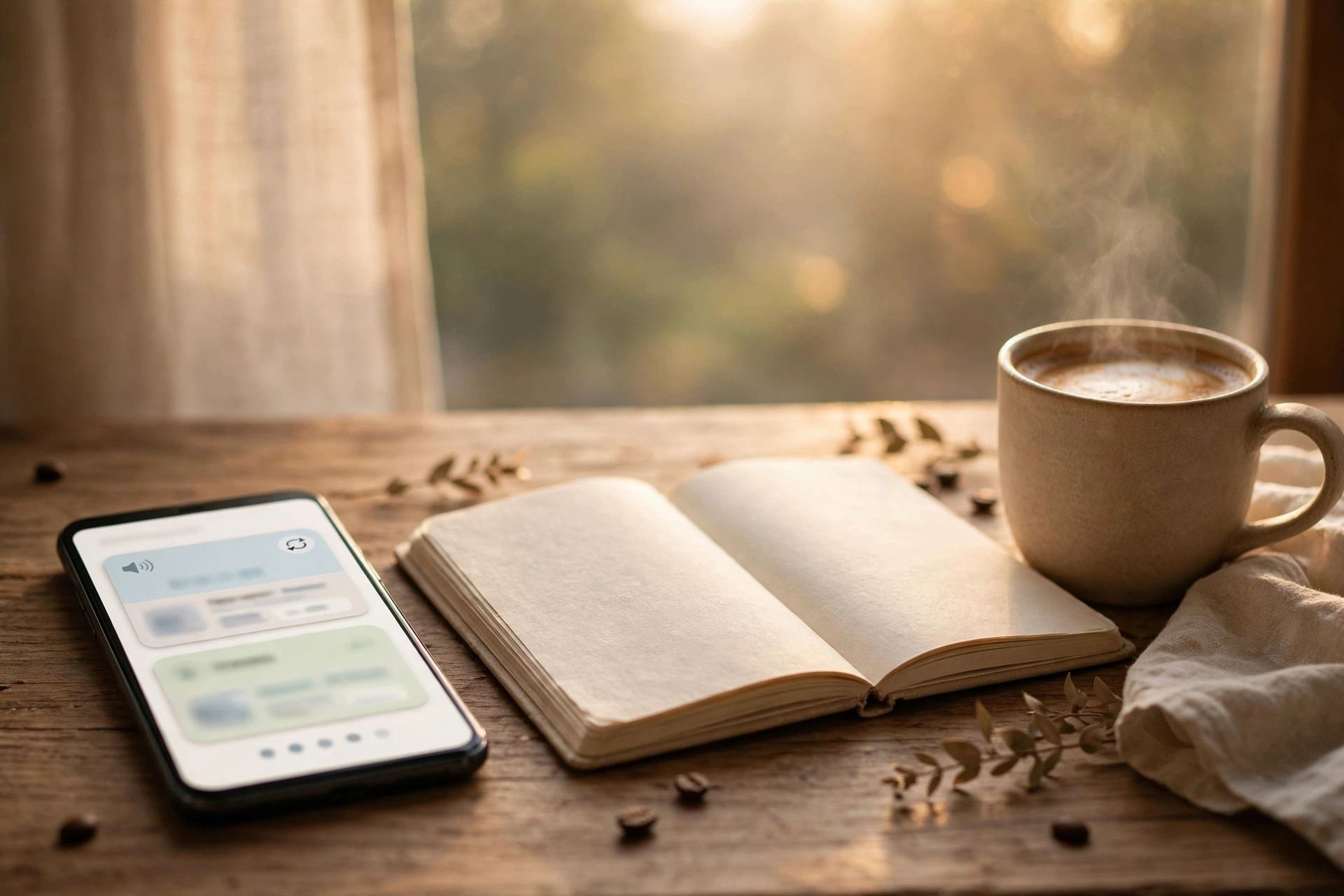
Language apps: useful servants, terrible masters. The constant pattern — learners collect five apps, do 15 minutes in each, mistake activity for progress. Pick a small stack and commit:
One spaced-repetition app for vocabulary (the algorithm schedules reviews at the optimal moment). Make your own decks from encountered words, not just pre-made ones; self-made cards stick better.
One listening source at your level — a learner podcast series followed consistently beats ten random YouTube channels.
One speaking venue — an exchange app or tutoring platform with real humans, scheduled weekly.
That’s it; the rest is optional. Audit quarterly: if an app’s minutes aren’t translating into ability — if you can’t do more than three months ago — it’s entertainment, not education. Not the app’s fault; your time belongs in higher-value activities like conversation.
AI chat tools: genuinely useful for practice — patient, always available, able to role-play and correct mistakes. A supplement to human conversation, not a replacement.
Plateaus: Why They Happen and How to Break Them
Every learner hits plateaus — stretches where effort continues but progress feels frozen. Normal, predictable, breakable. Usually:
The three usual suspects: the intermediate plateau (your input got too comfortable — raise the difficulty), the fossilization trap (the same mistakes, hardened by repetition — hunt them with targeted feedback), and the motivation dip (change the game, don’t quit it).
The full breakdown — how each plateau feels, why it strikes at that stage, and how to punch through — is in Breaking Through Plateaus in our long-game guide. The meta-lesson: plateaus mean you’ve outgrown your activities. Trust the process, raise the difficulty, keep going.
Measure Progress So You Don’t Quit
Final piece: make progress visible. Invisible progress kills motivation.
Keep a “can-do” log. Monthly, note new abilities: “ordered food by phone,” “understood a joke in a show,” “explained my job for two minutes.” Concrete wins for the days the language feels impossible.
Revisit old material. Every few months, rewatch the first show you struggled with or reread your first graded reader. That ease proves growth — more convincing than any score.
Consider a proficiency test for a milestone — standardized, scheduled, credentialed. A calendar date focuses effort wonderfully.
Zoom out occasionally. Language learning is one of the few pursuits where effort compounds into something life-expanding: new friendships, new work, new ways of thinking — research even suggests bilingualism builds cognitive flexibility. My student from the opening? She switched methods, started speaking weekly, and six months later held a ten-minute conversation with a native speaker. She cried a little. I understood completely — nothing like the moment a language starts belonging to you. For more on learning anything better, browse more education guides — making learning feel possible is my whole job.
Frequently Asked Questions
For an English speaker, conversational ability in a similar language (Spanish, French) takes roughly 600-750 hours of quality study; very different languages (Mandarin, Arabic) take around 2,200 hours. At 30 minutes a day, that is several years; at an hour a day, under two years for easier languages. Consistent, effective methods matter more than raw talent.
Maximize high-return activities: learn the most frequent 1,000-2,000 words first, consume lots of level-appropriate (comprehensible) input, and start speaking from day one. Combine this with daily consistency — 30-60 minutes every day beats weekend marathons because sleep consolidates each session’s learning.
Not genuinely fluent, no — anyone promising that is selling something. In three months of intensive daily study you can reach a solid conversational foundation: handling daily situations, simple discussions, and basic reading. Real fluency takes hundreds of hours. Treat 3-month claims as marketing, not methodology.
Vocabulary first, grammar in context. Learn the most frequent words in example sentences so you can start understanding and communicating quickly. Pick up grammar when you encounter patterns you don’t understand in your input — rules learned to explain something real stick far better than rules memorized from tables.
30-60 minutes daily is the sweet spot for most learners — sustainable for years, and each session gets consolidated during sleep. More is fine if you enjoy it, but consistency matters far more than session length. Five focused 30-minute sessions a week will beat one 3-hour weekend session every time.
No. Children have an advantage in accent and ultimate attainment, but adults learn faster initially thanks to better study skills and existing language knowledge. Plenty of adults reach high proficiency starting in their 30s, 40s, 50s and beyond. The only real age limit is the belief that one exists.