
If you’re reading this, you’ve probably already done the hardest part of learning how to get a GED: deciding to do it. I’ve tutored students through this process for years, and I can tell you that almost everyone walks in thinking the logistics will be confusing, the test will be impossible, and they’re too far behind. Almost everyone is wrong on all three counts.
The GED is the most common high school equivalency credential in the U.S., and the process is far more straightforward than most people expect. Here’s the full path, step by step, from “should I do this?” to holding your diploma.
Table of Contents
- First, Make Sure the GED Is the Right Credential
- Check That You’re Eligible
- Understand the Four Tests
- Build a Study Plan That Actually Works
- Take the Official Practice Test
- How to Get a GED Test Date: Scheduling and Taking the Real Test
- After You Pass: What Your Diploma Unlocks
- Frequently Asked Questions
First, Make Sure the GED Is the Right Credential
A quick note before we dive in: the GED is one type of high school equivalency, but a few states use an alternative (the HiSET — the TASC was discontinued in 2021). If you live in one of those states, the general steps here still apply, but the test format and provider differ. You can check which credential your state uses at ged.com — it’s the official starting point for everything in this guide.
For most people, though, the GED is the answer. Colleges, employers, and the military treat it as equivalent to a high school diploma. It opens the same doors: college admissions, better jobs, financial aid, vocational programs. If you’ve ever hit a wall because of the missing diploma, the GED removes it.
One honest caveat I give every student: the GED is not a shortcut to a “better” diploma. It’s a different route to the same destination. Some competitive colleges prefer a full transcript; if you’re aiming at an extremely selective school, you may need community college credits on top. For the vast majority of goals, the GED does everything you need.
Check That You’re Eligible
Eligibility rules come from your state, not the GED Testing Service, but the broad strokes are consistent:
- Age: Most states require you to be at least 16, and if you’re 16 or 17, you’ll typically need parental consent, proof you’re withdrawn from school, and sometimes an age waiver. At 18, it’s simply a matter of not being currently enrolled in high school.
- Enrollment status: You can’t be enrolled in a K-12 school when you test.
- Residency: You test in the state where you live (or meet its residency rules).
- Cost: Roughly $30–$40 per subject test, so $120–$160 total in most states, though some states subsidize it. Some employers and nonprofits will reimburse you — worth asking.
If you’re under 18, start with your state’s GED administrator’s website to see exactly what’s required — the paperwork varies, and getting it wrong is the most common delay I see.
Understand the Four Tests
The GED is not one big test. It’s four separate subject tests, and you take them individually — all in one day or spread across weeks. That structure is a gift: you can study for and pass one subject at a time. Most of my students do math last, because it’s usually the hardest, and bank the confidence from the other three first.
Here’s what each section looks like:
Reasoning Through Language Arts (RLA) — 150 minutes. Reading comprehension, grammar, and an extended response (an essay analyzing two passages). The essay is formulaic once you learn the structure: introduction, body paragraphs tied to evidence from the texts, conclusion. Students who practice three or four essays almost always pass this section.
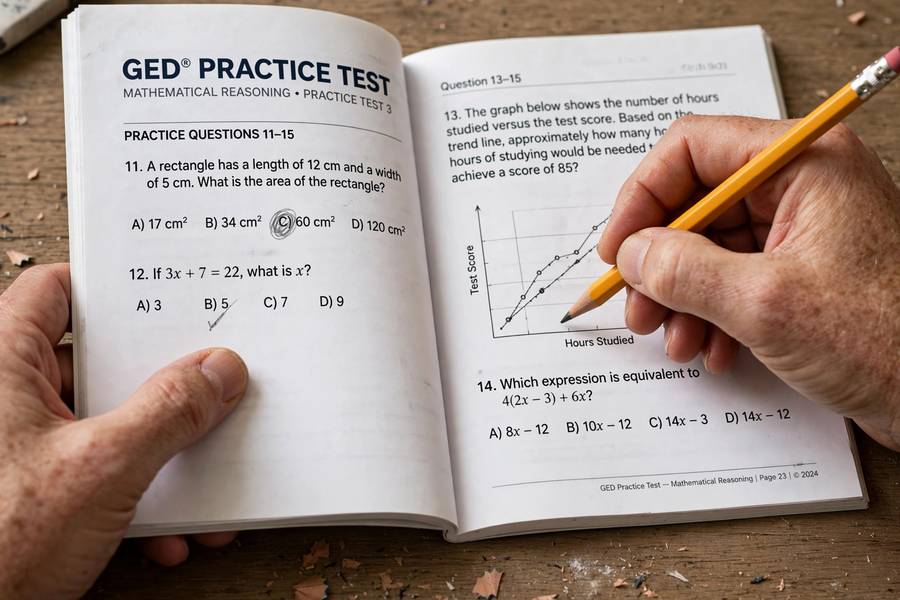
Mathematical Reasoning — 115 minutes. Algebra, quantitative reasoning, and geometry. You get a calculator (an on-screen TI-30XS) and a formula sheet. The passing level is roughly equivalent to late middle-school/early high-school math — it’s not calculus, but if you haven’t done algebra in years, budget the most study time here.
Science — 90 minutes. Life science, physical science, and earth/space science. The questions lean heavily on reading data — charts, graphs, experiments — rather than memorized facts. If you can interpret a graph, you’re most of the way there.
Social Studies — 70 minutes. Civics, U.S. history, economics, and geography, again mostly through documents and data analysis rather than raw memorization.
Each test is scored from 100 to 200. 145 is the passing score. There’s no penalty for guessing, so answer everything. If you don’t pass one, you retake just that one — not the whole battery.
Build a Study Plan That Actually Works
This is where I earn my keep as a tutor, because study approach is the single biggest predictor of success — more than prior schooling, more than age. Here’s the framework I give every GED student:
1. Take a diagnostic first. Before buying a book or opening an app, take a full free practice test for each subject (the GED website has them, and there are solid free options elsewhere). Score each one. Now you know exactly where to spend your time. Studying everything equally is the amateur move.
2. Schedule short, frequent sessions. Two hours once a week is worse than thirty minutes four times a week. Your brain consolidates between sessions — that’s the entire trick. Consistency beats marathons, and the same principle works when you study for final exams in any subject.
3. Front-load math. Whatever your diagnostic says, math takes the longest to rebuild. Start it first, even if you also work other subjects. Fifteen minutes of algebra practice a day, every day, will do more than any weekend cram.
4. Practice under test conditions. The GED is computer-based (even at test centers). Timed, multiple-choice, some drag-and-drop and fill-in-the-blank. Doing practice questions on paper at your own pace builds knowledge; doing them timed on a screen builds the skill you’ll actually need.
5. Learn the question types, not just the content. The GED loves certain formats — “which sentence is grammatically correct,” “what does this graph show,” “which evidence best supports the claim.” Once you recognize the patterns, half the test becomes familiar.
6. Use free resources before paid ones. The official GED site has free practice and prep materials. Public libraries often have GED study guides and sometimes free tutoring. Many adult education centers offer free or low-cost GED classes. Paid programs can be good, but start free — I’ve had students pass using nothing but library books and online practice.
For realistic timelines: most of my students who study 5–8 hours a week pass within 3–6 months, depending on their starting point. If you left school recently, it can be faster. There’s no deadline — the tests don’t expire individually, so go at your pace.
Take the Official Practice Test
The GED Testing Service offers an official practice test called GED Ready. It costs a small fee per subject (often around $7), and it’s the single most predictive thing you can do — it estimates your score on the real test. If you’re scoring 150+ on GED Ready, you’re ready. If you’re at 143, you know you need a little more work.
I tell students to take GED Ready when they think they’re ready, not before. It’s a readiness check, not a study tool. And here’s a nice detail: in many states, passing GED Ready qualifies you for a discounted rate on the real test — check your state’s policy.
How to Get a GED Test Date: Scheduling and Taking the Real Test
When you’re ready, scheduling is simple:
- Create an account at ged.com.
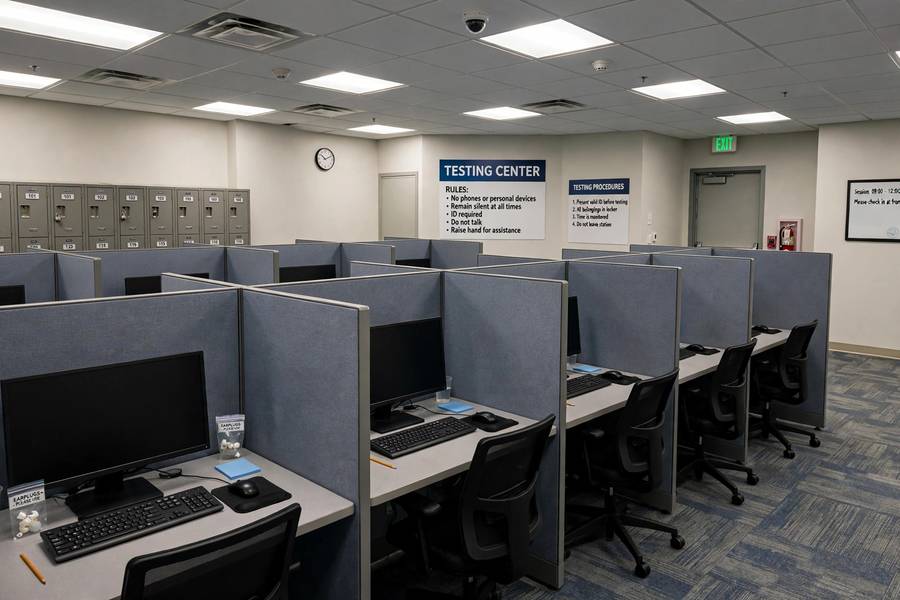
- Choose a test center or the online-proctored option. (Online testing has extra requirements — a private room, a webcam, a stable connection, and a room scan. If your home setup is shaky, choose a test center.)
- Book each subject separately or together — your call. Many students book the strongest subject first for momentum.
- Pay per test.
On test day: bring a valid government-issued photo ID (this is where knowing how to apply for a passport can matter if you don’t have another form of ID), arrive early, and leave your phone in the car — test centers are strict about devices.
Results come quickly — usually within a few hours, sometimes up to a day. If you pass, your diploma and transcript are available through your ged.com account. If you don’t pass a subject, you’ll get a score report showing exactly which topics to work on. In-person retakes can usually be scheduled quickly; online retakes have waiting periods after multiple attempts, so read the fine print.
One more practical note: if English isn’t your strongest language, the GED is also offered in Spanish at many centers, and the language skills transfer. I mention this because I’ve seen bilingual students stress about the RLA section when a different test language would have served them better.
After You Pass: What Your Diploma Unlocks
Passing all four tests earns you a high school equivalency diploma, issued by your state. Here’s what changes:
- College: You can apply to community colleges and most four-year schools. You’ll still need entrance exams or placement tests where required, and financial aid (FAFSA) is open to you.
- Employment: Jobs that require a high school diploma now accept your credential. If you’re aiming at a career ladder, this is the rung everything else stands on.
- Vocational and certificate programs: Trade schools, nursing assistant programs, IT certifications — nearly all accept a GED.
- The military: The GED qualifies you, though some branches have additional requirements.
Keep your transcript accessible — employers and schools will sometimes ask for it, and you can request official copies through ged.com. And if college is in your future, it’s worth looking ahead at how college applications work so you know what comes after the diploma. For students who go further still, it’s nice to know the long arc: a GED can be the first step on a path that ends with something as ambitious as a doctoral dissertation — I’ve seen stranger journeys.
The last thing I tell every student who passes: you didn’t just earn a credential. You proved you can set a hard goal, build a plan, and finish it. That’s the skill every employer and college is actually screening for. Congratulations in advance.

Frequently Asked Questions
Most students studying 5–8 hours a week pass within 3–6 months, depending on their starting point. Because the four tests are taken individually, you can move faster on strong subjects and take more time on weak ones.
Typically $30–$40 per subject test, or $120–$160 total, though prices vary by state and some states subsidize the cost. The official GED Ready practice test is a small additional fee per subject.
145 out of 200 on each of the four subject tests. There is no penalty for guessing, and you only retake the subjects you don’t pass — not the whole battery.
Yes, an online-proctored option exists with requirements including a private room, webcam, and stable internet connection. Many students prefer test centers to avoid technical issues.
For nearly all purposes — college admissions, employment, financial aid, and the military — the GED is treated as equivalent to a high school diploma. Extremely competitive colleges may also want to see college-level coursework.
You retake only the subject you didn’t pass. Your score report shows which topics need work, and in-person retakes can usually be scheduled quickly.