How to Pack Light: Two Weeks in a Carry-On

The classic overpacked 28-inch suitcase — “just in case” outfits, shoes for occasions that never occur — costs money, time, and joy: dragged up four flights of stairs to a Florence Airbnb (no elevator — obviously), too heavy to run with for a train connection, and hit with a $75 overweight fee on the way home.
Two-week trips — Japan, Morocco, the Balkans — are entirely doable with just a carry-on. Not as a stunt. Because it’s genuinely better: no checked-bag fees, no waiting at carousels, no lugging, total mobility. Here’s the complete system, including the common mistakes to avoid.
Table of Contents
- The Mindset Shift (This Is 80% of It)
- The 5-4-3-2-1 Rule
- Choose the Right Bag
- Packing Cubes Changed Everything
- Roll, Don’t Fold
- Shoes: The Hardest Part
- The Toiletry Truth
- What to Always Bring (and What to Stop Bringing)
- Laundry: The Secret Weapon
- Packing Light for Different Trips
- The Pre-Trip Packing Ritual
- Frequently Asked Questions
The Mindset Shift (This Is 80% of It)
Packing light isn’t a technique; it’s a decision. The decision is: Wear things more than once, do laundry, and do not pack for imaginary scenarios.
Every overpacked bag is packed for a fantasy version of the trip — the fancy dinner that never happens, the “what if it snows in May” anxiety, the three books for a week (half of one gets read). The real trip needs far less than the imagined one.
The question that fixes everything: for each item, ask “will this be used at least three times?” If not, it stays home.
The 5-4-3-2-1 Rule
This is the baseline formula for a week-plus trip, and it works:
- 5 tops (mix of casual and one slightly dressy)
- 4 bottoms (including what you wear on the plane)
- 3 pairs of shoes (worn: the bulkiest; packed: two compact pairs)
- 2 layers (a light jacket/fleece + a warmer layer or rain shell)
- 1 hat (sun protection that doubles as a bad-hair-day fix)
Everything in a single color palette — for example black, white, gray, and denim with one accent color. When everything matches everything, five tops and four bottoms make twenty outfits, not nine. This is the capsule wardrobe principle applied to travel, and it’s the highest-leverage packing decision you can make.
For two weeks: don’t double the formula. Add two tops and plan one laundry day. That’s it. The formula scales through laundry, not through more clothes.
Choose the Right Bag
Your bag is the constraint that enforces the system. A 40-liter carry-on (the maximum most airlines allow: roughly 22 x 14 x 9 inches) plus a personal-item backpack is enough — that’s the whole luggage for two weeks.
What to look for: a bag that opens like a suitcase (clamshell), not top-loading like a backpack — you’ll live out of it in hotel rooms and clamshell access is sanity. Lightweight (under 7 lbs empty — some “carry-ons” weigh 11 lbs before you put anything in them, which is madness). Good wheels, because you’ll be walking with it.
A common mistake: a beautiful hard-shell case that weighs 10.5 lbs empty. On a 15-lb carry-on weight limit (common on international budget airlines), that leaves just 4.5 lbs for actual belongings. A 6.8-lb soft-shell avoids the problem entirely. Weigh your empty bag. It matters more than any packing technique.
Packing Cubes Changed Everything
Packing cubes can seem like fussy organizer-brain nonsense — until the first trip with them. Here’s why they convert skeptics:
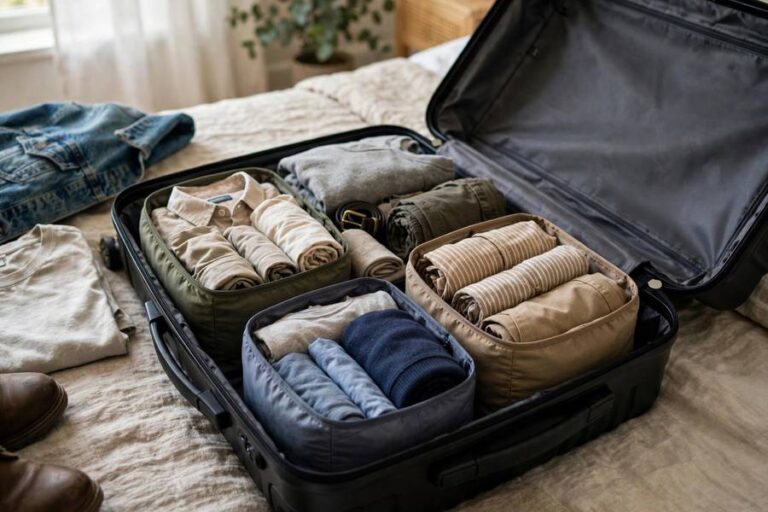
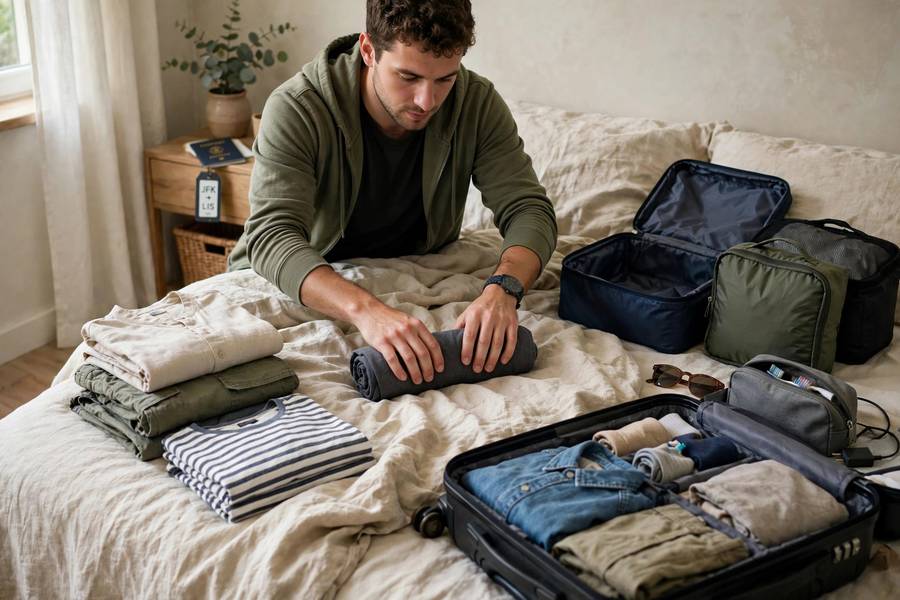
Compression: they squeeze the air out and keep clothes compact. Organization: one cube for tops, one for bottoms, one for underwear — you can find anything without exploding the bag. Clean/dirty separation: the dirty-laundry cube keeps everything else fresh.
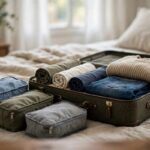
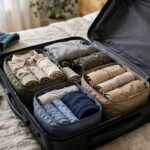
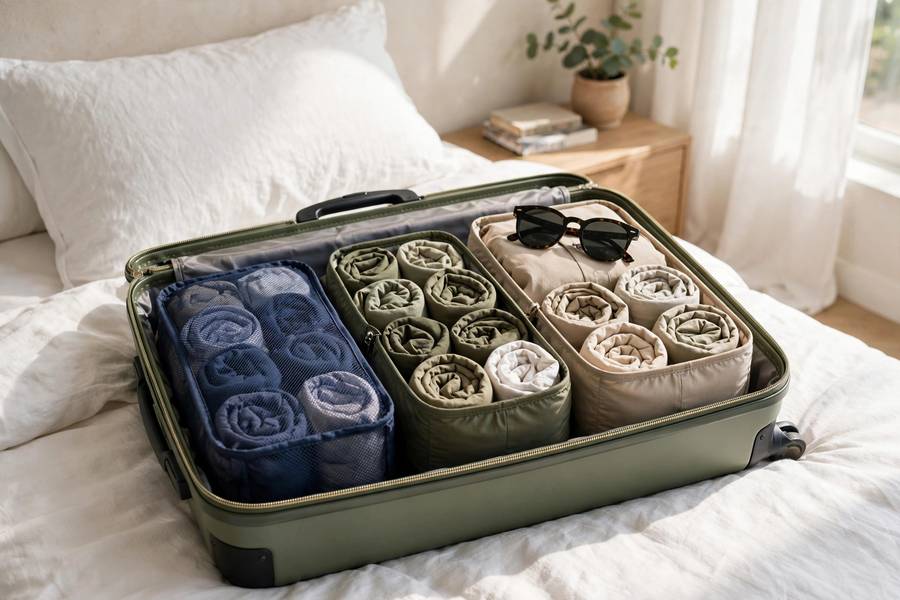
How to use them: medium cubes for clothes, a small one for underwear and socks, and a flat one for the “flat” stuff (documents, a scarf that doubles as a blanket). Roll clothes inside the cubes — the combination of rolling + cubes is the maximum-density system.
Roll, Don’t Fold
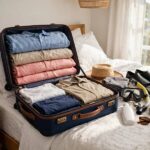
Rolling beats folding for travel, full stop. Rolled clothes take up less space, wrinkle less, and you can see everything at a glance. The military figured this out decades ago.
The technique: lay the item flat, fold in the sleeves/sides to make a rectangle, then roll tightly from the bottom. For jeans and heavier items, rolling still wins — they’re just bigger rolls. Delicate items (silk, linen) get rolled in tissue or placed flat on top.
The exception: structured items like blazers. For those, turn one shoulder inside out, tuck the other shoulder into it (bundling), and lay flat. But honestly — if your trip requires a blazer, that’s a different packing conversation.

Shoes: The Hardest Part
Shoes are the volume-killers. Three pairs is the max, and here’s the formula:
- Wear the bulkiest pair on the plane. Always. Boots, sneakers, hiking shoes — whatever takes the most space goes on your feet.
- One versatile walking pair packed (comfortable leather sneakers that work for city days and casual dinners).
- One compact pair for the specific trip (sandals for beach, flats for evenings, trail runners for hiking).
What to stop bringing: “nice” heels (the cobblestones of Europe are heel graveyards, and they almost never get worn), backup sneakers “just in case,” and anything white that shows every scuff. Every pair must earn its space by being wearable for full days, not single occasions.
The Toiletry Truth
Nobody needs a full bathroom in their carry-on. Here’s a complete kit: solid shampoo bar (no liquid limit, lasts months), small conditioner, toothbrush + paste, deodorant, sunscreen (the one non-negotiable full-size item), basic medications, and minimal makeup (tinted moisturizer with SPF, mascara — that’s the whole face).
The solid-toiletries revolution is real: shampoo bars, conditioner bars, and solid perfume eliminate the 3-1-1 liquids bag almost entirely. They last longer, weigh less, and never leak. Solid bars work just as well at home as on the road.
What to stop bringing: “just in case” full-size products, hotel-hoarded mini bottles (every traveler has a drawer of these at home), and anything available for €2 at a pharmacy abroad. Contact solution and prescription items are the only things worth over-packing deliberately.
What to Always Bring (and What to Stop Bringing)
Always worth packing: a packable down jacket (squishes to nothing, saves the day constantly), a large scarf (blanket, pillow, shawl, temple cover-up — the hardest-working item in the bag), a reusable water bottle (empty through security), a small first-aid kit, earplugs + eye mask (non-negotiable for hostels, planes, and thin-walled hotels), and a portable charger.
Leave behind: the travel pillow (the scarf works), multiple books (e-reader), “nice” outfits for imagined occasions, and full-size anything.
Laundry: The Secret Weapon
The thing that makes two weeks in a carry-on possible isn’t packing genius — it’s laundry. One mid-trip laundry session resets the whole system.
Options ranked: hotel laundry service (expensive but effortless), local laundromats (cheap, and oddly fun — laundromats are surprisingly social places), Airbnb/hotel washer (free — prioritize this when booking longer stays), and hand-washing (sink + travel soap for underwear and light items; they dry overnight).
The rhythm: pack for 7–8 days, do laundry on day 7 or 8. For a two-week trip, that’s one laundry day; for three weeks, two.
Fabric matters: merino wool and synthetic blends dry overnight and resist odor. Cotton takes forever to dry and holds odor — check the fabric when buying travel clothes.
Packing Light for Different Trips
Beach trip: even easier. The 5-4-3-2-1 rule still works; just swap layers for swim.
Cold-weather trip: the hardest case. Wear the coat and boots on the plane (non-negotiable). Pack thermal base layers, and layer rather than bringing bulk.
Business + leisure: one versatile outfit that dresses up (dark, simple, good fabric), and let accessories do the work. Nobody remembers that you wore the same blazer twice; everybody remembers the person who was comfortable.
Multi-climate trip: layers, layers, layers. A base layer + fleece + rain shell covers 40°F to 70°F. The scarf-as-blanket earns its keep on cold planes.
The Pre-Trip Packing Ritual
The night before every trip, follow the same ritual:
- Lay out everything that seems necessary.
- Remove a third of it (the “maybe” pile — it’s always a third).
- Pack what’s left using cubes and rolls.
- Pick up the packed bag. If it can’t be lifted into an overhead bin comfortably, remove more.
- Check documents, meds, chargers, passport — the only things that actually matter.
The final test: can everything be carried up four flights of stairs without misery? If yes, the packing is done.
Packing light isn’t about deprivation — it’s about freedom. Every trip gets faster, cheaper, and more enjoyable. The suitcase stops being something to manage and becomes something to forget about. That’s the whole point.
For the full item-by-item checklist to pair with this system, see the international packing guide.
Frequently Asked Questions
Use the 5-4-3-2-1 rule (5 tops, 4 bottoms, 3 shoes, 2 layers, 1 hat) in a single color palette, and plan one mid-trip laundry day instead of packing more clothes. Rolling clothes in packing cubes maximizes space, and wearing your bulkiest items on the plane saves the most room.
Pack 5 tops, 4 bottoms, 3 pairs of shoes, 2 layers, and 1 hat — all in a single color palette so everything matches. For trips over a week, add two tops and plan a laundry day rather than doubling the formula.
Rolling wins for travel: rolled clothes take up less space, wrinkle less, and let you see everything at a glance. Combine rolling with packing cubes for maximum density and organization. The only exception is structured items like blazers, which should be bundled flat.
The same technique for folding a fitted sheet neatly works wonders on packing cubes too — corners are corners.
Three pairs maximum: wear the bulkiest on the plane, pack one versatile walking pair, and add one compact pair for the specific trip (sandals, flats, or trail runners). Every pair must be wearable for full days — skip “occasion” shoes that only work for one imagined evening.
Prioritize accommodation with a washer for longer stays, use local laundromats (cheap and easy), or hand-wash light items in the sink with travel soap — merino wool and synthetics dry overnight. One mid-trip laundry day resets a carry-on wardrobe for a second week.
A 40-liter carry-on (about 22 x 14 x 9 inches) plus a personal-item backpack handles two weeks with the right system. Choose a lightweight bag (under 7 lbs empty) that opens clamshell-style like a suitcase — and weigh it empty, since heavy bags eat into strict airline weight limits.