
Every June, thirty NBA war rooms go quiet at once. Executives running billion-dollar franchises stare at a board of teenagers and try to predict the next decade. The draft is the league’s great equalizer — the worst teams get first crack at the best young talent, and one June night can redirect a franchise for fifteen years: LeBron in 2003, Duncan in 1997, Wembanyama in 2023.
But it isn’t just “worst team picks first.” There’s a lottery, flattened odds, tradable and protected picks, two rounds, and eligibility rules that shape the entire basketball pipeline. Here’s the complete breakdown.
Table of Contents
- What the NBA Draft Is
- Who’s Eligible: The Age Rule and Early Entry
- The Draft Lottery: How the Top Picks Are Decided
- The Full Pick Order: Rounds 1 and 2
- Trading Picks: The Stepien Rule and Protections
- Draft Night: How It Actually Unfolds
- After the Draft: Contracts, Two-Ways, and Draft-and-Stash
- A Short History of the Draft
- Frequently Asked Questions
What the NBA Draft Is
The NBA Draft is the league’s annual event where its 30 teams take turns selecting eligible amateur players — mostly from college basketball and international leagues. There are two rounds of 30 picks each, 60 picks total. Once drafted, a team holds that player’s NBA rights; no other team can sign him without a trade or release.
The purpose is competitive balance: bad teams pick early, getting first access to the best prospects — the league’s mechanism against permanent dynasties and permanent doormats. It doesn’t always work, but the logic holds: talent flows to the teams that need it most.
Who’s Eligible: The Age Rule and Early Entry
Not just anyone can enter. The eligibility rules, agreed between the league and the players’ union, are specific:
- A player must be at least 19 years old during the calendar year of the draft.
- He must be at least one NBA season removed from his high school graduating class. In practice, this means American prospects spend one year in college, the G League, or another pro league after high school — the famous “one-and-done” rule.
- Early entrants: College players can declare and withdraw by a set deadline to preserve eligibility — testing the waters is now low-risk.
- International players are automatically eligible at age 22; younger internationals must declare as early entrants.
- A player who goes undrafted becomes a free agent — the draft isn’t the only door into the league.
The age rule is endlessly debated: supporters say it protects teams and gives prospects development time; critics call it a restriction on earning a living. The league allowed preps-to-pros from 1995 (Kevin Garnett) through 2005, but one-and-done has held ever since.
The Draft Lottery: How the Top Picks Are Decided
The 14 teams that miss the playoffs don’t simply pick in reverse record order — the top of the draft is decided by a lottery, designed to discourage outright tanking.
How it works:
- The 14 non-playoff teams enter with record-weighted odds. Since 2019 the odds are flattened: the three worst teams each get 14 percent at the top pick, scaling down to 0.5 percent for the best lottery team.
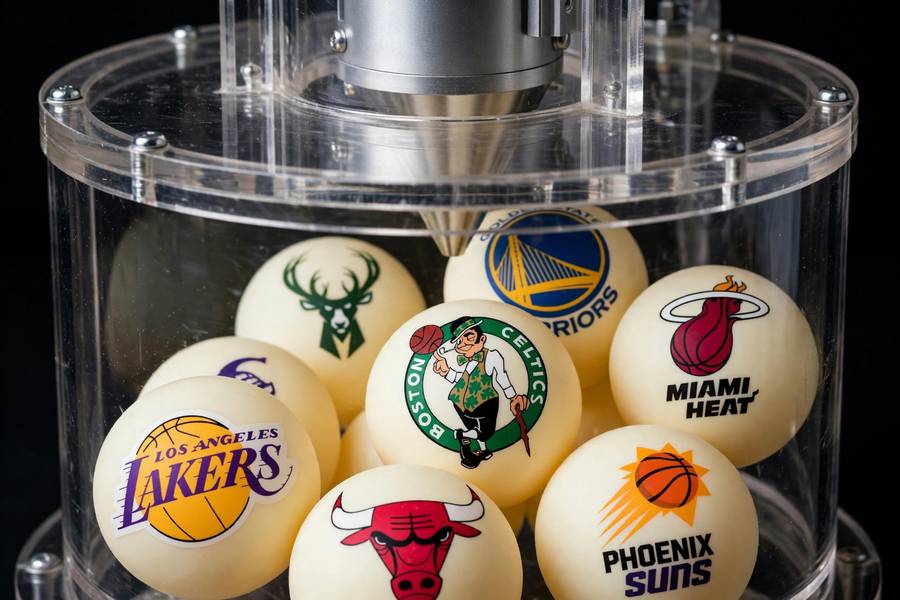
- Fourteen numbered ping-pong balls produce 1,001 possible four-ball combinations; one is discarded and the remaining 1,000 are assigned to teams in proportion to their odds.
- The drawings decide the top four picks in order; remaining lottery teams then slot 5–14 by reverse record.
- It happens in a private room weeks before the draft with team reps and auditors watching; results are revealed on TV in reverse order, envelope by envelope.
Why flatten the odds? The old system gave the worst team a 25 percent shot at number one — an open invitation to lose. The 2019 reform cut that nearly in half and extended the lottery to the top four picks. Tanking survives, but the math no longer rewards a race to the bottom like it did.
The frozen envelope. In 1985, the first lottery year, the Knicks won the top pick and took Patrick Ewing — and theorists have spent forty years insisting the envelope was chilled so the commissioner could identify it by touch. The league denies it; the video is inconclusive; the ghost story endures.
The Full Pick Order: Rounds 1 and 2
First round (picks 1–30):
- Picks 1–4: decided by the lottery.
- Picks 5–14: the remaining lottery teams, in reverse order of record (worst record picks earliest).
- Picks 15–30: the 16 playoff teams, in reverse order of regular-season record — the team with the worst record among playoff teams picks 15th, and the NBA champion picks 30th (last).
Second round (picks 31–60):
- The second round follows straight reverse order of regular-season record for all 30 teams — worst record picks 31st, champion picks 60th. No lottery.
Tiebreakers: When teams finish with identical records, the order is decided by random drawing.
Two notes: the worst-record team can fall no further than 5th, no matter the lottery luck. And playoff success is “punished” — win the title, pick last. Help flows to the teams that need it.

Trading Picks: The Stepien Rule and Protections
Draft picks are assets, and teams trade them constantly — sometimes years in advance. Two rules govern the market:
The Stepien Rule. Named for former Cavaliers owner Ted Stepien, whose team traded away five consecutive years of first-round picks in the early 1980s and cratered the franchise. The rule: a team cannot trade its first-round pick in consecutive future years. You can trade this year’s pick and the pick two years out, but never back-to-back future firsts. It exists so no owner can mortgage a franchise’s entire future in one desperate move.
Pick protections. Traded picks can carry conditions — “top-3 protected” means the original team keeps the pick if it lands in the top three, with the obligation rolling to a future year. It’s how teams trade picks without risking catastrophe, and why draft-night deals come with fine print.
Pick swaps let a team exchange its pick for another team’s if the other’s is higher. Second-round picks trade freely with no Stepien restrictions — which is why a dozen of them change hands on draft night for cash.
Drafts are won in the trade market: the Celtics turning assets into Jayson Tatum, the Mavericks maneuvering for Luka Dončić. The picks matter less than what smart front offices do with them.
Draft Night: How It Actually Unfolds
Draft night is part television show, part high-stakes poker game:
- The setting: an arena of prospects, families, and fans, the commissioner at the podium. Recent drafts have expanded to two nights — first round one night, second round the next.
- The clock: 5 minutes per first-round pick, 2 minutes in the second. Most picks are decided early; the time is for last-second trade calls.
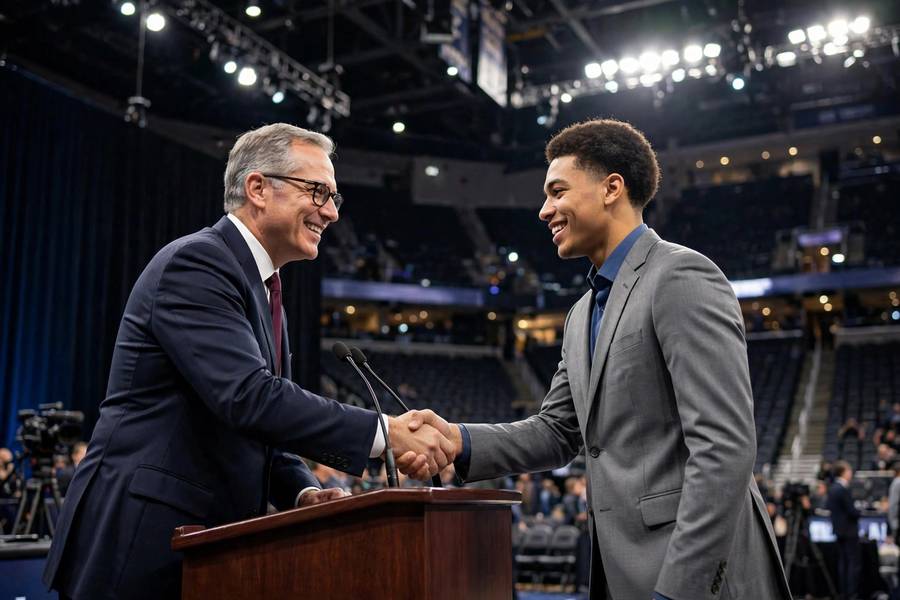
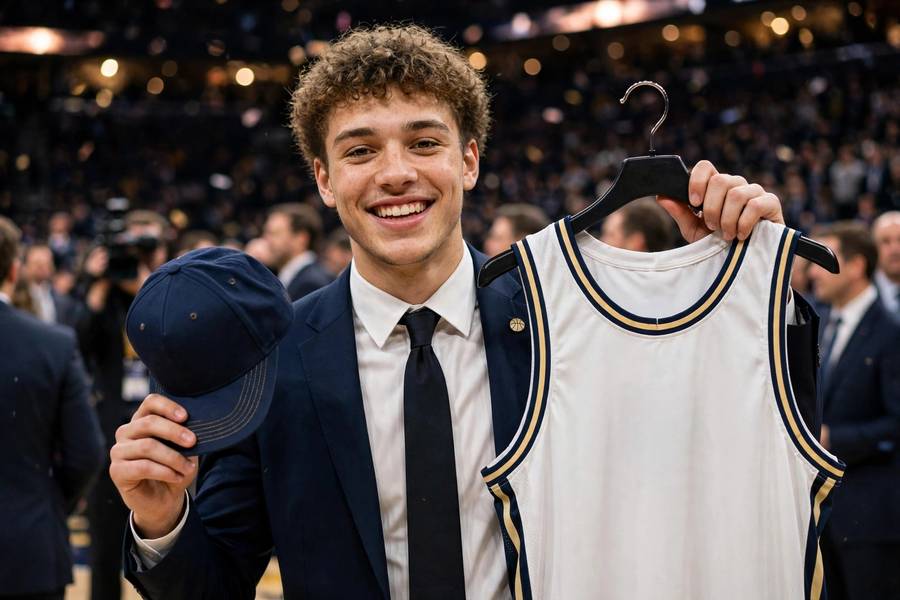
- The announcement: the commissioner (or a deputy) announces each pick: “[Player], [team] selects…” The player walks out, holds up the jersey, puts on the team cap, hugs the commissioner. The cap part is theater — about a third of first-round picks are traded within minutes, and the player already knows he’s going somewhere else.
- The trades: draft-night trades are announced as the picks happen. “The draft rights to [player]” get dealt constantly. Front offices are on the phones the entire night, and the big screens track a chaos of moving picks.
- The green room: top prospects wait on camera. Getting called early is glory; sliding down the board live is agony — every year a projected top-five pick is still sitting there at 12.
After the Draft: Contracts, Two-Ways, and Draft-and-Stash
Getting drafted is the start, not the finish:
- First-round picks get guaranteed rookie-scale contracts — a fixed salary slot by draft position, with team options for years three and four. The top pick makes roughly five times the 30th pick — about $12.3 million in year one for the #1 pick versus about $2.5 million for the 30th pick on the current rookie scale.
- Second-round picks get no guaranteed money — they fight for roster spots in summer league and camp. Some of the league’s best stories are second-rounders who outplayed their slot.
- Two-way contracts let teams carry extra developmental players who split time between the NBA club and its G League affiliate. Many second-round picks and undrafted players start here.
- Draft-and-stash: teams can draft an international prospect and leave him playing overseas, retaining his rights indefinitely. It’s how teams draft for the future without using a roster spot — the Spurs built a dynasty partly on well-timed stashes.
- Undrafted free agents sign as soon as the draft ends, and every year a few make rosters and stick.
A Short History of the Draft
1947: The first draft (then the BAA) — teams picked whoever they wanted, including players who never played a minute.
1966–1984: The coin-flip era — the worst teams in each conference flipped a coin for the top pick. Simple, and easy to game.
1985: The first lottery, and the frozen-envelope controversy that never died.
1989: The draft shrinks to two rounds (it had been as many as ten in the early days, then seven). Sixty picks became the permanent shape of draft night.
2003: The legendary class — LeBron, Melo, Bosh, Wade. The gold standard every class is measured against.
2023: Victor Wembanyama goes first to San Antonio, the most hyped prospect since LeBron — instantly justifying the Spurs’ “rebuilding” season.
The format keeps evolving — two nights, flattened odds, G League pathways — but the core idea hasn’t changed since 1947: the worst teams get first pick of the future. For another sport’s championship structure, see how the World Cup tournament format works — and for a single rule that shapes a sport’s tactics, the offside rule in soccer explained.
Frequently Asked Questions
The NBA Draft has two rounds of 30 picks (60 total). The 14 teams that miss the playoffs enter a weighted lottery that decides the top four picks; the rest of the first round and all of the second round follow reverse order of regular-season record. The worst teams pick earliest to promote competitive balance.
Fourteen ping-pong balls produce 1,000 numbered combinations, distributed among the 14 non-playoff teams by odds — the three worst teams each get 14 percent. Four drawings decide the top four picks in order; remaining lottery teams then slot 5–14 by record. The worst team can fall no further than fifth.
Players must be at least 19 during the draft’s calendar year and one NBA season removed from their high school class — the “one-and-done” rule. College players can declare early and withdraw by a deadline; international players are auto-eligible at 22. Undrafted players become free agents.
The Stepien Rule bars teams from trading their first-round draft pick in consecutive future years. Named for a former Cavaliers owner who traded five straight years of first-rounders, it prevents franchises from mortgaging their entire future in a single deal.
Two rounds, 30 picks each, for 60 total picks. The draft was reduced to two rounds in 1989 after previously running as many as seven to ten rounds. First-round picks receive guaranteed rookie-scale contracts; second-round picks must earn their roster spots.
A protected pick has conditions attached when traded — for example, “top-3 protected” means the original team keeps the pick if it lands in the top three, with the obligation rolling to a future year. Protections let teams trade picks while limiting their downside risk.