
Every July, for three weeks, the biggest annual sporting event on Earth takes over France — and most Americans barely notice. The Tour de France is professional cycling’s Super Bowl, World Cup, and Olympics rolled into one: 21 stages, roughly 3,500 kilometers (about 2,200 miles), and a level of physical suffering that’s genuinely hard to comprehend.
I’m Ryan, and I’ll be honest — I came to cycling late, through the drama of the mountain stages. Now I plan Julys around it. Here’s everything you need to understand what you’re watching.
Table of Contents
- The Tour in One Paragraph
- The Format: 21 Stages Over 23 Days
- The Types of Stages
- The Jerseys: What the Colors Mean
- How Teams Work (It’s a Team Sport, Really)
- The Mountains: Where Legends Are Made
- Time Trials
- The Finish in Paris
- Frequently Asked Questions
The Tour in One Paragraph
The Tour de France is a 21-stage bicycle race held every July, covering about 3,500 km across France (and sometimes neighboring countries). Around 176 riders start, organized into teams of 8. The rider with the lowest total time across all stages wins the yellow jersey. It’s been running since 1903, it’s watched by an estimated 150 million TV viewers worldwide, and roughly 12 million spectators line the roads each year — making it the world’s largest free-to-attend sporting event.
The Format: 21 Stages Over 23 Days
The race runs for 23 days with 2 rest days built in — usually after the first week and after the second week, timed around the transfers between regions.
Each day is a stage — essentially one day’s race, with its own winner. But the overall winner (the yellow jersey) is decided by cumulative time across all 21 stages. You don’t have to win a single stage to win the Tour — you just need the lowest total time. Consistency beats flashes of brilliance.
Riders who finish each stage within the time limit continue; those who abandon (crashes, illness, exhaustion) are out. Typically 130–150 of the 176 starters make it to Paris.
The Types of Stages
A Tour route is deliberately varied — that’s the whole point. Different stages favor different riders:
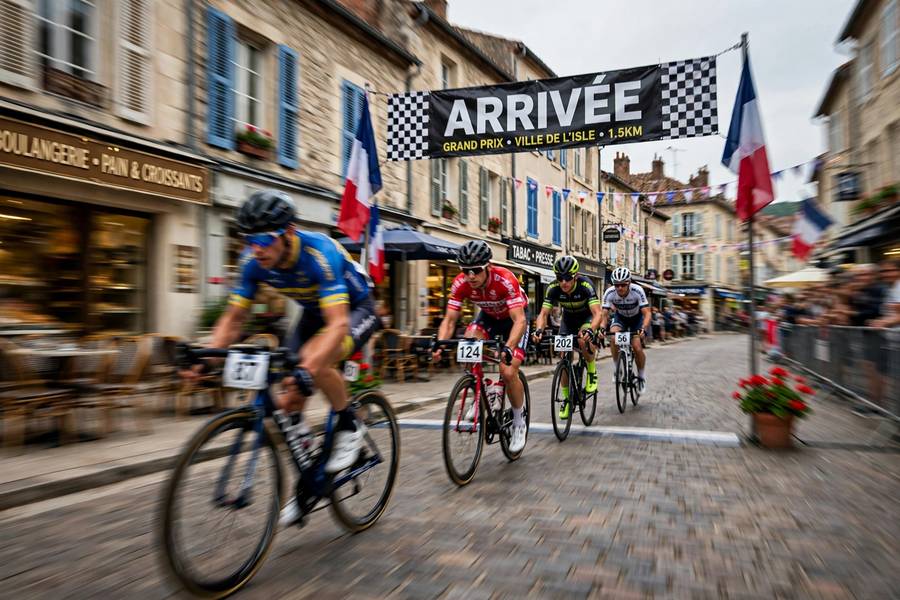
Flat stages: Long, fast days across plains and valleys. These end in bunch sprints — 60+ riders hurtling toward the line at 70 km/h. Chaotic, dangerous, spectacular. Sprinters live for these.
Hilly/medium-mountain stages: Rolling terrain with smaller climbs. Breakaways often succeed here — a small group escapes early and (sometimes) holds off the chasing peloton. Unpredictable and tactically rich.
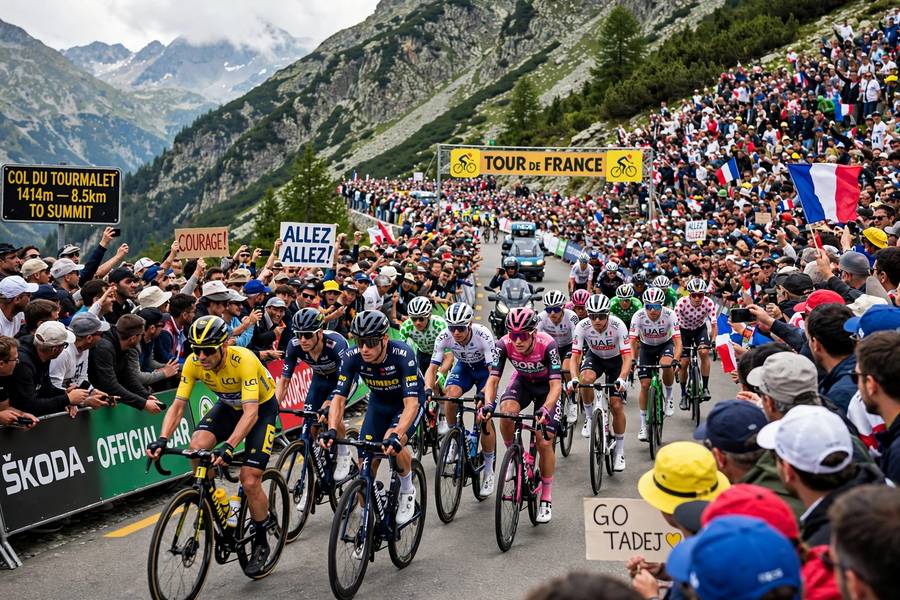
Mountain stages: The legendary days. Multiple massive climbs in the Alps or Pyrenees — ascents like Alpe d’Huez (21 hairpin bends), Mont Ventoux (a moonscape above the treeline), and the Col du Tourmalet. This is where the overall race is usually decided and where the strongest riders in the world are revealed.
Individual time trials: Riders race alone against the clock over a set course. No drafting, no teammates, no hiding — just rider versus road. Time trials often decide close Tours.
Team time trials (not every year): The whole team races together against the clock. Beautiful to watch, brutal to ride.
The Jerseys: What the Colors Mean
The Tour awards four distinctive jerseys, worn each day by the leader of each classification:
Yellow jersey (maillot jaune): The big one. Worn by the rider with the lowest overall time — the leader of the general classification. Winning the Tour means wearing yellow into Paris on the final day. It’s the most famous jersey in sports.
Green jersey: The points classification — essentially the sprinters’ championship. Riders earn points for high stage finishes and intermediate sprints. The green jersey usually goes to the best sprinter, though all-rounders can contend.
Polka dot jersey: The King of the Mountains. Points are awarded at the top of categorized climbs, with harder climbs worth more. The polka dot jersey goes to the best climber — often a wiry specialist who suffers gloriously in the high mountains.
White jersey: Best young rider — the highest-placed rider under 26 in the overall standings. It’s the “future star” award, and past winners read like a who’s-who of cycling greatness.
A rider can hold multiple classifications, but only wears one jersey per day (priority: yellow > green > polka dot > white), with the next-placed rider wearing the others.
How Teams Work (It’s a Team Sport, Really)
This surprises newcomers: cycling looks individual, but the Tour is deeply a team sport. Each team has 8 riders with specialized roles:
- The leader (GC contender): The team’s best overall rider, protected by everyone else. The whole team works for this rider’s yellow jersey chances.
- Domestiques: The workers. They fetch water bottles, set the pace, chase down breakaways, and shelter their leader from the wind. “Domestique” means “servant” in French — the name tells you everything about the selflessness required.
- Sprinters: Specialists who contest flat-stage finishes, with teammates (the “lead-out train”) delivering them to the final 200 meters.
- Climbers: Mountain specialists who support the leader in the high mountains or chase stage wins and the polka dot jersey.
Drafting is the physics that makes teamwork essential: riding behind another rider saves up to 30% of your energy. The peloton — the main pack — is an exercise in collective energy conservation, and teams manipulate it like a chess piece.
The Mountains: Where Legends Are Made
The mountain stages are the Tour’s soul. Climbs are categorized from 4 (easiest) to 1, with hors catégorie (“beyond category”) reserved for the monsters — climbs so hard they break the rating system.
What makes the mountains special:
- The crowds. Hundreds of thousands of fans line the climbs, running alongside riders (sometimes too close), creating a wall of noise. It’s unlike any atmosphere in sports.
- The suffering is visible. You can see exactly how hard it is — faces contorted, bodies rocking. There’s no hiding on a mountain.
- Tactics explode. Teams attack, rivals crack, minutes are gained and lost. A rider can lose the Tour on a single climb.
Alpe d’Huez, with its 21 numbered hairpins, is the most famous climb in cycling — part race course, part pilgrimage site, with the names of past stage winners painted on every bend.
Time Trials
The “race of truth.” One rider, one bike, one clock. Time trials strip away drafting and teamwork — it’s pure power and aerodynamics. Riders use special TT bikes, skinsuits, and helmets that look like something from science fiction.
A long time trial late in the race has decided many Tours. The dynamic is delicious: the climber who’s been gaining time in the mountains versus the time trialist who claws it back against the clock. Two completely different athletes, one yellow jersey.
The Finish in Paris
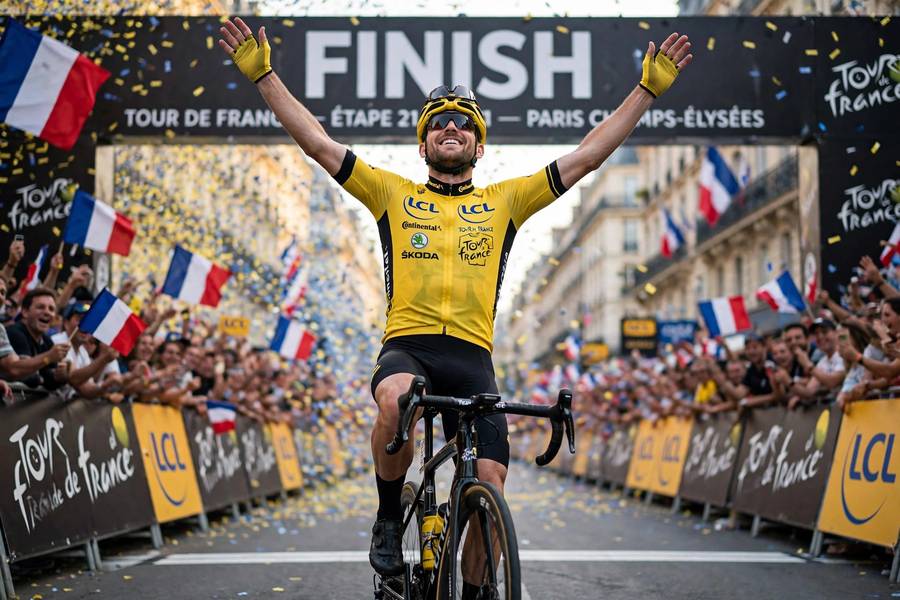
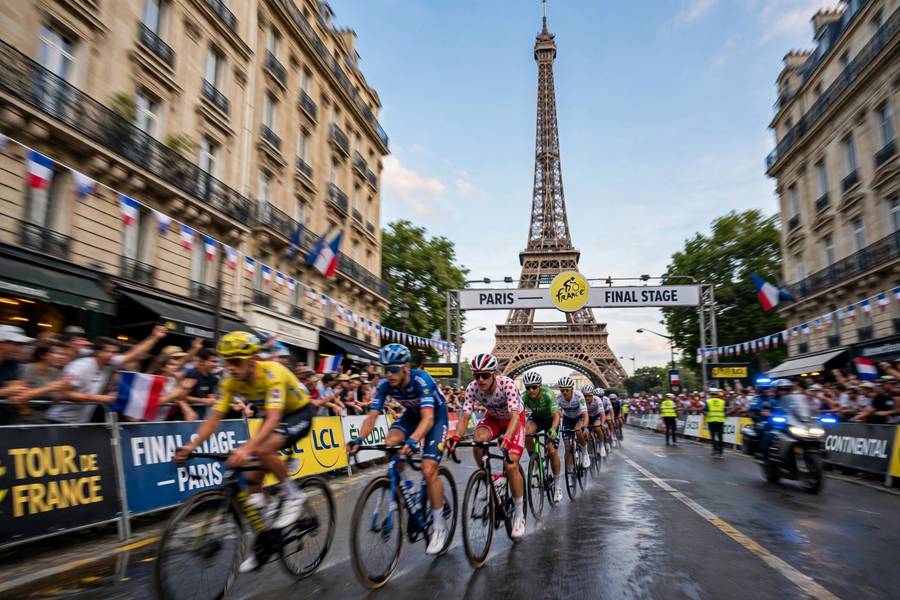
The final stage always ends on the Champs-Élysées in Paris — multiple laps of the most famous boulevard in the world, finishing in a sprint beneath the Arc de Triomphe.
By tradition, the final stage is ceremonial until the Paris circuits begin: the yellow jersey winner isn’t attacked, the teams pose for photos, champagne is sometimes sipped on the bike. Then, once they hit Paris, the sprinters’ teams take over and it’s a full-gas race to the line.
The overall winner is confirmed, the jerseys are awarded on the podium, and three weeks of the hardest racing in sports comes to an end — until next July.
Keep reading: if this helped, you’ll also like how the World Cup works, golf scoring — I wrote them in the same plain-English style.
Frequently Asked Questions
The Tour de France is professional cycling’s biggest race: 21 stages over 23 days each July, covering about 3,500 km. Around 176 riders compete, and the rider with the lowest total time wins the yellow jersey.
The Tour lasts 23 days (21 racing stages plus 2 rest days) and covers roughly 3,500 kilometers (about 2,200 miles) across France and occasionally neighboring countries.
The yellow jersey is worn by the rider with the lowest cumulative time across all stages — the overall race leader. The rider wearing yellow into Paris on the final stage wins the Tour de France.
Yellow (lowest overall time), green (most sprint points), polka dot (best climber / King of the Mountains), and white (best rider under 26). A rider wears only one per day, with priority going yellow, then green, polka dot, white.
No — the overall winner is decided by lowest total time across all 21 stages, not by stage wins. A rider can win the Tour without winning a single stage through consistent high finishes.
Because drafting behind other riders saves up to 30% of a rider’s energy. Teams use domestiques to shelter their leader from the wind, chase breakaways, set the pace, and deliver sprinters to the finish — the leader’s victory is a team achievement.