

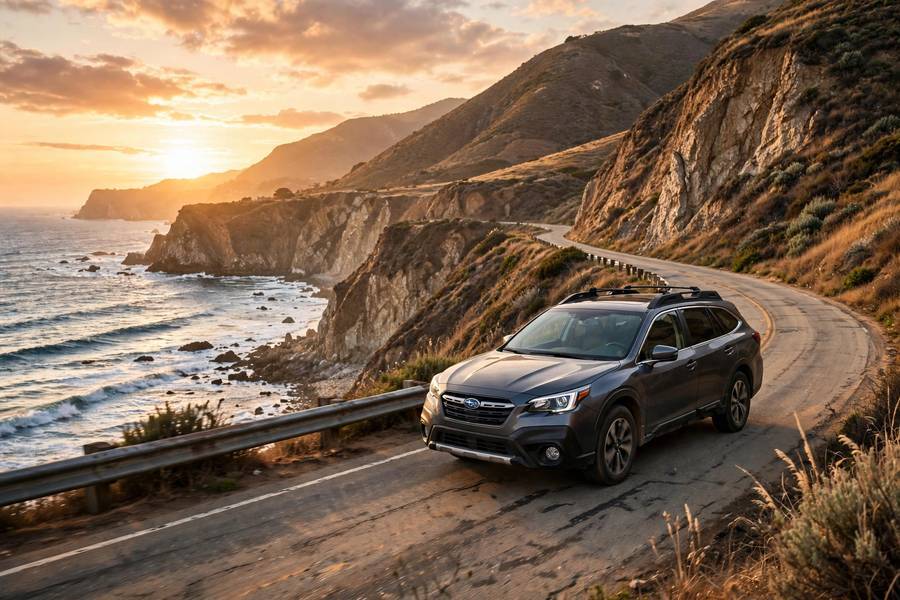
America is a country best understood at 65 miles per hour with the windows down. I’ve driven the Pacific Coast Highway with salt on the windshield, crossed the desert Southwest with the AC fighting a losing battle, and done the Blue Ridge Parkway in peak fall color with the windows down just to smell it. The road trip is America’s native art form, and these ten routes are its masterpieces.
This isn’t a list of highways. It’s a list of drives where the road itself is the destination — where you’ll pull over a dozen times a day because you have to, not because the guidebook said so.
Table of Contents
- How to Choose Your Route
- The Classics
- Coastlines
- Mountains and Deserts
- The Scenic Byways
- Road Trip Essentials
How to Choose Your Route
Before the list, a framework. The best road trip for you depends on three things:
- Time: A long weekend opens up 500–800 miles comfortably. A week opens up 1,500+. Don’t try to compress — the biggest rookie mistake is routing 3,000 miles into seven days and seeing everything through glass.
- Season: Fall color in the Appalachians (October), desert Southwest in spring/fall (avoid summer’s furnace), Pacific Coast nearly year-round, northern routes June–September.
- Temperament: Do you want kitsch and diners (Route 66), wilderness (Alaska Highway), or coastline (PCH)? There’s no wrong answer, but the vibe differs enormously.
My standing advice: fewer miles, more stops. The slow travel mindset applies double on the road — the trip is the stops, not the odometer.
The Classics
1. Route 66: Chicago to Santa Monica (2,400 miles)
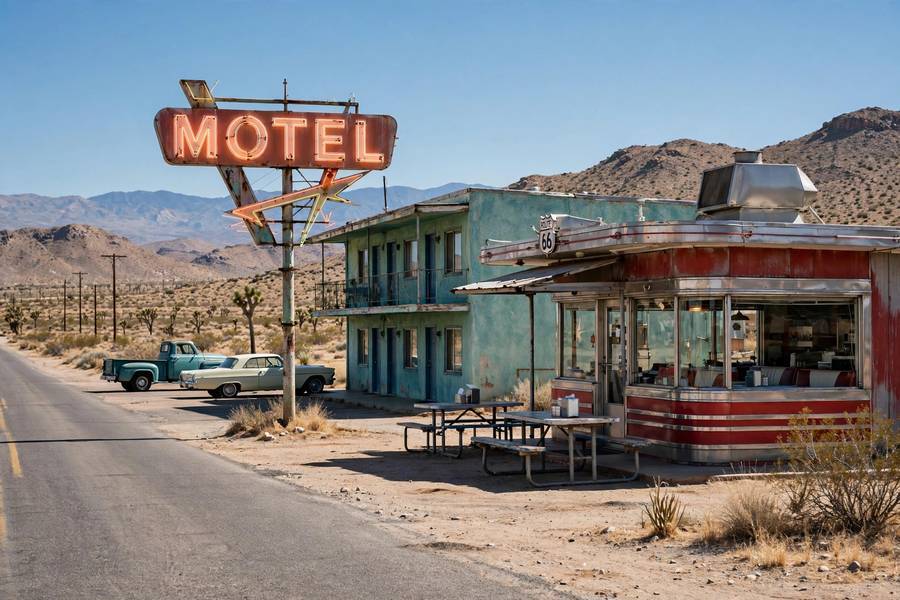
The Mother Road. Two thousand four hundred miles of neon signs, giant blue whales, Cadillac ranches, and diners where the coffee is bottomless and the pie is homemade. It’s not the fastest way across America — that’s the point. The interstate bypassed these towns decades ago, and what’s left is a living museum of roadside Americana.
Do it right: Allow 2–3 weeks. The best stretches are in Oklahoma, Texas, New Mexico, and Arizona — the Midwest opening is skippable if you’re short on time. Stay in the vintage motels (the Blue Swallow in Tucumcari, the Wigwam in Holbrook). Talk to people — Route 66 runs on characters.
2. Pacific Coast Highway: San Francisco to Los Angeles (450 miles)
Highway 1 along Big Sur is the most beautiful stretch of pavement in America — cliffs plunging into the Pacific, the Bixby Bridge arcing over a cove, sea mist burning off by noon. Drive it north to south so you’re on the ocean side of the road.
Do it right: Two to three days minimum. Stop at every turnout that tempts you (there will be dozens). Eat at Nepenthe in Big Sur. Check road conditions before you go — landslides periodically close sections, and detours are long.
Coastlines
3. Overseas Highway: Miami to Key West (113 miles)
Short, sweet, and surreal — 42 bridges hopping across turquoise water to the southernmost point in the continental US. The Seven Mile Bridge, with ocean on both sides to the horizon, is one of the great driving experiences anywhere.
Do it right: It’s a day trip, but make it an overnighter in Key West. Sunset at Mallory Square, key lime pie everywhere, and the gloriously weird energy of Duval Street.
4. Oregon Coast: Astoria to Brookings (340 miles)
The underrated coast. Rugged sea stacks, moody lighthouses, Tillamook cheese, and the famous Goonies rock at Cannon Beach. Less traffic than California, wilder scenery, and some of the best chowder on the planet.
Do it right: Three days. Stop at every state park viewpoint — they’re frequent and free. The stretch between Newport and Florence, through the dunes, is spectacular.
Mountains and Deserts
5. Blue Ridge Parkway: Virginia to North Carolina (469 miles)
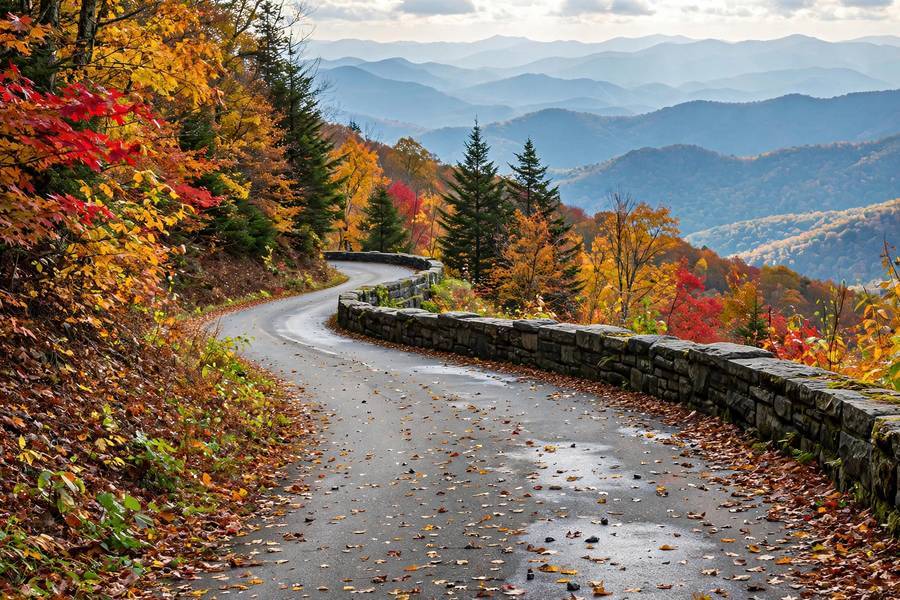
America’s favorite drive, and it earns it — especially in October, when the hardwoods ignite in red and gold. No commercial traffic, no billboards, just 469 miles of ridgeline cruising through the Appalachians, connecting Shenandoah and Great Smoky Mountains National Parks.
Do it right: Go midweek in fall to dodge the leaf-peeper traffic. The speed limit is 45 mph — this is a drive to savor, not to make time on. Pack layers; elevation changes mean temperature swings.
6. The Desert Southwest Loop: Las Vegas → Zion → Bryce → Arches → Monument Valley (900 miles)
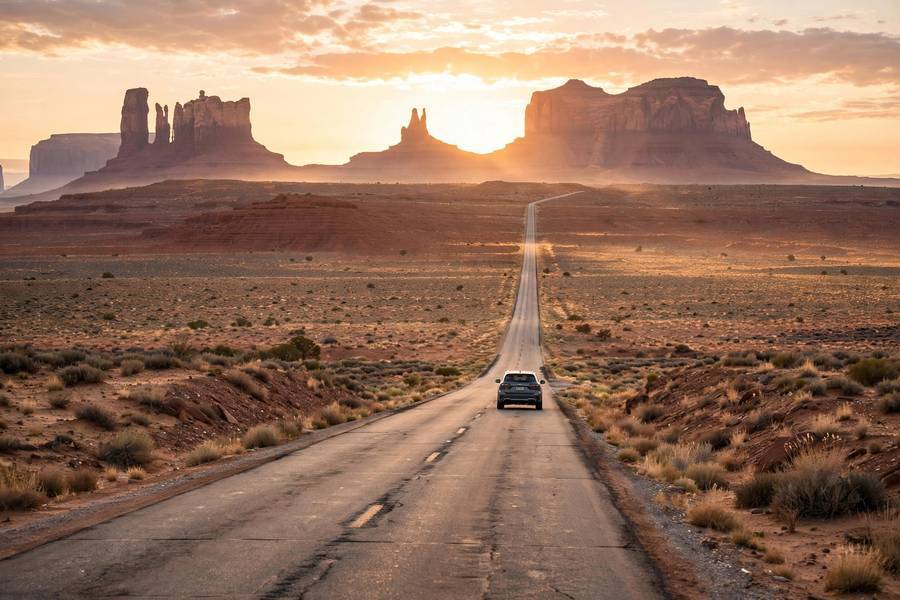
The Mighty Five national parks of Utah plus the Grand Canyon and Monument Valley — the densest concentration of mind-bending geology on earth. Red rock arches, slot canyons, hoodoos, and desert skies so dark the Milky Way casts shadows.
Do it right: 7–10 days, spring or fall (summer is dangerously hot for hiking). Book park lodging far ahead. This is the trip that converts people into national park obsessives.
7. Beartooth Highway: Montana to Wyoming (68 miles)
The shortest drive on this list and maybe the most dramatic per mile — 68 miles of switchbacks climbing to 10,947 feet, crossing from Montana into Yellowstone’s northeast entrance. Snow walls in June, alpine wildflowers in July, and views that make you pull over laughing.
Do it right: It’s only open roughly Memorial Day to mid-October (snow-dependent). Combine with Yellowstone and Grand Teton for the ultimate mountain week.
The Scenic Byways
8. Natchez Trace Parkway: Nashville to Natchez (444 miles)
The contemplative road trip. A two-lane parkway following an ancient Native American trail through Tennessee, Alabama, and Mississippi — no trucks, no billboards, just rolling green hills, waterfalls, and Civil War and prehistoric sites. It’s the antidote to interstate hypnosis.
Do it right: Three unhurried days. The Cypress Swamp at mile 122, the ghost town of Rocky Springs, and the live music waiting in Nashville and Natchez at either end.
9. Alaska Highway: Dawson Creek to Delta Junction (1,387 miles)
The adventure. Nearly 1,400 miles through British Columbia and the Yukon to Alaska — bears, hot springs (Liard River is the classic stop), the Sign Post Forest at Watson Lake, and a frontier feeling that’s getting rare. This is the road trip as expedition.
Do it right: Two weeks minimum, June to August. Carry a spare tire, extra fuel awareness (stations are sparse), and a sense of humor about gravel sections and construction delays. The journey genuinely is the destination here.
10. Hill Country and Big Bend: Texas (600-mile loop)
Texas’s secret: the Hill Country’s spring wildflowers (late March–April bluebonnet season is unreal), Fredericksburg’s German-Texan wineries, and then west to Big Bend — one of America’s least-visited, most soul-stirring national parks, where the desert meets the Rio Grande under the darkest skies in Texas.
Do it right: A week. Go in spring for wildflowers or fall/winter for Big Bend hiking (summer is brutal). Book Big Bend lodging early — it’s remote and limited.
Road Trip Essentials
The unglamorous stuff that makes or breaks a road trip:
- The car: Rental or your own, get something comfortable with good mileage. Check the spare tire and know how to use it. For remote routes (Alaska, desert Southwest), carry extra water — a gallon per person per day.
- Navigation: Download offline maps. Cell service dies in the mountains and desert, exactly where you need directions most.
- Snacks and water: A cooler with drinks and real food beats gas-station roulette. Some of my best road trip memories involve a scenic turnout and a grocery-store picnic.
- Lodging strategy: Book the must-stays (national park lodges, popular towns in season); wing the rest. Small-town motels are part of the experience.
- Music and podcasts: Download playlists and podcast series before you lose signal. A road trip without a soundtrack is just driving.
- Flexibility: The best road trip moments are unplanned — the roadside pie stand, the hot spring someone mentions, the detour that becomes the highlight. Leave room for them.
For the packing side, my international travel packing guide covers the systems that work just as well on four wheels.
Frequently Asked Questions
The Pacific Coast Highway (San Francisco to Los Angeles) is the ideal first road trip — short enough for a long weekend, spectacular throughout, with easy logistics and no remote-driving stress. Route 66 is the classic choice if you have 2-3 weeks.
Plan 200-300 miles per day on scenic routes (4-6 hours of driving with stops), up to 400-500 on interstates when covering ground. The golden rule: fewer miles and more stops beats marathon driving — you’ll remember the turnouts, not the odometer.
Late spring (May-June) and early fall (September-October) are ideal for most routes — good weather, thinner crowds, open mountain passes. Avoid the desert Southwest in summer and northern mountain routes before Memorial Day or after mid-October.
Budget roughly $150-250 per day for two people sharing costs: $80-150 for motels/hotels, $40-60 for food, $30-50 for gas, plus park fees and activities. Camping and cooking cut this dramatically; park lodges and restaurants raise it.
Drive your own for trips under ~2,000 miles if it’s reliable and comfortable — familiarity matters on long drives. Rent for longer trips (saves wear), one-way routes (avoid backtracking), or if you want something more suitable like an SUV for mountain/desert routes.
A cooler with drinks and snacks, offline maps downloaded, a paper atlas as backup, a basic emergency kit (jumper cables, spare tire knowledge, flashlight), layers for elevation and weather changes, and a dedicated “car bag” with everything you need without unpacking — sunscreen, chargers, wipes, and trash bags.