
I’m Marcus. A customer once watched a PDR technician erase a golf-ball-sized dent from her door in twenty minutes — no paint, no filler, no body shop stay — and she looked at me like we’d performed witchcraft. Honestly? It’s close. Paintless dent repair (PDR) is one of the most impressive skills in the auto trade, and most car owners have no idea it exists until they need it.
If your car has a dent and the paint isn’t broken, PDR is almost always the best fix: cheaper, faster, and better than traditional body work. Here’s exactly what it is, how it works, and where its limits are.
In This Guide
- What Paintless Dent Repair Actually Is
- How PDR Works: The Techniques
- Which Dents Qualify for PDR
- What PDR Costs
- PDR vs Traditional Body Shop Repair
- The Limits: When PDR Can’t Help
- How to Find a Good PDR Technician
- Frequently Asked Questions
What Paintless Dent Repair Actually Is
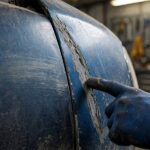
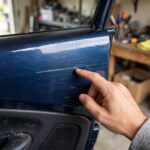
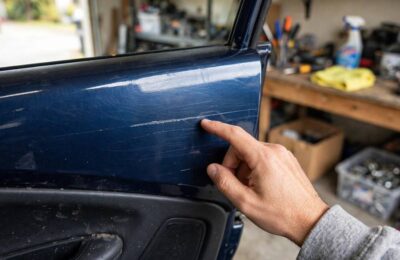
Paintless dent repair is the art of massaging dented sheet metal back to its original shape from behind the panel — without sanding, filling, or repainting anything. The technician accesses the backside of the dented panel and uses specialized tools to push the metal back out, working gradually until the panel’s original contour is restored.
The key insight: modern car paint is flexible. Factory paint can stretch and return without cracking through moderate deformation. So if the impact dented the metal but didn’t break the paint, a skilled technician can reverse the dent while the original factory paint — with its perfect color match and corrosion protection — stays completely intact.
That last part is the real value. Factory paint is applied in controlled conditions with corrosion treatments no body shop can fully replicate. Preserving it matters, especially on newer or higher-value cars.
How PDR Works: The Techniques
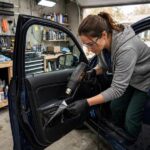
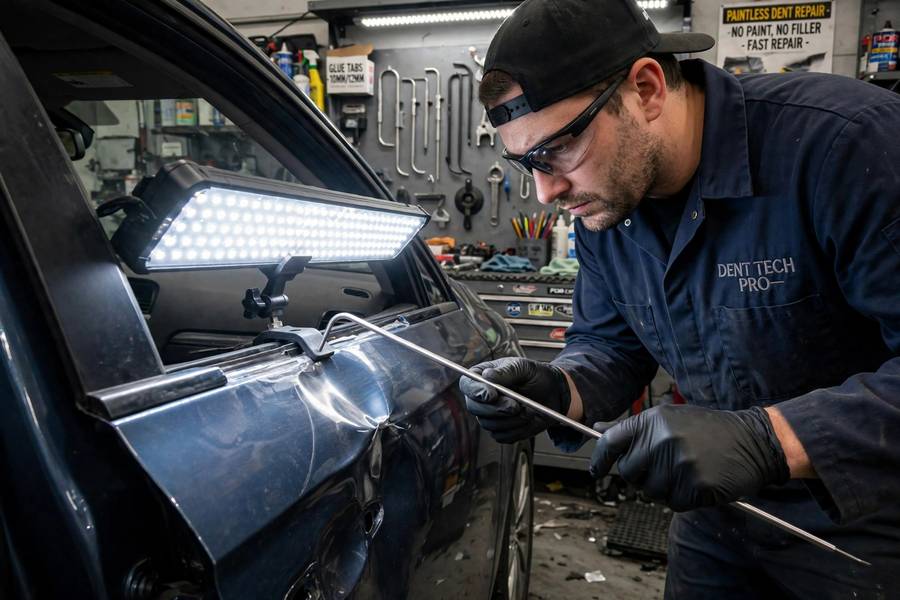
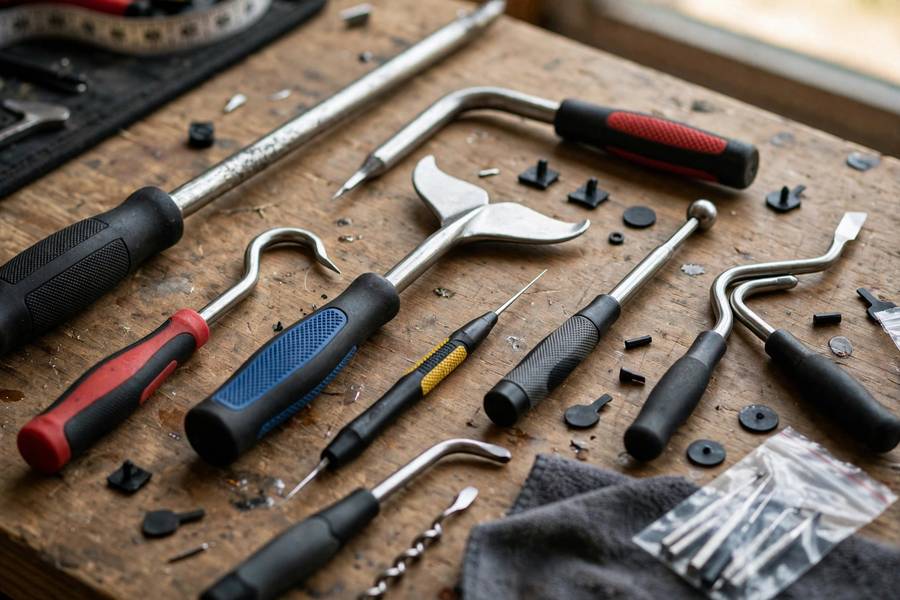
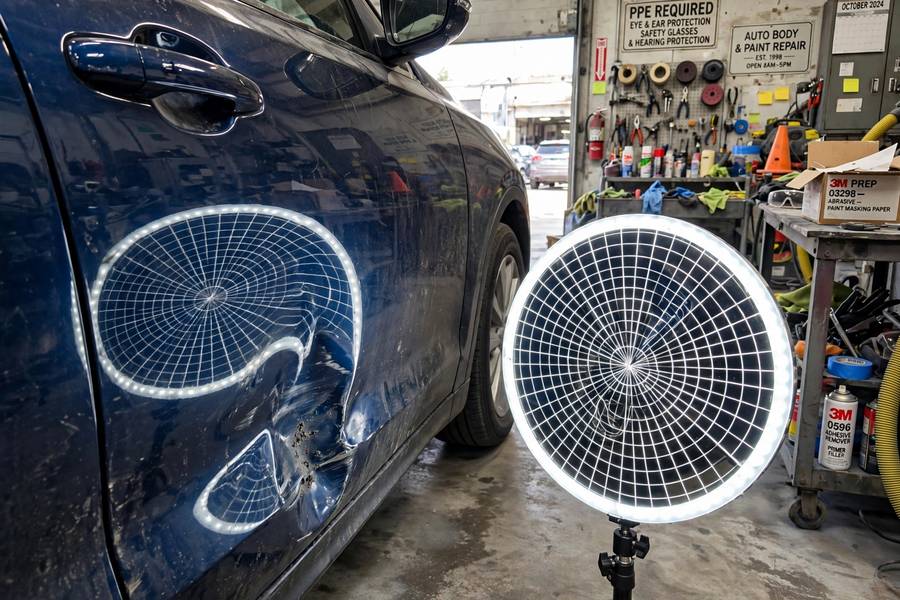
Push-from-behind (the classic method). The technician removes interior trim or accesses the panel through existing openings, then uses long metal rods with various tip shapes to apply precise pressure to the backside of the dent. Working under special LED reflection lighting that reveals every ripple, they push the low spots up gradually — dozens or hundreds of tiny pushes, constantly checking progress in the reflected light. It’s slow, methodical work that looks like nothing and accomplishes everything.
Glue pulling. When the backside isn’t accessible (double-walled panels, some roof rails), the technician glues a pulling tab to the outside of the dent and uses a slide hammer or lifter to pull the metal outward. Modern glue-pull systems are remarkably effective and have expanded what PDR can fix.
Tap-down work. After pushing, tiny high spots remain. The technician uses a specialized tap-down tool and hammer to level these micro-highs, blending the repair invisibly into the surrounding panel.
A good PDR repair is genuinely undetectable — I’ve run my hands over finished PDR work and been unable to find where the dent was. The skill ceiling is extraordinarily high; the difference between an average tech and a master is the difference between “pretty good” and “invisible.”
Which Dents Qualify for PDR
The ideal PDR candidates:
- Door dings from parking lots — the bread and butter of PDR
- Hail damage — PDR was practically built for this; a skilled tech can clear dozens of hail dents
- Shopping cart impacts and minor bumper taps
- Basketball, hail, and falling-object dents on hoods, roofs, and trunk lids
- Crease dents (within limits — sharp creases are harder)
The qualifying conditions matter more than the cause:
- Paint must be intact. No cracking, chipping, or scratching through the paint at the dent site. If the paint broke, PDR alone can’t fix it.
- The dent can’t be on a body line edge — or rather, it can, but it’s much harder and results vary. Flat and gently curved areas are ideal.
- The metal can’t be stretched too far. Deep, sharp dents stretch the metal beyond what can be shrunk back. Shallow, smooth dents are perfect.
- No prior body filler in the area. PDR can’t push filler.
When in doubt, a reputable PDR tech will tell you honestly whether your dent qualifies — the good ones turn away work they can’t make invisible.
What PDR Costs
PDR pricing is refreshingly straightforward compared to body shop estimates:
- Small door ding (quarter-sized): $75–$150
- Medium dent (golf ball to tennis ball): $150–$250
- Large dent (softball+): $250–$400
- Hail damage: $2,000–$5,000+ for a whole car, but usually covered by comprehensive insurance
Most single dents fall in the $100–$250 range and take 30 minutes to 2 hours. Compare that to a traditional body shop: $500–$1,500+ for the same dent, with your car gone for days and aftermarket paint that may never match perfectly.
Many PDR technicians are mobile — they come to your home or office with their tools and lighting. The convenience factor is real: dent fixed in your driveway during your lunch break.
PDR vs Traditional Body Shop Repair
| Factor | PDR | Traditional body shop |
|---|---|---|
| Original paint preserved | Yes | No — panel gets repainted |
| Typical cost (single dent) | $75–$300 | $500–$1,500+ |
| Time | 30 min – 2 hours | 2–5 days |
| Color match risk | None | Possible mismatch |
| Carfax/vehicle history impact | None | May show as accident repair |
| Works on | Dents with intact paint | Everything, including paint damage |
The vehicle-history point deserves emphasis: insurance-claimed body shop repairs can appear on vehicle history reports and affect resale value. PDR typically involves no claim and no record — the car simply looks like it was never dented, because as far as the metal and paint are concerned, it wasn’t.
The Limits: When PDR Can’t Help
Honest limits, from someone who refers work to PDR techs weekly:
- Broken paint. If the impact cracked or chipped the paint, PDR can’t restore the finish. You’ll need traditional repair.
- Very sharp creases. A hard crease through a body line may improve 80–90% but not reach invisible. A good tech will tell you this upfront.
- Stretched metal. Deep impacts stretch metal beyond recovery — pushing it back leaves ripples.
- Aluminum panels. Many modern hoods and trunk lids are aluminum, which doesn’t “remember” its shape like steel and is harder to work. PDR on aluminum is possible but more difficult and sometimes not advisable.
- Dents on edges and seams. Extremely limited access and structural rigidity make these poor candidates.
- Previous repairs. Body filler doesn’t push — if the area was filled before, PDR is off the table.
None of these are the technician’s fault — they’re physics. The mark of a good PDR tech is declining the jobs that won’t come out right.
How to Find a Good PDR Technician
PDR is a skill trade with no meaningful licensing, so vetting matters:
- Ask for before/after photos of similar dents. Experienced techs have portfolios.
- Check reviews specifically mentioning dent types like yours (hail, door dings, creases).
- Get the assessment in person. Reputable techs want to see and feel the dent before quoting — anyone quoting blind is guessing.
- Ask what they can’t fix. A tech who cheerfully claims to fix everything is a tech who’ll take your money and deliver 70%.
- Hail specialists often travel storm routes seasonally — some of the best in the business follow the weather.
While you’re getting the dent sorted, it’s a good moment for a broader once-over — the kind of basic car competence that includes things like how to jump start a car and cosmetic upkeep like how to clean car headlights. Small maintenance habits compound.
Paintless dent repair is the best deal in auto body work: your original factory paint preserved, the dent genuinely gone, a fraction of the cost, and your car back the same day. If your dent has intact paint, call a PDR tech before you call a body shop. You’ll likely save hundreds and get a better result.
Frequently Asked Questions
Paintless dent repair (PDR) is a technique for removing dents by massaging the sheet metal back to its original shape from behind the panel, without sanding, filling, or repainting. It preserves the factory paint and costs far less than traditional body shop repair.
Most single dents cost $75–$300 depending on size: small door dings run $75–$150, medium dents $150–$250, and large dents $250–$400. Hail damage for a whole car runs $2,000–$5,000+ but is usually covered by comprehensive insurance. Most repairs take 30 minutes to 2 hours.
No. PDR requires intact paint — if the impact cracked or chipped the paint, traditional repair is needed. Very sharp creases, deeply stretched metal, dents on panel edges, aluminum panels, and areas with previous body filler are also poor candidates or impossible.
No — that’s the entire point. PDR works the metal from behind without touching the paint surface (except in glue-pull methods, which use removable adhesive). The factory paint, with its perfect color match and corrosion protection, stays completely intact.
Typically no. PDR usually involves no insurance claim and no body shop record — it’s a cosmetic correction, not an accident repair. This is one of its advantages over traditional body work, which can appear on reports like Carfax and affect resale value.