
I’m Jonathan. If you’re exploring franchising, the franchise fee is the first number you’ll encounter — and one of the most misunderstood. It’s not a purchase price. It’s not a deposit. It’s essentially an admission ticket: a one-time payment for the right to join the system, use the brand, and receive initial training and support.
But “what’s included” varies enormously between a $15,000 home-services franchise and a $2 million fast-food buildout. Here’s the complete breakdown.
In This Guide
- The Franchise Fee Defined
- What the Initial Fee Typically Covers
- Typical Fee Ranges by Industry
- Initial Fee vs Ongoing Royalties
- Other Fees Beyond the Franchise Fee
- Is the Fee Worth It? How to Judge
- Negotiating and Red Flags
- Frequently Asked Questions
The Franchise Fee Defined
The franchise fee (also called the initial franchise fee) is a one-time, upfront payment you make to the franchisor when you sign the franchise agreement. It buys you:
- The license to operate under the brand name and trademarks
- Access to the operating system — the manuals, processes, and know-how
- Initial training for you and key staff
- Launch support — site selection help, grand-opening marketing, initial setup guidance
- A defined territory (in most systems)
Critically, the fee is generally non-refundable. Once paid, it’s gone whether you open successfully or not. That fact alone should make you diligent — which is the theme of this entire article.
The fee is disclosed in Item 5 of the Franchise Disclosure Document (FDD), which franchisors must legally provide. If anyone quotes you a fee verbally that differs from the FDD, the FDD governs.
What the Initial Fee Typically Covers
What’s bundled into the fee varies by franchisor, but commonly includes:
- Brand license for the agreement term (usually 5–10 years)
- Training program — typically 1–4 weeks at headquarters plus on-site launch support
- Operations manual access — the complete playbook
- Site selection assistance and lease negotiation guidance
- Grand opening marketing package and initial advertising support
- Technology setup — POS systems, software licenses, initial configuration
- Initial inventory or supplies (in some systems; often separate)
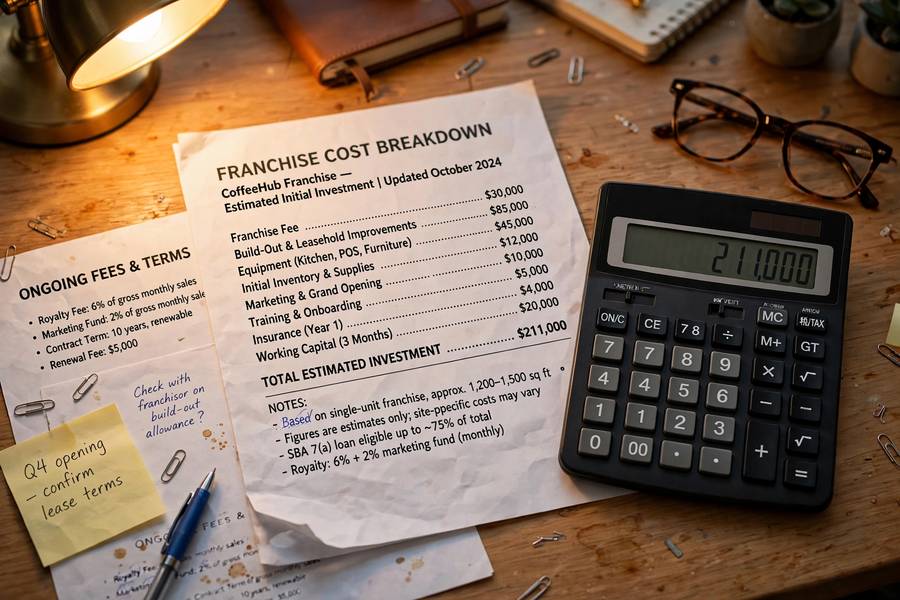
What’s usually not included: the physical buildout, equipment, real estate, working capital, and ongoing supplies. Those fall under “total initial investment” — a much bigger number. The franchise fee is just the entry ticket; the full investment is the whole trip.
Many franchises come with built-in inventory systems so you are not figuring out stock control from scratch.
Typical Fee Ranges by Industry
Fees correlate with brand strength and buildout complexity:
- Home services (cleaning, lawn care, handyman): $15,000–$40,000 fee; $50,000–$150,000 total investment. Low overhead, often home-based to start.
- Fitness (boutique gyms, 24-hour clubs): $30,000–$60,000 fee; $200,000–$500,000+ total. Equipment-heavy.
- Food — quick service: $30,000–$50,000 fee for emerging brands; $500,000–$2M+ total investment. Major brands (McDonald’s et al.) command higher fees and far higher buildout costs.
- Food — full service / fast casual: $40,000–$60,000 fee; $500,000–$1.5M total.
- Retail: $25,000–$50,000 fee; $150,000–$400,000 total depending on footprint.
- Senior care / healthcare services: $40,000–$60,000 fee; $100,000–$200,000 total. Often non-medical (no facility required).
- Education / tutoring: $25,000–$45,000 fee; $100,000–$250,000 total.
These are 2026 ballparks — always verify against the current FDD. And remember: the fee is the smallest check you’ll write. The total investment is what determines whether you can afford the opportunity.

Initial Fee vs Ongoing Royalties
Newcomers conflate these; they’re entirely different:
- Franchise fee: one-time, upfront, non-refundable. Pays for entry, training, and launch.
- Royalties: ongoing, typically 4–8% of gross revenue (not profit), paid weekly or monthly for the life of the agreement. This is the franchisor’s recurring income — and your permanent cost.
The royalty is the more important number long-term. A $30,000 fee amortized over 10 years is $3,000/year. A 6% royalty on $800,000 annual revenue is $48,000/year — every year, whether you’re profitable or not. When evaluating a franchise, model the royalties against realistic revenue, not the fee. The fee is a hurdle; the royalty is a treadmill.
Marketing fund contributions (1–4% of gross) stack on top of royalties. Combined ongoing fees of 8–12% of gross revenue are common — understand what that does to your margins before signing.
Other Fees Beyond the Franchise Fee
The FDD’s Item 6 lists all fees. Beyond the initial fee and royalties, expect:
- Marketing/advertising fund: 1–4% of gross, pooled for system-wide advertising
- Technology fees: monthly POS, software, and platform charges
- Training fees for additional staff or refresher training
- Transfer fee: if you sell your franchise (often $5,000–$15,000+)
- Renewal fee: at agreement end (sometimes a percentage of the then-current fee)
- Required purchases: supplies, ingredients, or equipment you must buy from approved vendors — sometimes at above-market prices, which is effectively a hidden fee
- Mandatory remodels: periodic refresh requirements that can cost $50,000–$250,000+
Add them all up over a 10-year term. The total cost of the relationship — not just the entry fee — is what you’re really evaluating.
Is the Fee Worth It? How to Judge
The fee is worth it if what you receive exceeds what it would cost you to build independently:
- Value the brand. Would the brand name on your door generate more than the fee’s worth in customer traffic? For strong brands, absolutely. For unknown emerging franchises charging $40,000, question it hard.
- Value the system. How much would it cost you — in time and mistakes — to develop equivalent operations, training, and supply chains? For first-time owners, this is often worth more than the brand.
- Talk to franchisees. Ask directly: “Was the initial fee worth what you got?” Current and former franchisees give the only honest answer.
- Compare fee-to-support ratios. A $50,000 fee with excellent training and launch support beats a $20,000 fee with a PDF manual and a good-luck handshake.
- Check the failure rate. Item 20 of the FDD shows outlet closures. High fees plus high churn equals a franchisor profiting from turnover — the worst pattern in the industry.
The alternative to buying a system is building one from scratch — a startup gives you full control and zero royalties, but you pay in risk and ramp-up time instead of fees. Run both scenarios on paper before you decide which kind of owner you want to be.
For the full picture of the franchise trade-off, the key question is always margin math: royalties come off gross revenue, so model them against realistic sales — not optimistic projections — before signing anything.
Negotiating and Red Flags
Can you negotiate the fee? Sometimes, at the margins: multi-unit discounts are common (second and third units at reduced fees), veteran discounts exist in many systems, and emerging franchisors may flex to land early franchisees. Major established brands rarely budge on the headline fee.
Red flags:
– Fees dramatically above comparable systems without proportional brand strength
– Pressure to pay before you’ve reviewed the FDD (you legally get 14 days — use them)
– Verbal promises that contradict the FDD
– A franchisor whose revenue comes mostly from fees rather than royalties — it means they profit from selling franchises, not from franchisee success
– Required vendor purchases at obvious markups (a backdoor fee increase)
The franchise fee is your one-time ticket into the system — $15,000 to $60,000+ depending on the industry, covering the brand license, training, and launch support. But it’s the smallest part of the financial picture: total investment, ongoing royalties on gross revenue, and mandatory purchases determine the real economics. Whatever path you choose, the discipline is the same one every entrepreneur needs: model the real economics before you commit capital — and never let fee excitement override margin math.

Frequently Asked Questions
A franchise fee is a one-time upfront payment to the franchisor for the right to operate under their brand — covering the brand license, operating system, initial training, and launch support. It typically ranges from $15,000 to $60,000+ depending on the industry, and is generally non-refundable.
The franchise fee is a one-time upfront payment for entry into the system. Royalties are ongoing payments — typically 4–8% of gross revenue, paid weekly or monthly for the life of the agreement. Long-term, royalties cost far more than the initial fee.
Almost never. Franchise fees are generally non-refundable once paid, whether you open successfully or not. This makes thorough due diligence — reading the FDD, talking to franchisees, consulting a franchise attorney — essential before signing.
Sometimes at the margins: multi-unit discounts, veteran discounts, and flexibility from emerging franchisors are common. Major established brands rarely negotiate the headline fee. What’s more negotiable are territory terms, development schedules, and transfer provisions.
Beyond the initial fee: ongoing royalties (4–8% of gross), marketing fund contributions (1–4%), technology fees, transfer fees, renewal fees, required vendor purchases (sometimes at markups), and mandatory periodic remodels. The FDD’s Item 6 lists them all — total them over a 10-year term to see the real cost.