The most valuable names in business are single words. Apple. Nike. Uber. Stripe. One word is easier to remember, easier to spell, easier to brand, and — in the age of voice search and social handles — easier to find. The problem is that every good dictionary word is taken, which is why one-word naming has become a creative discipline of its own.
I have named enough businesses to know the patterns that work: real words used unexpectedly, invented words that feel familiar, and compounds that read as one. Here are 100+ one-word name ideas organized by industry, plus the method for inventing your own. (For the full naming framework, see how to name a business.)
Table of Contents
- Why One Word Wins
- The 4 Formulas for One-Word Names
- Tech and Software
- Creative and Agency
- Food and Beverage
- Wellness Brands
- Fintech and Professional Services
- Home Services and Trades
- Retail and E-commerce
- How to Invent Your Own
- Checking Availability
- Frequently Asked Questions
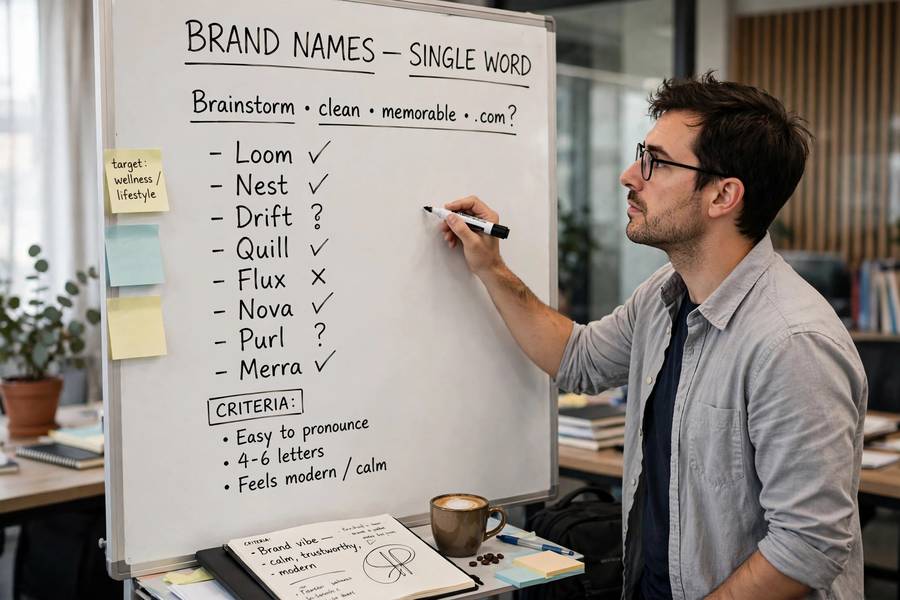
Why One Word Wins
Memory. Working memory holds about four chunks of information. A one-word name consumes one chunk; a three-word name consumes three. In a world of infinite options, the name that costs the least memory wins the recall.
Digital fit. One word is a username, a hashtag, a domain, an app icon. “Bluebird” works everywhere; “Bluebird Creative Solutions LLC” works nowhere digitally. The internet rewards brevity structurally.
Authority. Single-word names signal confidence. They suggest the company is the category — or intends to be. There is a reason startups rebrand from descriptive phrases to single words as they grow: it is a power move.
The cost. All of this is why good one-word names are expensive — the dictionary is picked over, premium domains cost thousands, and trademarks are crowded. The ideas below are starting points; expect to iterate toward something ownable.
The 4 Formulas for One-Word Names
1. Real word, unexpected context. Take an ordinary word and apply it where it does not belong. “Apple” for computers. “Shell” for oil. The surprise creates memorability; the familiarity creates trust. Formula: [common noun] + [unrelated industry].
2. Invented word that feels real. “Kodak,” “Xerox,” “Zillow” — coined words engineered to sound like they mean something. The trick is phonetic familiarity: use common syllable patterns, avoid unpronounceable clusters. If people can spell it after hearing it once, it works.
3. Compound compressed to one. Two words fused: “Facebook,” “Snapchat,” “DoorDash.” Reads as one word, carries two meanings. The fusion must be seamless — if people naturally split it back into two words, the magic breaks.
4. Modified real word. Drop a vowel (Tumblr, Flickr), change a letter (Lyft), add a suffix (-ly, -ify, -io). This was the 2010s startup playbook — effective but now crowded. Use sparingly; the pattern is recognizable enough to feel generic if done lazily.
The general principles of what makes a good business name apply doubly here — with one word, every syllable carries more weight.
Tech and Software
Short, sharp, slightly technical. The industry that perfected one-word naming:
Real-word style: Beacon, Lattice, Forge, Signal, North, Kernel, Relay, Prism, Anchor, Harbor, Flint, Slate, Grove, Ember, Current
Invented style: Zentro, Vexla, Quorix, Nymbl, Kytro, Zentix, Volar, Qubix, Nexla, Zyrra
Compound style: Cloudbreak, Dataspark, Codehaven, Bitforge, Softline, Techroot, Webnest, Appwell
Tech names skew abstract on purpose — the product will evolve, so the name must not box it in. “Lattice” can become anything; “InvoiceApp” cannot.
Creative and Agency
Expressive, with personality. Agencies sell taste, and the name is the first portfolio piece:
Real-word style: Studio (taken, but the pattern), Canvas, Muse, Fable, Opus, Revel, Kindred, Halcyon, Wildcard, Anthem, Parable, Lumen
Invented style: Creativo, Artiva, Designo, Brillia, Imagin, Kolor, Studiq, Artzy, Vivia
Compound style: Brandcraft, Storyline, Pixelhouse, Ideafarm, Dreamforge, Artengine
Creative names can be more emotional and less “serious” than other industries — the audience expects flair. But keep it pronounceable; you will say this name on every sales call for a decade.
Food and Beverage
Appetizing sounds. Food names work through sensory suggestion:
Real-word style: Crumb, Zest, Savor, Ember, Harvest, Brine, Cinder, Thyme, Clove, Melt, Crave, Feast
Invented style: Yumma, Tastia, Flavoro, Munchly, Savoria, Delish (taken — pattern reference), Craveo
Compound style: Foodcraft, Tastebud, Mealbox, Ovenly, Freshline, Cookhouse
Food naming has a special constraint: the name will be spoken by hungry people on phones. If it cannot survive a noisy restaurant call — “Did you say Crumb or Crumbs?” — reconsider. Clarity beats cleverness when stomachs are involved.
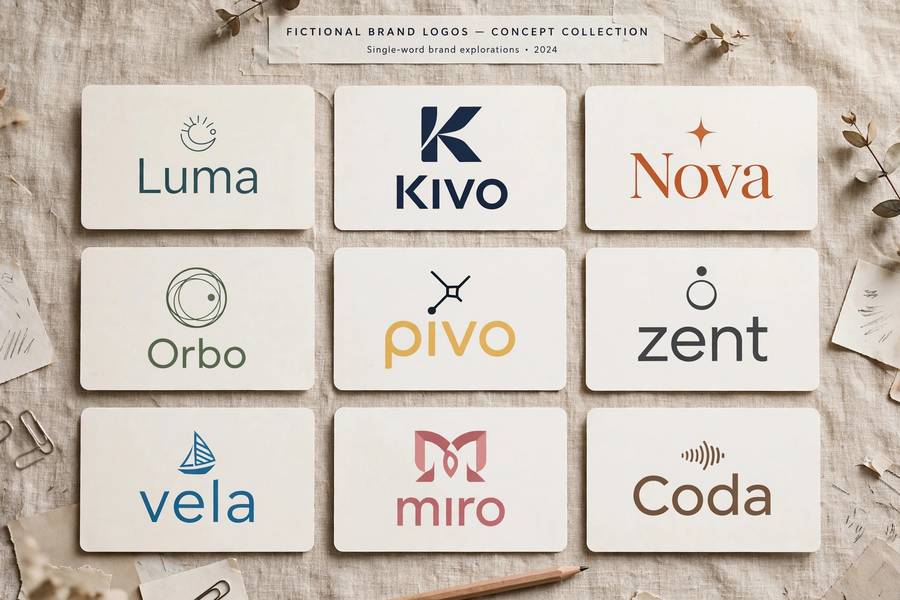
Wellness Brands
Calm, clean, trustworthy. This industry punishes anything that sounds gimmicky:
Real-word style: Vital, Bloom, Clarity, Restore, Align, Thrive, Serene, Pulse, Willow, Haven, Ritual, Balance
Invented style: Wellvia, Vitalis, Curia, Sanara, Tranquil (pattern), Welnis, Healthia
Compound style: Mindbody (taken — pattern), Wellspace, Healco, Calmline, Bodywise, Soulcare
Wellness names must navigate a fine line: aspirational without promising specific outcomes. Avoid anything that sounds like a promise of results — both for ethics and for regulatory reasons.
Fintech and Professional Services
Solid, brief, credible. Banking and law reward understatement:
Real-word style: Ledger, Sterling, Beacon, Anchor, Meridian, Summit, Cornerstone (two words — pattern), Vault, Compass, Foundry, Granite
Invented style: Finaro, Ledgra, Monetix, Capitalo, Trustia, Fiscora
Compound style: Moneywise, Wealthline, Taxnest, Fundflow, Capitaliq (pattern)
Fintech names should feel like they have existed for decades, even when they launched last Tuesday. Avoid playful spellings — nobody wants their accountant to sound whimsical.
Home Services and Trades
Friendly, local, reliable. These names get spoken over fences and recommended at barbecues:
Real-word style: Fixly, Handy (pattern), Sparrow, Oak, True, Solid, Swift, Bright, Prime, Honor
Invented style: Fixora, Handly, Tradesy (pattern), Serviq, Provo, Taskly
Compound style: Homefix, Proserve, Fixit (pattern), Trusttrade, Servicemax (pattern), Handyhands
Trade names live and die on the referral: “Call Sparrow, they fixed our roof.” If the name is not referral-friendly — hard to remember, hard to spell — the best work in the world will not generate word of mouth.
Retail and E-commerce
Distinctive and searchable. Online retail names must survive the search bar:
Real-word style: Nomad, Fern, Wilder, Juniper, Atlas, Cove, Dune, Meadow, Ember, Tide
Invented style: Shopia, Retaily, Buyza, Marketa, Vendio, Cartly
Compound style: Shopwell, Buywise, Storely, Marketmind, Cartopia
E-commerce names have a unique requirement: domain and handle availability matter more than in any other industry, because the name is the storefront. Check the .com before you fall in love.
How to Invent Your Own
The method I use with clients:
- List 20 words related to your industry, your values, and your customer feeling. Not names — raw material words.
- List 20 words from unrelated domains you like the sound of (nature, music, architecture, food).
- Combine across lists using the four formulas. Generate 50+ candidates without judging.
- Filter for sound: say each aloud. Kill anything hard to pronounce, spell, or remember after one hearing.
- Filter for meaning: does it suggest the right feeling? Kill anything with negative or confusing associations.
- Filter for uniqueness: Google each survivor with your industry. Kill anything with an established competitor.
- Test the top 5 with the voicemail test, the spelling test, and ten real humans.
The catchy business name ideas list has more raw material if your word lists run dry.
Checking Availability
For one-word names, this step kills 90% of candidates — plan for it:
Domain. The .com is the standard. If it is taken, check who owns it — a parked page might be buyable; an active business is a dead end. Budget for the possibility that your perfect name’s domain costs $2,000–$10,000. Decide your ceiling in advance.
Trademark (USPTO). Search the federal database for your industry class. One-word marks are heavily crowded — expect conflicts and have backups ready.
Social handles. Check the major platforms. Consistent handles across platforms matter more for one-word brands because the name is so short that variations confuse.
State business registry. The easiest check, and the one people forget until the bank asks.
App stores (if relevant). A conflicting app name creates confusion even without legal conflict.
Expect to generate 50+ candidates to find 3–5 that clear all checks. This is normal. The availability gauntlet is the reason good one-word names are valuable — scarcity creates the worth.

Frequently Asked Questions
Strong patterns include real words in unexpected contexts (Beacon, Lattice, Forge), invented words that sound familiar (Zentro, Vexla), and fused compounds (Cloudbreak, Dataspark). The best choice depends on your industry — tech favors abstract, food favors sensory, fintech favors solid and understated.
List 20 industry words and 20 appealing unrelated words, combine them using four formulas (unexpected real word, invented familiar word, fused compound, modified real word), generate 50+ candidates, then filter by sound, meaning, and uniqueness. Test finalists with real humans before checking availability.
They’re more memorable, digitally fitter (usernames, domains, hashtags), and signal confidence — but they’re harder to find available and can be vague about what you do. They work best when paired with a descriptive tagline or when the brand will invest in building meaning into the word.
Yes, if it’s distinctive and not confusingly similar to an existing mark in your industry class. Single dictionary words are hardest to protect; invented or suggestive words are easiest. Always search the USPTO database before committing — one-word marks are heavily crowded.
Check whether it’s an active business (dead end) or a parked page (potentially buyable, often $2,000–$10,000). Set your budget ceiling in advance. Alternatives like get[name].com or [name]hq.com work but dilute the one-word power — sometimes the right move is choosing a different name with a clean .com.