
I’m Ava. Every movie you’ve ever loved started as someone trying to explain an idea persuasively — and the film treatment is the document where that explanation lives. Before the screenplay, before the financing, before anything, there’s usually a treatment: a prose telling of the film’s story, written to make a reader need to see this movie exist.
If you have a movie idea, the treatment is likely your first real step toward selling it. Here’s what it is, how it’s structured, and how to write one that works.
In This Guide
- What a Film Treatment Is
- Treatment vs. Screenplay vs. Synopsis vs. Logline
- The Standard Treatment Format
- How Long Should a Treatment Be?
- How to Write a Treatment: Step by Step
- What Makes Treatments Sell
- Common Mistakes
- Frequently Asked Questions
What a Film Treatment Is
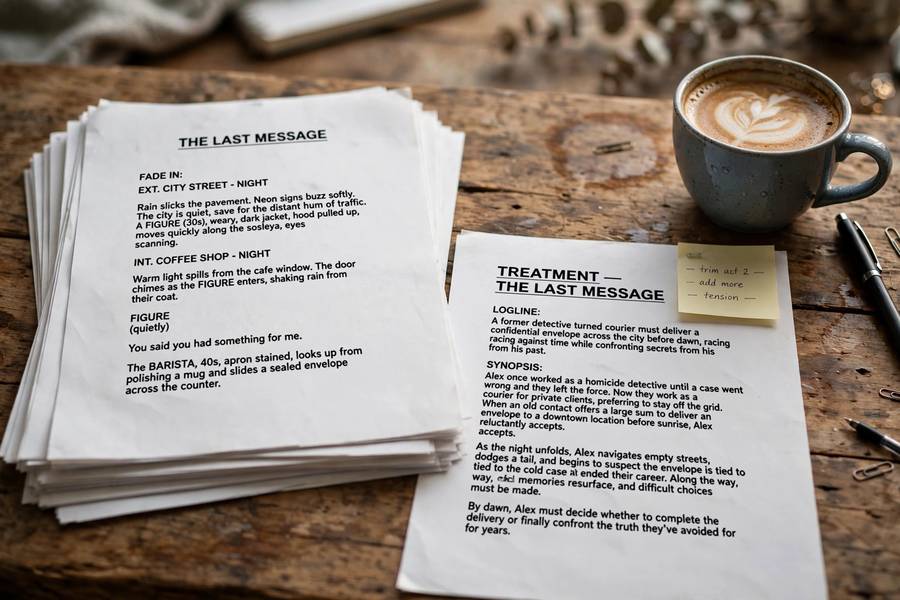
A film treatment is a prose document that tells your movie’s story from beginning to end — the characters, the world, the plot’s major turns, and the emotional journey — written in present tense, designed to be read by producers, executives, and directors evaluating whether to develop the project.
Think of it as the story without the screenplay formatting: no scene headings, no dialogue blocks, no camera directions. Just the narrative, told compellingly, hitting every structural beat that makes the film work.
Its purposes: – Selling the idea to producers, studios, or financiers before a script exists – Aligning collaborators — director, writer, and producer agreeing on the story’s shape – Guiding the screenplay — many writers draft the treatment first as a structural blueprint, then expand it into script pages
A great treatment reads like a short story you can’t put down. A bad one reads like a plot summary. That difference is everything.
Treatment vs. Screenplay vs. Synopsis vs. Logline
Writers mix these up constantly. The hierarchy, from shortest to longest:
Logline (1–2 sentences). The entire movie compressed: protagonist, goal, obstacle, stakes. Example: “A young FBI trainee seeks an imprisoned killer’s help to catch another murderer.” If you can’t write the logline, you don’t have a movie yet.
Synopsis (1 page). The story’s beginning, middle, and end — including the ending — in a page. Used in queries and submissions.
Treatment (5–30 pages). The full narrative in prose: acts, sequences, character arcs, key scenes described vividly, major set pieces. This is the selling document.
Screenplay (90–120 pages). The actual script — dialogue, action lines, scene structure — the blueprint for production.
Each serves a different reader at a different stage. The treatment is where the story gets proven; the screenplay is where the film gets built. For the next step after your treatment, my guide on how to write a screenplay picks up where this leaves off.
The Standard Treatment Format
While there’s no single mandated template, professional treatments follow conventions:
Title page: project title, “written by [you],” your contact info. Some include the logline.
The document itself: – Written in present tense (“Sarah runs,” not “Sarah ran”) — it should feel like the movie unspooling now – Prose paragraphs, not script formatting – Character names in CAPS on first introduction, with a brief vivid description (“MARCUS (40s), a mechanic whose hands never fully come clean”) – Organized by acts or sequences with clear structural progression – No dialogue except the occasional killer line that defines a character or moment – No camera directions — you’re selling story, not directing
Tone: confident, visual, propulsive. Write the movie you want the reader to see. “The city burns” beats “there is a fire in the city.” Every paragraph should move the story forward or deepen character — preferably both.
How Long Should a Treatment Be?
It depends on purpose and project scale:
- Short treatment / extended synopsis: 3–8 pages. Common for TV pitches and initial submissions.
- Standard feature treatment: 10–20 pages. The industry sweet spot for selling a feature idea.
- Detailed treatment / step outline: 25–40 pages. Used when the treatment doubles as the screenplay blueprint — sometimes called a “beat sheet on steroids.”
Longer isn’t better. A 12-page treatment that crackles beats a 30-page one that drones. Executives read dozens weekly; respect their time and they’ll respect your story.
How to Write a Treatment: Step by Step
-
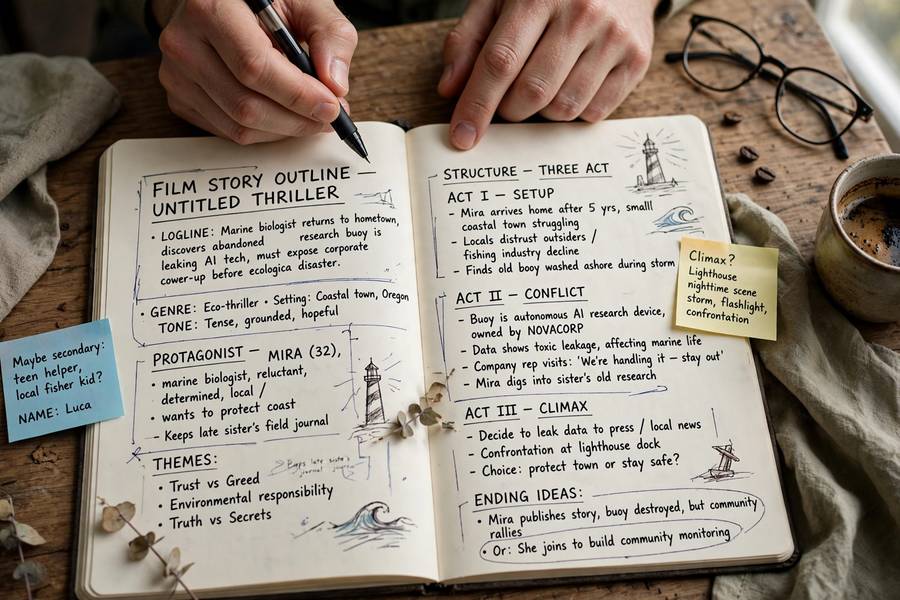
Nail the logline first. If the movie can’t survive compression to two sentences, the treatment will ramble. Write and rewrite until it’s sharp.
-
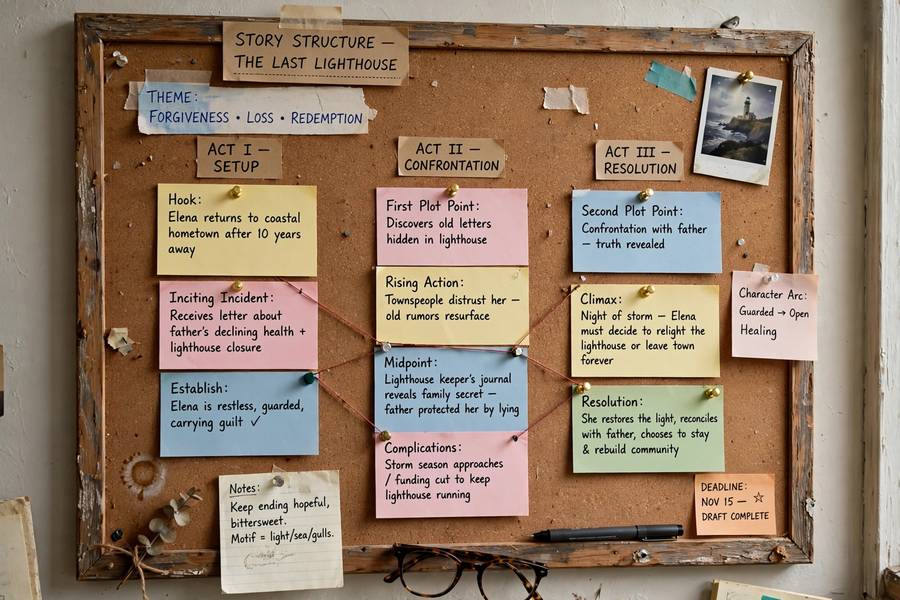
Map the structure. Three acts (or your chosen structure) with the major beats placed: inciting incident, act breaks, midpoint reversal, climax, resolution. Know your skeleton before adding flesh.
-
Write the opening. The first page must hook — establish character, world, and the story’s engine fast. Readers decide within two pages whether to continue.
-
Tell act by act. Write each act as flowing prose, hitting every plot turn and character beat. Describe key scenes vividly enough to see — but don’t storyboard; that’s the director’s job later.
-
Track the emotional arc. Plot is what happens; story is what it means. Make sure the protagonist changes — or meaningfully refuses to — and that the reader feels the journey.
-
Land the ending. Write the actual ending, fully. Treatments that fade out (“and then… something amazing happens”) signal a writer who doesn’t know their own story. The ending is the sale.
-
Revise for pace. Read it aloud. Cut every paragraph that doesn’t advance plot, character, or tone. Treatments should feel breathless in the right places and tender in the right places — never flat.
What Makes Treatments Sell
From producers I’ve interviewed, the patterns in treatments that get optioned:
- A killer concept, clearly expressed. High-concept isn’t mandatory, but clarity is. The reader should be able to pitch it to their boss in one sentence.
- Characters with want and need. The protagonist wants something external and needs something internal — and the story forces them to confront the gap. This is Screenwriting 101 because it works.
- Visual storytelling. Film is a visual medium; treatments that describe images (“the lighthouse beam sweeps across empty water”) excite producers more than internal monologue.
- Fresh but familiar. “It’s X meets Y” remains the industry’s favorite shorthand — original enough to excite, familiar enough to finance.
- An ending that earns the read. The final pages should deliver an emotional payoff that makes the reader think “I have to see this made.”
And the unglamorous truth: relationships matter as much as the document. Treatments from trusted sources get read carefully; cold submissions face brutal odds. Network, get referrals, and treat every submission professionally.
Common Mistakes
- Writing the screenplay in prose. Over-detailing every scene. The treatment is the story’s shape, not its every wrinkle.
- Hiding the ending. “Twist ending — you’ll have to read the script!” No. Decision-makers need the whole story.
- No character interiority. Plot without character is a Wikipedia summary. We need to feel the protagonist’s journey.
- Forgetting the theme. What is this movie about beneath the plot? Treatments without theme feel hollow.
- Wrong tense or formatting. Past tense, script formatting, camera directions — all signal amateur hour.
- Too long, too precious. If you’re in love with every sentence, you’re not editing. Kill darlings.
For the craft fundamentals that underpin all of this, my filmmaking tips cover the practical realities writers need to understand about production.
A film treatment is your movie’s story in compelling prose — 5 to 30 pages, present tense, structured by acts, written to make a reader desperate to see the film exist. Nail the logline, map the structure, write it visually, land the ending, and revise ruthlessly. It’s the first real step from “I have an idea” to “this movie is happening.”
Frequently Asked Questions
A film treatment is a prose document telling a movie’s complete story — characters, plot, and emotional arc — written in present tense to persuade producers and executives to develop the project. It’s longer and more detailed than a synopsis but lacks screenplay formatting: no dialogue blocks, scene headings, or camera directions.
Standard feature treatments run 10–20 pages — the industry sweet spot for selling an idea. Short treatments (3–8 pages) suit TV pitches and initial submissions; detailed treatments (25–40 pages) double as screenplay blueprints. Longer isn’t better: a crackling 12 pages beats a droning 30.
A treatment tells the story in prose paragraphs (present tense, minimal dialogue, no formatting) to sell the idea and align collaborators. A screenplay is the 90–120 page production blueprint with scene headings, action lines, and dialogue formatted to industry standard. The treatment proves the story; the screenplay builds the film.
Not strictly, but most professional writers draft one — it forces you to solve story structure before investing months in script pages. Treatments are also the standard document for pitching ideas to producers before a script exists, making them essential if you want to sell an idea rather than a finished script.
Always. Decision-makers need the complete story including the twist or resolution — treatments that hide the ending signal a writer who hasn’t solved their own story. The ending is often what sells the project, so write it fully and make it land.