
I’m Chris, and I have a confession: the first screenplay I ever wrote was 140 pages long, had four protagonists, and opened with a six-page dream sequence. It was, to put it kindly, unfilmable. A friend who actually works in development read ten pages and said, “Chris. This is a novel wearing a screenplay costume.” He was right.
Here’s what I’ve learned since: writing a screenplay is a craft with real rules, and the rules exist for good reasons. Every movie you’ve ever loved started as a script — usually a messy one that got rewritten half to death. This guide walks you through the whole process, from blank page to finished draft: the format, the structure, the characters, the dialogue, and the rewrite where the actual magic happens. No film degree required.
What a Screenplay Actually Is (And Isn’t)
First, the mindset shift. A screenplay is not literature. Nobody reads it for pleasure — it’s a blueprint for a movie. Its job is to make a reader see the film in their head, fast. That’s why scripts are written in present tense, in spare visual language, and why a standard feature script runs about 90–120 pages: roughly one page per minute of screen time.
For a deeper dive, see our guide to best anime series of all time.
This is liberating once you accept it. You’re not writing beautiful prose; you’re writing instructions for images and sound. “She stares at the door. It doesn’t open.” beats a paragraph of interior monologue every time, because one can be filmed and the other can’t. And the script is the cheapest part of the movie to fix — every problem you solve on the page saves ten problems on set.
We break down best anime of all time step by step in a separate guide.
The Format: Learn It, Then Forget About It
Screenplay format looks intimidating — all those capital letters and weird margins — but it’s just a shared language so everyone on a production can read fast. The basics:
- Sluglines (scene headings): INT. COFFEE SHOP – DAY. Interior or exterior, location, time of day. That’s it.
- Action lines: What we see, present tense, lean. Three lines max per paragraph is a good rule.
- Character names in caps above their dialogue, with parentheticals used sparingly. (If every line needs a parenthetical, the dialogue isn’t working.)
- Dialogue: Centered-ish, natural, no speeches. Real people interrupt each other.
Don’t format by hand. Use free software — WriterDuet or a properly set-up template — that handles margins automatically. Readers can smell wrong formatting in seconds, and it signals “amateur” before they’ve read a word.
Step 1: The Idea (And the Logline Test)
Every script starts with “what if.” What if a hitman had to protect the kid he was hired to eliminate? What if the heist crew’s getaway driver couldn’t drive stick?
Here’s my test: can you pitch it in one sentence — a logline — that makes someone lean in? If the concept can’t survive one sentence, it won’t survive 110 pages.
Write down ten ideas. Pick the one you’d still be excited about in month four, because that’s how long this takes.
Step 2: Structure — The Skeleton Under Every Movie
I know, “structure” sounds like the fun police. But here’s the thing: audiences have watched thousands of stories, and their brains expect certain rhythms. You can break the rules later; first learn them.
The classic three-act structure, simplified:
- Act One (pages 1–25ish): Set up the world, the character, and the problem. Ends with the inciting incident — the event that launches the story and can’t be undone.
- Act Two (pages 25–90ish): The long middle. The character pursues the goal, hits obstacles, and everything gets worse. The midpoint brings a major twist or reversal; the end of Act Two is the “all is lost” moment — the lowest point.
- Act Three (pages 90–110ish): The climax — the final confrontation where the character proves they’ve changed — and a brief resolution.
Is it formulaic? In bad hands, yes. In good hands, it’s invisible — it’s just the shape of a satisfying story. Learn the beats, then make them yours.

Step 3: Characters People Actually Care About
Plot gets people to start watching; character gets them to keep watching. Two tools that fix 90% of weak characters:
Give every major character a want and a need. The want is the conscious goal (win the championship, get the promotion). The need is the deeper lesson they must learn (trust people, let go of control). Great movies are about the collision between the two — the character chases the want and is transformed by the need. If your protagonist could achieve their goal in Act One and be happy, you don’t have a movie yet.
Give them a distinct voice. Cover the character names in your dialogue and you should still tell who’s talking. One speaks in short bursts, one rambles, one never answers directly. Voice comes from background, attitude, and desire — not from quirky catchphrases.
Step 4: Outline Before You Write (Your Future Self Will Thank You)
The outline is where you solve story problems for free. A beat sheet — 40 to 60 bullet points covering the whole movie — takes a week and saves you months of rewriting a broken draft.
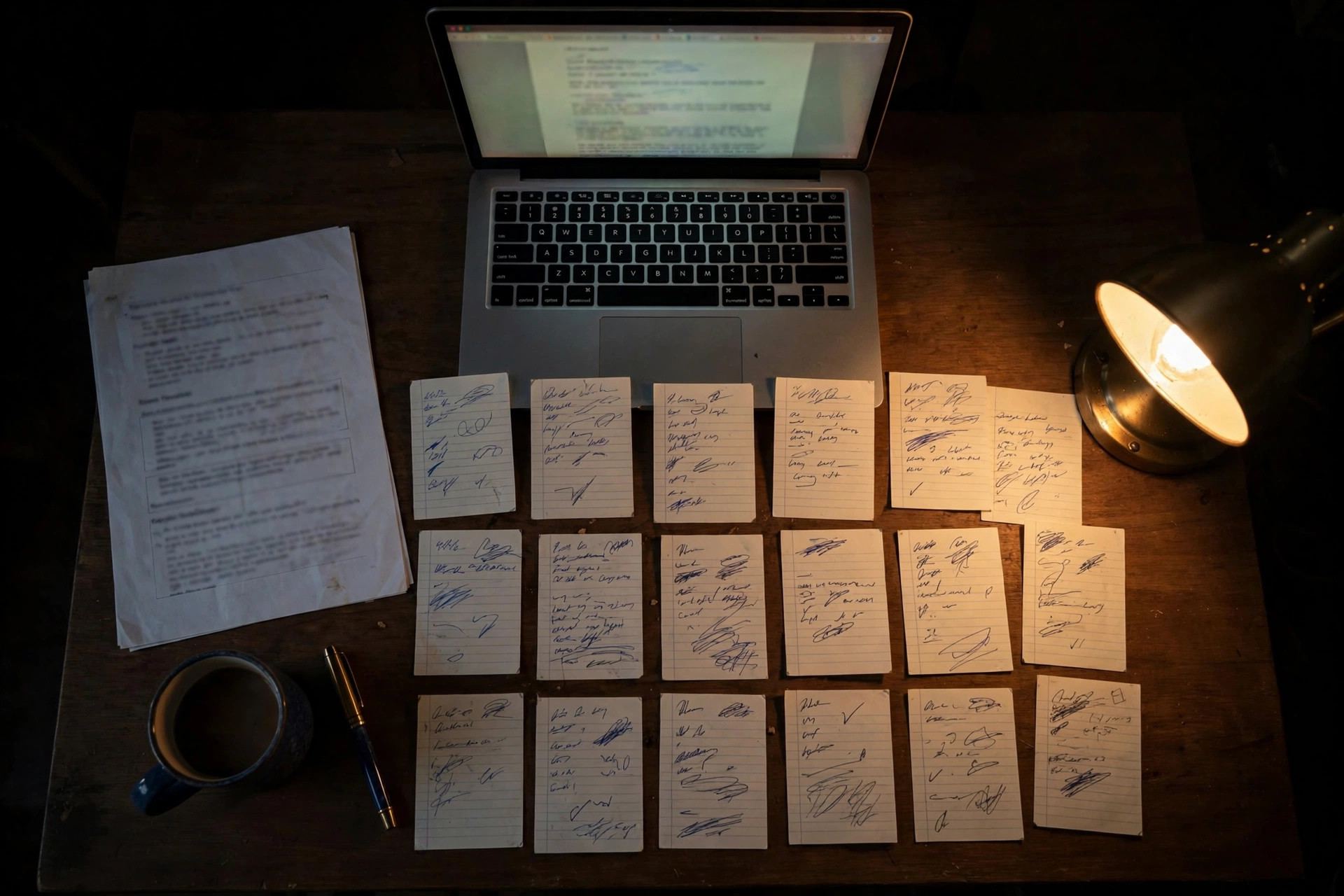
My preferred method: index cards on a wall (or a digital equivalent), one card per scene, arranged in three columns for the three acts. You can see the movie’s shape. Too many cards in Act Two? Your middle sags. No cards between the midpoint and the climax? You’ve got a hole. Rearranging cards is free; reshooting scenes is not.
Don’t skip this because outlining “kills the magic.” The outline just makes sure there’s a movie underneath the magic.
Step 5: The First Draft — Write Fast, Write Bad
Here’s permission: your first draft is allowed to be terrible. Expected to be, even. The pros call it the “vomit draft” — get it all out, don’t look back, don’t edit as you go.
Set a daily page target (3–5 pages is sustainable for most people with day jobs) and protect that writing time like it’s sacred. This is genuinely the hardest part — not talent, but showing up. If carving out consistent creative hours feels impossible alongside everything else, you’re dealing with the same work-life puzzle everyone faces, and it’s worth getting deliberate about how to balance work and personal life (https://www.wedlockcross.com/how-to-balance-work-personal-life/) so the script doesn’t die in week three.
Don’t show the first draft to anyone. Finish it, take a week off, then read it like a stranger. That’s when the real work starts.

Step 6: The Rewrite — Where Scripts Are Actually Written
Nobody’s first draft is the movie. The rewrite is the job. Here’s how to attack it:
First pass: structure. Does the story work? Is the inciting incident early enough? Does Act Two sag? Fix the big bones before touching a single line of dialogue. Rewriting dialogue in a broken structure is rearranging deck chairs.
Second pass: characters. Does everyone want something? Is the protagonist active or just reacting? Cut any character who could vanish without changing the plot.
Third pass: scenes. Every scene should either advance the plot or reveal character — ideally both. If a scene does neither, cut it, no matter how much you love the dialogue in it.
Fourth pass: dialogue. Now polish the lines. Read everything out loud. If it sounds written, rewrite it.
Get feedback between passes — but from the right people. You want readers who’ll tell you what’s not working, not friends who’ll say “it’s great!” Writers’ groups and trusted peers beat polite friends.
Dialogue That Doesn’t Suck
Quick masterclass, because bad dialogue kills more scripts than bad plots:
- Subtext over text. People rarely say what they mean. “Fine. Do whatever you want” means the opposite. Write what characters want to say underneath the words.
- Read it out loud. Always. Your ear catches what your eye misses.
- Cut the pleasantries. No “hi, how are you, I’m fine” unless the awkwardness is the point. Enter scenes late, leave early.
Beginner Mistakes (I Made All of These)
- Directing on the page. “Camera pans left to a close-up as she…” — no. You’re the writer, not the director. Write what we see, not camera moves. (One or two are forgivable; a script full of them is not.)
- Over-describing. Three-line action paragraphs max. If you need half a page to describe a room, the room doesn’t matter that much.
- The 140-page first draft. Pros overwrite then cut; beginners overwrite and ship. Aim for 100–110 pages. Shorter reads faster, and faster gets read.
- Starting with a dream sequence. Just… don’t. It’s the screenwriting equivalent of “it was all a dream.”
- No second act. A great setup and a great ending with sixty pages of wandering in between. The middle is the movie — do the work there.
What To Do With a Finished Script
Finished is a big deal. Celebrate. Then:
Do a table read. Get friends to read the parts aloud. You’ll hear every problem in ninety minutes. It’s the highest-value rewrite tool that exists, and it’s free.
Get coverage or enter contests. Professional script coverage gives you blunt, structured feedback. Reputable contests (Nicholl, Austin, Final Draft’s Big Break) get your work in front of real readers — and placing well is a genuine career credential.
Understand what happens next. A finished script enters development — the long road of options, rewrites, and financing. If you’re curious how the machine works after the script leaves your hands, I’ve mapped out how movies are made (https://www.wedlockcross.com/how-are-movies-made/) from development through distribution. Knowing the system helps you navigate it.

Frequently Asked Questions
A first draft typically takes 2–4 months writing a few pages a day, but the full process — outlining, drafting, and multiple rewrites — usually runs 6–12 months for a feature. Rushing the rewrite phase is the most common reason scripts fail; professional writers often say the rewrite, not the draft, is where the screenplay is actually written.
Use dedicated screenwriting software that formats automatically — free options like WriterDuet work well for beginners, and professionals often use Final Draft. Never format by hand or in a plain word processor; incorrect formatting signals “amateur” to readers instantly. The software handles margins, sluglines, and pagination so you can focus on story.
For a feature film, aim for 90–120 pages, with 100–110 as the sweet spot — roughly one page equals one minute of screen time. Comedy and horror trend shorter; drama can run longer. Anything over 130 pages from an unknown writer is a hard sell. Shorter scripts read faster, and scripts that read fast get finished.
Strongly recommended. A beat sheet or index-card outline (40–60 cards covering the whole film) lets you solve story problems for free before drafting. Writers who skip outlining usually discover structural problems in the draft — when fixing them costs months instead of an afternoon of rearranging cards. Outlining doesn’t kill creativity; it protects it.
The classic framework: Act One (roughly pages 1–25) sets up the world and ends with the inciting incident; Act Two (pages 25–90) is the confrontation, with a midpoint twist and an “all is lost” low point; Act Three (pages 90–110) delivers the climax and resolution. It’s the underlying rhythm of most commercial films — learn it before you experiment with alternatives.
There’s no single path, but proven routes include: placing in reputable contests (Nicholl, Austin Film Festival), getting professional coverage and querying managers with a strong logline, and networking through film communities. Most working writers sell after writing multiple scripts — your first screenplay is usually your education, not your paycheck. Keep writing; volume builds skill and luck.
The Bottom Line
Writing a screenplay comes down to this: a one-sentence idea strong enough to survive 110 pages, a structure that holds it up, characters worth following, an outline that saves you months, a fast terrible first draft, and a ruthless rewrite. That’s the whole job. It’s simple; it’s not easy.
My first script was 140 pages of unfilmable ambition. The lesson wasn’t “give up” — it was “learn the craft.” Every script since has been better, because every script taught me something. Yours will too. Open the software, write the logline, and start.
For more film coverage — how movies get made, what to watch, what to skip — it’s all in the entertainment section (https://www.wedlockcross.com/category/entertainment/). Now close this tab and go write.