How Much Does It Cost to Start a Daycare? The Real Numbers

Every prospective daycare owner asks me this question first, and almost everyone underestimates the answer. The internet is full of cheerful claims that you can “start a daycare for $2,000 from your living room.” Technically possible in the most permissive state with the tiniest license. Realistically? You are looking at $10,000 to $50,000 for a home daycare and $50,000 to $150,000+ for a center — before you enroll a single child.
I have advised enough childcare startups to know where the money actually goes, and more importantly, where founders get blindsided. This is the honest breakdown: every major cost category, the ranges, the hidden expenses nobody warns you about, and how to figure out your number. If you are still mapping the big picture, start with my guide on how to start a daycare, then come back here for the math.

The Short Answer by Daycare Type
Costs scale with capacity and regulation. Here are realistic ranges:
Home daycare (6–12 children): $10,000–$50,000. You already have the building, so the money goes to licensing, safety modifications, equipment, and insurance. The low end assumes you own a suitable home and your state has modest requirements. The high end covers significant renovations and premium setup.
Small center (20–50 children): $50,000–$150,000. Commercial lease deposits, build-out to code, commercial-grade everything, initial staffing, and working capital. Most first-time center owners land around $80,000–$100,000.
Large center (50+ children): $150,000–$500,000+. Purpose-built or heavily renovated space, full staff roster, playground construction, and months of operating runway. This is a serious commercial undertaking.
Franchise daycare: $100,000–$500,000+. Franchise fees ($25,000–$50,000 alone), mandated build-outs, and royalty structures. You buy a brand and a system, and you pay for both.
These are startup costs — one-time money to open the doors. Operating costs are a separate conversation, and they are what actually determine whether you survive year one.
Licensing and Legal Costs
Before you spend a dollar on toys, you spend on permission:
License application fees: $100–$500. Varies wildly by state. Some states charge under $100 for home daycare; commercial center licenses in strict states run several hundred.
Background checks: $50–$150 per person. You, every employee, and in home daycare, every adult in the household. Fingerprinting-based FBI checks are the expensive ones.
Business formation: $100–$800. LLC filing fees plus registered agent costs. Do not operate as a sole proprietorship with other people’s children in your care — the liability exposure is reckless.
Legal review: $500–$2,000. An attorney reviewing parent contracts, liability waivers, and employee agreements — skip this and you’ll pay more later.
Permits and inspections: $200–$1,000. Fire marshal inspection, health department permits, zoning variances for home daycares. Zoning fights are the silent budget-killer.
Training and certifications: $200–$600. CPR/first aid, food handler permits, required childcare training hours. Most states mandate specific training before licensing.
Realistic licensing/legal total: $1,500–$5,000 for home daycare, $3,000–$10,000 for centers.
Facility Costs: Home vs Commercial Space
Home daycare: Your facility cost is mostly opportunity cost — dedicating rooms to the business. Budget $0–$5,000 for the space itself, but check your homeowner’s insurance and HOA rules. Some HOAs prohibit home businesses outright, and discovering this after you have spent $20,000 on setup is a special kind of pain.
Commercial lease: The big one. Childcare-suitable commercial space runs $15–$30 per square foot annually in most markets, more in cities. A 3,000 sq ft center at $20/sq ft is $60,000/year — and landlords want first month, last month, and a security deposit upfront: $15,000–$30,000 before you turn a key. Plus tenant improvement allowances are rare for childcare because the build-out is so specialized.
Budget 3–6 months of rent as working capital on top of deposits. You will not be full on day one.
Renovation and Safety Compliance
This is where estimates go to die. Code requirements for childcare facilities are extensive:
Egress and fire safety: $2,000–$15,000. Second exits, fire-rated doors, emergency lighting, sprinkler modifications. Older buildings are the worst — bringing a 1960s retail space up to childcare fire code can cost more than the lease deposit.
Bathroom modifications: $3,000–$10,000. Child-height toilets and sinks, diaper-changing stations with required clearances. Plumbing work is never as cheap as you hope.
Kitchen compliance: $2,000–$8,000. If you serve food (and you should — it is a competitive advantage), health department kitchen requirements apply: commercial-grade surfaces, separate handwashing sinks, proper storage.
Flooring: $3,000–$12,000. Non-toxic, washable, impact-absorbing flooring throughout. Carpet is generally prohibited in childcare spaces.
Outdoor play area: $5,000–$30,000. Fencing (required height and specs), impact-absorbing surfacing under equipment, shade structures, and the equipment itself. This single line item shocks more founders than any other.
General childproofing: $1,000–$3,000. Window guards, door alarms, locked storage for hazardous items, water-heater temperature limits.
Realistic renovation total: $5,000–$25,000 for home daycare, $20,000–$80,000 for centers.
Equipment, Furniture, and Supplies
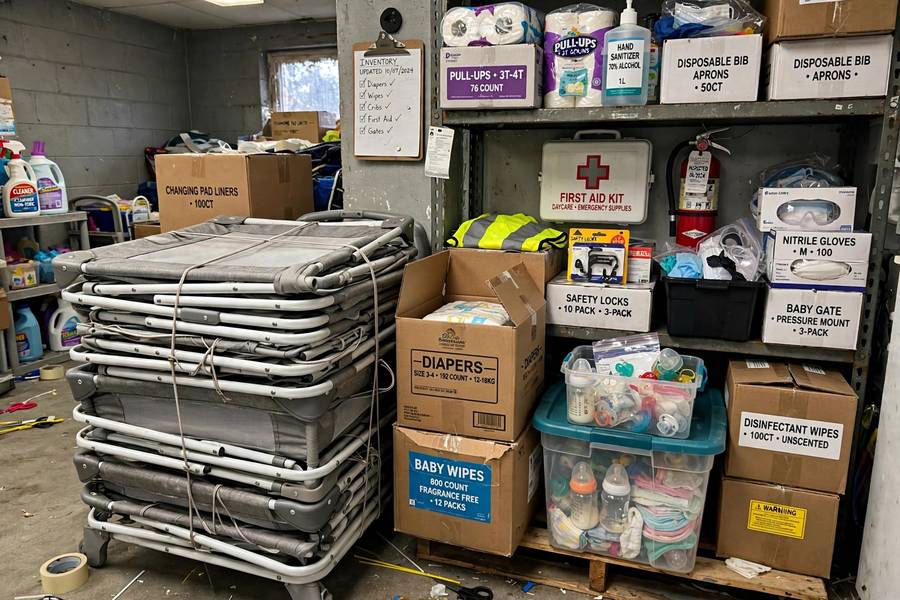
Furniture: $3,000–$15,000. Cribs ($150–$300 each, and you need one per infant), cots, child-sized tables and chairs, high chairs, adult seating, office furniture. Buy commercial-grade; residential furniture will not survive a year of daycare use.
Educational materials and toys: $2,000–$8,000. Age-appropriate toys, books, art supplies, learning materials. Budget for rotation — children destroy and outgrow materials constantly.
Nap and rest equipment: $500–$2,000. Cots, sheets, blankets. States specify spacing and sanitation requirements.
Kitchen and feeding: $1,000–$4,000. Bottles, dishes, utensils, food storage, cleaning supplies. If you do baby food prep on-site, add equipment costs.
Technology: $1,000–$3,000. Check-in systems, parent communication apps, security cameras (parents expect them now), office computer and printer. Good daycare management software pays for itself in billing accuracy alone.
Initial consumable stock: $500–$1,500. Diapers, wipes, cleaning supplies, first-aid restocking, art consumables. The monthly burn on consumables surprises everyone — budget $200–$500/month ongoing.
Staffing: Your Biggest Ongoing Cost
Staffing is 60–70% of operating costs, and you need staff before you open:
Pre-opening payroll: $5,000–$20,000. You hire and train before enrollment revenue starts. Budget 4–8 weeks of payroll with minimal income.
Wages. Childcare workers earn $13–$18/hour in most markets; lead teachers $16–$24/hour; assistant directors $40,000–$55,000/year. Your daycare staff-to-child ratio requirements dictate headcount — ratios are the law, not a suggestion, and they make staffing costs largely fixed regardless of enrollment.
Benefits and taxes. Add 20–30% on top of wages for payroll taxes, workers’ comp, and any benefits. Workers’ comp for childcare is not cheap — it is a physical job with injury risk.
Your own salary. Pay yourself from day one, even if it is modest. Founders who “take salary later” burn out and make desperate pricing decisions. Build a reasonable owner salary into the operating budget.
Insurance: Non-Negotiable
General liability: $1,500–$5,000/year. Covers injuries and accidents. For centers, expect the higher end.
Professional liability: $1,000–$3,000/year. Covers claims of negligence in care.
Property insurance: $1,000–$4,000/year. Covers your equipment and improvements.
Workers’ compensation: $2,000–$8,000/year. Required with employees; rates vary by state and claims history.
Commercial auto (if transporting children): $2,000–$5,000/year. Fifteen-passenger vans are insurance nightmares — many carriers will not write them.
Abuse and molestation coverage: $500–$2,000/year. A separate rider most general policies exclude. Get it. The name is unpleasant; the protection is essential.
Expect $5,000–$20,000/year total, with a significant chunk due upfront.
Marketing and Enrollment Costs
Brand and website: $500–$3,000. Logo, website, Google Business Profile setup. Parents research online first — a daycare without a decent website loses to one with it, every time.
Signage: $500–$2,000. Building signage, banners, vehicle decals. Check local sign ordinances before ordering.
Launch marketing: $1,000–$5,000. Social media ads, local parent groups, open house events, printed materials. Budget for 3–6 months of sustained effort — enrollment is a pipeline, not an event.
Photography: $300–$800. Professional photos of your space (empty, staged beautifully) for the website and listings. Phone photos of your facility cost you enrollments.
The Hidden Costs Nobody Mentions
Working capital gap: $10,000–$30,000. The killer. You open at 30% enrollment and it takes 6–12 months to fill. Meanwhile rent, payroll, and insurance are due in full. Most daycare failures are not bad businesses — they are undercapitalized good businesses. Have 6 months of operating expenses in reserve.
Subsidy program delays. If you accept state childcare subsidies (and you should consider it — it fills seats), reimbursements can lag 60–90 days. You float the cost.
Turnover costs. Childcare turnover runs 25–40% annually. Each departure costs $3,000–$5,000 in recruiting, onboarding, and overtime coverage.
Ongoing training. States require annual training hours per employee. Budget the hours and the course fees.
Accounting and payroll: $200–$500/month. Do not do payroll by hand with ratio-driven staffing. Outsource it from day one.
How to Calculate Your Number
Here is the method I give every founder:
- Pick your model (home, small center, large center) and capacity.
- Call your state’s licensing office and get the exact fee schedule and requirement list — not the website summary, the actual packet.
- Get three contractor quotes for the safety build-out; take the middle one and add 20%.
- Price your equipment from two commercial suppliers, not retail wishlists.
- Build a 12-month cash flow with a realistic enrollment ramp and find the deepest negative month. That number, plus 20%, is your working capital requirement.
- Add it all up. That is your startup cost. If the number scares you, it should — better scared now than broke in month eight.
Then read up on how to price daycare services to make sure the revenue side of your plan is as honest as the cost side.
Frequently Asked Questions
A home daycare typically costs $10,000–$50,000 to start: licensing and legal ($1,500–$5,000), safety renovations ($5,000–$25,000), equipment ($5,000–$15,000), insurance ($3,000–$8,000/year), and working capital for the months before you’re full.
A small daycare center (20–50 children) costs $50,000–$150,000 to open; large centers run $150,000–$500,000+. The biggest costs are commercial lease deposits, code-compliance renovations ($20,000–$80,000), staffing before enrollment revenue starts, and 6 months of operating working capital.
Working capital — the cash to survive 6–12 months of partial enrollment while paying full rent, payroll, and insurance. Most daycare failures are undercapitalized businesses, not bad ones — keep 6 months of operating expenses in reserve.
Realistically, no — even the leanest home daycare needs several thousand dollars for licensing, background checks, insurance, and safety compliance. Grants and small business loans exist, but you need capital or financing to open legally and safely.
Most daycares take 12–24 months to reach stable profitability, with enrollment typically ramping from 30% at opening to 85%+ by month 12. Profitability depends on maintaining near-capacity enrollment, since staffing costs are largely fixed by ratio requirements.