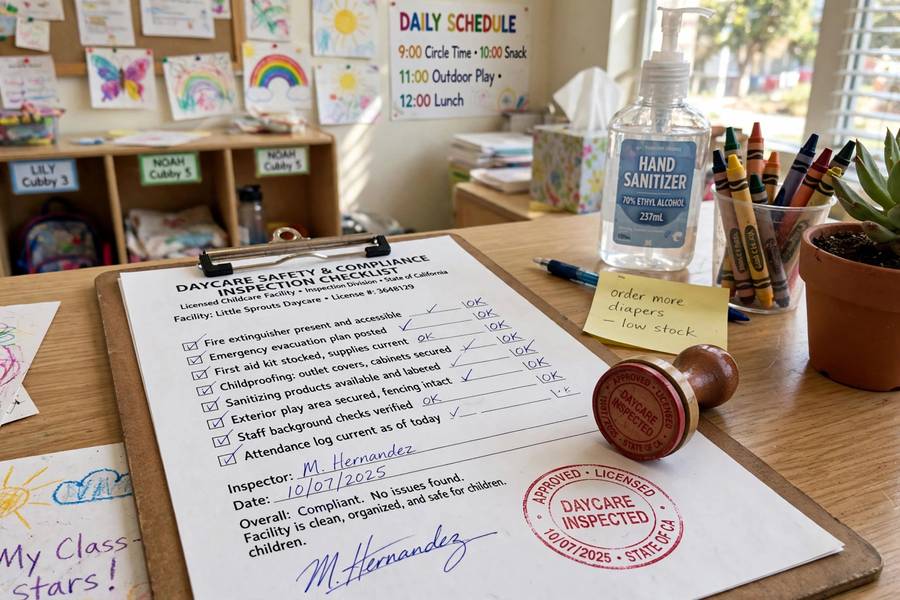
Here is the uncomfortable truth about daycare licensing in America: there is no national standard. Every state writes its own rules, and the differences are enormous. What qualifies you to open a home daycare in one state would get you shut down in another. I have seen founders move across a state line and discover their entire business model was illegal in the new jurisdiction.
This guide gives you the framework: what licensing generally covers, how home daycare rules differ from center rules, where the big state-by-state differences lie, and exactly how to find your state’s requirements. For the full startup picture, see how to start a daycare.
Table of Contents
- Why Licensing Varies So Much
- The Two License Types: Home vs Center
- What Every State Regulates
- Where States Differ Most
- Strict vs Lenient States: The Spectrum
- The Licensing Process Step by Step
- Inspections: What to Expect
- Common Reasons Applications Get Denied
- How to Find Your State’s Exact Requirements
- Frequently Asked Questions
Why Licensing Varies So Much
Childcare regulation sits at the intersection of three things states care about deeply and differently: child safety, workforce policy, and small business. The result is a patchwork.
Some states treat home daycare as an extension of parenting — light-touch registration, minimal inspections. Others treat every childcare arrangement as a commercial enterprise requiring the full apparatus: background checks, training hours, facility standards, unannounced inspections. Neither approach is obviously wrong; they reflect different philosophies about risk and the role of government.
The practical consequence for you: everything in this guide is a framework, not a rulebook. Your state’s licensing office is the only authoritative source. I will show you how to read their materials like a professional.
The Two License Types: Home vs Center
Every state distinguishes between care in a residence and care in a commercial facility, though the names vary (family child care, group family child care, child care center, etc.):
Home daycare (family child care). Typically allows 6–12 children in the provider’s residence. Requirements focus on the safety of the home environment: safe sleep practices, hazard removal, emergency planning, and background checks for all household adults. Training requirements are lighter — often 15–30 hours pre-licensing. Inspections may be annual or biennial, sometimes announced.
Centers. Commercial facilities with higher capacity. Requirements are substantially stricter: director qualifications (often a degree or credential in early childhood education), detailed staff ratio requirements, facility standards (square footage per child, bathroom ratios, kitchen specs), comprehensive emergency plans, and more frequent inspections — usually unannounced.
The middle tier. Many states have a “group family” or “large family” license for home providers caring for 7–14 children with an assistant. This is often the sweet spot for profitability, but it carries center-like requirements for the assistant’s qualifications.
What Every State Regulates
Despite the variation, every state’s licensing covers the same core domains:
Background checks. Universal. FBI fingerprint checks for providers, staff, and household members. Certain criminal convictions are automatic disqualifiers everywhere; the list of which convictions varies.
Health and safety standards. Safe sleep (back-to-sleep, bare cribs), supervision requirements, hazard-free environments, sanitation, food safety, medication administration protocols, and injury reporting.
Ratios and group sizes. Maximum children per caregiver, broken down by age group. Infants always have the tightest ratios. These numbers are the single biggest driver of your staffing costs and capacity planning.
Training. Pre-licensing orientation plus annual continuing education hours (typically 12–24 hours/year). CPR/first aid is universally required.
Physical environment. Minimum indoor square footage per child (usually 35 sq ft), outdoor play space requirements, bathroom and handwashing facilities, safe drinking water, temperature controls.
Emergency preparedness. Written emergency plans, evacuation drills (monthly in most states), emergency contacts and authorizations for every child, disaster supplies.
Record-keeping. Enrollment records, immunization records, incident reports, staff files, attendance logs. States audit these, and sloppy records are among the most common violations.
Where States Differ Most
The devil is in these details:
Capacity thresholds. In some states you can care for 4–6 unrelated children without any license; in others, caring for even one unrelated child for pay triggers licensing. This single threshold determines whether “babysitting” and “daycare” are legally different things where you live.
Education requirements. Some states require only a high school diploma for home providers; others require early childhood coursework or a Child Development Associate (CDA) credential. Center directors face degree requirements in strict states.
Inspection frequency and style. Ranges from annual announced visits to multiple unannounced inspections per year. Unannounced inspections change how you operate — you must be compliant every day, not just on inspection day.
Zoning and HOA interaction. Some states preempt local zoning restrictions on home daycares; others leave you to fight city hall alone. This is a make-or-break issue that founders discover too late.
Subsidy program rules. If you want to accept state childcare assistance payments, there is usually a second layer of requirements beyond basic licensing — and the reimbursement rates vary enormously.
Discipline policies. What you may and may not do is spelled out differently everywhere. Corporal punishment is banned universally, but the specifics of time-out rules, restraint policies, and behavior guidance plans vary.
Strict vs Lenient States: The Spectrum
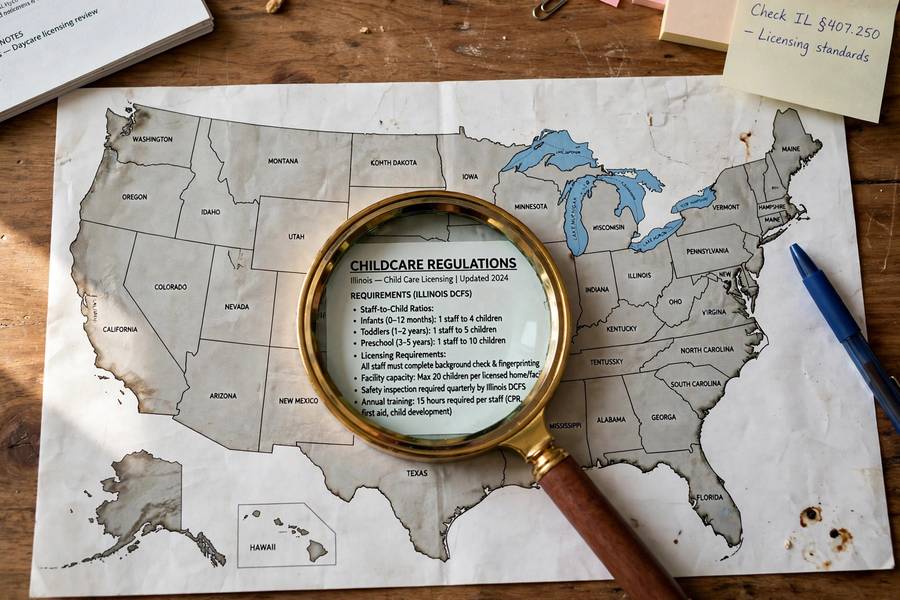
I will not name-and-shame specific states here because rules change, but the spectrum looks like this:
Strictest tier: Northeastern and West Coast states generally. Expect degree requirements for directors, tight ratios, extensive training hours, frequent unannounced inspections, and detailed facility standards. Startup costs are higher, but so are the rates parents will pay — the market has adapted to the cost structure.
Middle tier: Most Midwestern and Southern states. Meaningful requirements but navigable for a determined founder. Home daycare is genuinely accessible; centers require real investment.
Most lenient tier: A handful of states with minimal oversight, particularly for small home daycares. Lower barriers to entry — which also means more competition and lower price points.
Here is the strategic insight most founders miss: stricter states are often better business environments. High barriers keep out casual competitors, parents pay premium rates, and the regulatory moat protects your investment. The cheapest state to enter is often the hardest state to profit in.
The Licensing Process Step by Step
The sequence is broadly similar everywhere:
- Orientation. Attend (or complete online) the state’s pre-licensing orientation. This is usually free and mandatory. Do this first — it answers half your questions.
- Application. Submit the license application with fees, floor plans, and personal documentation. Be meticulous; incomplete applications go to the back of the queue.
- Background checks. Get fingerprinted. This takes 2–8 weeks depending on the state — start early, as it is often the longest pole in the tent.
- Training. Complete required pre-licensing training hours while the application processes.
- Home/facility preparation. Make the safety modifications, install required equipment, set up record-keeping systems.
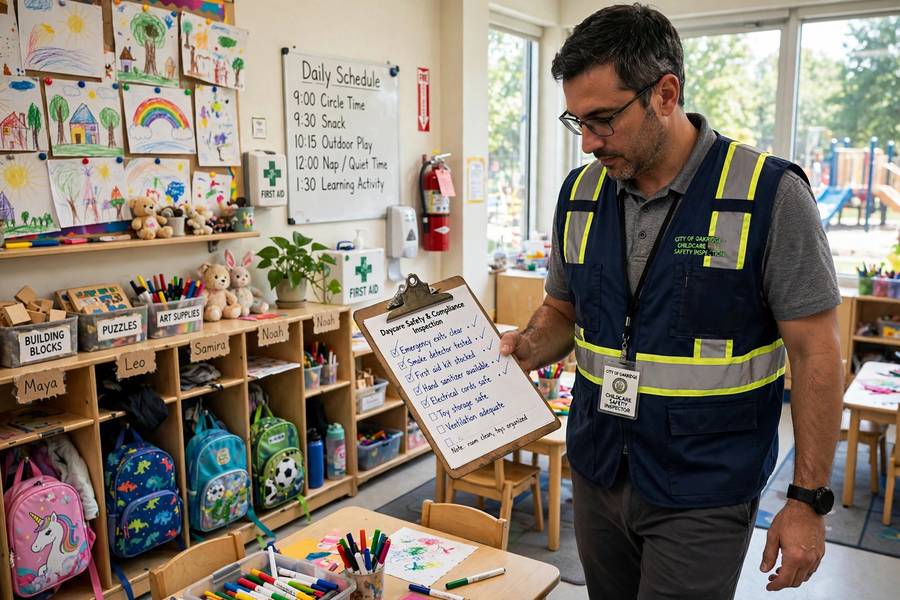
- Pre-licensing inspection. The inspector walks your space with a checklist. You will almost certainly get a correction list — this is normal, not failure.
- Corrections and re-inspection. Fix everything on the list, document it with photos, and pass the follow-up.
- License issuance. You receive your license with its capacity, age ranges, and any conditions. Frame it — you earned it.
Realistic timeline: 3–6 months for home daycare, 6–12 months for centers. Anyone promising faster is selling something.
Inspections: What to Expect
Your relationship with your licensing inspector matters enormously. Treat them as a consultant, not an adversary:
Be inspection-ready every day. With unannounced inspections, the only strategy is genuine compliance. The providers who dread inspections are the ones cutting corners.
Keep records immaculate. Inspectors spend as much time on paperwork as on the physical space. Organized files signal a well-run program.
Fix violations immediately and document it. A violation corrected on the spot with photo evidence is a very different thing from a violation that lingers across inspections. Repeat violations escalate — fines, probation, license actions.
Ask questions. Inspectors would rather answer a question now than write a violation later. The good ones are genuinely helpful. I have seen providers build collaborative relationships that made every subsequent inspection smoother.
Parents choosing care use many of the same lenses — our daycare safety checklist for parents shows what families look for, which is worth reading as the operator too.
Common Reasons Applications Get Denied
Disqualifying background findings. The most common hard stop. Some states have waiver or appeal processes; know yours before you apply.
Inadequate space. Not meeting square-footage minimums or lacking required outdoor space. Measure before you sign a lease.
Zoning non-compliance. The home daycare killer. Verify zoning before spending on anything else.
Incomplete applications. Missing documents, unsigned forms, skipped training. The bureaucratic unforced errors.
Prior enforcement history. If you have had a license revoked or been barred in another state, most states will find out through national databases.
Financial instability (centers). Some states ask for proof of financial viability. They have seen too many centers open and collapse within months, stranding families.
How to Find Your State’s Exact Requirements
Here is the professional method:
- Find your state’s childcare licensing agency. Search “[your state] child care licensing” — it is usually under the Department of Human Services, Department of Children and Families, or Department of Education. Bookmark the provider page, not the parent page.
- Download the full regulation document, not the summary brochure. It is long and boring and it is the actual law. Read the sections on your license type twice.
- Attend orientation before making any financial commitments.
- Call the licensing office with your specific questions. Ask for the analyst assigned to your county if possible. Write down names and dates — verbal guidance matters when disputes arise.
- Join your state’s family child care association (home providers) or childcare association (centers). These groups track regulatory changes and share compliance strategies. The membership fee is the best money you will spend.
- Talk to three licensed providers in your area about their licensing experience. They know which requirements the inspectors actually emphasize.
The regulations are the floor, not the ceiling. The providers who thrive treat licensing as the minimum and build their reputation on exceeding it.
Frequently Asked Questions
In most states, yes — once you care for more than a small number of unrelated children (often 3–6, depending on the state). A few states exempt very small arrangements. Check your state’s threshold before assuming you’re exempt; operating unlicensed when a license is required can mean fines and shutdown.
Typically 3–6 months for home daycare and 6–12 months for centers. Background checks (2–8 weeks) are often the longest step. Incomplete applications and zoning issues are the most common causes of delay.
Certain criminal convictions (especially involving children, violence, or drugs) are automatic disqualifiers in every state. Other common reasons: inadequate facility space, zoning violations, incomplete applications, and prior license revocations. Some states offer waiver or appeal processes.
It varies by state — many conduct unannounced inspections at least annually, while some announce routine visits. The safe approach is to operate as if an inspector could walk in any day, because in many states they can.
Search for your state’s child care licensing agency (usually under Human Services or Children and Families), download the full regulation document for your license type, attend the pre-licensing orientation, and join your state’s childcare provider association for practical guidance.