Daycare Safety Checklist for Parents: 25 Things to Verify Before Enrolling

I’m going to be straight with you: most parents choose a daycare on vibes. The place felt warm, the director was nice, the kids looked happy — done. Vibes matter, but they’re not a safety system. I’ve seen the inside of this industry, and the difference between a genuinely safe program and a lucky one is a set of specific, verifiable things. This daycare safety checklist for parents gives you those things — 25 of them — so your decision rests on evidence, not just a good tour.
A quick note on perspective: I write about the business side of childcare at how to start a daycare. Good providers WANT you to ask these questions — it’s how they distinguish themselves from the ones hoping you won’t.
Licensing and Credentials
Start here. Everything else is secondary if the basics aren’t legal.
- Verify the license yourself. Don’t take their word for it — look up the facility on your state’s childcare licensing website. Confirm the license is current, and read the inspection history. Past violations are public record in most states.
- Read the actual violations, not just the count. A citation for “paperwork filed late” is noise. A citation for “out of ratio” or “unsupervised child” is signal. Learn to tell the difference.
- Ask about staff background checks. Every adult with child contact should have fingerprint-based background checks. Ask when they were last run — “at hire” is minimum; periodic rechecks are better.
- Confirm CPR and first aid certification. Not “someone on staff” — ask what percentage of classroom staff is currently certified, and when certifications expire. The answer should be immediate and specific.
- Check required training hours. States mandate annual training hours for caregivers. Ask what training staff completed this year. A provider investing in training is a provider investing in your child.
How to ask without sounding adversarial: “I’m comparing a few programs and putting together my notes — could you tell me…” Framed as diligence, not accusation. The good providers will respect it; the bad ones will get defensive. That reaction is itself data.
Staff and Supervision
Your child will spend more waking hours with these people than with you on weekdays. Vet them like it matters — because it does.
- Observe the actual ratios. Count children and adults in each room during your tour. Compare to your state’s required ratios (infants typically 1:3 or 1:4, toddlers 1:4 to 1:6, preschool 1:8 to 1:12). If the room is over ratio during a scheduled tour — when they’re on their best behavior — imagine a normal Tuesday.
- Ask about staff turnover. “How long has the lead teacher in the infant room been here?” High turnover is the industry’s chronic problem, and it’s a safety issue too — unfamiliar caregivers miss cues. Look for programs where lead teachers stay 2+ years.
- Watch how staff interact with children. During your tour, are caregivers at the children’s eye level? Do they respond to crying promptly? Are they on their phones? Ten minutes of observation tells you more than any brochure.
- Ask about the discipline policy — in writing. It should be positive guidance (redirection, natural consequences), never physical, never shaming. If they can’t produce a written policy, that’s a problem.
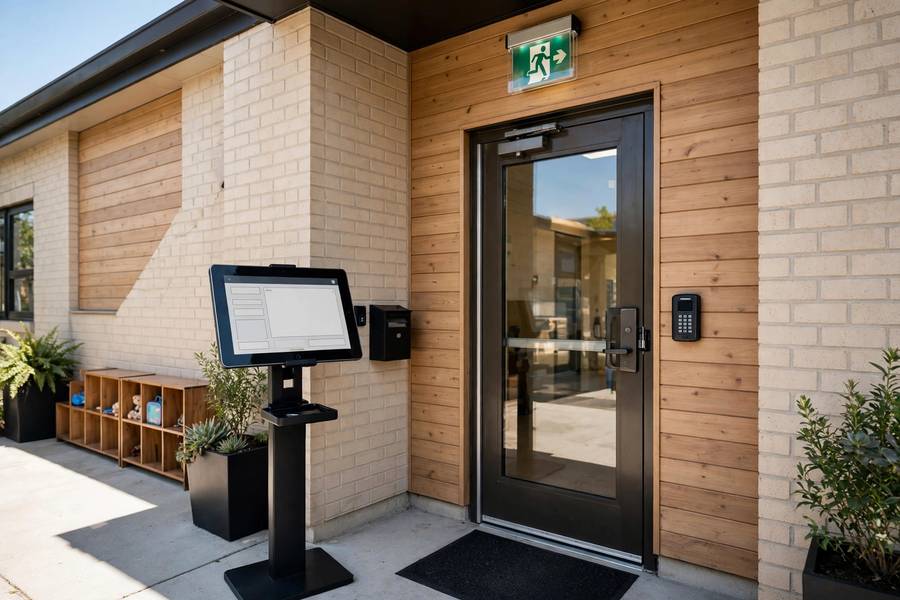
- Confirm the authorized pickup system. How do they verify who’s taking your child? Photo ID checks, authorized pickup lists, codes or keypads. “We know all the parents” is not a system — it’s a hope.
The Facility Walk Through
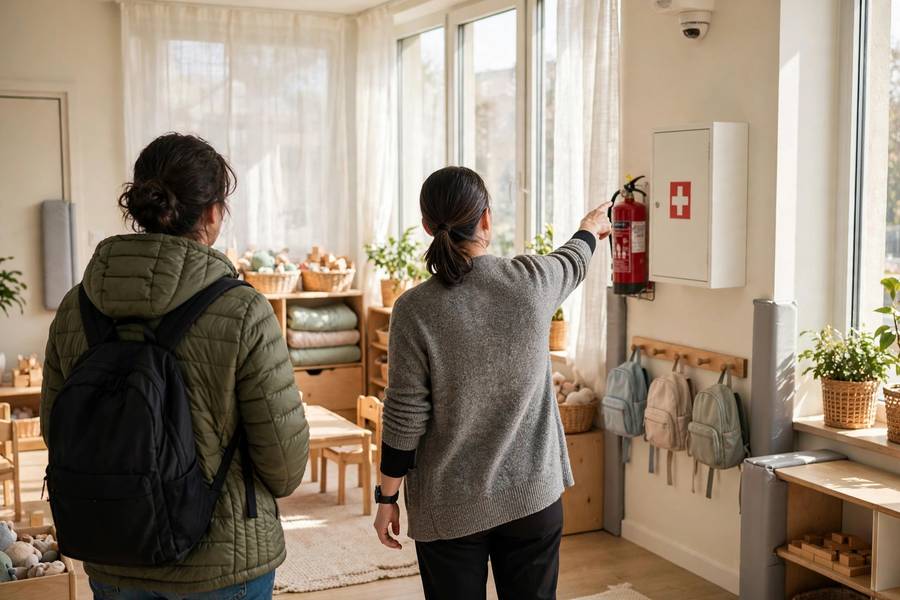
Tour with fresh eyes and a slow pace. Here’s what to actually look at:
- Entry security. Is the front door locked during operating hours? How do visitors get in — buzzer, keypad, staff escort? An unlocked front door with free access is an immediate disqualifier.
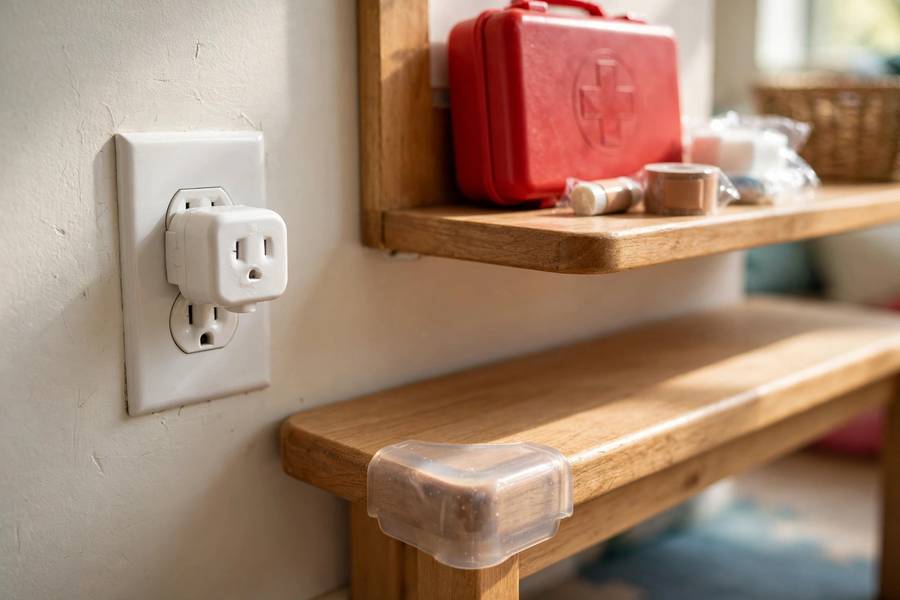
- Outlet covers, corner guards, gated stairs. The basics should be visible everywhere, not just in the room they show you first. Ask to see the bathrooms and hallways too.
- Sleep areas. Infants must sleep on their backs in bare cribs — no blankets, bumpers, or stuffed animals (safe sleep standards). Ask about their safe sleep policy and watch a naptime if you can.
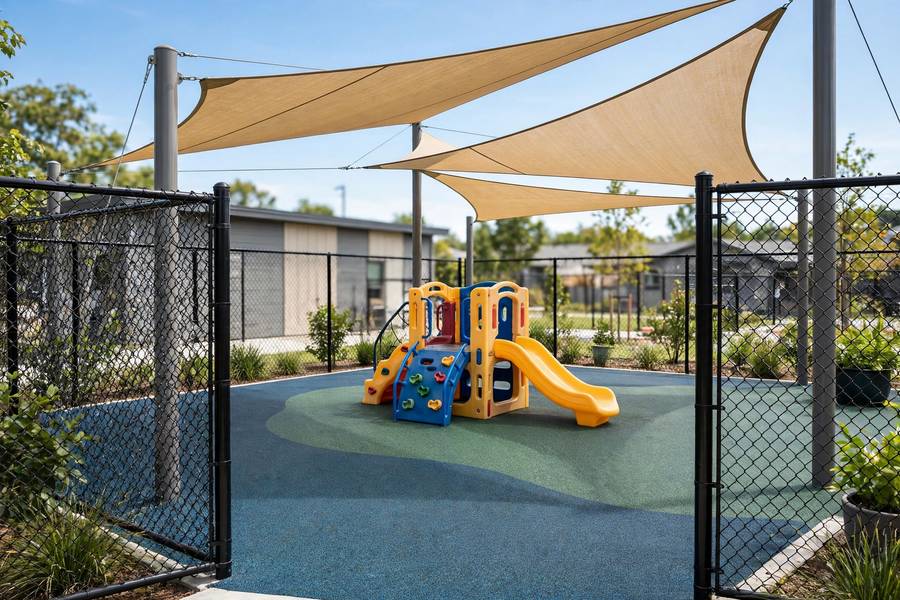
- Outdoor play space. Fenced with a self-latching gate, age-appropriate equipment, soft landing surfaces (rubber mulch or mats, not concrete), shade, and no standing water or accessible hazards. Check the fence line yourself — gaps and broken latches are common.
- Cleanliness at child level. Get down to a toddler’s height. Are the floors clean? Are small objects (choking hazards) picked up? Are cleaning supplies locked away — actually locked, not just “put up high”?
The unannounced drop-in test: after enrolling, drop in unannounced occasionally at different times. Not to catch them — to see the real operation. Programs that welcome this are confident in their daily reality. Programs that discourage it are telling you something.
Health and Hygiene Standards
Illness policies protect your child and reveal how seriously a program takes health:
- Handwashing routines. Children and staff should wash hands on arrival, before meals, after toileting, after outdoor play. Watch whether it actually happens or just appears in the handbook.
- Illness exclusion policy — in writing. Fever thresholds, vomiting/diarrhea rules, return criteria (typically fever-free 24 hours without medication). Vague policies mean sick kids stay and everyone gets sick.
- Food handling. If meals are provided: is the kitchen clean, is food stored properly, are allergies tracked visibly (not just in a file)? Ask how they handle a severe allergy — the answer should involve specific protocols, not reassurances.
- Diapering and toileting procedures. Gloves, sanitized changing surfaces between children, proper handwashing after. For potty-training ages: how do they handle accidents? With patience and discretion, or frustration?
- Medication administration. Written authorization required, medications locked, logged doses with times and staff initials. “We just give it when they need it” is not a medication policy.
Emergency Preparedness
You hope it’s never tested. Verify it anyway.
- Fire drills and evacuation plans. Ask how often they drill (monthly is standard), where children go, and how infants are evacuated (cribs on wheels are the standard method — ask to see them). The plan should be posted, not just described.
- Severe weather and lockdown procedures. Tornado/hurricane shelter areas, lockdown protocols for intruder situations. Staff should be able to describe these without hesitation.
- First aid supplies. Ask to see the first aid kits — in each classroom, not just the office. Check expiration dates on the spot. Expired supplies in a dusty kit tell you preparedness is theoretical.
- Emergency contacts and authorization. Your file should include multiple emergency contacts, medical authorization forms, and your pediatrician’s info. Ask how they’d reach you if phones are down — the good programs have a plan B.
- Incident reporting. How and when do they notify you of injuries? You want: immediate call for anything beyond a minor scrape, written incident reports for everything, with photos. Ask to see a blank incident report form — its existence and detail level tells you everything.
Daily Communication
Safety isn’t just physical — it’s knowing what’s happening with your child every day:
- Daily reports. What did they eat, how long did they nap, diaper changes, mood, activities? Digital (app with photos) or paper — either works, but it must be consistent and detailed. “Good day!” is not a daily report.
- Photo updates. Not for cuteness — for evidence. Photos of your child engaged, eating, playing tell you the day is real and supervised. Programs that share freely are programs with nothing to hide.
- Responsiveness. Text or call with a question during the decision process and time the response. Under 2 hours during business hours is good. Over 24 hours is a preview of how they’ll communicate in an emergency.
- Parent-teacher conferences. At least twice a year, structured, with developmental observations. It signals the program sees your child as an individual, which is the foundation of attentive care.
This communication standard is also what makes balancing work and personal life possible for working parents — when you trust the daily updates, the workday guilt drops dramatically.
Red Flags That Mean Walk Away
Individual concerns can be discussed. These are walk-away signals — no second chances:
- Reluctance to show you the license or inspection history. If it’s hard to verify, it’s bad.
- No written policies for discipline, illness, emergencies, or pickup authorization. Verbal reassurances aren’t policies.
- Over ratio during your tour. They’re showing you their best. Their best is illegal.
- Staff can’t answer basic safety questions. “What’s the evacuation plan?” met with blank stares means drills don’t happen.
- High-pressure enrollment tactics. “This spot will be gone tomorrow” for childcare is manipulation, not marketing. Good programs have waitlists; they don’t need pressure.
- Badmouthing other programs or former families. Unprofessional, and it’ll be you they’re badmouthing next.
- Your gut says no. After 25 checks, trust the feeling too. You’re entrusting them with your child — comfort matters alongside compliance.
One more thing: the best programs encourage you to check everything on this list. When I describe quality markers like the Montessori method explained, the underlying principle is the same — intentional, observable, professional care. If a provider welcomes your scrutiny, that’s the strongest signal of all.
Frequently Asked Questions
Look up the facility on your state’s childcare licensing website — licenses and full inspection histories are public record in most states. Read past violations carefully: paperwork citations are noise, but ratio violations or supervision failures are serious signals.
Count actual staff-to-child ratios in each room, check entry security (locked doors, visitor procedures), look at outlet covers and gated stairs, inspect the outdoor fence, observe staff-child interactions, and ask about CPR certification, discipline policy, and emergency drills — all in writing.
Walk away from: reluctance to show licensing, no written safety policies, over-ratio classrooms during tours, staff who can’t describe emergency procedures, high-pressure enrollment tactics, and visible hazards like unlocked doors or unfenced play areas.
Ask about background checks (fingerprint-based), CPR/first aid certification percentages, annual training hours completed, and lead teacher tenure — 2+ years in the same classroom is a strong signal. Watch ten minutes of actual staff-child interaction during your tour.
Yes, occasionally and at different times. It shows you the real daily operation, not the tour version. Quality programs welcome drop-ins confidently; programs that discourage them are telling you something important.