

Ask ten fitness experts when to work out and you’ll hear ten different answers. The 5 a.m. crowd swears by sunrise sessions. The after-work crew insists evenings are where real progress happens. So who’s right?
Here’s the honest answer: the best time to exercise is the time you’ll actually do, week after week. Consistency beats timing every time. But that doesn’t mean timing is irrelevant. Your body temperature, hormones, and energy levels follow a daily rhythm, and those shifts can genuinely affect how strong, fast, and focused you feel during a workout.

This guide breaks down the real pros and cons of morning and evening exercise, what the science actually shows, and how to pick the slot that fits your life — because a good workout at a “suboptimal” hour beats the perfect workout you skip.
Does Workout Timing Actually Matter?
Yes, but not as much as most people think. Researchers who study circadian rhythms — the body’s internal 24-hour clock — have found measurable differences in physical performance across the day. Core body temperature peaks in the late afternoon, and that warmth tends to coincide with slightly better strength, power, and flexibility.
At the same time, habit research consistently shows that people who exercise at the same time every day stick with their routines far longer than people who constantly rearrange their schedule. That means the “best” time on paper is meaningless if it doesn’t survive your real calendar.
Think of it this way: timing is a small multiplier on top of a much bigger number — consistency. A 5% performance edge from training at the ideal hour doesn’t matter if it causes you to skip half your sessions.
Morning Exercise: The Case For It
Morning workouts have one massive advantage that has nothing to do with physiology: they happen before the day can interfere. Meetings run late, kids get sick, traffic piles up — but none of that touches a workout that’s already done by 7 a.m.
Beyond reliability, many people report that morning exercise sets the tone for the entire day. A brisk session before breakfast can leave you sharper and more alert at work, partly because exercise wakes up your nervous system and partly because starting the day with a win feels good.
Don’t forget morning hydration either — here are the benefits of drinking water in the morning.
Pros of Morning Workouts
- Fewer conflicts: Your schedule is least likely to be hijacked early in the day, so adherence tends to be higher.
- Better sleep for many people: Morning exercisers often report falling asleep more easily at night, possibly because physical activity reinforces the body’s wake-up signal.
- Mood boost that lasts: Exercise triggers the release of endorphins and other feel-good chemicals, and a morning session spreads that lift across your whole day.
- A quieter gym: If you train at a gym, mornings before rush hour usually mean shorter waits for equipment.
Cons of Morning Workouts
- Stiffer start: Your body temperature is at its lowest in the early morning, so joints and muscles need a longer, more deliberate warm-up.
- Slightly lower peak strength: You probably won’t lift your heaviest or sprint your fastest at 6 a.m. compared to late afternoon.
- The wake-up cost: If you’re not naturally a morning person, the habit may only survive if you protect your bedtime — and many people don’t.
Evening Exercise: The Case For It
By late afternoon and early evening, your body is fully warmed up. Body temperature is near its daily peak, reaction times are sharp, and muscles are more pliable than they were at dawn. For pure performance — your heaviest lift, your fastest mile — this window is hard to beat.
Evenings also offer something mornings can’t: decompression. After a day of sitting, deadlines, and screens, a workout acts as a pressure valve. Many people find that exercise is the most effective way to mentally switch off from work.

Pros of Evening Workouts
- Peak physical performance: Strength, power, and flexibility tend to be at their daily best between late afternoon and early evening.
- Stress relief: Exercise after work can defuse the day’s tension instead of carrying it to bed.
- Warmer, looser muscles: A full day of movement means you’re naturally warmed up, which can lower the risk of strains.
- Social and class options: Most group classes and training partners are available in the evening.
Cons of Evening Workouts
- Life gets in the way: Late meetings, social plans, and simple fatigue are the top reasons evening exercisers skip sessions.
- Sleep disruption for some: Vigorous exercise very close to bedtime can make it harder to fall asleep. The effect varies a lot from person to person.
- Crowded facilities: Gyms are typically busiest between 5 and 8 p.m.
What Does the Science Actually Say?
Let’s be careful here, because workout timing is one of those topics where headlines overstate modest findings. Here’s what’s genuinely well-established versus what’s hype.
Well-established
- Performance follows body temperature. Measures like grip strength, vertical jump, and sprint speed tend to peak in the late afternoon and early evening, tracking core body temperature. The difference is real but small — a few percentage points, not a transformation.
- Same time every day builds stronger habits. People who train at a consistent hour automate the routine faster than people who vary their timing. Habit strength is one of the best predictors of long-term exercise adherence.
- Timing can shift your sleep clock. Bright morning light plus morning exercise reinforces an early chronotype, while intense late-night training can delay sleepiness.
Overhyped
- Fasted morning cardio “burns more fat.” Any tiny difference in fat burning during the session tends to wash out over 24 hours. Total diet and total activity matter far more than whether you ate before the workout.
- There’s one magic hour for everyone. Individual chronotypes — whether you’re a natural lark or owl — matter more than the clock. A night owl forcing 5 a.m. workouts is fighting biology and will likely quit.
What About Weight Loss and Muscle Building?
If your goal is weight loss, the honest truth is that exercise timing barely moves the needle compared to your overall diet and weekly activity. Burning roughly the same calories at 7 a.m. or 7 p.m. leads to roughly the same result. Choose the time you’ll sustain.
For muscle building, there’s a mild argument for late afternoon or evening sessions, when you’re at your strongest and can handle slightly heavier loads or more volume. But the far bigger levers are progressive overload, enough protein, and sufficient sleep. If you want a program built for home training regardless of hour, our guide to building muscle at home covers bodyweight progressions and minimal-equipment routines that work morning, noon, or night.

How to Choose Your Time: A Simple Decision Guide
Forget the “right” answer and run through these questions instead:
- When do you actually have free time? Look at your real week, not an ideal one. Pick the slot with the fewest conflicts.
- Are you a morning person or a night owl? Match your workouts to your natural energy peaks, not someone else’s routine.
- When do you sleep best afterward? If late training keeps you wired, move sessions earlier. If morning workouts leave you groggy all day, try evenings.
- Can you keep the same hour? Consistency of timing helps habits form. A fixed 6:30 p.m. slot beats “whenever I feel like it.”
- What did you actually do last month? Your track record is data. If you’ve tried mornings for years and always quit, try evenings.
Answer honestly and the “best” time reveals itself — it’s personal, not universal.
Timing Tips for Home Workouts
Training at home removes the commute but adds new timing considerations. Without a gym’s fixed hours, it’s easier to let “later” become “never” — so home exercisers benefit even more from a locked-in schedule.
- Anchor it to an existing habit. Train right after waking up, immediately after work, or just before your evening shower. Anchored habits survive busier than floating ones.
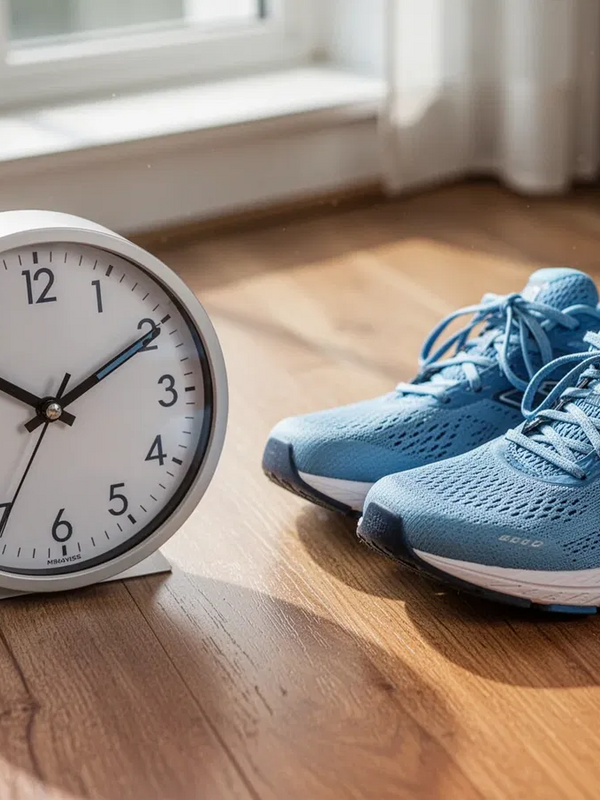
- Set out your gear the night before. Visible shoes, a mat, or dumbbells reduce morning friction to nearly zero.
- Keep sessions shorter on low-energy days. A 20-minute workout you complete beats the 60-minute one you skip. Scaling down keeps the streak alive.
If you’re just getting started with training at home, a structured plan removes the guesswork — our no-gym muscle-building guide lays out a full weekly program you can slot into whatever hour you choose.
Neither is universally better. Evenings offer a slight performance edge because your body is warmer, while mornings tend to win on consistency and sleep quality. The best choice is the time you’ll repeat most days.
It can for some people, especially vigorous training within an hour or two of bedtime. But many people sleep fine after evening workouts. If your sleep suffers, try moving sessions earlier or switching to lighter activity at night.
A light snack — a banana, toast, or a few sips of a sports drink — helps most people perform better, especially for sessions longer than 45 minutes. For short, easy workouts, water alone is fine. What matters is that you fuel your total day adequately.
A common guideline is about 1–2 hours after a full meal and 30–60 minutes after a small snack. Exercising on a very full stomach often causes discomfort, while a small pre-workout snack is usually well tolerated.
Not in any meaningful way. Research shows total daily diet and total activity determine fat loss far more than whether you eat before cardio. Train fed or fasted based on whichever feels better and lets you perform well.
Late afternoon to early evening may offer a small edge for strength sessions, since you’re at your strongest then. But training consistently with progressive overload matters far more. If you train at home, here’s a complete home workout program that works at any hour.
The Bottom Line
The morning-versus-evening debate will never fully settle, because the honest answer is personal. Evening sessions may squeeze out a few extra percentage points of performance. Morning sessions tend to survive real life better. Both can build an excellent body of work over a year.
So pick the time that fits your energy, your schedule, and your sleep — then protect it like an appointment. Twelve months of consistent 6 a.m. jogs will always beat six weeks of “perfectly timed” workouts you abandon. The clock matters less than the commitment.




Pingback: How to Build Muscle at Home: The No-Gym Guide