
You don’t need a gym membership to build real muscle. What you need is a body that can be loaded progressively, enough food to fuel growth, and a program you actually follow. All three are available in your living room.
The idea that muscle only grows under barbells is one of fitness’s most persistent myths. Your muscles can’t tell the difference between a dumbbell and a heavy backpack — they only sense tension. Apply enough tension, keep increasing it over time, and they will grow.
This guide covers everything: the science of why muscles grow, the best bodyweight and minimal-equipment exercises, a complete weekly program, and the nutrition and recovery rules that make it all work — no gym required.
Can You Really Build Muscle Without a Gym?
Yes — up to a point that surprises most people. Beginners and intermediate lifters can build substantial muscle at home for years. Studies on bodyweight training show meaningful muscle and strength gains when exercises are taken close to failure and progressed over time.
The ceiling is higher than people think, too. With push-up variations, pull-up progressions, single-leg squats, and a pair of adjustable dumbbells or resistance bands, you can challenge every major muscle group. The only people who truly outgrow home training are advanced lifters chasing maximal strength — and even they can maintain or grow for long stretches with smart programming.
The real bottleneck is rarely equipment. It’s progression: most home workouts fail because people do the same 20 push-ups for months. Muscles adapt to what you did last time; growth demands a reason to get bigger. That reason is progressive overload.
The 4 Rules of Muscle Growth (Wherever You Train)
These principles are non-negotiable, gym or no gym:
- Progressive overload: Gradually increase the difficulty — more reps, harder variations, slower tempos, added weight, or shorter rest periods. If your workouts look identical every week, your muscles have no reason to change.
- Train close to failure: The final few reps of a set — the ones that feel hard — drive most of the growth. You don’t need to collapse on the floor, but stopping while you could easily do 10 more reps won’t cut it. Leave 1–3 reps “in the tank.”
- Hit each muscle 2+ times per week: Muscles respond better to being trained twice a week than once. A full-body routine three times weekly is the simplest way to guarantee this.
- Eat and sleep enough: Training is the stimulus; food and sleep are where growth happens. A slight calorie surplus (eating a bit more than you burn) plus adequate protein supports muscle gain. Most adults do well with roughly 1.6–2.2 grams of protein per kilogram of bodyweight per day, spread across meals.
What Equipment Do You Actually Need?
Start with nothing. Your bodyweight is genuinely enough for the first several months if you progress exercises properly. When bodyweight alone stops being challenging, add gear in this order of value:
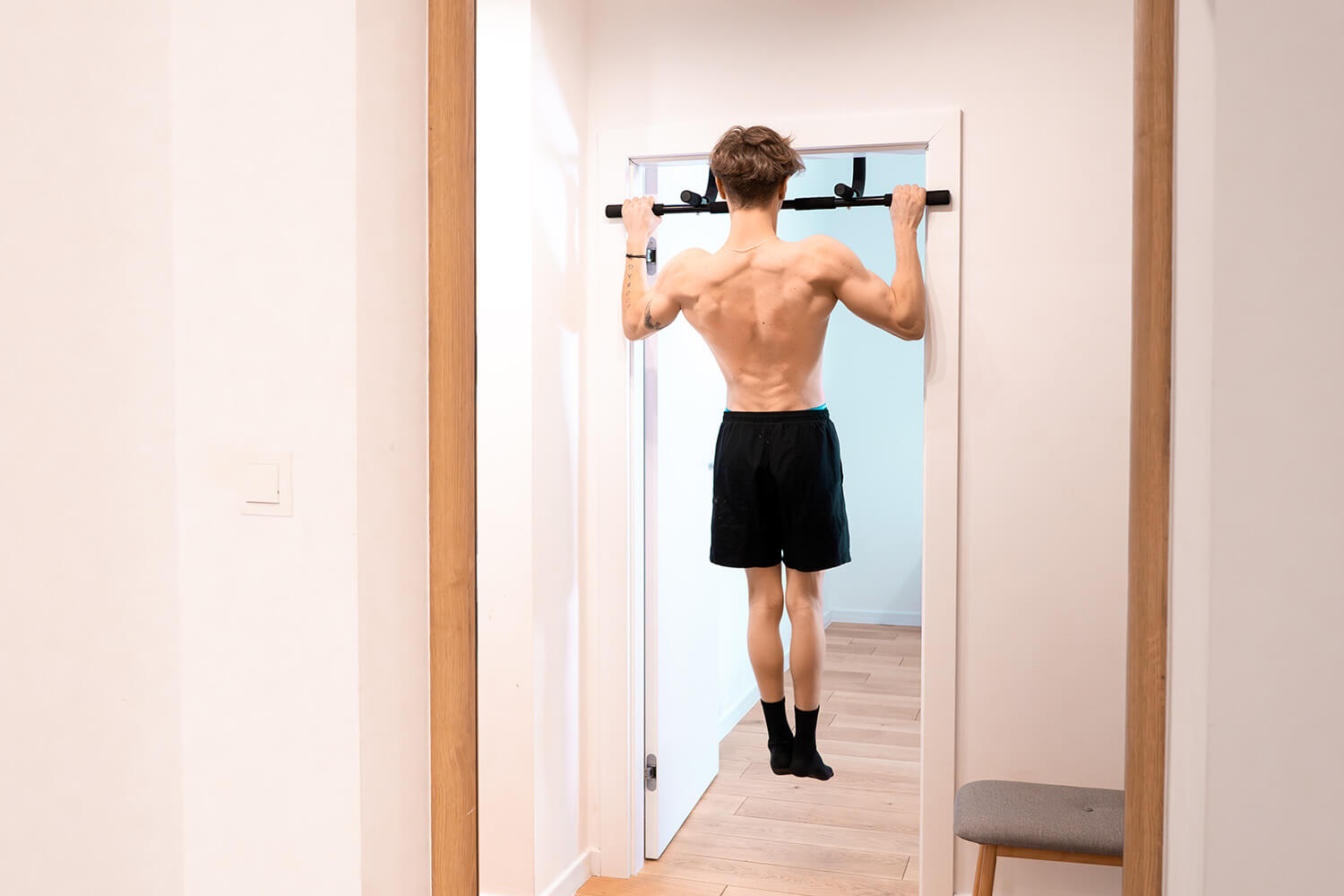
- A doorway pull-up bar — the single best home investment. Back and biceps are nearly impossible to train hard without something to pull on.
- Resistance bands — cheap, portable, and excellent for adding tension to pressing and rowing movements.
- Adjustable dumbbells — the most versatile single purchase. They add dozens of movements and precise progression.
- A sturdy chair or bench — for dips, Bulgarian split squats, and hip thrusts.
- A backpack you can load with books — free weighted vest for push-ups and squats.
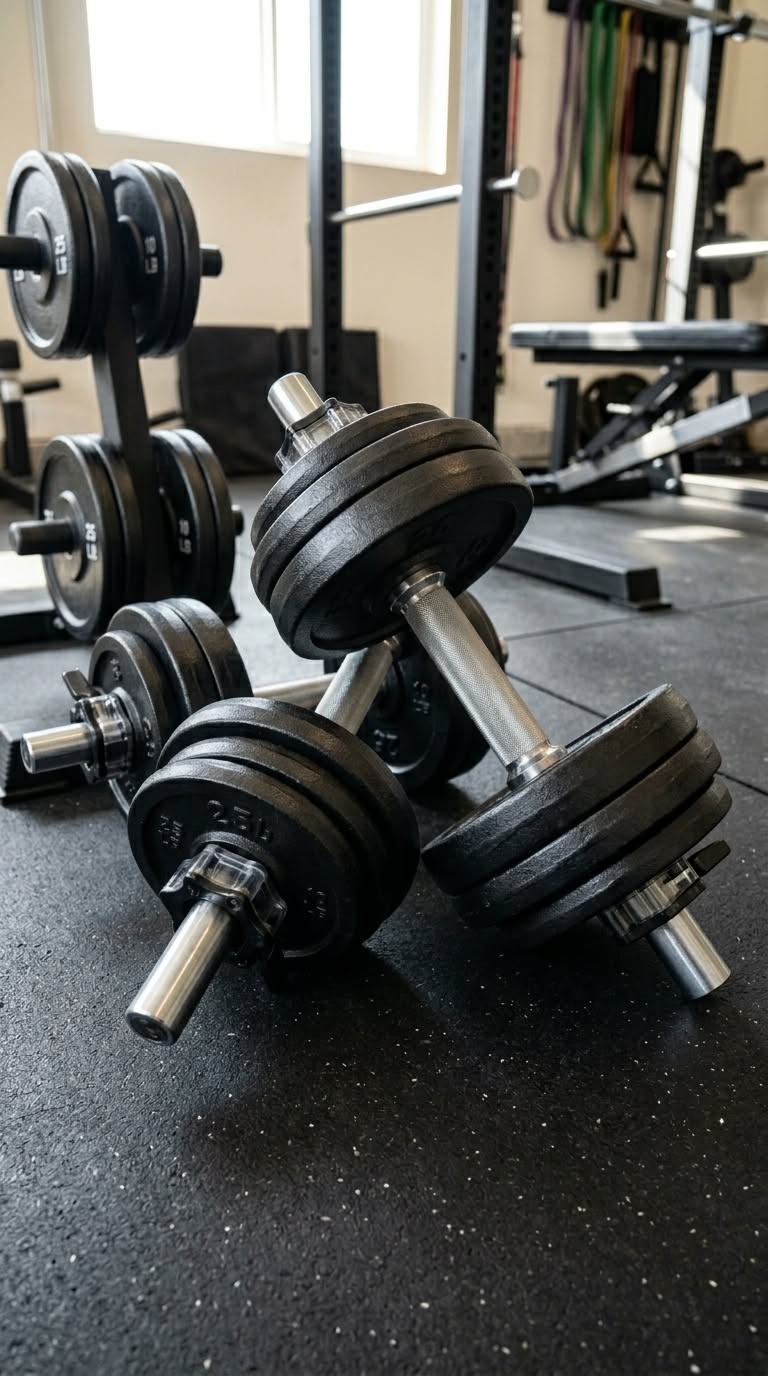
That’s it. A pull-up bar, bands, and adjustable dumbbells cost less than a few months of most gym memberships and cover everything below.
The Best Home Exercises by Muscle Group
Each exercise lists an easy start and a harder progression, so you can keep overloading for months.
Chest
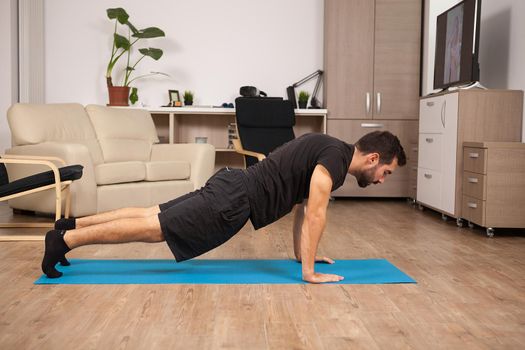
- Push-ups → incline push-ups (hands on a chair) → standard → diamond push-ups → archer push-ups → one-arm push-up progressions.
- Dumbbell floor press — lie on your back, press dumbbells from chest level. Great when push-ups get easy.
Back
- Pull-ups / chin-ups → dead hangs → negative pull-ups (jump up, lower slowly) → full reps → weighted with a backpack.
- Bent-over dumbbell rows or band rows — hinge at the hips, pull the weight to your ribs.
Legs
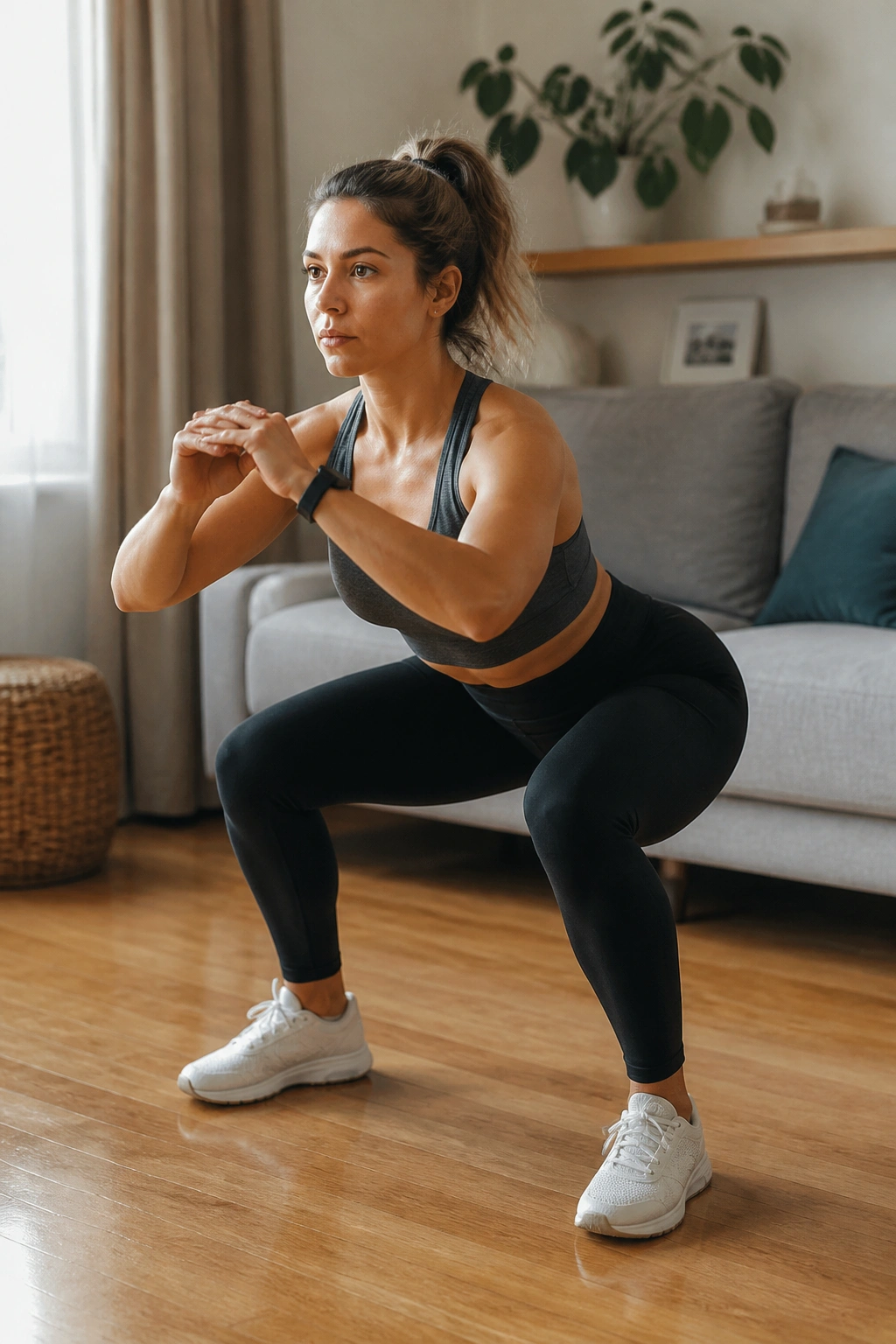
- Bodyweight squats → split squats → Bulgarian split squats (rear foot on a chair) → pistol squat progressions.
- Glute bridges → single-leg glute bridges → hip thrusts with shoulders on a chair.
- Romanian deadlifts with dumbbells — hinge at the hips, keep a flat back; the king of home hamstring training.
Shoulders
- Pike push-ups (hips high, head toward the floor) → feet-raised pike push-ups → wall handstand push-up progressions.
- Dumbbell overhead press and lateral raises — simple, effective, hard to mess up.
Arms
- Chair dips → straight-leg dips → weighted dips for triceps.
- Dumbbell or band curls for biceps; chin-ups also hammer them.
Core
- Planks → longer holds → plank shoulder taps → ab-wheel or band rollouts.
- Dead bugs and hollow-body holds — safer and more effective than endless crunches.
The Complete 3-Day Home Program
This full-body routine hits every muscle group three times per week — the sweet spot for growth. Each session takes 45–60 minutes. Rest 60–90 seconds between sets, 2–3 minutes between exercises.
Day A
- Push-ups (or your current progression): 3 sets of 8–15 reps
- Bulgarian split squats: 3 sets of 8–12 reps per leg
- Dumbbell or band rows: 3 sets of 10–15 reps
- Pike push-ups: 3 sets of 6–12 reps
- Plank: 3 holds of 30–60 seconds
Day B
- Pull-ups / chin-ups (or negatives): 4 sets of as many as possible
- Dumbbell Romanian deadlifts: 3 sets of 10–15 reps
- Dumbbell floor press: 3 sets of 8–12 reps
- Glute bridges or hip thrusts: 3 sets of 12–20 reps
- Dead bugs: 3 sets of 10 reps per side
Day C
- Bodyweight squats (or pistol progression): 3 sets of 12–20 reps
- Chair dips: 3 sets of 8–15 reps
- Dumbbell overhead press: 3 sets of 8–12 reps
- Dumbbell or band curls: 3 sets of 10–15 reps
- Hollow-body hold: 3 holds of 20–40 seconds
Run A-B-C across the week (e.g., Monday, Wednesday, Friday), then repeat. When you can complete all sets at the top of the rep range with 1–2 reps left in the tank, move to a harder variation or add weight. That’s progressive overload in action.
Nutrition: Eating to Grow
Training provides the signal, but muscle is built from food. Two things matter most:
- Enough total calories. To gain muscle, eat slightly above maintenance — roughly 200–300 calories over what keeps your weight stable. Gaining more than about 0.25–0.5% of bodyweight per week usually means extra fat, not extra muscle.
- Enough protein. Aim for roughly 1.6–2.2 grams per kilogram of bodyweight daily, spread over 3–4 meals. Each meal should include a palm-sized portion of protein: eggs, chicken, fish, Greek yogurt, lentils, tofu, or whey.
Carbs fuel your workouts; don’t fear them. A meal with carbs and protein 1–3 hours before training and a protein-rich meal afterward is a simple, effective pattern.
Recovery: The Forgotten Half of the Program
Muscles don’t grow during the workout — they grow during the recovery afterward. Training creates the stimulus; sleep, rest days, and deload weeks do the building.
- Sleep 7–9 hours. Growth hormone release peaks during deep sleep. Consistently sleeping 5–6 hours will blunt your results no matter how good the program is.
- Take rest days seriously. Three hard sessions per week with real rest days between them beats five half-recovered sessions.
- Deload every 6–8 weeks. Cut volume roughly in half for a week to let joints and tendons catch up with your muscles.
When you train matters less than that you recover well — but if you’re deciding between morning and evening sessions, our guide to the best time to exercise breaks down the real pros and cons of each.
On training days, hydration matters as much as protein — see the benefits of drinking water in the morning.
Common Mistakes That Stall Home Gains
- Doing the same workout forever. Without progression, you maintain — you don’t grow. Track reps and variations, and make each week slightly harder.
- Training to total failure every set. Grinding out ugly, painful reps wrecks recovery without adding much growth. Stop 1–3 reps short.
- Skipping legs and back. Push-ups alone build an unbalanced physique. Pull-ups and split squats are non-negotiable.
- Undereating. You cannot build significant muscle in a large calorie deficit. If the scale hasn’t moved in a month, you’re probably not eating enough.
- Program hopping. Give any program at least 8–12 weeks before judging it. Constant switching resets your progress.
Beginners typically notice visible changes within 8–12 weeks of consistent training and proper eating, with meaningful muscle gain over 6–12 months. Strength improves faster than size at first — that’s normal.
Yes, especially as a beginner or intermediate. Push-up, pull-up, squat, and hinge progressions can challenge muscles for a long time. Adding a pull-up bar and eventually dumbbells or bands extends the runway considerably.
Three full-body sessions per week is the sweet spot for most people — enough stimulus for growth with enough recovery between sessions. More is fine only if you can recover from it.
No. Protein powder is convenient, not magical. If you hit your daily protein target from whole foods — meat, eggs, dairy, legumes — a shake adds nothing extra. It’s simply an easy way to fill a gap.
The time you’ll do consistently. That said, there are genuine differences between morning and evening training — performance, sleep, and adherence all shift with the hour. Our morning vs. evening exercise comparison walks through the science so you can pick your slot.
Absolutely. Muscle responds to resistance training at any age — research consistently shows adults well into their 60s and beyond gain strength and muscle from progressive training. Prioritize a thorough warm-up, progress gradually, and protect your sleep.
The Bottom Line
Building muscle at home comes down to four things: exercises you can make harder over time, training each muscle twice a week, eating slightly more protein and calories than maintenance, and sleeping enough to recover. A pull-up bar, some bands, and a pair of adjustable dumbbells remove every real excuse — the rest is showing up three times a week for the next six months. The gym was never the magic. The program is. Start with Day A today, and pick a training hour that fits your life — here’s how to choose the best time to exercise if you’re unsure.