
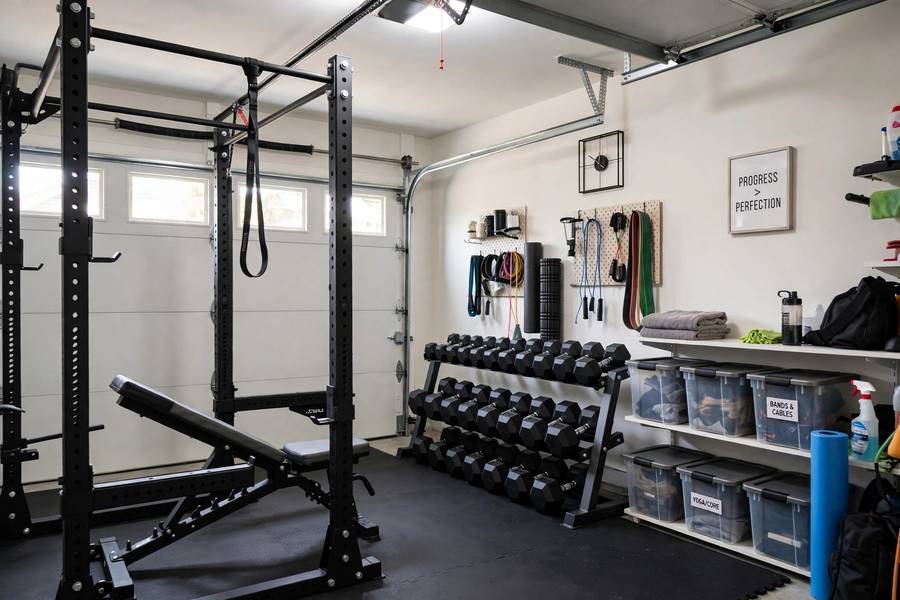
The home gym market wants you to believe you need a $5,000 all-in-one machine to train at home. You don’t. I’ve helped dozens of clients build home gyms, and the best ones — the ones actually used for years — are usually the simplest. A few versatile pieces, bought in the right order, in whatever space you have.
The secret to a great home gym isn’t the budget. It’s buying in the right sequence so every dollar adds training capability, and setting up the space so you actually want to walk in there. Here’s exactly how to do both.
Table of Contents
- Start With Your Space, Not Your Shopping List
- Tier 1: The Essentials ($100–$300)
- Tier 2: The Serious Setup ($300–$800)
- Tier 3: The Dream Gym ($800–$2,000+)
- Flooring: Don’t Skip This
- Small Space Solutions
- What NOT to Buy
- Setting Up for Consistency
- Frequently Asked Questions

Start With Your Space, Not Your Shopping List
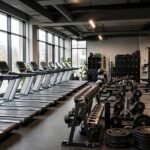
Before buying anything, measure your space and be honest about it. A power rack needs roughly 4×6 feet plus room to load plates. An adjustable bench needs 2×4 feet. Dumbbells need a corner.
Good home gym spaces, ranked:
- Garage — the classic. Concrete floors, high ceilings, ventilation. Ideal.
- Spare room/bedroom — works great with rubber mats to protect floors.
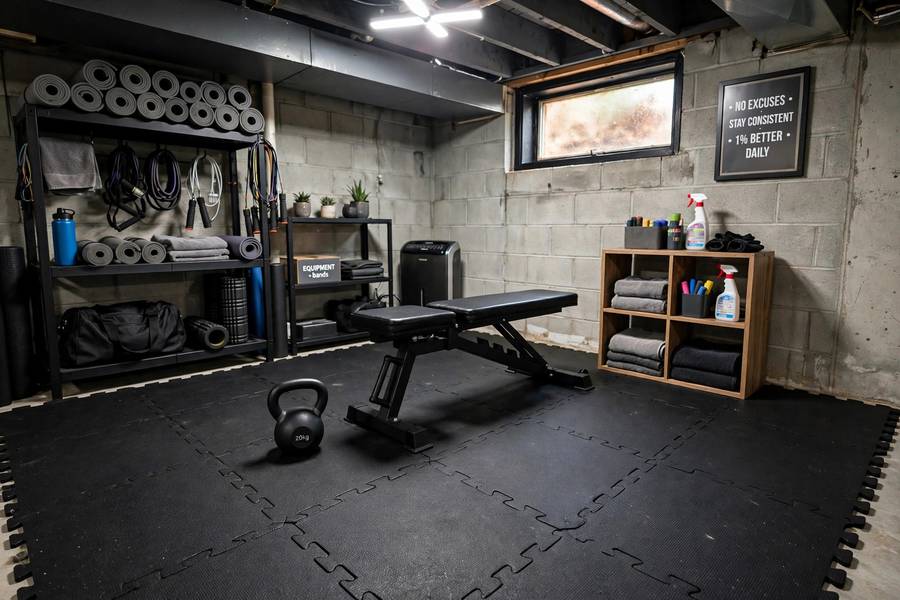
- Basement — watch ceiling height for overhead pressing and pull-ups.
- Living room corner — totally viable for dumbbell + bodyweight training.
- Balcony/patio — fine in good weather; equipment needs weather protection.
You need less space than you think. A 6×8 foot area handles 90% of training. The key insight: your gym should be set up and ready. Equipment buried in a closet doesn’t get used — friction kills home workouts faster than anything.
Tier 1: The Essentials ($100–$300)
This tier trains your entire body effectively. If this is all you ever buy, you’re covered.
Adjustable dumbbells ($100–$200). The single best home gym purchase. One pair replaces 15 pairs of fixed dumbbells. Look for quick-adjust mechanisms — slow spin-lock handles kill workout flow.
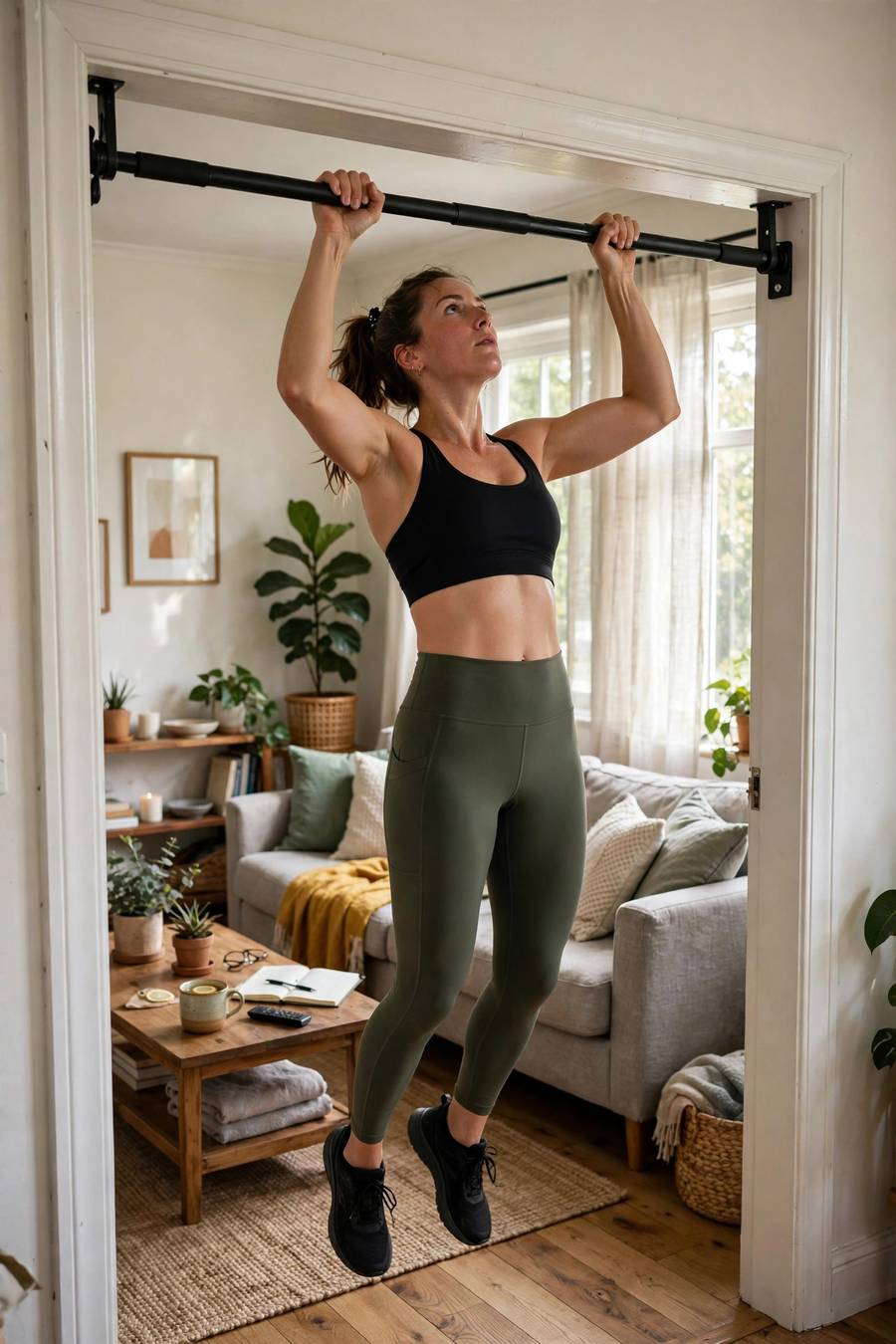
Pull-up bar ($30–$50). Doorway-mounted bars need no screws (most models) and unlock the best upper-body pulling exercise. Check your door frame width first.
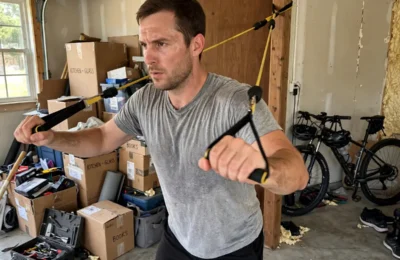
Resistance bands ($20–$40). A set of loop bands adds assistance work, warm-ups, and travel training. Not a replacement for weights, but a great complement.
Exercise mat ($20–$30). For floor work and comfort.
With just this, you can do every bodyweight exercise plus loaded pressing, rowing, squatting, hinging, and carrying. That’s a complete program. Many of my clients train for years on Tier 1 alone — it’s the foundation of building muscle at home without a commercial gym.
Tier 2: The Serious Setup ($300–$800)
Add these when Tier 1 feels limiting (usually 6–12 months in):
Adjustable bench ($100–$200). Flat/incline/decline capability unlocks proper chest work, supported rows, and Bulgarian split squats. This is the highest-impact Tier 2 purchase.
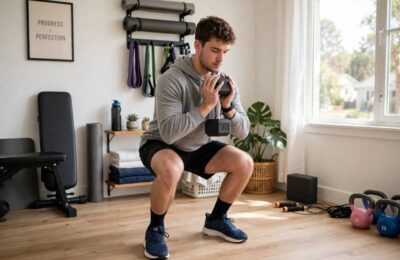
Kettlebell ($40–$80). One 16kg (men) or 12kg (women) bell adds swings, goblet squats, and carries. Start with one; add a heavier one later.
Squat stand or half rack ($200–$400). For safe barbell squatting and benching. Full power racks are better but bigger; quality stands handle most lifters fine.
Olympic barbell + plates ($200–$400 used). Buy plates used — iron is iron. Check local marketplaces; home gym equipment resells constantly at half price.
Tier 3: The Dream Gym ($800–$2,000+)
For committed lifters who’ve outgrown Tier 2:
- Full power rack with pull-up bar and safety arms
- More plates (you’ll always want more plates)
- Specialty bars (trap bar, safety squat bar)
- Cable system or functional trainer for lat pulldowns and cable work
- Cardio piece (rower, bike, or jump rope — rowers give the most bang per dollar)
Stop here unless you’re opening a commercial facility. Beyond this point, you’re collecting, not training.
Flooring: Don’t Skip This
Bare concrete is hard on equipment and joints; carpet is unstable for lifting. The answer: rubber horse-stall mats (4×6 feet, ~$40–$50 each at farm supply stores). They’re the same thing as “gym flooring” at triple the price.
Cover your lifting area — minimum one mat under your main work zone, ideally the full space. Mats protect floors from dropped weights, deaden sound (your family/neighbors will thank you), and provide stable, grippy footing.
For apartments, double up mats and avoid dropping weights from height. Your downstairs neighbors didn’t sign up for your deadlift PR.
Small Space Solutions
No garage? No problem. The best small-space setups:
- The corner gym: adjustable dumbbells + bench that folds flat + doorway pull-up bar. Fits in 4×6 feet, stores against a wall.
- The closet gym: resistance bands, a mat, and adjustable dumbbells live in a closet; you train in the living room and put it away after. Keep setup under 3 minutes or you won’t do it.
- The balcony: weather-resistant kettlebell + bands. Simple, effective, rent-free.
The principle: minimize setup friction. Every minute of assembling equipment is a minute your motivation leaks away. The best time to exercise is whenever you’ll actually do it — and a ready-to-go corner gym makes “whenever” much more likely.
What NOT to Buy
Learn from others’ expensive mistakes:
- All-in-one home gym machines. They do many things badly, break often, and cost a fortune. Free weights beat them at a third the price.
- Ab-specific gadgets. Ab wheels cost $10 and work better than $200 ab machines.
- Too much, too soon. The classic mistake: buying Tier 3 before proving you’ll use Tier 1. Earn each purchase with six months of consistent training.
- Cheap barbells. A bad barbell (poor knurling, bends under load) is genuinely dangerous. Buy quality bars, cheap plates.
- Mirrors before mats. Mats protect your floor and joints; mirrors just feed your ego. Priorities.
Setting Up for Consistency
The best equipment is useless if you don’t train. Design for adherence:
- Keep it visible and ready. Dumbbells on the stand, bench unfolded, mat down. A gym you can see is a gym you’ll use.
- Good lighting and airflow. Dark, stuffy spaces kill motivation. A fan and a bright bulb cost almost nothing.
- Entertainment ready. A phone stand or old tablet for timers and music. Some people need silence; most train better with energy.
- A simple program posted on the wall. Decision fatigue is real. Know what you’re doing before you walk in.
Your home gym’s greatest advantage isn’t convenience — it’s the removal of every excuse. No commute, no waiting for equipment, no hours. Just you and the work.
Maintaining Your Home Gym
A home gym lasts decades with minimal care:
- Wipe down benches and bars monthly — sweat corrodes over time. A damp cloth is enough.
- Check bolts quarterly. Racks and stands loosen with use. Five minutes with a wrench prevents wobbles.
- Oil barbell sleeves once or twice a year so plates spin smoothly.
- Store bands out of sunlight. UV degrades rubber fast; a drawer or bag doubles their life.
- Keep the floor clean. Sweep mats weekly — grit grinds into rubber and shortens its life.
Buy quality once and maintain it, and your $500 setup will still be going strong in 2035. That’s the real economics of home training.
The “One In, One Out” Equipment Rule
Home gyms accumulate clutter like any space. The rule: every new piece of equipment must replace or clearly outperform something you have.
Before buying, ask:
1. What specific exercise does this enable that I can’t do now?
2. Will I use it weekly for the next year?
3. Where will it live?
Two “yes” answers minimum, plus a storage spot. This discipline keeps your gym functional instead of becoming an expensive storage room with good intentions.
Frequently Asked Questions
A complete starter setup (adjustable dumbbells, pull-up bar, bands, mat) runs $100–$300. A serious setup with bench and barbell runs $300–$800. A full dream gym stays under $2,000 — less than two years of most gym memberships.
Adjustable dumbbells. One purchase replaces an entire dumbbell rack and enables full-body training in minimal space. Add a pull-up bar second.
Absolutely. Muscle grows from progressive overload, not from commercial machines. Dumbbells, a bench, and a pull-up bar provide everything needed for serious muscle building with the right program.
6×8 feet handles 90% of training. A power rack setup wants 8×8 feet. Even a 4×6 foot corner works for dumbbell and bodyweight training — the minimum viable home gym fits almost anywhere.
If you’ll train consistently at home, yes — a $500 setup pays for itself in under a year versus memberships, and the zero-commute convenience usually increases training frequency. If you need the social environment, keep the membership.
Rubber horse-stall mats (4×6 ft) from farm supply stores — identical to expensive “gym flooring” at a third of the price. They protect floors, reduce noise, and provide stable footing for lifting.