
Gyms look like simple businesses: rent space, buy equipment, collect memberships. The reality is a capital-intensive, operations-heavy grind where the winners understand one thing deeply — you’re not selling fitness, you’re selling the habit of showing up. Everything downstream flows from that.
I’ve seen the P&Ls. Big-box gyms, boutique studios, garage-gym expansions — the economics vary wildly, but the failure modes rhyme: undercapitalization, wrong location, and a membership model that doesn’t survive January’s resolution crowd leaving by March.
Table of Contents
- Pick Your Model First (This Decides Everything)
- The Real Startup Costs by Model
- Location: The 3-Mile Rule
- Equipment: What to Buy and What to Skip
- The Membership Math (Know This Cold)
- Staffing: Your Biggest Cost and Biggest Risk
- Marketing That Actually Fills a Gym
- Frequently Asked Questions

Pick Your Model First (This Decides Everything)
“Gym” covers radically different businesses. Pick one:
Big-box / commercial gym (10,000+ sq ft). High volume, low price ($20-50/month). Needs 2,000+ members to work. Capital intensive ($500k-$2M+). You’re competing with Planet Fitness and LA Fitness on price and convenience — brutal unless your location is exceptional.
Boutique studio (1,500-4,000 sq ft). One modality done well: HIIT, boxing, Pilates, spin. Premium pricing ($150-300/month). Needs 200-400 members. Lower capital ($100k-$400k), higher margin per member, but you’re selling experience and community — the product is the vibe as much as the workout.
Personal training studio. Appointment-based, tiny footprint. Highest margin per client ($60-150/session), but you’re selling hours — scaling means hiring trainers, which means managing people.
24/7 keycard gym. Unstaffed or minimally staffed, access-controlled. Lower labor costs, but security, maintenance, and liability need serious systems.
Garage-to-commercial (CrossFit-style affiliate). Start lean in small space, grow into bigger. Lowest entry cost, but the model depends heavily on coaching quality and community.
Each model has different customers, economics, and failure modes. The most common mistake: building a big-box facility with boutique pricing, or a boutique experience at big-box prices. Pick a lane.
The Real Startup Costs by Model
Boutique studio: $100,000-$400,000
– Lease deposits + buildout: $40k-$150k
– Equipment: $30k-$100k
– Sound/lighting/brand fit-out: $15k-$50k
– Permits, insurance, legal: $10k-$25k
– Working capital (6 months): $50k-$150k
Mid-size commercial gym: $300,000-$800,000
– Everything above, scaled up, plus more cardio equipment (the most expensive per square foot)
Budget big-box: $500,000-$2,000,000+
Lean personal training studio: $50,000-$150,000
The line item everyone underfunds: working capital. You’ll be cash-negative for 6-12 months while membership builds. If you open with exactly enough to build and nothing to operate, you’re done before the grand opening banners fade.
Location: The 3-Mile Rule
The fitness industry’s rule of thumb: 80% of members come from within 3 miles (or 10-15 minutes drive). Your location’s surrounding population IS your market.
What to evaluate:
– Population density in the radius. Count rooftops, not wishful thinking. A suburban location needs enough households within 10 minutes.
– Visibility and parking. Drive-by visibility fills big-box gyms. Boutique studios can survive on destination traffic — but parking still matters everywhere except dense urban cores.
– Competition mapping. Plot every gym, studio, and YMCA in the radius. If three boutiques already serve your modality, you need a genuinely different offer — not “we’ll be friendlier.”
– Demographics vs pricing. Premium pricing needs household incomes to support it. $250/month memberships don’t sell in $45k-median-income zip codes, no matter how nice the towels are.
Lease terms: negotiate tenant improvements, free rent during buildout, and assignment rights. Get a commercial broker who knows fitness — they know which landlords have been burned by failed gyms (many) and what concessions are realistic.
Equipment: What to Buy and What to Skip
Buy quality on:
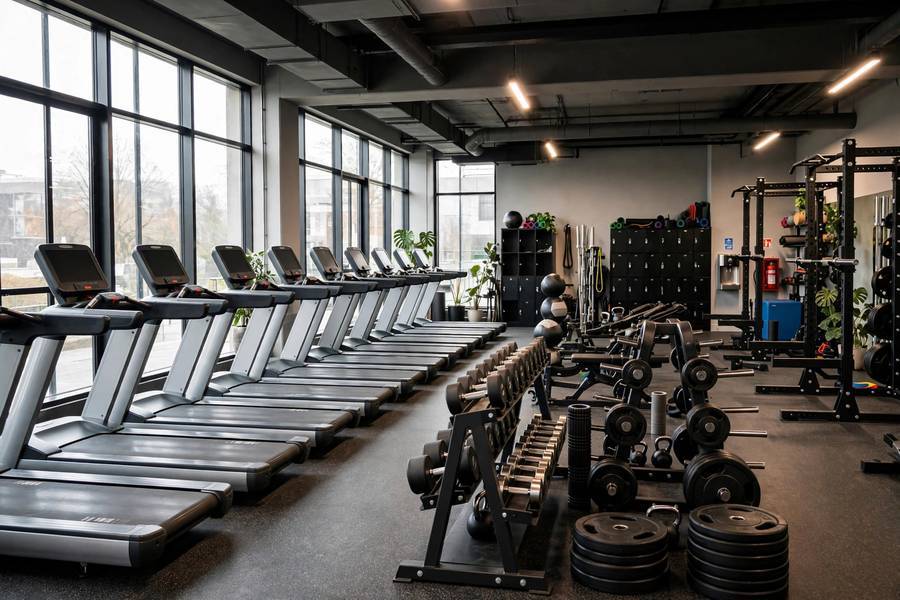
– Cardio machines — treadmills especially. Commercial-grade ($4,000-$8,000 each) or you’ll replace residential units yearly. Budget 30-40% of equipment spend here for general gyms.
– Flooring — rubber flooring throughout training areas. Cheap flooring tears, smells, and injures. $3-$8/sq ft installed.
– Racks and rigs — the skeleton of a strength area. Buy once, cry once.
Economize on:
– Dumbbells/kettlebells — iron is iron. Buy used from closing gyms (there are always closing gyms — grim, but true).
– Accessories — bands, mats, balls. Commodities.
– Tech — start with a solid booking/billing system (Mindbody, ABC Fitness, Gymdesk). Skip the fancy app until you have members.
Skip initially: saunas, smoothie bars, retail walls, recovery lounges. These are margin decorations for profitable gyms, not growth drivers for new ones. Add them from cash flow in year two.
Buy used where it doesn’t matter (weights, benches), new where it does (cardio electronics, anything with a motor). And get maintenance contracts on cardio — downtime on treadmills during January is revenue walking out the door.
The Membership Math (Know This Cold)
This is the entire business in one equation:
Monthly recurring revenue = members × average dues
Break-even members = monthly fixed costs ÷ (average dues − variable cost per member)
Example: $35,000/month fixed costs (rent, salaries, insurance, loan payments). Average dues $45. Variable cost per member ~$5 (towel service, billing fees, wear). Contribution per member: $40. Break-even: 875 members.
Now the truths that make or break you:
Churn is the silent killer. Industry average: 30-50% annual member churn. Meaning you must replace a third to half your base every year just to stand still. Everything — onboarding, community, results — should serve retention. A 5% improvement in retention is worth more than a 20% improvement in sales.
January lies. Resolution signups spike, then 60-70% vanish by April. Don’t staff, spend, or borrow against January numbers. Smart operators sell annual/paid-in-full plans in January to lock the revenue before motivation fades.
Price for the model. $20/month needs 2,000+ members and ruthless cost control. $200/month needs 250 members and an exceptional experience. The dead zone is $70-100/month with neither volume nor premium experience — that’s where gyms go to die.
Ancillary revenue matters. Personal training, supplements, merch, specialty classes — target 20-30% of revenue from non-dues sources. Dues cover costs; ancillaries create profit.
The strategic thinking behind these numbers connects to how to become an entrepreneur — the discipline of knowing your break-even before you sign anything.
Staffing: Your Biggest Cost and Biggest Risk
Labor runs 35-45% of revenue in most gym models — your largest expense and your product.
- Hire trainers who sell and coach. The brilliant coach who can’t retain clients is a cost center. The average coach who keeps 30 clients for two years is a profit engine.
- Front desk is sales. Every tour, every trial, every “just looking” — that’s a sales conversation. Train it, script the basics, track conversion rates.
- Pay structure: base + commission on sales and retention. Pure commission creates churn-and-burn culture; pure salary creates complacency.
- The owner trap: if the business can’t run a week without you, you don’t own a business — you own a job with a lease.
Marketing That Actually Fills a Gym
What works, in order of ROI for new gyms:
- Pre-sale before opening. Sell founding memberships 60-90 days before doors open. Target: 200-400 members on day one. This is the difference between opening strong and bleeding from month one.
- Local SEO + Google Business Profile. “Gym near me” is pure intent. Own it.
- Referral programs. Members bring friends — the highest-converting channel in fitness. Pay real rewards ($50-100 credit), not tote bags.
- Corporate/wellness partnerships. Nearby employers with wellness budgets = bulk memberships.
- Targeted social ads. Geo-fenced, offer-driven (21-day trial, 6-week challenge). Track cost per trial and trial-to-member conversion religiously.
What doesn’t: sponsoring everything in town, expensive grand openings nobody attends, and discounting dues to buy members (discount members churn fastest and refer nobody).
For the venture fundamentals underneath all of this, it’s worth reading what a startup actually is. More operational playbooks on what branding actually means.

Frequently Asked Questions
A boutique studio runs $100,000-$400,000; a mid-size commercial gym $300,000-$800,000; a budget big-box $500,000-$2M+. Always include 6-12 months of working capital — most gyms are cash-negative while membership builds.
Yes, when the membership math works: typical net margins run 10-20% for well-run facilities. Profitability hinges on hitting break-even member counts, controlling churn (industry average 30-50% annually), and generating 20-30% of revenue from non-dues sources like training.
Divide monthly fixed costs by contribution per member (dues minus variable cost). Example: $35,000 fixed costs ÷ $40 contribution = 875 members. Know this number before signing a lease — it’s the single most important figure in the business.
Member retention. With 30-50% annual churn industry-wide, you must replace a third to half your base yearly just to stand still. Onboarding, community, and delivering visible results matter more than any marketing campaign.
Buy new commercial-grade cardio (treadmills especially — $4,000-$8,000 each) and flooring; buy used for weights, benches, and accessories (closing gyms sell these cheap). Get maintenance contracts on anything with a motor.