Weekly Endurance Workout Plan: 4-Day, 5-Day, and 6-Day Templates

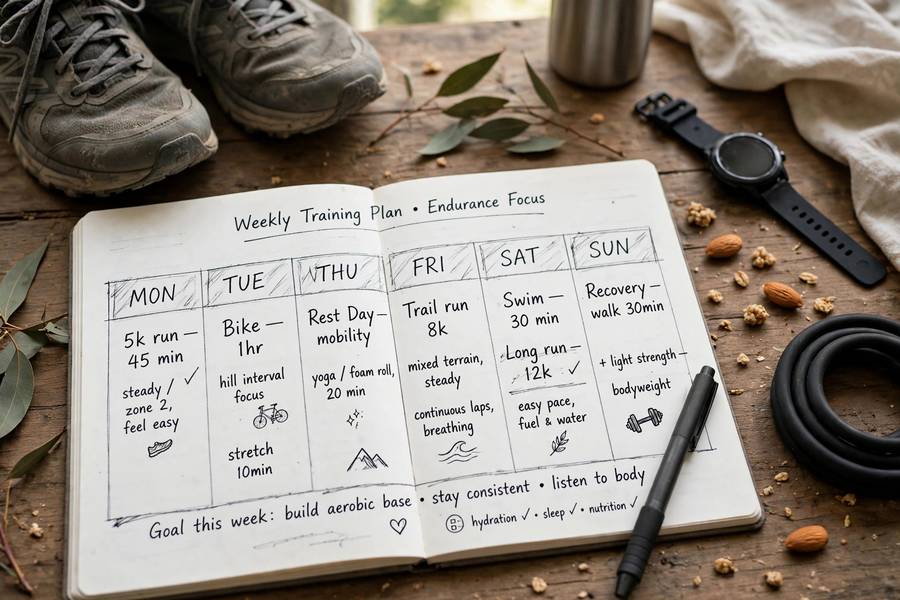
The difference between people who build endurance and people who just exercise is not talent or gear. It is the week. Random workouts produce random results; a structured week compounds. I have written thousands of training weeks for endurance athletes, and they all share the same skeleton: easy volume, one long session, one quality session, strength twice, rest scheduled. The details change with fitness and goals, but the architecture does not. In this guide I will give you three complete weekly plans, 4-day, 5-day, and 6-day, each with exact session prescriptions you can start Monday. No guesswork, no “listen to your body” vagueness, just the week, written out. Choose the plan matching your current schedule, anchor the strength work with workout routines for beginners principles, and time your key sessions with best time to exercise guidance.
The Architecture of a Training Week
Every effective endurance week contains five elements. One: easy aerobic volume, 2 to 4 sessions at conversational effort, forming 70 to 80 percent of total time. Two: one long session, the week’s cornerstone, 60 to 150 minutes depending on goals. Three: one quality session, intervals or tempo, capped at 10 to 20 percent of volume. Four: two strength sessions, full-body, 30 to 40 minutes. Five: one to two full rest days, scheduled, not earned. Arrange them so hard days are separated by easy days or rest, long sessions have a rest or easy day after, and strength never precedes a key endurance session. This architecture works for runners, cyclists, rowers, and triathletes because it respects physiology, not fashion. Memorize the skeleton and you can build your own weeks forever. strength training for runners

The 4-Day Plan (Time-Crunched)
Monday: rest. Tuesday: 40-minute easy session + 20-minute full-body strength. Wednesday: rest or 20-minute walk. Thursday: quality session, 10-min warm-up, 5 x 3 min hard / 2 min easy, 10-min cool-down. Friday: 30-minute easy + 20-minute strength. Saturday: long session, 75-90 minutes easy. Sunday: rest. Total: ~4 hours. This plan works because the two strength sessions piggyback on easy days, the quality session stands alone, and the long session has rest on both sides. It is the minimum effective structure for real progress, and I have seen busy professionals build marathon fitness on it. The non-negotiable: protect Thursday and Saturday like appointments. marathon training for beginners
The 5-Day Plan (The Sweet Spot)
Monday: 45-min easy. Tuesday: quality session (intervals or tempo, 45 min total) + 20-min strength after. Wednesday: 40-min easy recovery. Thursday: 30-min easy + 30-min strength. Friday: rest. Saturday: long session, 90-120 min easy. Sunday: 30-min easy walk or rest. Total: ~5.5 hours. This is the plan I prescribe most; five days gives enough frequency for adaptation with enough rest for recovery, and the Wednesday easy day between quality sessions is the secret sauce. Most athletes can sustain this indefinitely, which is the entire point. Progress it by extending the long session 10 minutes per week and adding one interval to the quality session every two weeks.

The 6-Day Plan (Serious Builders)
Monday: 50-min easy + strides. Tuesday: quality session (60 min). Wednesday: 45-min easy + 30-min strength. Thursday: 60-min moderate aerobic. Friday: 30-min easy + 30-min strength. Saturday: long session, 2-2.5 hours. Sunday: rest. Total: ~7.5 hours. Reserve this for athletes with 12+ weeks of base and solid recovery habits (8 hours sleep, adequate fueling). The Thursday moderate session is the addition that separates this from the 5-day plan; it adds meaningful volume without the cost of a second quality day. Warning signs you are not ready for six days: needing caffeine to train, resting heart rate climbing, or dreading sessions. Drop to five days without guilt; the plan you sustain beats the plan you survive.
Where Strength Fits
Two sessions, full-body, 30 minutes each, on easy cardio days, never before quality or long sessions. The template: squat variation 3×8, hinge variation 3×8, push 3×10, pull 3×10, core circuit 2 rounds. During high-volume endurance weeks, cut to 2 sets each for maintenance. Strength is the support system, not a competing goal, so it should never compromise the week’s key sessions. If a strength day leaves you too sore for tomorrow’s quality session, you went too heavy; back off 10 percent. The goal is armor, not PRs.
Adapting the Plan to Your Life
Shift days to fit your life but preserve the relationships: quality separated from long by at least two days, strength never before key sessions, rest days real rest. Travel week? Do the 4-day plan. Sick? Skip the quality session first, then shorten easy days, never train through fever. Night shift? Train whenever you can be consistent; the body adapts to schedule regularity more than to clock time. The plan is a template, not a religion. Follow the architecture, adapt the details, and string together months. That is the whole secret, and it has never changed.
Pick your plan, start Monday, and do not redesign it for four weeks. The week works if you work the week.
Tracking Your Week: The Three Numbers
Each Sunday, record three numbers: total training time, longest session duration, and morning resting heart rate average. Total time should trend up 5-10 percent monthly during build phases. Longest session should grow 10 minutes weekly until it hits your goal duration. Resting heart rate should drift down over months. If all three move correctly, the plan works; change nothing. If time rises but heart rate does not fall, your easy days are too hard. If the long session stalls, you are skipping it or running it too fast. These three numbers diagnose 90 percent of training problems without any fancy metrics. Fancy watches are nice, but a notebook and honesty outperform a thousand dollars of technology used carelessly.
What If You Miss Days?
Miss one day: skip it entirely, do not shuffle the week. Miss two days: drop the quality session that week and keep everything easy. Miss a full week: repeat the previous week rather than jumping ahead. The cardinal rule of missed training is never to stack: doubling up sessions to “make up” lost time is how overtraining and injury happen. Fitness is built over months; a missed week is a rounding error if you return sensibly and a disaster if you panic-train. The athletes who handle missed days best are the ones with the longest streaks, because they understand that consistency is measured in months, not in perfect weeks.
Fueling Around Your Training Week
Match nutrition to the week’s architecture. Long-session days: eat a real meal 2-3 hours before, take 30-60g carbs per hour during sessions over 75 minutes, and eat a protein-plus-carb meal within two hours after. Quality days: normal meals, light snack 60 minutes before. Easy days: eat normally; no special fueling needed under an hour. Rest days: slightly fewer carbs, same protein. The common error is eating the same every day regardless of training load; periodizing nutrition with training improves both adaptation and body composition. Hydration follows the same logic: drink to thirst on easy days, be deliberate with electrolytes on long and quality days. Simple, matched to the work, no magic required.

Easy aerobic volume (70-80%), one long session, one quality session (10-20%), two full-body strength days, and 1-2 rest days. Hard days separated by easy days; strength never before key sessions.
Four days is the minimum effective structure, five is the sweet spot most athletes sustain indefinitely, six suits experienced athletes with solid recovery. More than six is rarely better.
Twice weekly, 30 minutes, full-body, on easy cardio days. Never before quality or long sessions. During peak volume weeks, cut to maintenance sets.
The long session. Duration-dependent adaptations only trigger past 60-75 minutes. Protect it like an appointment and extend by 10 minutes weekly.
Yes, preserving relationships: quality and long separated by 2+ days, strength never before key sessions, real rest days. The architecture matters more than the specific days.
Yes, if you keep every session easy for the first month and treat the quality day as optional strides. The structure works at any fitness level; only the intensity and duration scale. Start conservative and progress the long session first.
Start with the 4-day plan for your first 8-12 weeks, keeping the quality day as optional strides. Move to 5 days when you finish weeks feeling fresh rather than wrecked. The right plan is the one you can repeat for months; ambition that outruns recovery just creates injuries.