How to Build Stamina for Sports: The Complete Athlete’s Guide


Soccer players do not need marathon endurance. They need to sprint, recover, and sprint again for 90 minutes. That quality has a name, repeat sprint ability, and it is built differently from pure aerobic base. I have conditioned athletes for soccer, basketball, rugby, and martial arts, and the biggest mistake I see is coaches giving field-sport athletes distance-runner programs. The result is athletes who can jog for an hour but gas out in the first 20 minutes of a game. Sport stamina is specific: it is the right energy systems, trained the right way, layered on a general aerobic base. In this guide I will show you how to build the base every athlete needs, then bridge it to your sport’s actual demands, with off-season and in-season templates. The strength foundation follows workout routines for beginners logic, and fueling matters enormously, see what to eat after a workout for the recovery side.
Stamina vs Endurance: What Athletes Actually Need
Endurance is sustained steady output; stamina for sports is repeated high output with incomplete recovery. A marathoner needs the first, a midfielder needs the second. The physiology differs: repeat sprint ability depends on your aerobic system recovering you between efforts and your anaerobic system producing the efforts. This means field-sport athletes need both a big aerobic base (for recovery between sprints) and specific anaerobic conditioning (for the sprints themselves). Training only one leaves you half-prepared. The classic error is the distance-runner approach: lots of slow miles, no sprint work, and then shock when game intensity hits. The opposite error is all sprints all the time, which builds a fragile athlete who cannot recover between sessions. You need the base and the bridge. strength training for runners

The Aerobic Base: Every Sport’s Foundation
Every sport benefits from 8 to 12 weeks of general aerobic base building in the off-season: 3 to 4 easy sessions per week, 30 to 60 minutes, conversational effort, your choice of modality. This is not sport-specific and that is the point; a bigger aerobic engine improves recovery between every effort in every sport. Soccer players with better aerobic bases cover more high-intensity distance late in games, not because they sprint more in training, but because they recover faster between sprints. Do not skip this phase because it looks like “just cardio.” It is the foundation everything else stacks on, and athletes who build it dominate the fourth quarter.
Sport-Specific Conditioning: Bridging the Gap
Once the base exists, bridge it to your sport with small-sided games, tempo runs, and circuit training that mimics work-to-rest ratios. Soccer: 4v4 games are the best conditioning tool ever invented, automatically replicating match intensity. Basketball: full-court 3v3 with short rests. Combat sports: round-based bag work matching competition rounds. The principle: conditioning should look like the sport, not like a track workout. Two sport-specific sessions per week in the 6 weeks before the season, layered on maintained base work, peaks athletes beautifully. Keep one easy aerobic session weekly even in-season; the base decays without maintenance.
Repeat Sprint Ability: The Money Quality
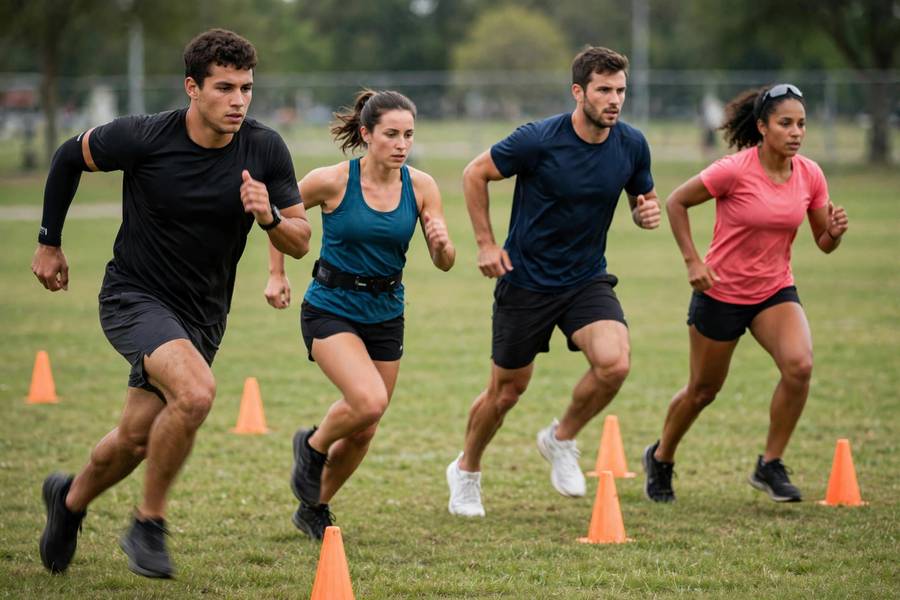
Repeat sprint ability is trained with, unsurprisingly, repeated sprints: 6 to 10 x 20-30 meter sprints with 20 to 30 seconds recovery, once a week in preseason. The short recoveries are the point; they train your aerobic system to clear metabolites fast. Progress by adding sprints, not by lengthening recoveries. Complement with tempo intervals: 8 to 10 x 1 minute at 85 percent with 1 minute easy. This is the session that separates athletes who finish games from athletes who finish games strong. One RSA session and one tempo session per week is the maximum; more just creates fatigue that masquerades as fitness.
In-Season vs Off-Season Programming
Off-season (8-12 weeks): build the base, 4 easy sessions/week, 2 strength sessions, 1 RSA session added in the final 4 weeks. Preseason (4-6 weeks): 2 sport-specific sessions, 1 RSA, 1 tempo, 2 strength (reduced volume), 1 easy aerobic maintenance. In-season: practices are the conditioning; add 1 easy aerobic session and 1-2 short strength sessions for maintenance, nothing hard outside practice. The in-season error is adding extra conditioning on top of games; games ARE the conditioning, and extra work just digs a recovery hole. Trust the off-season bank you built.
Recovery Between Games and Sessions
Between sessions: sleep 8+ hours, protein at every meal, and carbs around training; athletes who under-fuel cannot adapt no matter how perfect the program. Between games in tournaments: light movement, compression, and easy spinning beat complete rest for clearing soreness. Contrast: 48 hours minimum between hard conditioning sessions, and never schedule RSA work the day before a game. Monitor morning resting heart rate; a 5+ beat elevation for two days means back off. The best ability in sports is availability, and availability is built through intelligent recovery, not heroic training.
Build the base, bridge it to your sport, train repeat sprints specifically, and recover like a professional. That is sport stamina, and it wins games.
Testing Your Sport Stamina
Measure what matters with three tests. The Yo-Yo Intermittent Recovery Test: 20-meter shuttles with 10-second recoveries, increasing in speed; it is the gold standard for field-sport fitness and directly predicts match performance. Test every 6 weeks in preseason. The repeat sprint test: 6 x 30-meter sprints with 25 seconds recovery; record total time and the drop-off from fastest to slowest. Less than 5 percent drop-off is elite repeat ability. The 5-minute max distance run: a simple aerobic check that should improve through base phases. Test on the same surface, same time of day, similar conditions, and log everything. Numbers remove opinion from programming; if the Yo-Yo improves, the program works, regardless of how anyone feels about it.
Youth Athletes: A Special Note
For athletes under 16, skip the structured interval work entirely. Youth stamina develops best through free play and small-sided games; their aerobic systems are highly responsive to unstructured activity and their growth plates do not need adult loading. The research is clear that early specialization and intense conditioning correlate with burnout and injury, not with elite outcomes. Keep it fun, keep it varied across sports, and introduce structured conditioning gradually from age 15-16. The best thing a youth coach can do for long-term stamina is to make kids love moving. Everything else follows in time.
Mental Stamina: The Overlooked Half
Physical stamina gets all the programming, but games are lost mentally long before legs give out. Train it deliberately: practice staying process-focused when fatigued by setting small targets (next 5 minutes, next play) instead of thinking about the clock. Use a pre-planned reset routine, three deep breaths and a cue word, for the moments when frustration spikes; rehearsed resets beat willpower every time. And train tired decision-making in practice: end sessions with small-sided games when legs are heavy, because that is when games are decided. The athletes who finish strong are not fitter in some magical way; they have practiced being tired and staying sharp. Mental stamina is trainable, and it is the cheapest performance upgrade in sports.
Start your next off-season with eight weeks of base building before anything else, and watch what happens to your fourth quarter.
Endurance is sustained steady output (marathon); sport stamina is repeated high output with incomplete recovery (soccer). Field sports need repeat sprint ability: an aerobic base for recovery between efforts plus anaerobic conditioning for the efforts.
Build an 8-12 week aerobic base first, then add sport-specific conditioning: small-sided games (4v4), repeat sprints (6-10 x 20-30m), and tempo intervals. In-season, practices are the conditioning; just maintain with easy cardio and lifting.
The ability to reproduce maximal efforts with short recoveries, the defining quality of field and court sports. Train it with repeated short sprints on incomplete rest, once weekly in preseason.
Yes, in the off-season. A bigger aerobic base improves recovery between every high-intensity effort in a game. Soccer players with better bases cover more sprint distance late in matches.
Practices provide the conditioning stimulus. Add only easy aerobic maintenance and short strength sessions. Extra hard conditioning on top of games creates a recovery hole, not fitness.
Build a bigger aerobic base in the off-season (faster recovery between efforts), add repeat-sprint training in preseason, and check fueling; most second-half fade is under-fueling plus insufficient base, not lack of toughness.
Team sports demand repeat sprint ability with chaotic work-rest ratios, trained through small-sided games and RSA sessions. Individual endurance sports demand sustained output, trained through base volume and tempo work. Both need the aerobic base; they differ in how the top end is sharpened.