Core Strength for Runners: The Complete Coach’s Guide

Every runner I coach hears the same speech in week one: your core is not your abs, and crunches will not make you faster. Your core is the transmission system between your arms and legs, and when it is weak, every stride leaks energy like a punctured tire. When it is strong, you glide.
This guide covers what core strength actually means for runners, the exercises that build it, the mistakes that waste your time, and a simple weekly routine. It pairs with our strength training for runners guide and our dedicated core strength builder.
What ‘Core’ Actually Means for a Runner
Forget the six-pack. For runners, the core is the entire trunk system: deep abdominals, obliques, lower back, glutes, and the pelvic floor, all working to stabilize your spine and pelvis while your limbs fly. Every footstrike sends force up through your body, and the core decides whether that force drives you forward or wobbles you sideways.
I explain it with a car analogy: your legs are the engine, your core is the chassis. A powerful engine in a floppy chassis wastes energy and breaks parts. Runners with weak cores overstride, rotate excessively, and collapse at the hips late in races. The fix is not more miles; it is a stiffer, smarter chassis.
Why Core Strength Directly Makes You Faster
Here is the mechanism. A stable pelvis keeps your legs moving in efficient lines instead of swaying. A braced trunk lets your arm swing counterbalance your legs instead of twisting your whole body. Less wasted motion means less energy per stride, which means you hold pace longer at the same effort.
I have watched runners drop 30 seconds per mile in marathon pace after eight weeks of dedicated core work, with zero change in mileage. That is not magic; it is reclaimed energy. Late-race form collapse is almost always core fatigue first, leg fatigue second. Train the core and you push the collapse point further down the road.
The Crunches Mistake: What Not to Do
Crunches train spinal flexion, which is the opposite of what running needs. Running needs a trunk that resists motion: anti-extension, anti-rotation, and anti-lateral-flexion. A thousand crunches build a skill your sport never uses, and the repetitive spinal flexion can irritate backs.
I banned crunches from my programs years ago and injury complaints dropped. If your core routine is crunch-based, you are training for a mirror, not a marathon. The exercises below train the core the way running actually uses it: as a stabilizer, not a mover.
Anti-Extension: Dead Bugs and Body Saws
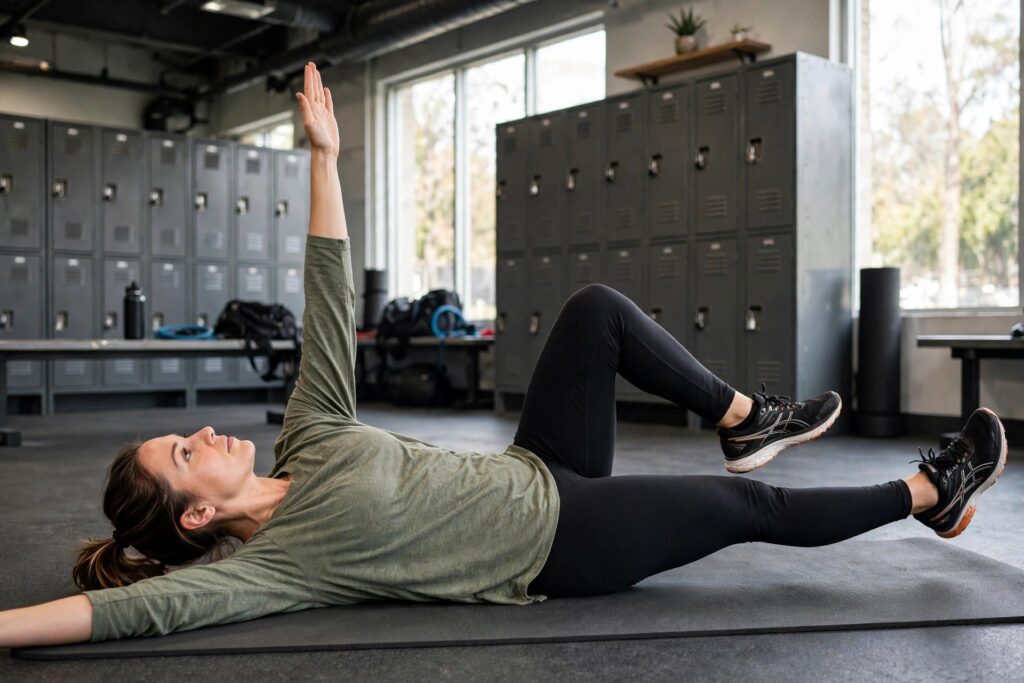
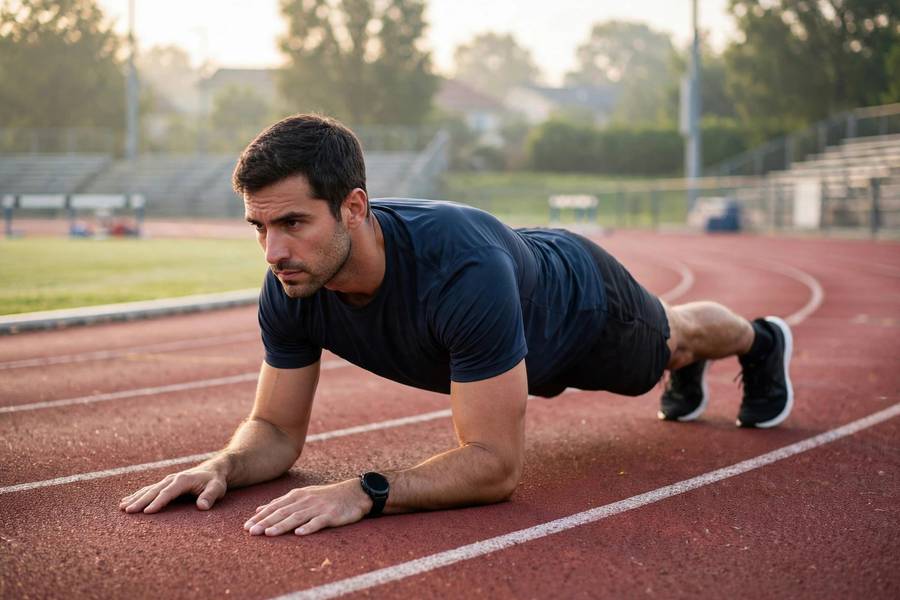
Anti-extension exercises teach your core to prevent your lower back from arching under load. The dead bug is the foundation: on your back, lower back pressed to the floor, opposite arm and leg extending slowly. The body saw, a plank where you rock forward and back on your forearms, is the advanced version.
Do dead bugs for 3 sets of 8 per side, and body saws for 3 sets of 10 slow rocks. The cue that fixes everything: ribs down. The moment your ribs flare, your back takes over and the abs check out. Master anti-extension and your posture at mile 22 will thank you.

Anti-Rotation: Pallof Press and Bird Dogs
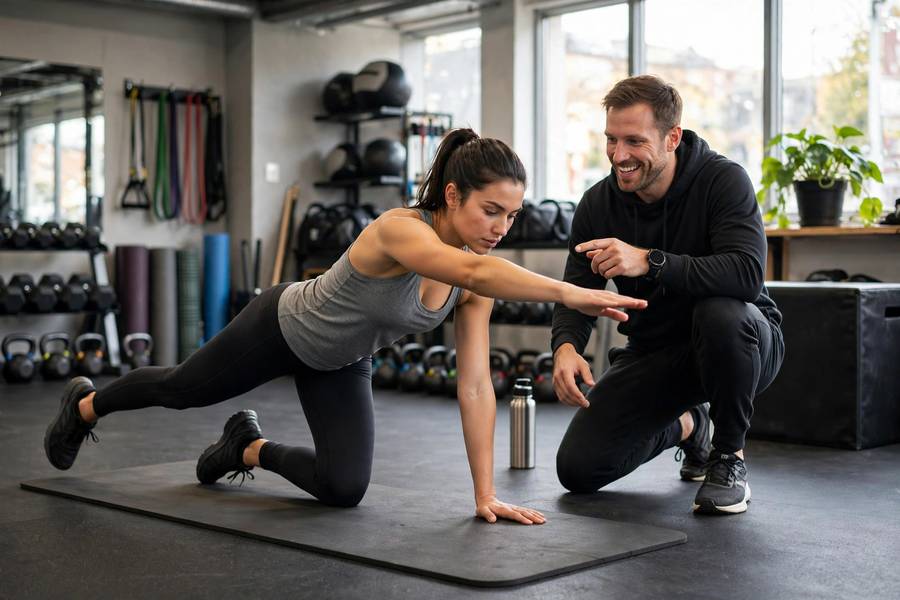
Every stride rotates your torso; your core’s job is to meter that rotation. The Pallof press is my number one pick: press a band or cable straight out from your chest and resist the rotational pull for two seconds. The bird dog, on all fours extending opposite arm and leg, trains the same quality with a balance challenge.
Program 3 sets of 10 per side for each. Move slowly; speed hides cheating. I watch for the hips staying level in the bird dog and the torso staying square in the Pallof press. These two exercises alone fix the excessive torso twist I see in probably half the runners I assess.
Lateral Stability: Side Planks Done Right
Runners live on one leg, which means lateral stability is non-negotiable. The side plank trains the obliques and glute medius to keep your pelvis level with every stride. Most runners do them wrong: hips sagging, top shoulder rolling forward, holding their breath.
Do 3 sets of 30 to 45 seconds per side, with the top foot in front of the bottom foot for stability. Progress by adding hip dips or a top-leg lift. The test I use: film yourself from behind while running. If your hips drop visibly on each stride, your side plank game needs work. This pairs perfectly with the hip work in our runner strength program.
Glutes: The Core’s Powerful Neighbors
Strictly speaking the glutes are not the core, but functionally they are its engine room. Weak glutes force the lower back to stabilize the pelvis, which is like asking the intern to run the company. Glute bridges, hip thrusts, and clamshells belong in every runner’s core routine.
I program glute activation before every run: 2 sets of 15 glute bridges and 15 clamshells per side. Two minutes that prevent the dead-butt stride pattern behind most knee pain. Your core routine is incomplete if your glutes are asleep, so wake them up daily.
The 15-Minute Runner’s Core Routine
Here is the exact routine I give my runners, three times per week after easy runs. Dead bugs: 2 sets of 8 per side. Side plank: 2 sets of 30 seconds per side. Pallof press: 2 sets of 10 per side. Glute bridge: 2 sets of 15. Bird dog: 2 sets of 8 per side. Fifteen minutes, no equipment beyond a band.
Do it after easy runs when you are warm but not destroyed. Never before hard workouts; fatigued stabilizers compromise your quality session. After eight weeks, film your running form and compare. The difference in hip stability and posture is usually visible to the naked eye. For the full progression beyond this starter routine, see our core strength guide.
Core Training Mistakes Runners Make
The big three mistakes: training the core like a bodybuilder with crunches and sit-ups, doing core work when exhausted after hard sessions, and expecting results in two weeks. Core strength is neural as much as muscular; it takes six to eight weeks of consistent work to rewire movement patterns.
The other mistake is treating core as a separate hobby instead of part of the system. Your core routine should connect to your lifting and your running, not exist in isolation. That integration mindset is exactly what our strength training for runners framework is built around: everything serves the stride.
Core Training for Marathoners vs 5K Runners
Different distances stress the core differently, and your training should reflect that. Marathoners need endurance stability: the ability to hold posture for three-plus hours as everything fatigues. Their core work should emphasize longer holds, higher reps, and exercises done in a pre-fatigued state to simulate late-race conditions.
5K and 10K runners need reactive stiffness: a trunk that stays rigid while the legs cycle fast. Their core work can be shorter and more intense, with explosive elements like medicine ball throws and fast Pallof press variations. The principle is specificity: train the core quality your race demands.
Middle-distance runners sit between the two. I assess each athlete’s race demands and weak links, then bias the program accordingly. A marathoner with a collapsing pelvis at mile 20 gets endurance-biased work; a 5K runner leaking power gets stiffness-biased work. Same toolbox, different blueprint.
Testing Your Core: 3 Simple Assessments
You cannot improve what you do not measure. My three core assessments for runners take ten minutes. One: the forearm plank for time, with perfect form. Under 60 seconds suggests a real deficit; over two minutes with good form is solid. Film it from the side: sagging hips mean the test is over, whatever the clock says.
Two: the side plank per side, comparing left and right. More than a 15 percent difference is an imbalance worth fixing. Three: the dead bug quality check: ten slow reps per side with the lower back glued to the floor. If the back arches or the movement speeds up uncontrollably, the deep core needs work.
Retest every eight weeks. I keep my athletes’ scores in their training logs next to their race times, because the correlation is real: when core scores climb, late-race fade shrinks. It is one of the most motivating feedback loops in training.
Yes. A stable core reduces wasted motion, keeps the pelvis level, and delays late-race form collapse. Many runners see meaningful pace improvements after 6-8 weeks of consistent core work.
No. Crunches train spinal flexion, which running never uses. Runners need anti-extension, anti-rotation, and lateral stability exercises like dead bugs, Pallof presses, and side planks.
Three short sessions per week, about 15 minutes each, ideally after easy runs. Daily glute activation (2 minutes) is a great addition.
Expect 6-8 weeks of consistent work before movement patterns visibly change. Core strength is largely neural, so patience and consistency matter more than intensity.
After easy runs. Doing core work before hard sessions fatigues the stabilizers you need for quality running, and doing it after hard sessions means poor form from exhaustion.