Do Runners Need to Lift Heavy? A Coach’s Honest Answer


This is the question I get most from experienced runners: “Ryan, should I be lifting heavy?” They have heard that heavy lifting builds power, and they have also heard it makes you slow and bulky. Both camps are half right, which is why the real answer needs a proper explanation.
Here is my honest, experience-backed answer: most runners benefit enormously from lifting heavier than they think, but “heavy” means something specific for a runner, and getting it wrong costs you. Let me show you the sweet spot. This fits into our wider strength training for runners system.
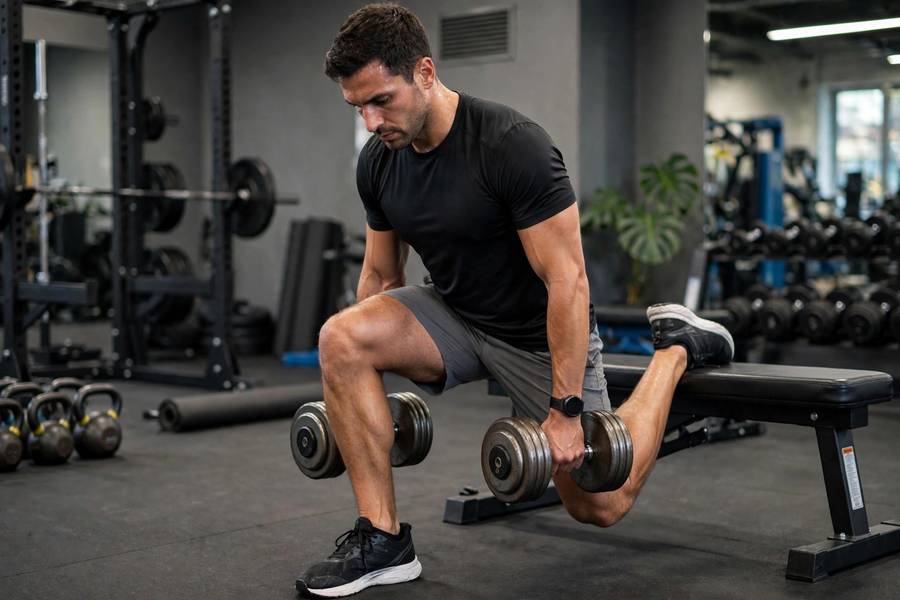
The Short Answer: Heavier Than You Think, Lighter Than a Powerlifter
Most runners lift too light to get stronger. If you can do 20 easy reps, you are building endurance you already have from running, not strength you lack. For runners, “heavy” means a weight you can lift for 4 to 8 challenging reps with good form: roughly 75 to 85 percent of your one-rep max.
That is heavy enough to recruit high-threshold muscle fibers and build real force, but nowhere near powerlifting territory. You are not chasing a 200-kilo squat. You are chasing the ability to produce more force per stride without adding mass. Different goal, different loading.
Why Heavy-ish Lifting Makes Runners Faster
Running speed comes from force applied to the ground in minimal time. Heavier lifting trains your nervous system to recruit more muscle fibers simultaneously, which directly improves that force application. This is called neuromuscular adaptation, and it is the primary benefit for runners.
The beautiful part: these neural gains come with almost no muscle growth in endurance athletes. Your body is so calorie-hungry from running that hypertrophy barely happens. I have had marathoners deadlift 1.5 times bodyweight and stay exactly the same size. They just got springier, and their race times dropped.
The Case Against Maximal Lifting for Runners
Now the other side, because honesty matters. True maximal lifting, singles and doubles above 90 percent, carries real costs for runners: high central nervous system fatigue, longer recovery, and injury risk that is hard to justify when you also run 60 miles a week.
I have seen runners try to powerlift and marathon train simultaneously, and it ends one of two ways: the running suffers or something tears. Your recovery budget is finite. Spend it where the return is highest, which for runners is the 4 to 8 rep range with impeccable form, not maximal singles.
What ‘Heavy’ Looks Like in Practice
Let me make it concrete. Goblet squats with a 24-kilo bell for sets of 6. Romanian deadlifts with 60 kilos for sets of 6. Bulgarian split squats with 16-kilo dumbbells for sets of 8 per leg. Hip thrusts with 80 kilos for sets of 8. These are serious weights that build serious strength, and they fit inside a 45-minute session.
The test I use: the last two reps of every set should be hard but clean. If your form breaks, it is too heavy. If you could do five more reps, it is too light. That window is where runners get stronger without getting beaten up.

Heavy Lifting and Injury Prevention
Here is the benefit nobody talks about enough. Tendons and bones adapt to heavy loading by getting denser and stiffer, which is exactly what protects against stress fractures and tendinopathy. Light weights do not provide enough stimulus for these adaptations; the tissue needs real load to remodel.
I program heavier phases specifically before high-mileage blocks for this reason. Eight weeks of solid strength work before marathon training builds the armor that the marathon training then tests. Runners who skip this step and jump straight into big mileage are the ones I see in the injury clinic by week six.
How Heavy Lifting Fits With High Mileage
The art is in the scheduling. During peak mileage weeks, I drop lifting intensity to maintenance: lighter weights, fewer sets, just enough to keep the strength you built. During lower-mileage or base phases, we push the weights up and build.
Never schedule your heaviest lifting the day before your hardest run. I separate hard lifting and hard running by at least 24 hours, ideally 48 for key sessions. The full periodization logic is laid out in our runner strength training guide, because timing is half the battle.
What About Bodyweight-Only Training?
Bodyweight training is a fine starting point, and single-leg bodyweight work like pistol squat progressions can be genuinely challenging. But there is a ceiling: once you can do 15 clean Bulgarian split squats per leg, you need external load to keep progressing.
Think of bodyweight as phase one and loaded training as phase two. Most runners I assess are stuck in phase one years after they should have progressed. If your strength sessions feel easy, they are maintenance at best. Add load, and watch what happens to your hill running.

The Bulky Myth: Why Runners Will Not Get Huge
Let me kill this fear permanently. Building significant muscle mass requires a calorie surplus, high training volume, and minimal cardio. Distance runners live in the exact opposite conditions: high cardio volume that actively suppresses hypertrophy signaling.
Elite distance runners who lift heavy look lean and wiry, not bulky. The muscle they build is dense and functional. I have coached runners through heavy strength blocks for years and never once had someone complain they got too big. They complain about one thing only: that they did not start sooner.
A Simple Heavy-ish Template for Runners
Twice a week, 45 minutes. Session A: Bulgarian split squat 3×8 per leg, Romanian deadlift 3×6, Pallof press 3×10 per side, calf raise 3×12 per leg. Session B: step-up 3×8 per leg, hip thrust 3×8, single-arm row 3×8 per side, dead bug 3×8 per side.
Rest 90 seconds between heavy sets; your nervous system needs it. Progress by adding small amounts of weight when all sets feel clean. Run this for eight weeks and retest: I promise your stride will feel different. Pair it with dedicated core strength work and you have the complete durability package from our strength training for runners program.
Heavy Lifting for Masters Runners (40+)
If you are over 40, heavy-ish lifting is not optional; it is medicine. After 40, muscle mass declines about 1 percent per year without resistance training, and power declines even faster. Running alone does not stop this. Loaded strength work is the only intervention that preserves the muscle and bone density masters runners need.
The approach shifts slightly with age: longer warm-ups, more conservative progression, and extra attention to recovery. But the loading principle stays the same. I coach runners in their 50s and 60s doing trap-bar deadlifts and heavy split squats, and they are the most durable athletes in my program. Age is a reason to lift, not an excuse to avoid it.
Start lighter than your ego wants and progress patiently. Tendons adapt slower than muscles at any age, and slower still after 40. Eight weeks of gradual loading builds the foundation; then you can push. The masters runners who lift consistently do not just run longer into life; they run better right now.
Sample 8-Week Strength Block for Runners
Here is the progression template I use. Weeks 1-2: learning phase. Moderate weights, 3 sets of 10, focus on perfect form and full range. You should finish sessions feeling worked but not destroyed. This phase builds the movement patterns everything else rests on.
Weeks 3-5: building phase. Increase weights so you are working at 3 sets of 6 to 8 challenging reps. Add one set to the main lifts. This is where real strength accumulates. Weeks 6-7: intensity phase. Heaviest weights of the block, 4 sets of 5 to 6 on the main lifts, longer rests. Week 8: deload. Cut volume in half, keep movements crisp, and let the body absorb the gains.
After the deload, retest: pick a benchmark like your 8-rep Bulgarian split squat weight and compare. Then either run another block with higher starting weights or shift to maintenance during race season. This eight-week rhythm, repeated twice a year, is the engine of long-term runner strength.
Runners benefit most from moderately heavy lifting: weights you can handle for 4-8 challenging reps. This builds the neural strength and tissue resilience running needs, without the recovery cost of maximal powerlifting.
No. Distance runners’ high cardio volume suppresses muscle growth. Heavy lifting makes runners denser, springier, and more injury-resistant, not bigger.
4 to 8 reps per set at 75-85% of one-rep max is the sweet spot: heavy enough to build real strength, light enough to recover from alongside running.
Generally no. Maximal singles carry high fatigue and injury risk that is hard to justify alongside run training. The 4-8 rep range gives runners nearly all the benefit with far less cost.
During base or lower-mileage phases. In peak mileage weeks, drop to lighter maintenance lifting. Never schedule heavy lifting the day before a key running workout.