Runner Strength Workout at Home: No Gym Needed

“I would lift, but I do not have a gym.” I hear this weekly, and my answer is always the same: you do not need one. Some of the strongest, most durable runners I coach have never touched a barbell. They train in living rooms with a pair of dumbbells and a resistance band, and they are bulletproof.
This is my complete at-home strength program for runners: the minimal equipment list, the full 30-minute workout, and progressions that keep working for years. For the full programming philosophy, see our strength training for runners guide.
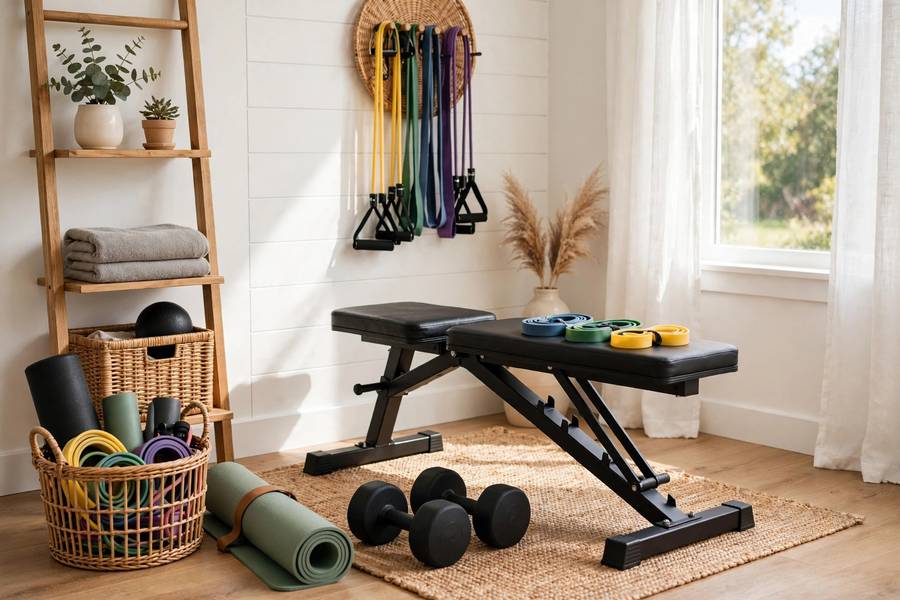
The Minimal Equipment List
You need three things. A pair of adjustable dumbbells or two kettlebells (start around 8 to 12 kilos each). A set of resistance bands including one loop mini-band. A sturdy chair or low table for step-ups and split squats. Total cost is less than two pairs of running shoes, and it lasts a decade.
That is genuinely it. I have programmed entire marathon strength blocks with this kit. The magic is not in the equipment; it is in exercise selection and consistency. A living room, this kit, and 30 focused minutes twice a week will outperform a fancy gym membership you never use.
Warm-Up: 5 Minutes That Prevent Injury
Never skip the warm-up, especially at home where you go from couch to workout in seconds. My at-home warm-up: 1 minute of marching in place with high knees, 10 bodyweight squats, 10 glute bridges, 10 lateral band walks per direction, and 10 arm circles each way.
This wakes up the glutes, warms the joints, and tells your nervous system that work is coming. Cold muscles and explosive movements are how home workouts cause injuries. Five minutes of this and you are ready for anything in the session.
The Workout: 30 Minutes, 6 Exercises
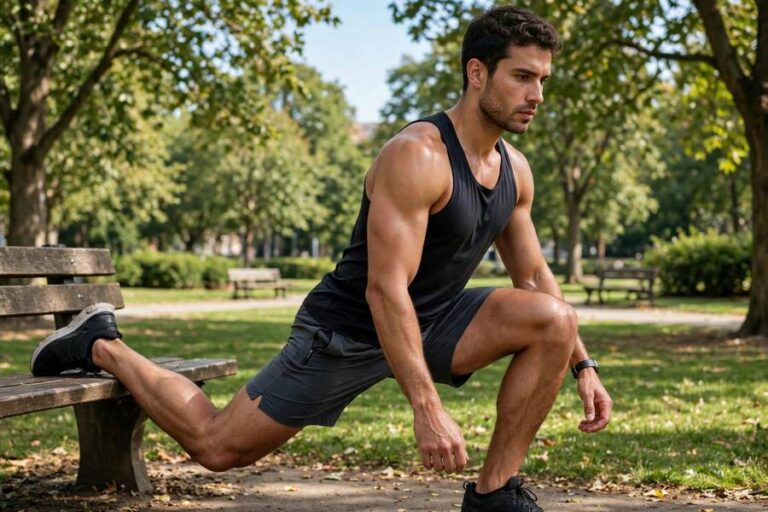
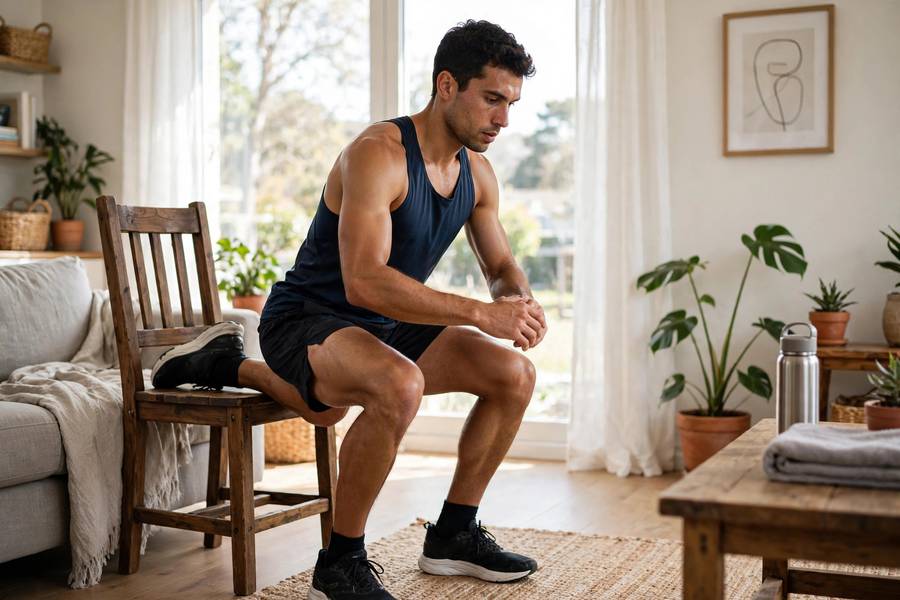
Here is the full session. Perform as straight sets with 45 to 60 seconds rest. One: Bulgarian split squat with rear foot on the chair, 3 sets of 10 per leg. Two: single-leg Romanian deadlift holding a dumbbell, 3 sets of 8 per leg. Three: step-ups onto the chair, 3 sets of 12 per leg.
Four: push-ups, 3 sets to near failure. Five: single-arm dumbbell row with hand on the chair, 3 sets of 10 per side. Six: dead bug, 2 sets of 8 per side, plus side plank 2 sets of 30 seconds per side. Thirty minutes, full body, done. Runners are shocked how hard this is the first time.
Exercise 1 and 2: The Single-Leg Foundation
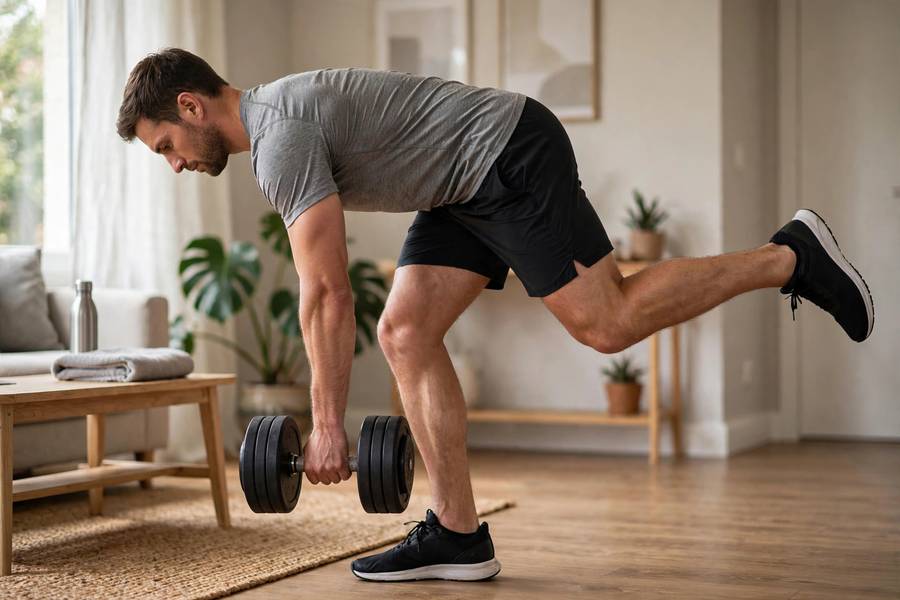
The Bulgarian split squat and single-leg Romanian deadlift are the heart of home training because they need no rack and no spotter. The split squat builds quad and glute strength; the single-leg deadlift builds hamstring strength and balance simultaneously.
Form cues that matter at home without a coach watching: in the split squat, keep the torso tall and lower until the front thigh is parallel. In the deadlift, keep a flat back and feel the hamstring stretch before driving the hips forward. Film yourself from the side once a month; the camera is brutally honest and free.
Exercise 3 to 5: Step-Ups, Push-Ups, Rows
Step-ups onto a sturdy chair build the knee-drive power running demands: 3 sets of 12 per leg, driving through the heel. Make sure the chair cannot slide; safety first in home setups. Push-ups train the upper-body endurance that maintains arm drive late in races: elevate hands on the chair if full push-ups are too hard.
The single-arm row balances all the forward-rolled posture runners develop: 3 sets of 10 per side, squeezing the shoulder blade. Runners neglect pulling muscles completely, and it shows in their slouched late-race posture. These three exercises fix the most common runner weaknesses with zero gym required.
Exercise 6: The Core Finisher
Finish every session with the dead bug and side plank. The dead bug trains anti-extension: 2 sets of 8 per side, lower back glued to the floor. The side plank trains lateral stability: 2 sets of 30 seconds per side, hips high.
This five-minute finisher is the highest-value part of the workout for injury prevention. A stable trunk protects everything above and below it. For a closer look at runner-specific core work, our core strength guide builds on exactly this foundation.
Progressions: Getting Stronger Without More Gear
The question everyone asks: what happens when bodyweight gets easy? Progress with tempo first: slow the lowering phase to four seconds. Then add reps, then add sets, then progress the movement: split squat to deficit split squat, deadlift to heavier dumbbell, push-up to feet-elevated push-up.
Single-leg work progresses almost indefinitely because balance is the limiter, not just strength. I have advanced runners doing pistol squat progressions and single-leg deadlifts with 24-kilo bells in their living rooms. You will not outgrow home training for years if you progress intelligently.

Scheduling Home Workouts Around Running
Do these sessions after easy runs or on rest days, twice weekly, 48 hours apart. My favorite home-training week: Tuesday session after an easy morning run, Friday session on its own day. Neither interferes with quality running, and the whole thing costs one hour per week.
The home advantage is time: no commute, no waiting for equipment. I tell busy runners that the workout they do in their living room beats the perfect gym program they skip. Start this week, stay consistent for two months, and reassess. The framework for fitting it all together lives in our strength training for runners system.
Making a Small Space Work
No spare room? No problem. My home program needs roughly two square meters: enough to lie down and lunge. Push furniture aside, and you have a gym. I have coached runners training in studio apartments, and the constraint actually helps: fewer distractions, faster sessions.
Noise matters if you have downstairs neighbors. Skip jumping movements or do them on a thick mat. Dumbbells can be lowered gently rather than dropped. The single-leg exercises in this program are naturally quiet, which is another reason they suit home training. Your neighbors will never know you are getting stronger.
Ventilation and flooring are the two upgrades that matter. Open a window, and train on a mat or rug rather than bare hard floors for joint comfort. That is the entire home gym fit-out. Everything else is optional, and I mean that: the program works in a hallway if the hallway is long enough to lunge in.
When to Upgrade Your Home Kit
Start with the basics: dumbbells, bands, a chair. After six to twelve months of consistent training, consider the upgrades in this order. First: heavier adjustable dumbbells, because progressive overload eventually outgrows starter weights. This is the highest-return purchase you will make.
Second: a sturdy bench, which makes hip thrusts possible, better rows, and safer step-ups. Third: a pull-up bar, for the upper-body pulling strength runners chronically lack. Fourth, only if you are committed: a kettlebell for swings and carries. Each upgrade should follow months of consistency, not precede it.
The rule I enforce: earn every purchase with six months of consistent training on what you have. Equipment does not build strength; showing up does. But once the habit is ironclad, better tools let you progress further. Buy the habit first, the hardware second.
Tracking Progress Without a Gym
You do not need fancy equipment to track progress; you need a notebook. Log every session: exercise, weight or band, sets, reps, and one line on how it felt. When last week’s 10-rep split squat becomes this week’s 12-rep split squat, you have proof the program is working, and that proof keeps you consistent through the boring middle months.
Retest three benchmarks every eight weeks: max clean Bulgarian split squats per leg, max push-ups, and longest perfect side plank per side. Write the numbers down and compare. I have my home-training athletes photograph their log pages and send them to me; accountability plus visible progress is the combination that turns a living-room routine into a multi-year habit.
Absolutely. Single-leg bodyweight exercises, dumbbells, and resistance bands provide years of progressive training. Most runners never outgrow a well-designed home program.
Adjustable dumbbells, a set of resistance bands including a mini-band, and a sturdy chair or step. That is enough for a complete program.
30 minutes twice a week: 5-minute warm-up, 20 minutes of main exercises, 5-minute core finisher. Consistency matters far more than duration.
Slow the tempo, add reps and sets, progress to harder variations (deficit split squats, feet-elevated push-ups), and emphasize single-leg work where balance extends the challenge.
After easy runs or on separate days both work. Keep sessions 48 hours apart and away from hard workouts and long runs.