8 Best Shoulder Exercises With Dumbbells (Complete Workout Included)


If I had to pick one piece of equipment for building shoulders and throw everything else away, I would keep the dumbbells without hesitating. Barbells are great for heavy pressing, cables are great for constant tension, but dumbbells do something neither can: they let each arm work independently through a natural range of motion. That means better delt activation, fewer compensation patterns, and shoulders that develop evenly instead of letting your dominant side do the driving.
I have programmed dumbbell-only shoulder work for clients in commercial gyms, garage gyms, and hotel rooms. It works everywhere, for everyone, from first-timers to advanced lifters. Here are the best shoulder exercises with dumbbells, how to do each one without wrecking your joints, and a complete workout you can run twice a week.
In this guide:
- Why Dumbbells Are the Best Shoulder Tool
- The 8 Best Dumbbell Shoulder Exercises
- Training With One Dumbbell vs a Pair
- The Complete Dumbbell Shoulder Workout
- Mistakes That Limit Dumbbell Shoulder Training
- Frequently Asked Questions
Why Dumbbells Are the Best Shoulder Tool
Four reasons, and they all matter. First, each arm works independently, which exposes and fixes strength imbalances. Everyone has a stronger side; dumbbells stop it from hiding. Second, the range of motion is natural. Your shoulders rotate and move freely instead of being locked to a bar path, which is kinder to cranky joints. Third, the stabilization demand is higher. Controlling two independent weights recruits more of the small shoulder stabilizers than a barbell does. Fourth, they are versatile. Press, raise, fly, shrug, carry: one pair of dumbbells covers the entire shoulder.
The only real limitation is loading. Most lifters cannot dumbbell-press as much as they can barbell-press, because the stabilizers give out first. For hypertrophy, that does not matter; the delts do not know the number on the dumbbell, they know tension and fatigue. For maximal pressing strength, keep a barbell press in the program too. For everything else, dumbbells are enough.
If you are new to lifting in general, read our weight lifting for beginners guide first for the fundamentals, then come back here for the shoulder-specific work.
The 8 Best Dumbbell Shoulder Exercises
1. Standing Dumbbell Overhead Press
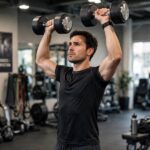
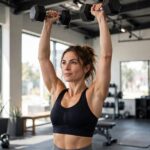
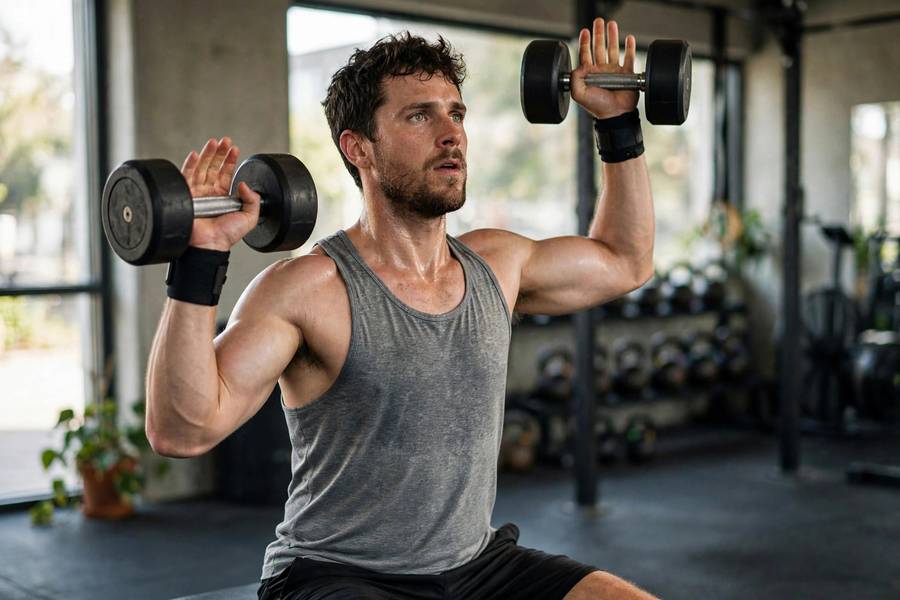
The foundation. Hold dumbbells at shoulder height, palms facing forward or slightly inward, brace your core, and press straight overhead until your arms are locked with biceps by your ears. Lower under control to the start. Standing forces your core to stabilize, which is a feature, not a bug. Four sets of 6 to 10 reps, heavy enough that the last two reps are a fight. The cue: “press the ceiling away.” It keeps the movement vertical instead of drifting forward.
2. Seated Dumbbell Press
Same movement, seated on a bench with back support. Removing the standing balance requirement lets you focus purely on the delts and usually lets you handle slightly more weight. I rotate standing and seated press every few weeks: standing for athleticism and core, seated for pure delt overload. Neither is “better.” They are different tools.
3. Dumbbell Lateral Raise
The side-delt builder, and the exercise that separates serious shoulder training from pressing-only programs. Stand tall, dumbbells at your sides, slight bend in the elbows, and raise out to shoulder height. Lower slowly. The details matter more here than on any other delt exercise:
- Lean forward a few degrees. A slight forward lean keeps the side delt loaded and the joint comfortable.
- Lead with the elbows. Think about lifting your elbows, not your hands. Hands lead to shrugging.
- Stop at shoulder height. Higher is traps, not delts.
- Use less weight than you think. If you cannot pause for a second at the top, it is too heavy.
Four sets of 12 to 15. This is the exercise I would pick if I could only do one for the rest of my life, because side delts are what make shoulders look wide.
4. Dumbbell Front Raise
Raise dumbbells straight forward to shoulder height, alternating or together. Keep the reps controlled and the weight honest. As covered in detail in our shoulder programming, front delts already get plenty of work from pressing, so treat this as a finisher: 2 to 3 sets of 12 to 15 after your presses, not a main event.
5. Arnold Press
Start with dumbbells at shoulder height, palms facing you. As you press overhead, rotate the palms to face forward. Reverse on the way down. The rotation extends the range of motion and hits the front delt through more of its arc while bringing the side delt in during the turn. Keep it smooth and controlled; this is not a movement to go heavy on. Three sets of 10 to 12.
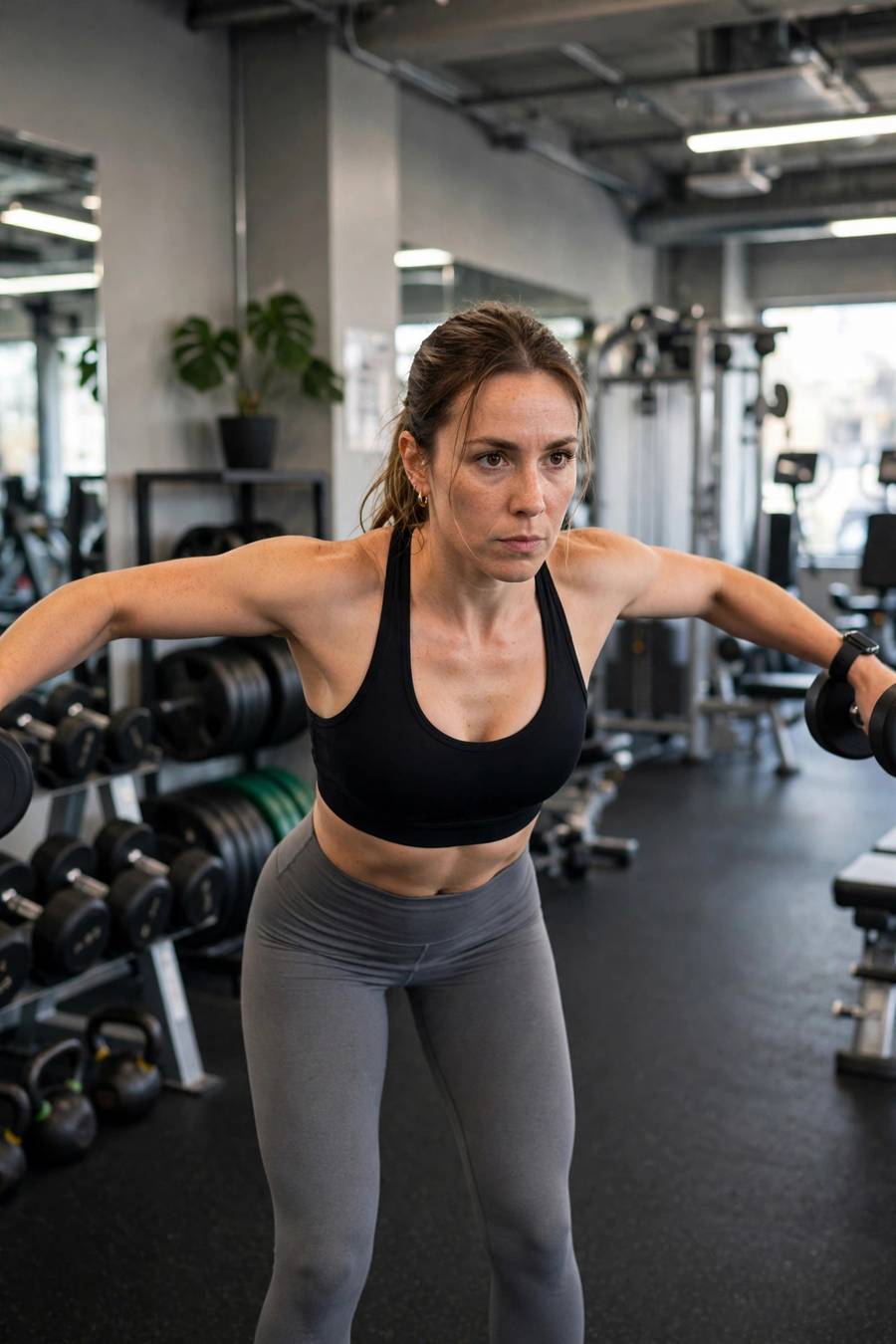
6. Bent-Over Reverse Fly
Hinge until your torso is near parallel to the floor and raise dumbbells out to the sides with elbows leading. This is your rear-delt money exercise with dumbbells. If the bent-over position bothers your lower back, do it chest-supported on an incline bench. Three to four sets of 12 to 15. Remember: stop at torso level, keep the shoulders down, and use a weight you can actually feel in the back of the shoulder.
7. Dumbbell Shrug
Hold heavy dumbbells at your sides and shrug straight up toward your ears, pause, and lower slowly. The traps are not delts, but big traps frame the shoulders and complete the upper-body look. The mistake is rolling the shoulders; shrug straight up and down. Three sets of 12 to 15 with a weight that challenges your grip. Straps are fine if grip is the limiter, but do some strapless sets too.
8. Dumbbell Upright Row (With a Caveat)
Hold dumbbells in front of your thighs and pull them up along your body to chest height, elbows leading and staying above the hands. The caveat: the upright row puts the shoulder in internal rotation under load, which bothers some people’s shoulders. Use a wide grip, stop at chest height (not chin), keep the weight moderate, and drop it instantly if you feel pinching in the front of the shoulder. For many lifters, lateral raises do the same job with zero risk. I include it because it works well for those it suits, not because everyone needs it.
Training With One Dumbbell vs a Pair
Sometimes you only have one dumbbell: a hotel gym, a home setup, a busy commercial gym where someone took the other one. Single-dumbbell training is not a limitation; it is a variation with its own benefits.
- Single-arm overhead press: The anti-rotation core demand is enormous. Your obliques work as hard as your delt. Great for athletes.
- Single-arm lateral raise: Hold a rack or wall with the free hand for balance and you can focus entirely on the delt. Some lifters feel the side delt better unilaterally.
- Single-arm reverse fly: Brace the free hand on a bench and row-fly with the working arm. Strict and effective.
When training unilaterally, always start with your weaker side and match the reps with the stronger side. Do not do extra reps with the strong arm “because it can.” The point is to close the gap, not widen it.
The Complete Dumbbell Shoulder Workout
Run this twice per week, at least 48 hours apart. It hits all three delt heads plus traps in about 40 minutes:
- Standing dumbbell overhead press: 4 x 6-10 (rest 2-3 min)
- Dumbbell lateral raise: 4 x 12-15 (rest 60-90 sec)
- Arnold press: 3 x 10-12 (rest 90 sec)
- Bent-over reverse fly: 3 x 12-15 (rest 60-90 sec)
- Dumbbell front raise: 2 x 12-15 (rest 60 sec)
- Dumbbell shrug: 3 x 12-15 (rest 60-90 sec)
Progress by adding a rep per set each week until you hit the top of the range, then increase the weight by the smallest increment available and drop back to the bottom of the range. This double progression is boring and it works, which is why I have used it with clients for years.
Slot this into a bigger plan with our push pull legs workout routine, and compare it against the full best shoulder exercises list to see where dumbbells fit among barbells, cables, and machines. For a complete dumbbell program beyond shoulders, the best dumbbell exercises guide has you covered.
Mistakes That Limit Dumbbell Shoulder Training
Pressing with flared elbows. Elbows straight out to the sides on overhead press puts the shoulder in a vulnerable position. Keep them slightly forward, around 30 to 45 degrees from the torso, and the joint will thank you.
Swinging lateral raises. The lateral raise done with a hip pop and a heave is the most cheated exercise in the gym. The delt is small; respect it. If you need momentum, the weight is too heavy.
Skipping the rear delt. Dumbbell trainees love presses and lateral raises. The reverse fly is always last and always skipped when time runs short. Put it third in the workout, not sixth, until it becomes a habit.
Never going heavy on presses. Delt hypertrophy loves moderate reps, but pressing strength needs heavy sets of 5 to 8 sometimes. If every set you do is 15 reps, you are leaving strength (and the size that follows it) on the table.
Absolutely. Dumbbells cover every shoulder function: overhead press for front delts, lateral raises for side delts, reverse flys for rear delts, plus shrugs and upright rows. The independent-arm action also fixes imbalances better than barbells. Adjustable dumbbells are enough for a complete shoulder program.
It depends on the exercise. Most lifters press 25 to 50 pounds per hand, lateral raise 10 to 25 pounds, and reverse fly 10 to 20 pounds. Start lighter than you think, especially on raises: the delts are small muscles, and strict form with moderate weight builds more size than heavy cheating.
Dumbbells are better for balanced development, joint-friendly range of motion, and fixing imbalances. Barbells allow heavier absolute loads for maximal pressing strength. For hypertrophy and shoulder health, dumbbells win. For pure overhead strength, include some barbell work. Most lifters benefit from both.
Four to six exercises covering all three delt heads: one heavy press, one lateral raise variation, one rear-delt movement, and optionally a front raise and shrugs. More than six usually means junk volume; the delts are small and fatigue quickly.
Both have value. Standing builds core stability and athleticism; seated lets you focus purely on the delts and often handle more weight. Rotate between them every few weeks, or do standing as your main press and seated as a secondary movement.