Shoulder Workout With No Equipment: The 40-Minute Plan That Actually Works


No gym? No problem. I have trained shoulders in hotel rooms, parks, and once in a garage with nothing but a floor and a doorframe, and I will tell you something the equipment industry does not want you to hear: your deltoids do not know what a dumbbell is. They know tension, fatigue, and progressive overload. You can create all three with your bodyweight if you pick the right movements and program them like you mean it. This is not a list of ten random exercises. It is a complete shoulder workout with no equipment that I have used with traveling clients for years, built around push-up variations, pike progressions, and isometric holds that actually build the front, side, and rear delts. Pair it with a smart overall plan like bodyweight exercises programming and the best shoulder exercises for when you do have gear, and you will never lose progress on the road again.
Can You Really Build Shoulders Without Weights?
Yes, with one honest caveat: bodyweight shoulder training caps out sooner than barbell training. You can build impressive, strong shoulders with no equipment, but you will eventually need harder variations to keep progressing, and there is a ceiling that dumbbells do not have. For most people, that ceiling is higher than they think. The deltoids respond extremely well to high volume, slow tempos, and mechanical disadvantage, all of which bodyweight training provides in spades. Studies on muscle growth consistently show that training close to failure matters more than the absolute load, and a set of pike push-ups taken two reps from failure will grow your front delts just fine. Where bodyweight shines is the side delt, which is notoriously hard to load heavy anyway; lateral raise variations with slow eccentrics are brutally effective. The rear delt is the weak link with no equipment, so we will cover specific moves for it below.
The 40-Minute No-Equipment Shoulder Workout
Warm up with two minutes of arm circles and band-free pull-aparts (clasp your hands behind your back and squeeze). Then run this circuit three times, resting 90 seconds between rounds.
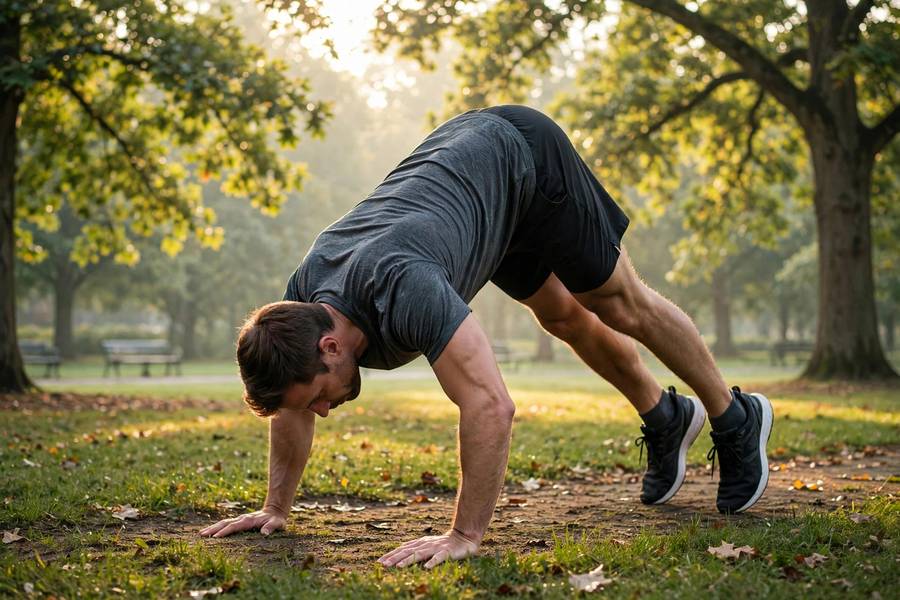
A1. Pike push-ups, 10-15 reps
Hips high, head between your arms, lower the crown of your head toward the floor. This is your main front-delt builder. Elevate your feet on a chair to make it harder.
A2. Decline push-ups, 12-15 reps
Feet on a chair or couch, hands on the floor. The decline angle shifts more load onto the front delts and upper chest than a flat push-up.
A3. Reverse snow angels, 12 reps
Lie face down, arms extended overhead. Lift your chest slightly and sweep your arms out to the sides and down to your hips, squeezing the rear delts and mid-back. Slow and controlled.
A4. Wall handstand hold, 20-40 seconds
Kick up against a wall and just hold. Isometric loading builds serious shoulder stability and the pump is unreal. Work up to 60 seconds over several weeks.
A5. Crab reaches, 10 per side
Sit with hands and feet on the floor, hips up in a reverse tabletop. Reach one arm overhead and behind you, rotating through the thoracic spine. Great for shoulder mobility under load.
Push-Up Variations That Hammer the Delts
Standard push-ups are a chest exercise first, but small tweaks turn them into delt builders. The pike push-up is king: the more vertical your torso, the more delt-dominant it becomes, progressing all the way to a full handstand push-up against a wall for advanced trainees. Pseudo-planche push-ups, where you turn your hands backward and lean forward, hammer the front delts and build the straight-arm strength that carries over to everything. Archer push-ups, shifting your weight to one side, let you approach single-arm loading without any equipment. And do not sleep on tempo: a push-up with a four-second lowering phase doubles the time under tension and will humble anyone who thinks bodyweight is easy. I program one hard push-up variation per session and rotate them every three to four weeks.

How to Make Bodyweight Harder Over Time
Progressive overload without weights comes down to four levers. First, leverage: move from pike push-ups to elevated pike to wall handstand push-up negatives. Second, volume: add a rep or a set each week; going from 3×10 to 4×12 pike push-ups over two months is real progress. Third, tempo: slow the eccentric to three or four seconds, add a pause at the bottom. Fourth, density: shrink your rest periods from 90 seconds to 60. Track everything in a notebook or your phone. The trainees who stall with bodyweight are almost always the ones who do the same reps with the same rest forever. Your muscles adapt to what you did last time plus a little more, so give them the little more. This principle is the same one behind any good strength training for runners plan: progression is the program.
Programming: Sets, Reps, and Frequency
Train shoulders twice a week with at least 48 hours between sessions. Each session: 3 to 4 rounds of the circuit above, which lands you at roughly 12 to 16 hard sets for the delts per week, right in the effective range for growth. Take every working set to one or two reps shy of failure; bodyweight sets are safe to push because there is nothing to drop on yourself. When you can complete all reps with clean form and 60-second rests, move to the harder variation. Add one dedicated rear-delt movement per session, because bodyweight pressing is front-delt dominant and imbalances creep in fast. Eat enough protein, sleep, and be patient: visible shoulder development from bodyweight takes eight to twelve weeks of consistent work, which is exactly as long as it takes with weights.
Your 4-Week No-Equipment Shoulder Progression
Here is exactly how to progress over a month. Week 1: run the circuit three times per session, twice a week, with 90-second rests. Master the movement patterns and stop each set two reps shy of failure. Week 2: add a fourth round to each session and cut rests to 75 seconds. You should notice the pump arriving earlier, which means your work capacity is improving. Week 3: introduce the harder variation of one exercise, usually elevating your feet for pike push-ups, and keep everything else the same. One progression variable at a time is the rule; change everything and you will not know what worked. Week 4: deload slightly by dropping back to three rounds but keep the harder pike variation, then test yourself with max-rep pike push-ups and a max wall handstand hold. Most people add 30 to 50 percent to both numbers in a month. After week 4, start a new cycle with the next harder variation in the progression chain. This is the same block structure I use in workout routines for beginners, just applied to bodyweight shoulders.
Track four numbers each session: rounds completed, reps on your hardest set of pike push-ups, handstand hold time, and rest periods. When all four improve, you are progressing. When they stall for two weeks, change one variable: usually rest periods or the exercise variation. Do not change your diet, sleep, and training all at once when you stall; fix training first, since that is the variable you control most directly. And film yourself once a month. Bodyweight progress is sneaky because the mirror changes slowly, but a video of your first wobbly pike push-up next to a clean elevated set four weeks later is undeniable proof the system works.

You can build strong, well-developed shoulders with push-up variations, especially pike and decline push-ups taken close to failure. Barbells allow heavier loading long-term, but most people have years of bodyweight progress available before that matters.
Slow-tempo lateral raise variations using a filled backpack or water jugs, plus high-rep pike push-ups. The side delt responds best to high volume and controlled eccentrics rather than heavy loads.
Twice per week with at least 48 hours between sessions. Each session should include 12 to 16 hard sets across 3 to 4 rounds, with sets taken to one or two reps shy of failure.
Reverse snow angels, prone Y-raises, and doorway rows cover the rear delts well with no equipment. Do at least one dedicated rear-delt movement per session since pressing variations are front-delt dominant.
Elevate your feet, slow the tempo to 3-4 second eccentrics, add reps and sets, then progress to wall-assisted handstand push-up negatives. Track reps, sets, and rest periods to ensure overload.
About 40 minutes including warm-up: 5 minutes of arm circles and mobility, then 3 to 4 rounds of the 5-exercise circuit with 60 to 90 seconds rest between rounds. As you get fitter and rest periods shrink, the same workout takes closer to 30 minutes.
Most beginners should start with incline pike push-ups, hands on a sturdy chair or couch, which reduces the load significantly. When you can do 3 sets of 12 clean incline reps, move to floor pike push-ups. Rushing to the full version with poor form is how necks get strained.