Pull-Up Progression for Beginners: From Zero to Your First Rep


Every beginner asks me for “a pull-up progression,” and most of what they find online is a random list of exercises with no order, no benchmarks, and no way to know when to move on. That’s not a progression — that’s a menu. A real progression is a sequence where each phase builds the specific capacity the next phase requires, with clear standards telling you when you’ve earned the next step. Skip steps and you stall; follow them and the first rep becomes inevitable.
This is the exact 8-phase progression I use with clients, from dead hang to first full pull-up. Each phase has an entry standard, the work to do, and an exit benchmark. You don’t advance until you hit the benchmark — that’s what makes it a progression instead of a suggestion.
How This Progression Works
Eight phases, each with a job. Phases 1 and 2 build the bottom position — grip and scapular control. Phases 3 and 4 build base pulling strength and top-position comfort. Phases 5 through 7 bridge the gap with assisted and partial work. Phase 8 is the payoff. Most people spend 1 to 3 weeks per phase, putting the total timeline at 8 to 16 weeks depending on starting point.
The rules: train 3 days per week on non-consecutive days. Work the phase you’re in — don’t jump ahead because phase 5 looks more exciting. Hit the exit benchmark before advancing; the benchmarks are the program. And keep doing the earlier phases as warm-ups even after you’ve moved past them — a phase 6 trainee still starts sessions with dead hangs and scapular pulls. Foundations don’t expire.
Equipment needed: a pull-up bar (a doorway bar is perfect — see my pull-up guide for the movement standard we’re building toward), something low to row under (a sturdy table, a barbell in a rack, or suspension straps), and one resistance band. That’s the entire equipment list. If you want to understand the tool better, my resistance band guide covers what bands can and can’t do.
Phase 1: The Dead Hang
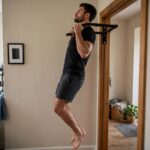
The job: Build the grip and shoulder stability to own the bar. The work: Hang from the bar with straight arms, shoulders actively pulled down away from your ears — not a passive dangle. Start with 4 sets of max hold, resting 90 seconds between sets. Do this every training day as your first exercise.
Exit benchmark: 45-second hang on your first set, 30 seconds on all four sets. Most people reach this in 1 to 3 weeks. If your hands are the limiter, add farmer’s carries twice a week — heavy dumbbells, 40-second walks, 3 sets. Grip responds fast when you train it directly.
Don’t rush this phase. Everything downstream — every rep, every set, your entire pull-up future — depends on your ability to hold the bar without thinking about it. A weak grip doesn’t just limit hangs; it limits every pulling exercise you’ll ever do. For the broader context of building a base, my beginner routines guide slots this work into a full program.
Phase 2: Scapular Pull-Ups
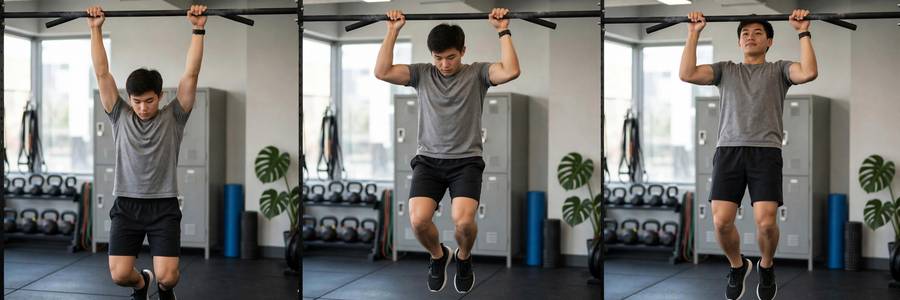
The job: Learn the initiation — the shoulder-blade movement that starts every real pull-up. The work: From a dead hang, pull your shoulder blades down and together without bending your elbows. Your body rises 2 to 3 inches. Hold 2 seconds at the top, lower with control. Three sets of 10, every session, after your hangs.
Exit benchmark: 3 sets of 12 crisp reps with a 2-second hold, no elbow bend, no swinging. This usually takes 1 to 2 weeks once the hang is solid.
This phase looks too easy to matter, and it’s the phase people are most tempted to skip. Don’t. The scapular initiation is the difference between a pull-up driven by the back and a pull-up yanked by the arms. Every client who struggles to “feel their lats” later is a client who rushed this phase. Two weeks here saves two months of frustration later. The movement is small; the payoff is enormous.
Phase 3: Inverted Rows
The job: Build raw pulling strength with an adjustable, honest movement. The work: Set a bar at hip height (or use a sturdy table edge). Hang underneath with your body straight as a board — heels on the floor, body rigid — and pull your chest to the bar. Four sets of 8 to 12, twice a week, adjusting difficulty by walking your feet forward (harder) or back (easier).
Exit benchmark: 3 sets of 12 with your body at 30 degrees or less from horizontal — nearly flat. Feet elevated on a bench counts as extra credit. Typical timeline: 2 to 4 weeks.
The non-negotiable here is body rigidity. The moment your hips sag, you’re not doing a row — you’re doing a weird hip-hinge thing that trains nothing. Squeeze your glutes, brace your abs, and keep the straight line from head to heels on every rep. If you can’t maintain it, raise the bar and reduce the angle. Honest easy reps beat dishonest hard ones, every time. Rows are also a permanent part of your training — even after you have pull-ups, they remain the best horizontal pulling builder in my bodyweight exercise arsenal.
Phase 4: Flexed-Arm Hangs
The job: Build strength and comfort in the top position — chin over the bar. The work: Jump or step up so your chin is over the bar, then hold. Three sets of max hold, resting 2 minutes between. This is isometrically brutal in a way that surprises people; your biceps, upper back, and grip all scream at once.
Exit benchmark: 20-second hold on the first set, 15 seconds on all three. Usually 1 to 2 weeks.
The flexed-arm hang does something psychological too: it makes the top of the bar familiar territory. Beginners fear the top position — it feels precarious, exposed. Spending accumulated minutes there teaches your nervous system that it’s safe, which matters enormously when phase 8 asks you to pull yourself into that position under your own power. Comfort is a trainable quality.

Phase 5: Eccentric Pull-Ups
The job: Train the full range of motion with supramaximal loading. The work: Jump to the top (chin over bar), then lower yourself over a full 5 seconds — controlled, no dropping, all the way to a dead hang. Five sets of 3 reps, resting 2 full minutes between sets. When you can’t control the full 5 seconds anymore, the session is over.
Exit benchmark: 5 sets of 3 with a true 5-second lowering on every rep. Typical timeline: 2 to 3 weeks.
Eccentrics work because you’re roughly 30 percent stronger lowering than lifting — they let you overload the exact muscles and range the pull-up needs, even though you can’t do the concentric rep yet. The muscle damage is significant, so respect the recovery: twice a week maximum for this phase, never on consecutive days. Soreness is expected; sharp elbow pain is not — back off immediately if the insides of your elbows complain.
Phase 6: Band-Assisted Pull-Ups
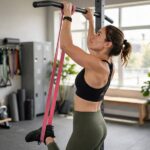
The job: Practice the complete movement pattern under reduced load. The work: Loop a band over the bar, put one knee in it, and do full pull-ups: dead hang at the bottom, chin over at the top, controlled lower. Five sets of 5 with the thinnest band that allows clean reps. Every week, try one set with the next thinner band.
Exit benchmark: 3 sets of 8 with the lightest band you own — or 5 clean reps with no band at all (in which case, skip to phase 8). Typical timeline: 2 to 4 weeks.
Band rules, because bands are the most misused tool in this progression: one knee in the band, not both feet (feet let you push and turn it into a leg exercise). Full range on every rep — the band doesn’t excuse half reps. And the goal is always to need less band, not to do more reps with the same band. If you’ve been on the same band for a month, you’re maintaining, not progressing — drop to the thinner band and accept fewer reps.
Phase 7: Top-Half and Partner Pull-Ups
The job: Bridge the final gap — build the specific strength for the last few inches. The work: Two exercises, twice a week. First, top-half pull-ups: stand on a box so you start with elbows at 90 degrees, then pull from there to chin-over-bar — 5 sets of 3. Second, partner-assisted pull-ups: have a partner support your mid-back or feet with the minimum help needed — 3 sets of 3, with the partner using less help each week.
Exit benchmark: 5 top-half reps from a dead stop, or 3 partner-assisted reps with barely-there assistance. Usually 1 to 2 weeks — this phase is short because it’s just the final nudge.
During this phase, attempt one unassisted pull-up at the start of each session when you’re fresh. One attempt — not five grinders. The day it goes up, it’ll feel almost easy, because the progression built every component separately and your nervous system finally assembles them. That surprise is the best moment in beginner training. Enjoy it.

Phase 8: The First Full Pull-Up
The job: Put it all together. The work: Warm up with hangs and scapular pulls, rest 5 minutes, chalk up, and pull. Dead hang, shoulders down, elbows to ribs, chest to bar. One perfect rep.
Exit benchmark: One strict, dead-hang, chin-over-bar pull-up. Then do it again after 5 minutes rest to prove it wasn’t a fluke.
When you get it — and if you honored every benchmark, you will — here’s what happens next: don’t max out. Do singles with full rest, 5 sets of 1, three times a week for two weeks. Then start pairing reps. Then follow a linear progression adding one rep per week. One becomes three, three becomes five, five becomes ten. The progression got you to the bar; consistency takes you from there.
The Weekly Schedule
Here’s how the phases map onto three weekly sessions. You work the phase you’re in, plus maintenance of earlier phases as warm-ups:
Monday: Dead hangs 3×max (always) → current phase work → inverted rows 3×10 (until phase 6, then maintain 2×10).
Wednesday: Scapular pulls 2×10 (always) → current phase work → flexed-arm hangs 2×max (phases 4+, maintain after).
Friday: Dead hangs 2×max → current phase work → eccentric or band work (whichever phase you’re in) → one honest pull-up attempt (phases 6+).
Total time per session: 25 to 35 minutes. That’s it. The progression works because it’s focused — every minute serves the goal. No filler exercises, no random accessory work. Just the straightest line from where you are to the bar.
Frequently Asked Questions
Eight to sixteen weeks for most beginners training 3 days per week. Your starting point determines the timeline: if you can already hang for 30 seconds and do rows, expect 8 to 10 weeks; from a complete zero, plan for 12 to 16. Rushing phases extends the timeline — hit every benchmark before advancing.
Only if you already meet a phase’s exit benchmark — test yourself and skip what’s already owned. But don’t skip phases because they look easy; the scapular phase in particular looks trivial and prevents the most common long-term problems. The benchmarks are the program. Skip the work, skip the results.
Stalls usually mean one of three things: under-recovery (add a rest day or take a light week), bodyweight working against you (even small fat loss helps significantly), or a weak link the phase doesn’t address (grip stalls fix with farmer’s carries, top-position stalls with extra flexed-arm hangs). Stay in the phase, address the limiter, and retest in two weeks.
Yes — this progression is your pulling work, not your whole program. Keep training push-ups, squats or lunges, and core work around it. Just don’t add other hard pulling (heavy rows, extra band work) on top, or recovery suffers. The progression plus a basic full-body routine is the complete package.
Absolutely — the progression is identical. Women typically spend longer in the early phases because of lower starting upper-body strength relative to bodyweight, so expect the longer end of the 8 to 16 week range. The benchmarks don’t change; the timeline just reflects the honest starting point. It works the same way for everyone.
Eight phases, clear benchmarks, no shortcuts. Start where you are, earn every step, and the bar will give you that first rep. It’s the hardest rep you’ll ever do — and the one you’ll remember longest.