
The pull-up is the ultimate honesty test in fitness. No machines, no momentum cheats that actually count — just you versus gravity. And here is what I tell every client who says “I can’t do a single one”: good. Most people can’t. That just means you are starting from the same place as everyone who eventually banged out sets of ten.
I have taken dozens of people from zero pull-ups to real reps. It is not magic and it does not take years. It takes the right progressions, practiced consistently. Here is the exact roadmap.
Table of Contents
- Why Pull Ups Are Worth It
- Perfect Pull Up Form
- The Zero-to-One Progression Plan
- From One Rep to Sets of Ten
- Common Mistakes That Stall Progress
- Programming: How Often and How Much
- Frequently Asked Questions
Why Pull Ups Are Worth It
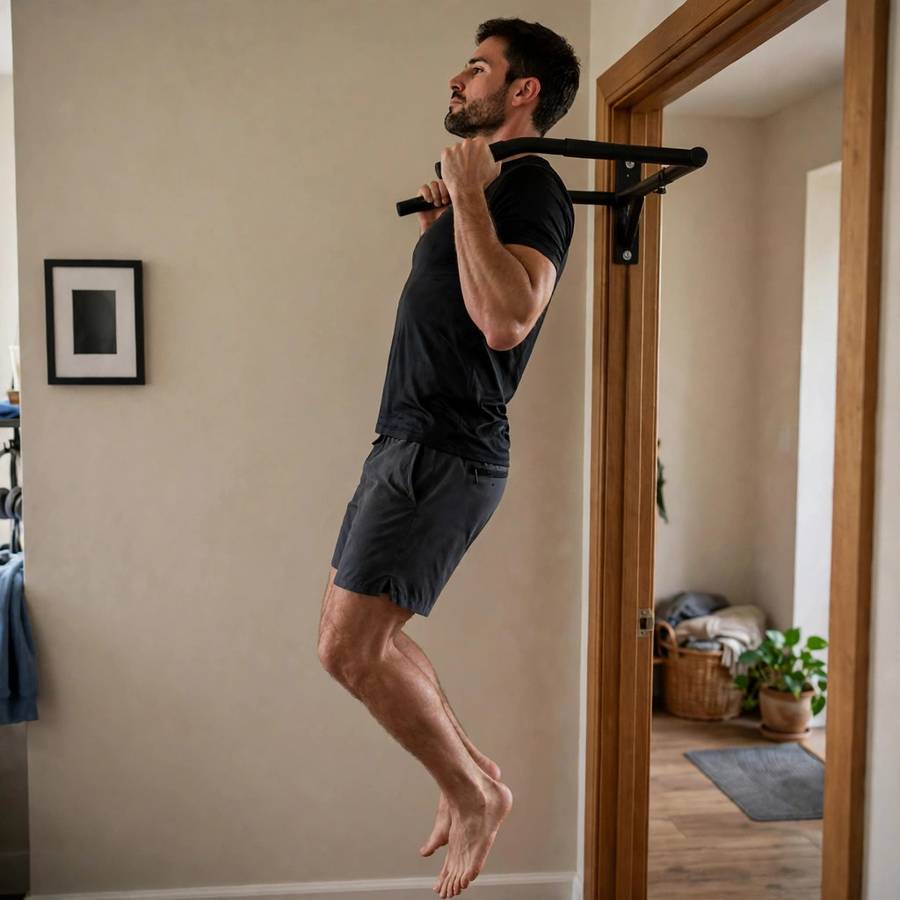
One movement trains your lats, biceps, rear delts, forearms, grip, and core — the entire upper-body pulling chain. Nothing else builds functional upper-body strength as efficiently. They need almost no equipment (a $30 doorway bar), they scale infinitely (add weight when bodyweight gets easy), and the first strict rep is one of the most satisfying milestones in training.
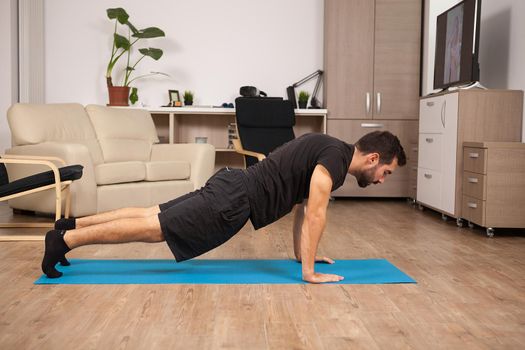
If your goal is a strong, capable upper body — especially training at home — pull-ups are non-negotiable. They pair perfectly with push-ups for a complete upper-body push/pull foundation, and they are a cornerstone of any serious bodyweight program.
Perfect Pull Up Form
Before progressions, learn what a real rep looks like — because half the “I can do pull-ups” claims out there would not pass:
- Grip: Overhand (palms away), hands just outside shoulder width. Full grip with thumbs wrapped — no false grip for beginners.
- Start from a dead hang. Arms fully extended, shoulders engaged (think “pull your shoulder blades down and back” — do not just dangle loosely).
- Pull your chest to the bar. Initiate with your back, not your arms — imagine pulling your elbows down to your ribs. Chin clears the bar.
- No kipping. No swinging, no leg kick. If you need momentum, you need an easier progression.
- Lower under control. Take 2–3 seconds on the way down. The eccentric (lowering) phase builds massive strength — do not waste it by dropping.
Chest-to-bar is the gold standard; chin-over-bar is the minimum. Pick one standard and hold it.
Form-Check Checklist: 5 Cues You Can Self-Test
You cannot fix what you cannot see — and most people train alone in a doorway with no coach watching. So here is how I teach self-checks: five cues, each with a physical test you can feel mid-rep. Run through them once a week on an easy set. The cue that feels wrong is the one to drill.
1. Knuckles to the ceiling. In the dead hang, the bar should sit across your fingers — not buried deep in your palm — with your knuckles pointing up and your thumbs wrapped underneath. The test: you should be able to wiggle your thumbs slightly. If they are pinned white and your forearms burn out before your back wakes up, your grip is too deep. Regrip higher on your fingers.
2. Ribs down. Before you pull, brace like someone is about to poke your stomach, and point your ribs at the floor. The test happens mid-rep: if your lower back arches and your legs swing forward as you rise, your ribs flared and your core checked out. Lower down, reset the brace, and pull again. This single cue fixes most swinging without ever thinking about your legs.
3. Elbows to back pockets. Initiate the pull by driving your elbows down toward your back pockets — your lats should switch on before your arms do much. The test: after a set, what is tired? If your biceps are screaming and your back feels like a passenger, you are pulling with your arms. Two weeks of scapular pull-ups will rewire the pattern.
4. The chin-and-straight rule. Two non-negotiables on every rep. At the top, your chin clears the bar — no craning your neck forward like a tortoise to fake the last inch. At the bottom, your arms straighten fully while your shoulders stay packed down (if your shoulders ride up to your ears, re-engage them before the next rep). Partial reps at either end build partial strength.
5. The two-second audit. Pause one count at the top — chin over, back squeezed — and take two to three seconds to lower. The test is simple: if you cannot hold the top for a breath, momentum did the rep, not you. If you drop instead of lowering, you threw away the half of the rep that builds the most strength. Film one set from the side once a month; the camera catches the cheats your body hides from you.
The Zero-to-One Progression Plan
Cannot do one pull-up? Follow this ladder. Master each step for the prescribed reps before moving on. Most people progress one step every 2–4 weeks.
Step 1: Dead Hangs (2–4 weeks)
Hang from the bar, shoulders engaged. Build to 3 sets of 30–60 seconds. This builds grip and shoulder stability — the foundation everything else needs. If you cannot hang 20 seconds, start here and nowhere else.
Step 2: Scapular Pull-Ups (2–3 weeks)
From a dead hang, pull your shoulder blades down and back without bending your arms — your body rises an inch or two. 3 sets of 8–10. This teaches your back to initiate the pull, fixing the #1 beginner fault (all-arms pulling).
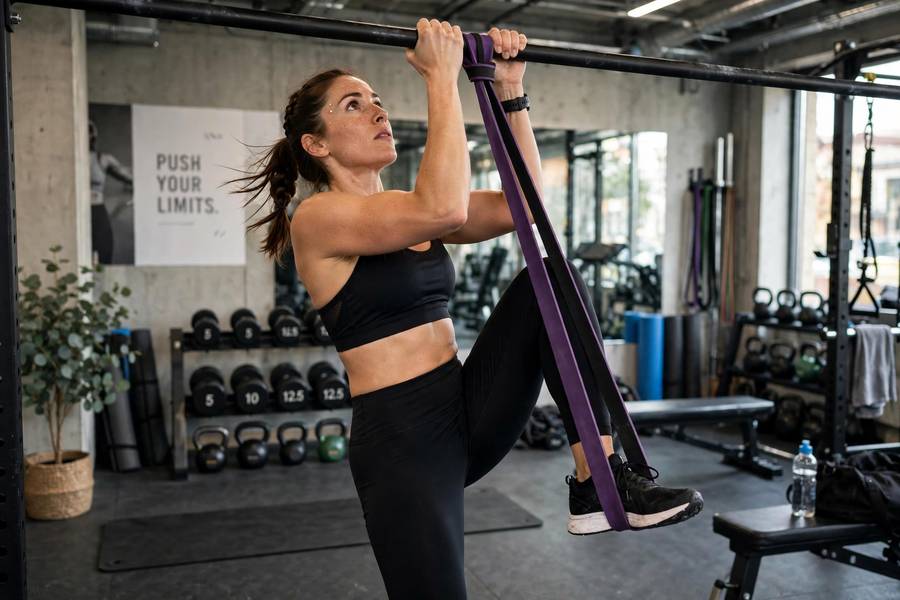
Step 3: Band-Assisted Pull-Ups (3–6 weeks)
Loop a resistance band over the bar, put a knee or foot in it, and do full pull-ups. The band helps most at the bottom (where you are weakest). Use the thinnest band that lets you do 3 sets of 5 with good form, then go thinner over time.
Step 4: Negatives (2–4 weeks)
Jump (or step) to the top position, then lower yourself as slowly as possible — aim for 5+ seconds. 3–5 singles per session. Negatives build the exact strength the full rep needs; this step alone has taken countless people from zero to one.
Step 5: The First Rep
Test when you can do 5-second negatives comfortably. Warm up, grip the bar, and pull. Most people surprise themselves — the strength was built in the steps above. Get it on video; you will want to remember this.

Programming Cheat Sheet: Sets, Reps, and Rest Per Step
Each step below tells you exactly what to do per session. Train these three days per week, either fresh or after your main workout — and stop one to two reps shy of failure on everything except negatives, which are singles by design.
| Step | Sets × Reps | Rest between sets | Move on when… |
|---|---|---|---|
| Dead hangs | 3 × 30–60 sec | 60–90 sec | You own 3 × 60 sec with shoulders packed |
| Scapular pull-ups | 3 × 8–10 | 60 sec | 3 × 10 crisp reps, no arm bend |
| Band-assisted | 3 × 5–8 | 90–120 sec | 3 × 8 on your thinnest band with full range |
| Negatives | 5 × 1 (5-sec lower) | 2 min | Five-second lowers feel controlled, not desperate |
| Grease the groove (max 1–3 reps) | Singles at ~50% max, spread through the day | — | Your max climbs to 5+ strict reps |
One rule overrides the table: form first. If your reps degrade, you are done for the day — junk volume teaches junk patterns.
From One Rep to Sets of Ten
Got one? Now build volume:
- Grease the groove: Do half your max reps, several times throughout the day, most days. If your max is 2, do singles spread across the day. This builds neurological efficiency fast.
- Add a rep per week: However you train, aim to add roughly one total rep per week. Slow and steady wins.
- Vary the grip: Chin-ups (underhand) are slightly easier and hammer biceps; neutral grip is shoulder-friendly. Rotate them in.
- Add weight eventually: When you can do 3 sets of 8 strict reps, start adding weight with a dip belt or backpack. Weighted pull-ups are the fast track to serious strength.
Stuck for 3+ Weeks? How to Break the Plateau
Three weeks with no progress feels like failure. It is not — it is information. Here is how I diagnose a stuck client, in order:
1. Name the actual sticking point. “Stuck on negatives” usually means one of three things: you cannot control the bottom third of the lower (weak lats — go back to band-assisted for two weeks), you swing uncontrollably (core — add dead-hang knee raises), or your grip gives out first (forearms — add farmer carries or extra hangs). Film a set. The camera tells the truth your ego will not.
2. Drop back one step for two weeks. This feels like going backwards. It is not. Rebuilding the previous step with perfect form almost always unlocks the next one — most plateaus are just shaky foundations finally billing you.
3. Change the stimulus, not just the effort. If you have been grinding negatives for a month, swap to band-assisted volume for two weeks, or add a fourth weekly day of easy grease-the-groove singles at your current step. The body adapts to the same stress; give it a different one.
4. Check the scale honestly. Pull-ups are the one lift where bodyweight is the weight on the bar. Gaining five kilos without gaining strength makes every rep harder — that is physics, not failure. You do not need to diet aggressively, but know the variable exists.
5. Take a deload week. If you have trained hard for six-plus weeks, do one easy week at half volume. I have seen more plateaus broken by rest than by any program tweak. Come back fresh and test.
When to actually worry: six-plus weeks of zero progress after trying the above means something structural — usually a shoulder issue or a program with no progression built in. Before that point, you are not stuck. You are adapting.
Common Mistakes That Stall Progress
- Half reps. Chin must clear the bar, arms must straighten at the bottom. Partial reps build partial strength.
- Kipping to “get one.” A kipping pull-up is a different exercise. Earn the strict rep first.
- Neglecting the lowering phase. Dropping from the top throws away half the strength stimulus.
- Training to failure daily. Pull-ups beat you up; train them 2–4 times per week with recovery, not daily max-outs (except grease-the-groove singles, which are submaximal).
- Ignoring bodyweight. At a given strength level, lighter is easier. You do not need to obsess, but be aware the scale matters here more than in any other lift.
Programming: How Often and How Much
Simple template that works:
- Beginners (progression phase): 3 days/week, 15 minutes on pull-up progressions after your main workout.
- Rep building: 3–4 days/week, 3–5 sets, stopping 1–2 reps shy of failure.
- Maintenance: 2 days/week keeps them.
Pair with pushing work (push-ups) and you have a complete upper body. Training at home? A doorway bar plus a floor is genuinely enough for an impressive physique.
Pull-Up Variations Worth Adding
Once strict pull-ups are solid, variations keep progress coming: chin-ups (underhand, more biceps), neutral-grip pull-ups (joint-friendly middle ground), wide-grip pull-ups (lat emphasis), archer pull-ups (unilateral strength toward one-arm work), and L-sit pull-ups (core integration). Rotate one variation per training block. Weighted pull-ups — hanging plates or a backpack from a dip belt — are the ultimate progression for pure strength.

Weighted Pull-Ups: The Beyond-Bodyweight Progression
Bodyweight pull-ups build an impressive upper body. Weighted pull-ups build a serious one. Once you can do three sets of eight strict bodyweight reps, adding load is the fastest way to keep getting stronger — and the programming is simple.
How to start. You need a dip belt (cheap, worth it) or a sturdy backpack loaded with books or plates. Warm up with two easy bodyweight sets, then add 2.5–5 kg (roughly 5–10 lbs) — less than your ego wants, more than enough to matter. Train 5 sets of 5, resting two to three minutes between sets. When you complete all 25 reps with good form, add the smallest increment you have next session. That is the whole system: double progression, session after session.
How to program the week. Two weighted days and one bodyweight volume day works for most people. Example: Monday 5×5 weighted, Thursday 5×5 weighted (slightly heavier, or one more rep per set than Monday), Saturday 3 sets of bodyweight reps stopping two shy of failure. Weighted work is neurologically demanding — do it fresh, early in the workout, never after exhausting your back.
Safety rules that matter more with weight. No kipping, ever — momentum plus added load is how shoulders get injured. Keep the dead-hang start and the controlled two-to-three-second lower from your bodyweight days. If a weight makes your form break, it is too heavy; drop it and earn it back. And test a one-rep max rarely, if at all — the 5×5 progression builds the same strength without the risk.
What to expect. Progress is slower than the beginner phase and that is normal — adding 1–2 kg a month is excellent. Hanging half your bodyweight for reps puts you in genuinely elite territory; even a quarter of bodyweight for sets of five is stronger than the vast majority of gym-goers. The pull-up bar, a belt, and patience: that is a complete upper-body strength program.
Frequently Asked Questions
Most beginners go from zero to one strict pull-up in 2–4 months following a proper progression (dead hangs → scapular pulls → band-assisted → negatives). Consistency 3x/week matters more than anything else.
Pull-ups use an overhand grip (palms away) and emphasize the back; chin-ups use an underhand grip (palms toward you) and involve the biceps more. Chin-ups are slightly easier for most beginners.
Submaximal grease-the-groove singles spread through the day are fine daily. Hard sets to near-failure need recovery — 2–4 sessions per week is the sweet spot for most people.
Yes — build to 30–60 second dead hangs before anything else. Grip and shoulder stability are the foundation; without them, every progression stalls.
Very — they let you practice the full movement pattern while building strength. Use the thinnest band that allows good form for sets of 5, and progress to thinner bands over weeks.
Usually it is technique (pulling with arms instead of back — fix with scapular pull-ups) or the strength-to-weight ratio. Practice the specific movement pattern; general gym strength does not automatically transfer.
Start with 2.5–5 kg (5–10 lbs) once you can do 3 sets of 8 strict bodyweight reps. Use a dip belt or a loaded backpack, train 5 sets of 5 with 2–3 minutes rest, and add the smallest increment whenever you complete all 25 reps. Small jumps, done consistently, add up fast.
Drop back to band-assisted pull-ups for two weeks and rebuild with perfect form — most negative plateaus are shaky foundations. Film a set to find the real weak point (grip, core, or the bottom of the rep), add one easy weekly session at your current step, and take a deload week if you have trained hard for six-plus weeks.