
Push pull legs — PPL — is one of the most popular training splits in the world, and unlike most popular things in fitness, its popularity is earned. The logic is simple: group muscles by movement pattern, train each group fresh, and rotate through the week. No overlap, no guesswork, no wasted sessions.
But popular doesn’t mean foolproof. Most PPL routines floating around online have the same flaws: too much volume, no progression plan, and leg days that look like an afterthought. I’ve programmed PPL for everyone from busy professionals to competitive lifters. Here’s the complete guide — what PPL is, the exact routines for 3-day and 6-day versions, and how to progress without burning out.
Table of Contents
- What Push Pull Legs Actually Means
- Why PPL Works (and When It Doesn’t)
- The 3-Day PPL Routine
- The 6-Day PPL Routine
- Exercise Selection Rules
- Sets, Reps, and Rest Periods
- Progression in Your Push Pull Legs Workout Routine
- Common PPL Mistakes
- Frequently Asked Questions
What Push Pull Legs Actually Means
The split divides your training by movement pattern:
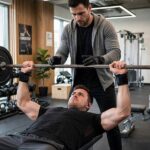
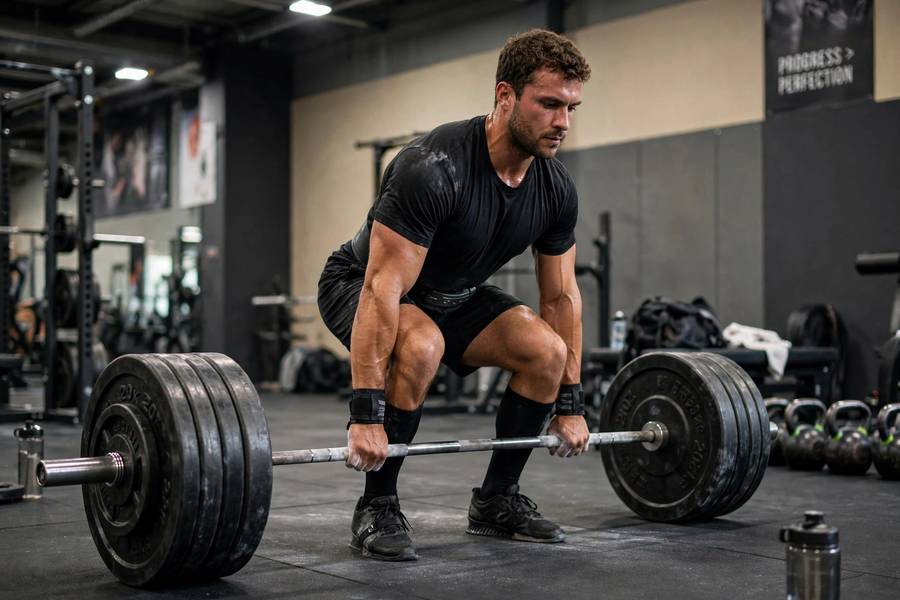
- Push day: Chest, shoulders, triceps — everything you push away from your body. Bench press, overhead press, dips, lateral raises, triceps work.
- Pull day: Back, biceps, rear delts — everything you pull toward your body. Deadlifts, rows, pull-ups, curls, face pulls.
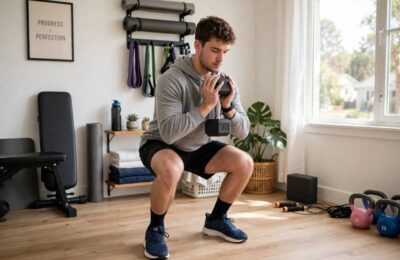
- Legs day: Quads, hamstrings, glutes, calves — squats, hinges, lunges, calf work, plus core.
The elegance is in the recovery logic: your pushing muscles rest while you pull, and vice versa. Triceps get hammered on push day, then rest completely on pull and leg days. Compare that to a chest-and-back day where everything overlaps — PPL’s separation is what lets you train hard and recover fully.
You run the three days in rotation: either once per week (3 training days) or twice per week (6 training days). Same exercises, different frequency — and that choice changes the programming significantly, as you’ll see below.
Why PPL Works (and When It Doesn’t)
Why it works: Each muscle group gets focused, high-quality work with full recovery before its next session. Sessions are logically organized — you warm up the pattern once and stay in it. It’s flexible: 3, 4, 5, or 6 days all work with adjustments. And it’s beginner-friendly to understand, which means people actually follow it.
When it doesn’t: PPL fails in three situations. First, when volume creeps — the 6-day version tempts people into marathon sessions that outrun recovery. Second, when leg day gets shortchanged (the classic: 25 sets for chest across the week, 8 for legs). Third, when there’s no progression plan — just showing up and doing the same weights forever. This guide fixes all three.
Who it’s for: Lifters past the pure-beginner stage (roughly 3–6+ months of consistent training) who can train at least 3 days a week and want a structured, proven framework. True beginners usually do better on full-body routines first — build the base, then specialize.
The 3-Day PPL Routine
One rotation per week. Each muscle gets hit once directly per week — lower frequency, so each session carries more volume. Rest 2–3 minutes on heavy compounds, 60–90 seconds on accessories.
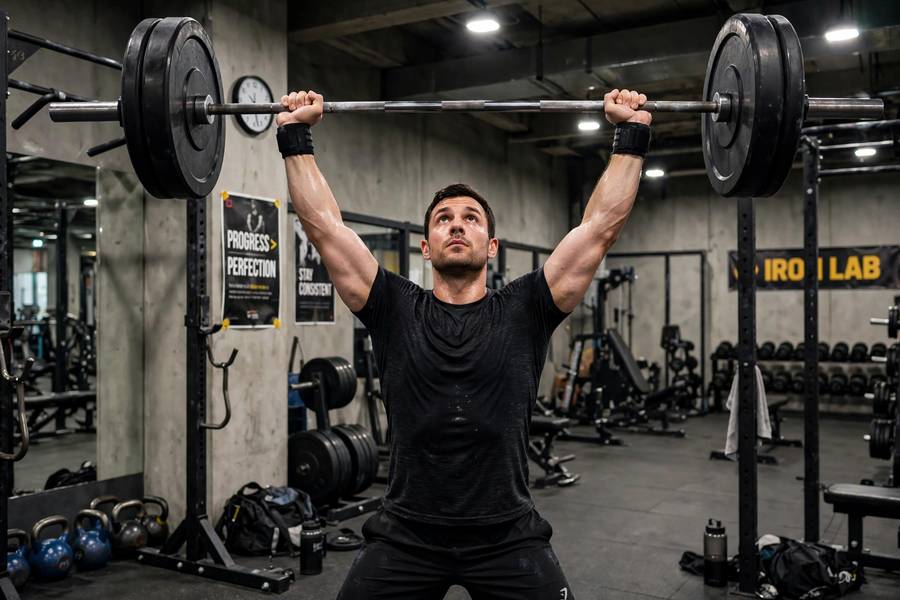
Push Day (Monday) – Barbell bench press — 4 sets × 6–8 reps – Standing overhead press — 3 × 8–10 – Incline dumbbell press — 3 × 8–12 – Lateral raise — 3 × 12–15 – Triceps pushdown — 3 × 10–12 – Overhead triceps extension — 2 × 10–12
Pull Day (Wednesday) – Deadlift — 3 × 5 (heavy, full rest between sets) – Pull-up or lat pulldown — 4 × 6–10 – Barbell row — 3 × 8–10 – Face pull — 3 × 12–15 – Barbell or dumbbell curl — 3 × 10–12 – Hammer curl — 2 × 10–12
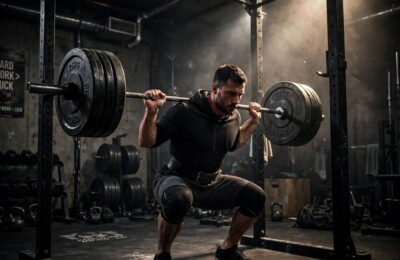
Legs Day (Friday) – Back squat — 4 × 6–8 – Romanian deadlift — 3 × 8–10 – Leg press — 3 × 10–12 – Walking lunge — 3 × 10 steps per leg – Standing calf raise — 4 × 12–15 – Hanging knee raise — 3 × 10–15
Sessions run 60–75 minutes. If you’re newer to these movements, nail the basics first — guides on how to do push-ups and how to do a plank correctly build the pressing and core foundations that make the barbell work safer.
The 6-Day PPL Routine
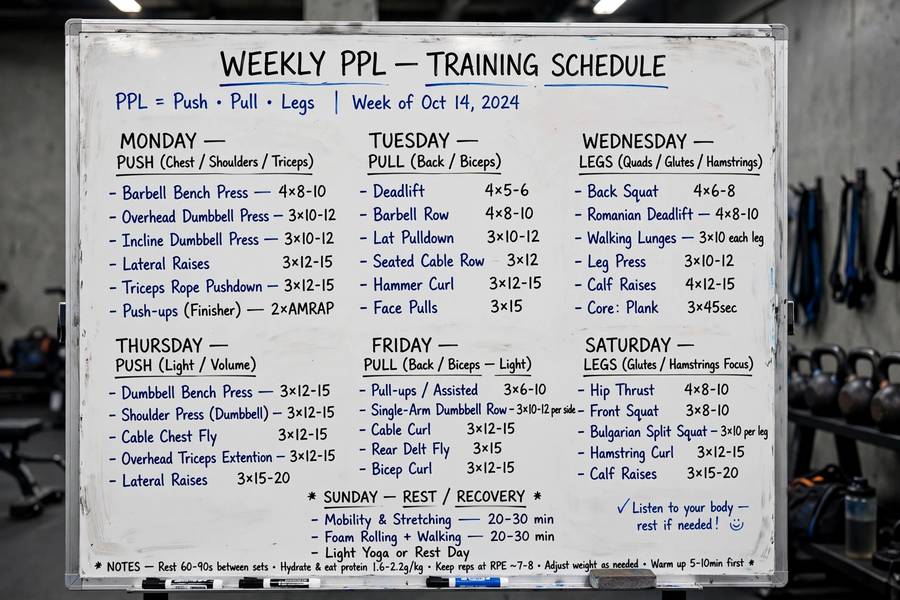
Two rotations per week (PPLPPL, rest Sunday). Each muscle gets hit twice weekly — higher frequency, so per-session volume drops. This is the classic mass-building version, and it demands respect for recovery.
Push Day A (Monday) — Heavy – Barbell bench press — 4 × 5–6 – Standing overhead press — 3 × 6–8 – Weighted dip — 3 × 6–8 – Lateral raise — 3 × 12–15
Pull Day A (Tuesday) — Heavy – Deadlift — 3 × 5 – Weighted pull-up — 4 × 5–8 – Barbell row — 3 × 6–8 – Barbell curl — 3 × 8–10
Legs Day A (Wednesday) — Heavy – Back squat — 4 × 5–6 – Romanian deadlift — 3 × 6–8 – Leg press — 3 × 8–10 – Standing calf raise — 4 × 10–12
Push Day B (Thursday) — Volume – Incline dumbbell press — 4 × 8–12 – Seated dumbbell press — 3 × 8–12 – Cable fly — 3 × 12–15 – Triceps pushdown — 3 × 10–12 – Overhead triceps extension — 3 × 10–12
Pull Day B (Friday) — Volume – Lat pulldown — 4 × 8–12 – Chest-supported row — 3 × 8–12 – Straight-arm pulldown — 3 × 12–15 – Face pull — 3 × 12–15 – Incline dumbbell curl — 3 × 10–12 – Hammer curl — 3 × 10–12
Legs Day B (Saturday) — Volume – Front squat or hack squat — 4 × 8–10 – Lying leg curl — 3 × 10–12 – Bulgarian split squat — 3 × 10 per leg – Seated calf raise — 4 × 12–15 – Cable crunch — 3 × 12–15
Sunday: Rest. Actually rest — not “active recovery” that turns into another workout.
The heavy/volume alternation is the key design feature: Day A builds strength with heavy compounds, Day B builds size with higher-rep accessory work. Together they cover both drivers of muscle growth.
Exercise Selection Rules
Don’t just copy the template blindly — understand the selection logic so you can substitute intelligently:
- Lead with a compound. Every day starts with the heaviest multi-joint movement for that pattern. This is where most of your progress comes from.
- One horizontal and one vertical movement per upper day. Push: bench (horizontal) + overhead press (vertical). Pull: row (horizontal) + pull-up (vertical). This ensures complete development.
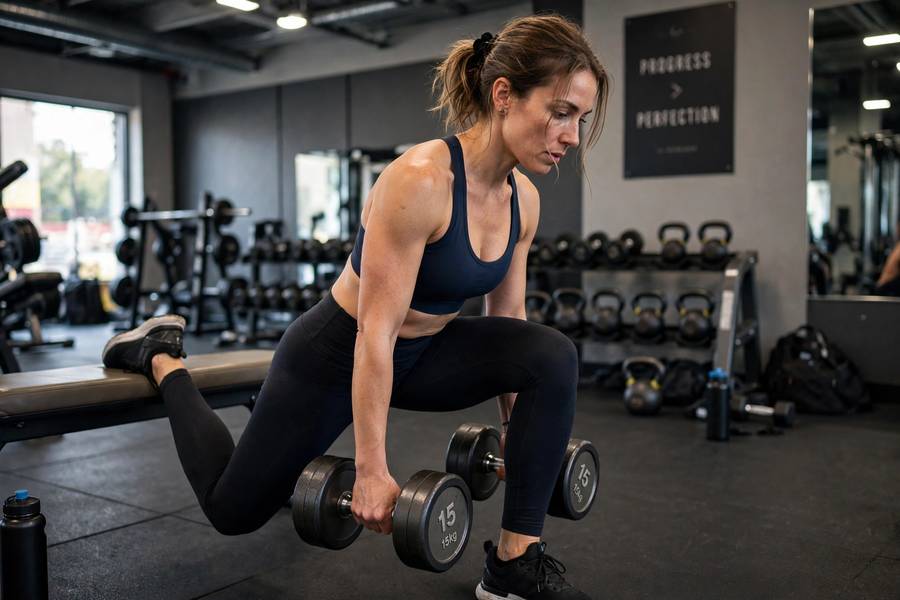
- Hit each muscle from its main functions. Chest gets a flat and an incline press. Back gets a vertical pull and a horizontal row. Quads get a squat pattern; hamstrings get a hinge and a knee-flexion movement (like leg curls).
- Small muscles go last. Triceps, biceps, calves, rear delts — accessories at the end, when the big work is done. They’re already half-trained from the compounds.
- Swap, don’t stack. If you substitute an exercise, replace — don’t add. The template’s volume is already calibrated. Adding “just one more” movement every week is how PPL programs bloat into 2-hour sessions.
For lifters without full gym access, the same push/pull/legs logic works with dumbbells and bodyweight — our bodyweight exercises collection covers the substitutions.
Sets, Reps, and Rest Periods
The rep ranges in the templates aren’t random — they map to training goals:
- 5–6 reps (heavy compounds): Strength focus. Full 3–5 minute rests on deadlifts and heavy squats. Leave 1–2 reps in reserve.
- 6–8 reps (main compounds): The hypertrophy-strength sweet spot. 2–3 minute rests.
- 8–12 reps (accessories): Pure muscle-building range. 60–90 second rests. Push these closer to failure — 0–2 reps in reserve is fine here.
- 12–15+ reps (isolation finishers): Pump and mind-muscle connection work. 60 seconds rest. These should burn.
Total sets per session: 16–24 for the 6-day version, 18–24 for the 3-day version. If your sessions consistently exceed 75 minutes, you’re resting too long or doing too much — trim accessories before touching compounds.
Progression in Your Push Pull Legs Workout Routine
A routine without a progression plan is just a list of exercises. Here’s the system — it’s called double progression and it’s all you need:
- Pick a rep range (say, 3 × 8–12).
- Start at the bottom of the range with a weight you can handle (3 × 8).
- Each session, try to add reps. 3 × 8 becomes 3 × 9, then 3 × 10…
- When you hit the top of the range on all sets with good form (3 × 12), add weight (5 lbs upper body, 10 lbs lower) and drop back to 3 × 8.
- Repeat forever.
For heavy compounds (5–6 rep range): add weight when you complete all sets at the top end with a rep or two in reserve. Smaller jumps — 2.5 to 5 lbs — keep progress moving longer.
When you stall (same weights for 3 weeks): first check sleep, food, and life stress — plateaus are usually recovery problems, not program problems. If recovery is dialed in, deload: cut weights by 10% for one week, then build back up. You’ll break through.
Track everything. Exercise, weight, sets, reps — every session, in a notebook or app. “I think I did 185 last time” is how progress dies. Written numbers are how it lives.
Common PPL Mistakes
Skipping or shrinking leg day. The most common PPL sin. Legs are half your musculature — a 30-minute leg day after 75-minute push and pull days is unbalanced programming. Give legs equal billing: equal session length, equal effort, equal progression focus.
Too much pressing, not enough pulling. Most people love push day and tolerate pull day. But a 2:1 push-to-pull ratio builds imbalances and cranky shoulders. The templates above are balanced — keep them that way. Face pulls and rows aren’t optional.
Deadlifting heavy twice a week on the 6-day split. Notice the 6-day template deadlifts heavy only on Pull Day A. Heavy deadlifts are the most fatiguing movement in training — twice-weekly heavy pulls will bury your recovery. One heavy session, one lighter hinge variation (Romanian deadlifts on leg day cover this).
No deloads. Running the 6-day version at full intensity for months without a break is how overuse injuries happen. Every 6–8 weeks, take a deload week: same exercises, half the volume, lighter weights. You’ll come back stronger.
Treating rest day as optional. The 6-day split has exactly one rest day. Protect it. Growth happens during recovery, and six hard sessions a week is already near the ceiling of what most natural lifters can sustain.
Run it clean for 12–16 weeks, progress the numbers, eat and sleep like you mean it. PPL done right is one of the most effective ways to train that exists. PPL done sloppy is just a lot of gym time. The difference is everything on this page.
Frequently Asked Questions
PPL splits training by movement pattern: push day (chest, shoulders, triceps), pull day (back, biceps), and legs day (quads, hamstrings, glutes, calves). The three days rotate once per week (3-day) or twice per week (6-day).
Yes — it’s one of the most effective hypertrophy splits, especially the 6-day version where each muscle is trained twice weekly. Success depends on proper volume, exercise selection, and a real progression plan.
Choose based on schedule and recovery. The 3-day version suits busy lifters with more volume per session; the 6-day version suits intermediates who can recover from high frequency. Both build muscle when programmed correctly.
Deadlifts go on pull day as the lead heavy compound. On the 6-day version, deadlift heavy only once per week — the movement is extremely fatiguing and twice-weekly heavy pulls outrun most lifters’ recovery.
60–75 minutes is the target. Sessions running longer usually mean excessive rest periods or too many accessory exercises — trim accessories before touching the compound movements.
Lifters with 3–6 months of consistent training can run the 3-day version. True beginners typically progress faster on full-body routines first, then graduate to PPL once the base is built.