
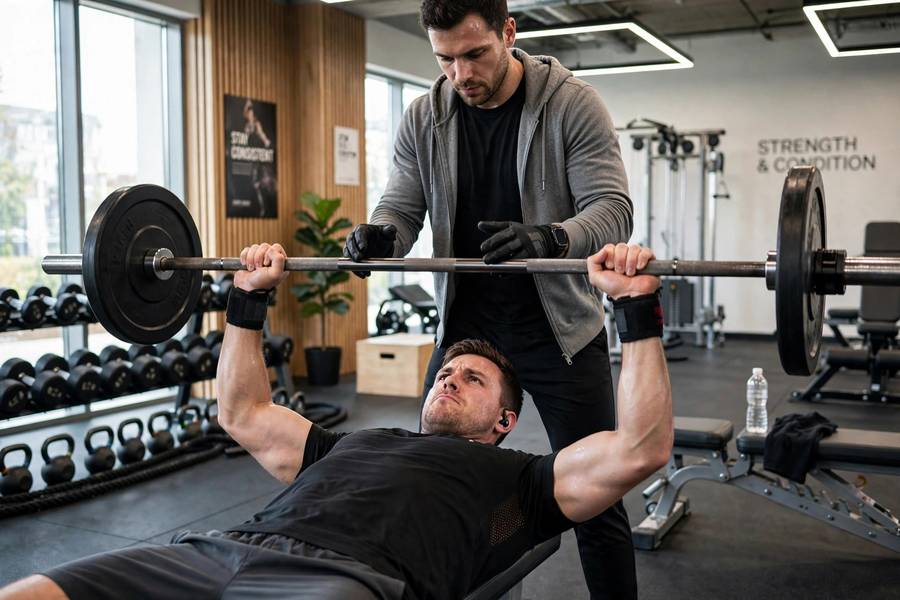
“What’s the best workout split?” is probably the most-asked question I get, and the honest answer annoys people: it depends on how many days you can actually train. The best split isn’t the one with the fanciest name — it’s the one that fits your real life and that you’ll follow for months.
A workout split is just how you divide your training across the week. The goal is always the same: hit every major muscle group with enough frequency and recovery. There are five classic splits, each suited to different schedules. Let’s find yours.
One note on goals: this guide covers every split — who it suits and how to schedule it. If your single goal is building size, our guide to the best workout split for muscle gain goes deep on the hypertrophy playbook: volume landmarks per muscle, progression schemes for growth, and exercise selection for size.
Table of Contents
- What Makes a Split Work
- Full Body (2–3 Days/Week)
- Upper/Lower (4 Days/Week)
- Push/Pull/Legs (3–6 Days/Week)
- The Bro Split (5–6 Days/Week)
- Hybrid and Custom Splits
- How to Choose Your Split
- Sample Weeks for Each Split
- Common Split Mistakes
- Frequently Asked Questions
What Makes a Split Work
Before the options, the principles. Any good split must:
- Train each muscle 2+ times per week (or very close). Once-a-week frequency is the biggest limitation of old-school splits — research consistently favors higher frequency for growth.
- Allow recovery. Muscles need ~48 hours before being hit hard again. Your split should respect that.
- Fit your actual schedule. A perfect 6-day split you follow for three weeks then abandon loses to a decent 3-day split you run for a year.
- Balance pushing and pulling. For every push movement, program a pull. Shoulder health depends on it.
Frequency and consistency beat split sophistication every time. A beginner on full-body 3x/week will outgrow an intermediate on a sloppy 5-day split.
Full Body (2–3 Days/Week)
Best for: beginners, busy people, anyone training 3 or fewer days.
You train everything, every session. One big compound movement per pattern — squat, hinge, push, pull, carry — plus a little accessory work. Sessions run 45–60 minutes.
Why it works: maximum frequency (each muscle 3x/week), simple to program, and missed sessions don’t wreck the week — you just do full body again next time. This is what I give every beginner, and what I recommend for building muscle at home with limited equipment.
Downside: sessions can feel long, and advanced lifters eventually need more volume per muscle than one session allows.
Upper/Lower (4 Days/Week)
Best for: intermediates training 4 days who want a balance of frequency and focus.
Two upper days, two lower days. Each muscle gets hit twice weekly with good volume per session. A classic:
- Monday: Upper (strength focus)
- Tuesday: Lower (strength focus)
- Thursday: Upper (hypertrophy focus)
- Friday: Lower (hypertrophy focus)
This is my personal favorite for most intermediates. It’s flexible — miss a day and you can shift things without breaking the structure — and it gives each session a clear purpose.
Push/Pull/Legs (3–6 Days/Week)
Best for: people who love training and want maximum flexibility.
- Push: chest, shoulders, triceps
- Pull: back, biceps, rear delts
- Legs: quads, hamstrings, glutes, calves
Run it 3 days (each once), or 6 days (each twice, the popular PPLPPL). The 6-day version is beloved by serious lifters because volume and frequency are both high.
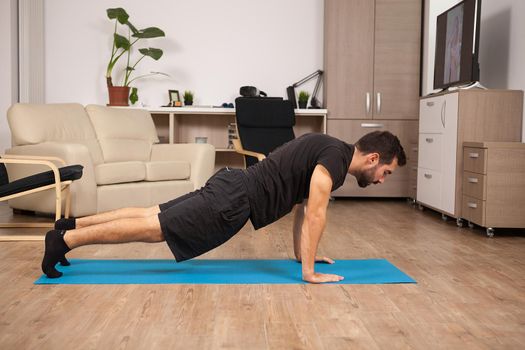
Caution: the 6-day version demands real recovery capacity — sleep, food, and stress management all matter. If your life is chaotic, the 3-day version still works great. And bodyweight exercises can fill any of these days when you can’t get to a gym.
The Bro Split (5–6 Days/Week)
Best for: advanced lifters who genuinely enjoy high-volume single-muscle days.
Chest day, back day, shoulder day, leg day, arm day — the classic bodybuilder split. Each muscle gets destroyed once a week with massive volume.
Honest take: it works, but it’s the least efficient option for most people. Once-weekly frequency leaves gains on the table versus hitting muscles twice. It survives on enjoyment — if you love arm day, you’ll train consistently, and consistency wins. But if you’re choosing on effectiveness alone, upper/lower or PPL beats it.

Hybrid and Custom Splits
Real life isn’t a textbook. Hybrids are fine:
- Full body + upper/lower: 3 days full body, or alternate full-body and upper/lower days across the week.
- PPL + full body: PPL for three days, one full-body day for lagging parts.
- Sport-specific: runners might do 2 full-body strength days; fighters might do push/pull + conditioning.
The rule: keep the principles (frequency, recovery, balance) and arrange freely. Your split should serve your goals, not the other way around.
How to Choose Your Split
Answer these three questions:
- How many days can you train for the next 6 months? Be honest. Count only days you’re 90% sure about.
- 2–3 → Full body
- 4 → Upper/lower
- 5–6 → PPL or bro split
- What’s your experience level? Beginners do best with full body regardless of available days — the frequency accelerates learning.
- What do you enjoy? The split you’ll actually do beats the theoretically optimal one.
When in doubt, go simpler. You can always add days later.
Sample Weeks for Each Split
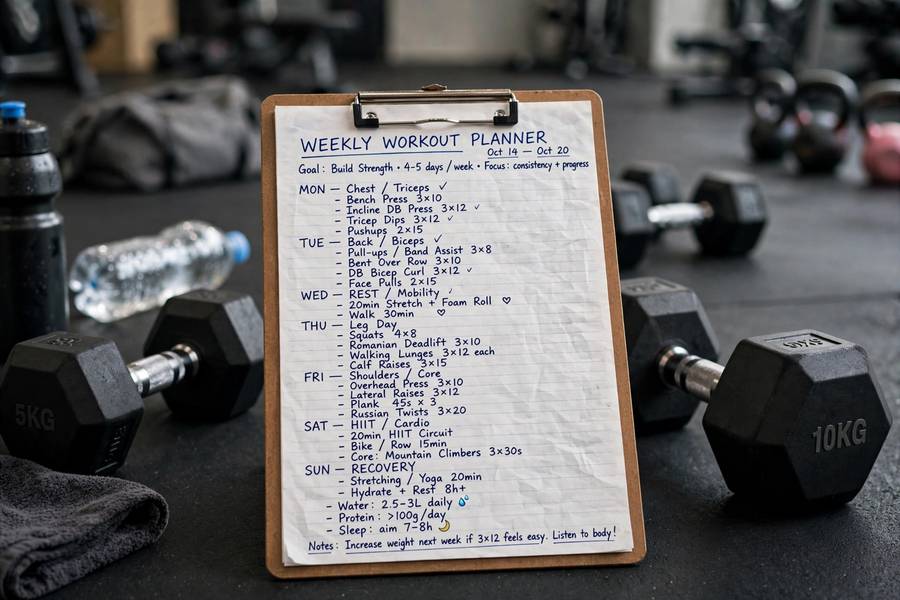
Full body 3x: – Mon: Squat, bench, row, overhead press, carry – Wed: Deadlift, push-up, pull-up/lat pulldown, lunge, core – Fri: Squat (lighter), incline press, row variation, hip hinge, carry
Upper/lower 4x: – Mon: Upper strength (bench, row, overhead press) – Tue: Lower strength (squat, Romanian deadlift, leg press) – Thu: Upper hypertrophy (incline dumbbell, lat pulldown, lateral raises, curls) – Fri: Lower hypertrophy (front squat, leg curl, Bulgarian split squat, calves)
PPL 6x: Push, Pull, Legs, rest, Push, Pull, Legs (or PPL 3x with rest days between).
As for the best time to exercise — it matters far less than split adherence. Train when you’ll actually show up.
Common Split Mistakes
- Changing splits every 3 weeks. Pick one and run it 8–12 weeks minimum. Program-hopping is progress-killing.
- Adding junk volume. More isn’t better past a point — 10–20 hard sets per muscle per week is the productive range for most.
- Skipping legs. Don’t be that person. Lower body is half your muscle mass.
- No progression plan. The split is the container; progressive overload is the engine. Add weight or reps over time, or nothing happens.
- Ignoring recovery. Six days of hard training with five hours of sleep is a recipe for burnout, not gains.
When to Change Your Split
A good split stops being good when your life or goals change. Switch when:
- Your schedule changes. New job, new baby, new semester — re-match the split to reality immediately. Forcing a 6-day split into a 3-day life is how people quit.
- Progress stalls for 4+ weeks despite good sleep, food, and effort. Sometimes a new stimulus (different split, different frequency) restarts adaptation.
- You’re bored. Enjoyment drives adherence. If you dread every session, the “optimal” split is failing at its real job.
- You’ve outgrown it. Beginners graduate from full-body to upper/lower naturally after 6–12 months as volume needs grow.
When you switch, change one variable at a time and give the new split a full 8–12 weeks. And keep what worked — your favorite movements and rep schemes transfer between splits freely.
Deload Weeks: The Planned Step Back
Every 4–8 weeks, take a deload: cut volume roughly in half for one week while keeping the same split. Same exercises, fewer sets, lighter weights.
It feels like slacking. It’s actually when your body consolidates gains — fatigue dissipates while fitness remains, and you return stronger. Lifters who never deload eventually get forced into one by injury or burnout, which costs far more than the planned week.
Schedule deloads proactively, especially on 5–6 day splits. Your joints will thank you.
Frequently Asked Questions
Full body 2–3 days per week. It gives maximum frequency for learning movements, it’s simple, and missed sessions don’t derail progress. Move to upper/lower after 6–12 months.
For most people, yes — PPL hits each muscle twice weekly (in the 6-day version) versus once for bro splits, and research favors higher frequency. But the best split is the one you’ll follow consistently.
3–5 days suits most goals. Beginners thrive on 3 full-body days; intermediates on 4-day upper/lower; dedicated lifters on 5–6 day PPL. More than 6 hard days is counterproductive for almost everyone.
Absolutely. A well-programmed 3-day full-body split builds significant muscle, especially for beginners and intermediates. Total weekly volume and progression matter more than days per week.
Light cardio (walking, easy cycling) on rest days is fine and aids recovery. Hard conditioning counts as training stress — schedule it deliberately rather than stacking it on top of lifting.
Minimum 8–12 weeks. Your body needs time to adapt and for you to learn whether it’s working. Switching every few weeks guarantees you’ll never know what actually works for you.