
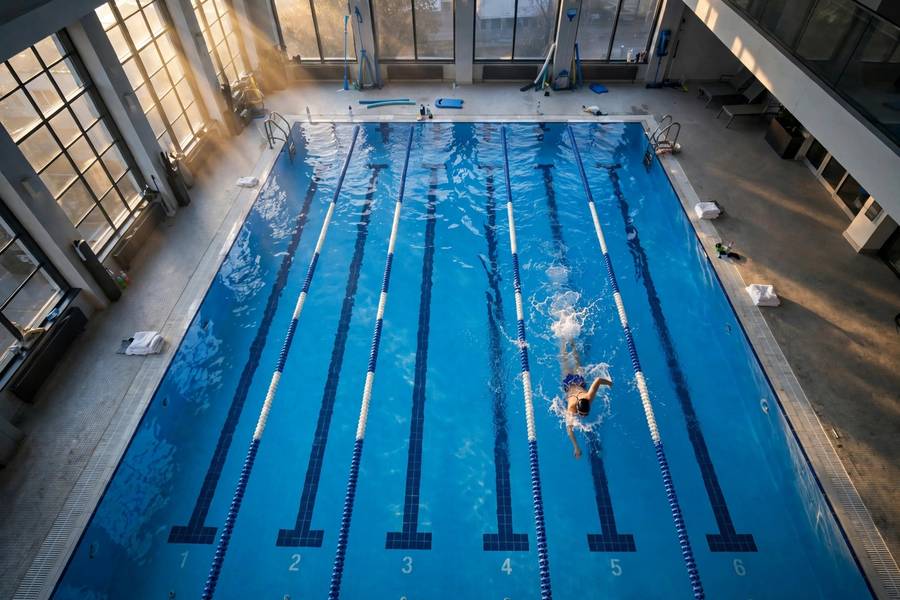
I learned to swim properly at 22, which in swimmer years is basically retirement age. I’d played college ball, I could run, I could lift — and I could not get across a 25-meter pool without my heart rate hitting the panic zone. My first lap felt like a marathon. My second lap felt like a negotiation with my lungs.
Here’s what nobody tells beginners: swimming is the one sport where fitness from other sports barely transfers. Runners gasp. Weightlifters sink. The water doesn’t care about your squat numbers. It cares about one thing — efficiency. And efficiency is teachable, which is great news for you.
I spent a season training with a masters swim group, notebook in hand, writing down everything the coaches said. These are the beginner swimming workouts that actually worked — not the ones from a poster on the pool wall, but the sessions real coaches give real beginners. Thirty minutes, three times a week, and you’ll be shocked how fast you change.
Table of Contents
- Why Swimming Is Weirdly Hard at First
- What You Need Before You Start
- The Golden Rule: Technique First, Speed Later
- Workout 1: The Survival Lap Plan (Week 1-2)
- Workout 2: The Drill Builder (Week 3-4)
- Workout 3: The Endurance Engine (Week 5-8)
- Workout 4: The Interval Intro (Week 8+)
- Breathing: The Skill That Changes Everything
- The Numbers: How Much Progress Is Normal?
- 5 Mistakes Every Beginner Makes
- Frequently Asked Questions
Why Swimming Is Weirdly Hard at First
Let’s talk physics, because this is where my notebook got interesting. Water is ~800x denser than air. Every flaw in body position multiplies: sagging hips drag like an anchor. If your head pops up, your legs drop like a seesaw.
I tracked my first month in lap times. Day one: 25 meters in about 55 seconds, arms flailing, completely spent. By day 30: 25 meters in 32 seconds, and I could chat at the wall. I hadn’t gotten fitter — my body just stopped fighting the water.
That’s the whole game. Beginners don’t need fitness; they need to stop wasting energy. Every workout below is built on that idea.
What You Need Before You Start
Keep it simple. Goggles that don’t leak (test them in the shop — press the cups to your eyes without the strap; they should suction for a second). A swimsuit you’re not adjusting every lap. That’s the required list.
Nice to have: a kickboard and a pull buoy. Most public pools have a stack of them on deck, free to grab. These two tools isolate your legs and arms so you can fix one thing at a time. Your coach friends call this “deconstructing the stroke.” I call it genius.
Skip the nose clip and the snorkel for now. They delay the one skill that matters most — breathing.
The Golden Rule: Technique First, Speed Later
Every coach I trained with said the same thing, and they said it like they’d been burned by ignoring it: do not chase speed until your technique is boring. Swimming fast with bad form is like sprinting in shoes tied together — impressive effort, terrible result.
How do you know your technique is ready for speed? The test my masters coach used: swim 200 meters at a pace where you could breathe through your nose at the wall. If you can do that without your stroke falling apart, you’re efficient enough to start pushing.
Until then, slow down. Slow reps with good form build the motor patterns that fast reps never will.
Workout 1: The Survival Lap Plan (Week 1-2)
This is exactly what I did in weeks one and two. The goal isn’t fitness — it’s comfort.
Warm-up (5 minutes): Walk the shallow end, arm circles, leg swings. Get wet, dunk your face, exhale underwater a few times. Sounds silly. Do it anyway.
Main set: Swim one length freestyle, rest 30-60 seconds, repeat 8 times. If freestyle falls apart, switch to backstroke — the only stroke where breathing isn’t a puzzle.
Catch-drill: 5 minutes at the wall: one hand waits in front until the other arrives. It forces a long, gliding stroke instead of a windmill.
Cool-down: 2 easy lengths backstroke. Leave before you’re exhausted — you should leave every beginner session wanting a little more.
Total: about 600 meters, 25-30 minutes, three times a week. By session six, something clicks — you stop thinking about survival and start thinking about swimming.
Workout 2: The Drill Builder (Week 3-4)
Time to build the stroke piece by piece. Drills look weird — embrace it.
Warm-up: 4 x 25 easy freestyle, resting 20 seconds between. Focus on long exhales underwater.
Drill set (the main course):
Kickboard Sets
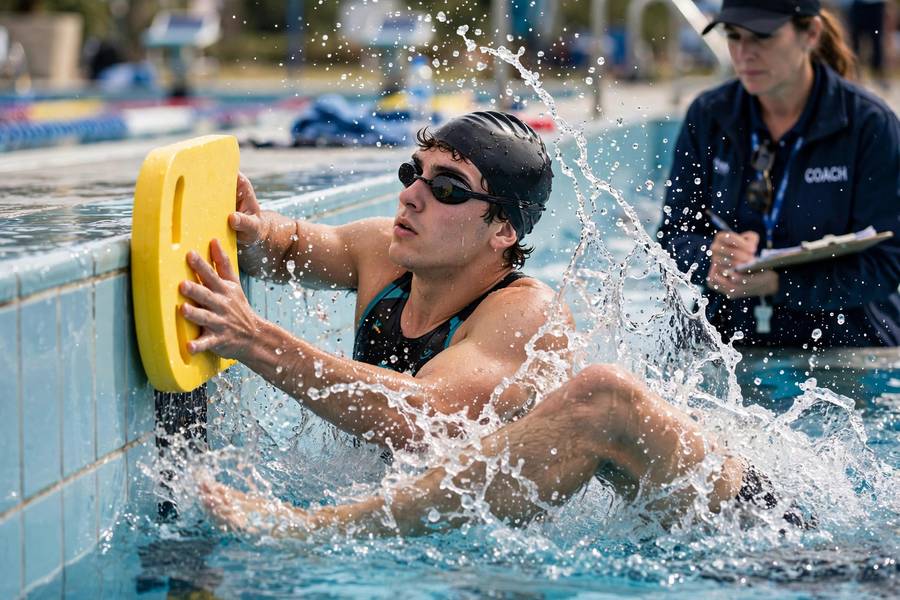
Grab a kickboard. Swim 4 x 50 meters kick only, arms locked on the board, head down. Kick from the hips, not the knees — think of your legs as a fishtail, not bicycle pedals. My coach’s cue: “small, fast kicks, like you’re shaking water off your feet.” Rest 30 seconds between each 50.
This builds the kick engine. Most beginners kick from the knees — like driving with the handbrake on. Two weeks of kickboard work fixed mine.
Pull Buoy Sets
Squeeze a pull buoy between your thighs. Now swim 4 x 50 freestyle, arms only, legs trailing. Without the buoy you’d sink; with it, you learn what your arms are actually supposed to do. Focus on a long reach and a full pull past your hip.
Full Stroke Finish
End with 4 x 50 full freestyle, putting it together. Rest 20-30 seconds. Notice how the drills changed things — most swimmers feel their stroke “click” during this part.
Cool-down: 2 x 25 backstroke, slow and lazy.
Total: about 1,000 meters, 30-35 minutes.
Workout 3: The Endurance Engine (Week 5-8)
Now we’re aerobic base. This is the workout that turns you from “person who can swim” into “swimmer.” It’s simple and brutally effective: longer, steadier swimming with shorter rests.
Warm-up: 200 meters easy — mix freestyle and backstroke.
Main set — the ladder: Swim 50m, rest 15 seconds. Swim 100m, rest 20 seconds. Swim 150m, rest 25 seconds. Swim 200m, rest 30 seconds. Then climb back down: 150, 100, 50. Total: 1,100 meters of steady swimming.
The rule: your pace on the last 50 should match your pace on the first 50. If you fade, you started too fast. Pacing is a skill, and the ladder teaches it better than anything.
Kick finisher: 4 x 25 kickboard, fast-ish, 20 seconds rest. Legs last because they’ll be tired — welcome to the club.
Cool-down: 100 meters easy anything.
Total: about 1,500 meters, 35-40 minutes. Twice a week for a month tripled my continuous-swim distance — no magic, just the boring middle of the training curve.
If mornings work better for you, that’s fine — here’s my take on the best time of day to exercise and why consistency beats the clock.
Workout 4: The Interval Intro (Week 8+)
You’ve got technique and endurance. Now we wake up the speed. Intervals are where swimming gets fun — short bursts, real rest, actual numbers to chase.
Warm-up: 200m easy + 4 x 25 drill of choice.
Main set: 8 x 50 meters at a “hard but controlled” effort — about 80% of your max. Rest 30 seconds between each. Write down your times. I’m not kidding — bring a waterproof notebook or memorize them. Watching those numbers drop week after week is the best motivation in sports.
Week one of intervals, my 50s were around 52 seconds. Six weeks later: 44 seconds. Same swimmer, same pool. The difference was entirely technique holding up under effort.
Technique check: If your stroke falls apart at speed, drop back to Workout 2’s drills for a session. Speed built on broken technique is debt you’ll pay later.
Cool-down: 200m easy.
Total: about 1,200 meters, 30 minutes. Intervals are short sessions. That’s the point — quality over quantity.
Breathing: The Skill That Changes Everything
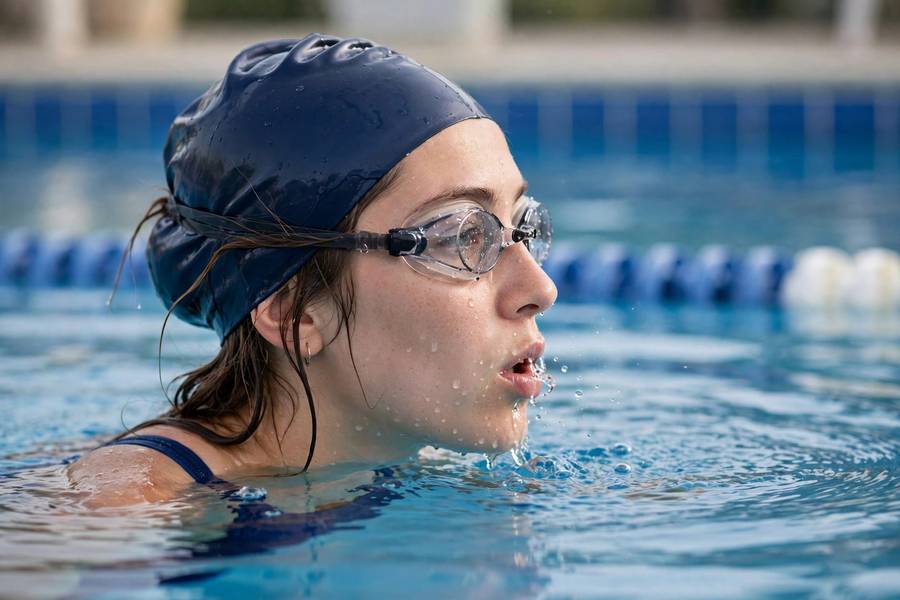
Breathing gets its own section because it’s the number one beginner problem. The mistake everyone makes: holding your breath, then gasping. Underwater, you should be constantly exhaling — a slow stream of bubbles through your nose and mouth. By the time your head turns to breathe, your lungs are empty and ready for a quick sip of air.
Breathe every three strokes (bilateral) or every two to one side. Bilateral keeps your stroke symmetric and straight. Every two feels natural — fight it.
Drill that fixed my breathing: swim freestyle with closed fists. It forces you to think about the breath cycle, not the arm pull. Two lengths fists, two lengths normal, repeat.
The Numbers: How Much Progress Is Normal?
Honest benchmarks from my notebook and the masters group:
- Week 2: 25m in ~45 seconds, need 60 seconds rest. Continuous swim: 100m.
- Week 4: 25m in ~35 seconds, need 30 seconds rest. Continuous swim: 400m.
- Week 8: 25m in ~28 seconds, need 15 seconds rest. Continuous swim: 1,000m.
- Week 12: You can swim 1,500m continuous in about 35 minutes. You’re officially a swimmer.
These are “regular person who shows up” numbers, not records. Behind them? Usually a technique issue — go back to the drills. Ahead? Skip to harder intervals.
One more number: 30 minutes of moderate swimming burns roughly 200-300 calories. But the real prize is zero-impact, full-body work — and you’ll sleep like a rock after.
5 Mistakes Every Beginner Makes
1. Looking forward. Your head weighs about 5kg, and where it goes, your body follows. Look at the bottom of the pool. The lane line is your friend.
2. Kicking from the knees. Bicycle kicking creates drag and exhausts you in minutes. Kick from the hips, legs nearly straight, feet floppy like flippers.
3. Holding the breath. Exhale underwater, always. Bubbles are your friend.
4. Skipping the warm-up. Cold muscles in cold water is how shoulders get hurt. Five easy minutes saves weeks of rehab.
5. Comparing to lane neighbors. The person flying past you has probably been swimming for ten years. Your only competition is last week’s you.
Off the pool deck, bodyweight exercises that build pool strength and learning how to hold a proper plank for core strength will make your stroke noticeably more stable. Core strength is free speed in the water.

Frequently Asked Questions
Three times a week is the sweet spot. Twice a week works but progress is slower — you spend each session re-remembering what your body forgot. Four or more is fine once your shoulders are conditioned, but beginners who jump to daily swimming often get shoulder soreness that forces a break.
About 30 minutes including warm-up and cool-down, roughly 600 to 1,000 meters in the first month. Quality matters far more than distance at this stage — twenty minutes of good technique beats an hour of thrashing. Build to 40 minutes by month three.
Backstroke, because breathing is never an issue — your face stays out of the water. Freestyle is the most useful stroke to learn first, though, since it’s the fastest and most common. Most coaches teach backstroke for comfort, then freestyle for real progress, then breaststroke.
Yes — kickboards are one of the best beginner tools because they isolate your leg technique so you can fix your kick without worrying about your arms or breathing. Most pools provide them free on deck. Use one for kick drills once or twice a week.
Because swimming fitness is mostly about efficiency, not raw conditioning. Runners and lifters gasp in the pool because bad technique wastes enormous energy fighting water resistance. As your stroke gets efficient — usually within 3 to 4 weeks of consistent practice — your endurance catches up fast.
Most consistent beginners can swim 1,000 meters without stopping in 8 to 12 weeks, swimming three times per week. Some get there faster with coaching or a drills-focused program. The key is building up gradually — don’t jump from 400 meters to 1,000 in one session.