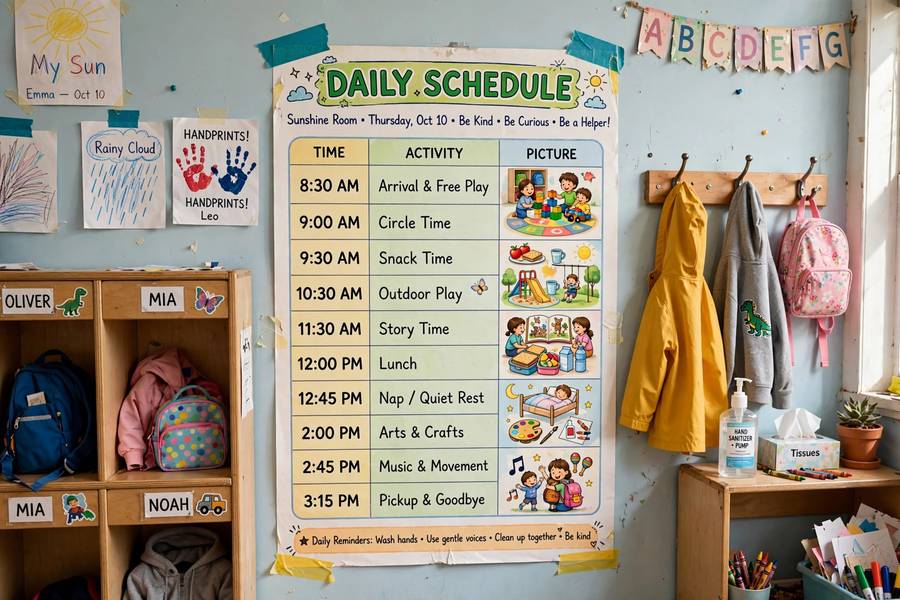
The best-run daycares I have seen do not feel rigid — but they run on rails. Children know what comes next, transitions are smooth, and the day has a rhythm you can feel. That rhythm does not happen by accident. It comes from a well-designed daily schedule, posted on the wall, followed consistently, and tuned over time.
A good schedule is a developmental tool, a behavior management system, and a parent communication asset all in one. This guide gives you the principles behind effective scheduling plus ready-to-use sample templates for infants, toddlers, and preschoolers — adaptable to home daycare or centers. (For the broader operation, see how to start a daycare.)
Table of Contents
- Why Schedule Matters More Than Curriculum
- The Rhythm Principles
- Infant Schedule Template (0–12 Months)
- Toddler Schedule Template (1–2 Years)
- Preschool Schedule Template (3–5 Years)
- Mixed-Age Home Daycare Adaptation
- Transitions: Where Schedules Succeed or Fail
- Communicating the Schedule to Parents
- Frequently Asked Questions

Why Schedule Matters More Than Curriculum
Controversial statement: a mediocre curriculum on a great schedule outperforms a great curriculum on a chaotic schedule. Young children regulate through predictability. When they know that snack follows outdoor play and nap follows lunch, their nervous systems settle. Settled children learn; anxious children do not.
The schedule also runs your business. Staffing follows the schedule — you need full ratio coverage at every point in the day, and the schedule tells you when you can stagger shifts. Meal prep, cleaning, documentation — everything slots into the rhythm. A daycare without a schedule is twelve small emergencies wearing a trench coat.
And parents read your schedule as a proxy for professionalism. A posted, detailed daily rhythm says “we have thought about your child’s day.” A vague “we play and learn” says nothing.
The Rhythm Principles
Before the templates, the principles that make any schedule work:
Alternate high and low energy. Active play → calm activity → active play → calm activity. Never stack two high-energy blocks back to back (chaos) or two passive blocks (restlessness). The day should breathe.
Anchor the non-negotiables. Meals, naps, and outdoor time are fixed points. Everything else flexes around them. When the day goes sideways — and it will — you return to the anchors.
Follow the children’s clocks, not the clock. A schedule is a rhythm, not a timetable. If outdoor play is going beautifully at 10:25, you do not interrupt it because the chart says 10:30. The times are targets; the sequence is the commitment.
Build in margin. Every transition takes longer than you think. Ten-minute buffers between major blocks absorb the reality of twelve children putting on shoes.
Front-load the learning. Cognitive peak for young children is mid-morning, roughly 9:00–11:00. Put your richest activities there. Afternoons are for free play, art, and outdoor time — not for introducing new concepts.
End as you began: calm. The last 30 minutes should wind down, not up. Children picked up in a calm state transition home peacefully; children picked up mid-chaos carry that chaos through the door, and parents notice.
Infant Schedule Template (0–12 Months)
Infants do not follow group schedules — they follow their own eating and sleeping rhythms. The “schedule” is really the caregiver’s framework for meeting individual needs predictably:
7:00–8:30 — Arrival and free floor time. Individual greetings, bottles as needed, tummy time and free exploration on padded mats. Soft music, calm voices — the day starts gently.
8:30–9:30 — Morning outing or sensory play. Weather permitting, a stroller walk (fresh air regulates infant sleep beautifully). Otherwise, sensory baskets — textured fabrics, soft balls, water play for older infants.
9:30–11:00 — Morning nap window. Infants sleep when tired, not when scheduled. The caregiver watches for sleepy cues and puts each baby down individually. While some nap, others get one-on-one floor time.
11:00–12:00 — Feeding and midday play. Bottles or first solids per each family’s plan, then interactive play: peek-a-boo, singing, gentle movement games.
12:00–2:30 — Afternoon nap window. The long nap for most infants. Caregiver uses this time for documentation, bottle prep, and room reset.
2:30–4:00 — Afternoon feeding and play. Second solid meal for older infants, outdoor time in strollers or on blankets, sensory exploration.
4:00–5:30 — Wind-down and pickup. Quiet play, final bottles, individual goodbyes. Each infant leaves calm — or as calm as infants get.
Key rule: never wake a sleeping infant for the schedule, and never force-feed on a timetable. The template serves the babies, not the reverse. Document each infant’s actual patterns in your daycare management software so parents see their child’s real day.
Toddler Schedule Template (1–2 Years)
Toddlers need the most structure of any age group — and resist it the most. The schedule must be rock-solid and invisibly flexible:
7:00–8:00 — Arrival and free play. Low-key table toys, puzzles, books. No big-group activities yet — children arrive dysregulated and need to land.
8:00–8:30 — Breakfast. Family-style. Toddlers serve themselves with help — the autonomy matters as much as the nutrition.
8:30–9:00 — Cleanup and circle time. Short — five to ten minutes max. A greeting song, the day’s picture schedule, one brief group activity. Toddlers’ group attention span is measured in single minutes; respect it.
9:00–10:15 — Outdoor play. The most important block of the day. Running, climbing, digging, trikes. A tired toddler is a teachable toddler; a cooped-up toddler is a behavior problem wearing shoes.
10:15–10:30 — Snack and regroup. Wash hands, refuel, transition inside.
10:30–11:15 — Planned activity. Art, sensory table, simple science (sink/float, color mixing), music and movement. One focused activity, not three — depth over variety.
11:15–11:45 — Free play and wind-down. Open the play zones. Begin dimming energy toward lunch.
11:45–12:15 — Lunch. Family-style. Conversation encouraged — mealtime is language development time.
12:15–2:30 — Nap. Non-negotiable. Dark room, white noise, consistent routine. Non-nappers rest quietly with books — the room stays calm for everyone.
2:30–3:00 — Wake-up and snack. Gentle waking, cuddle time for the groggy, afternoon snack.
3:00–4:00 — Outdoor play (again). Afternoon outdoor time burns the second wind and sets up better evenings at home — parents will thank you.
4:00–5:00 — Free play and centers. Open play zones, art table available, books. Low-demand afternoon.
5:00–5:30 — Pickup and goodbye ritual. A closing song or ritual gives the day a clear ending. Children who know the goodbye routine separate more easily.

Preschool Schedule Template (3–5 Years)
Preschoolers can handle — and need — more cognitive challenge and longer group times:
7:00–8:15 — Arrival and choice time. Learning centers open: blocks, dramatic play, art, books, manipulatives. Children choose; the teacher observes and facilitates.
8:15–8:45 — Breakfast and morning meeting. Calendar, weather, the day’s plan, a discussion question. This is where group belonging is built.
8:45–10:15 — Project and learning centers. The cognitive core: small-group teacher-led activities (early literacy, math concepts, science investigations) rotating through the week, plus open centers. This is the block to protect fiercely.
10:15–10:30 — Snack.
10:30–11:30 — Outdoor play and gross motor. Organized games introduced here — relay races, parachute play, obstacle courses — alongside free play.
11:30–12:00 — Music, movement, or story. A whole-group gathering that transitions energy downward.
12:00–12:30 — Lunch.
12:30–2:00 — Rest time. Preschoolers may not sleep, but they rest — quiet activities on cots. Protect this block; overtired preschoolers are a special kind of challenging.
2:00–2:30 — Snack and wake-up.
2:30–3:30 — Afternoon enrichment. Rotating specials: art studio, cooking project, gardening, building challenges. The week’s most creative work often happens here.
3:30–4:30 — Outdoor play.
4:30–5:30 — Choice time and pickup. Calm centers, closing circle, goodbye ritual.
Mixed-Age Home Daycare Adaptation
Home providers care for 0–5 together. The trick is staggered anchoring: infants follow individual rhythms; toddlers and preschoolers follow the group schedule; and you design overlap points where everyone is content simultaneously.
The magic windows: outdoor play (all ages love it, with the infant zone set up outside too), meals (stagger by 15 minutes — infants first), and nap (infants on individual schedules, everyone else 12:30–2:30). During focused preschool activities, toddlers get sensory play and infants get floor time — same block, three tracks, one caregiver rotating attention.
The honest truth: mixed-age scheduling is the hardest part of home daycare, and it takes about three months to find your rhythm. Give yourself grace in the beginning. The schedule is a living document — revise it monthly in your first year.
Transitions: Where Schedules Succeed or Fail
Transitions — moving twelve children from one activity to another — are where days fall apart. The techniques that work:
Warn before you move. “Five more minutes, then we clean up.” Then “two more minutes.” Then the transition song. Surprises create resistance; warnings create cooperation.
Make transitions activities. March to lunch like elephants. Hop to the bathroom like bunnies. Tiptoe to nap like mice. A transition framed as play is not a transition at all.
Assign jobs. Line leader, door holder, light monitor, snack helper. Children with jobs transition purposefully; children without jobs transition chaotically.
Sing everything. Cleanup songs, handwashing songs, goodbye songs. Music regulates groups of young children more reliably than any other tool. Find your five core songs and use them daily until the children sing them without you.
Communicating the Schedule to Parents
Post it visibly — at the entrance and on your website. Parents deciding between providers compare schedules.
Send daily reports showing what actually happened against the schedule. “We did art instead of music because the children were deeply engaged in painting” is a feature, not a failure — it shows responsive caregiving.
Explain the why. When parents understand that the schedule is developmental design, not rigidity, they become allies. A one-page “why our day looks like this” handout at enrollment prevents a hundred questions.
Note deviations honestly. If nap ran long because everyone was exhausted, say so. Parents trust providers who report reality over providers who report the plan.

Frequently Asked Questions
A daycare schedule needs anchored non-negotiables (meals, naps, outdoor time), alternating high and low energy blocks, age-appropriate learning activities in the mid-morning cognitive peak, smooth transitions with warnings and songs, and calm start and end rituals. Post it visibly and follow the sequence consistently.
Toddlers typically nap 1.5–2.5 hours (12:15–2:30 is standard); preschoolers rest 1–1.5 hours even if they don’t sleep. Infants follow individual sleep cues rather than group nap times. Never skip rest time — overtired children can’t learn or regulate behavior.
Use staggered anchoring: infants follow individual eating/sleeping rhythms, toddlers and preschoolers follow the group schedule, and design overlap windows (outdoor play, meals, nap) where all ages are content simultaneously. Expect three months to find your rhythm.
Aim for twice daily, 45–75 minutes each — typically mid-morning and mid-afternoon. Outdoor play is the most important block for toddlers’ behavior and development. A tired toddler is teachable; a cooped-up toddler is a behavior challenge.
Rhythmic, not rigid: follow the sequence consistently but flex the timing. If an activity is going beautifully, let it run long. The times are targets; the order of the day is the commitment. Children regulate through predictable sequence, not precise clock times.