Daycare Business Plan Template: What to Include (With Outline)

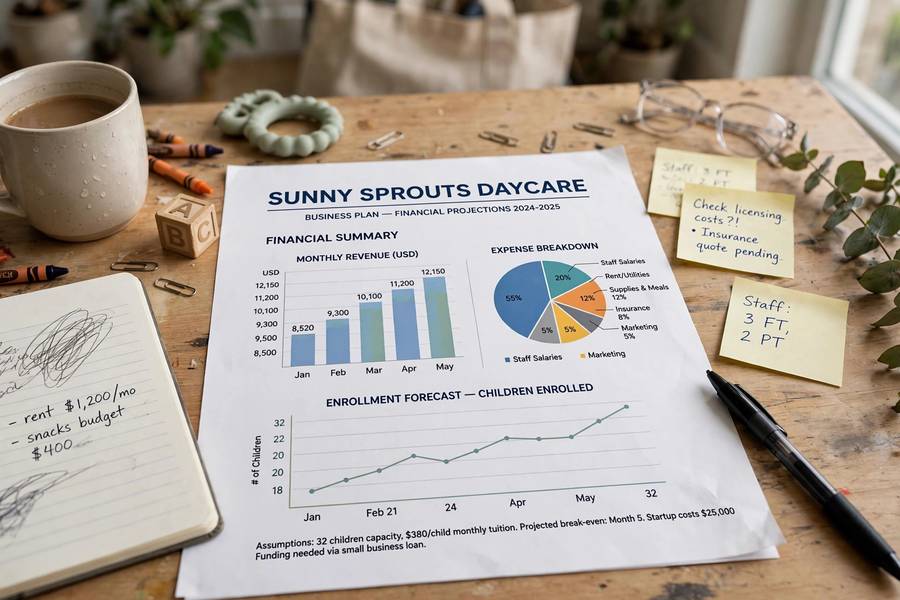
Most daycare founders write their business plan backwards: they start with the mission statement and run out of steam before the financials. Lenders read it the opposite way — they flip straight to the numbers, and if the numbers do not work, the mission statement does not matter. I have reviewed dozens of childcare business plans, and the ones that got funded all share the same structure.
This is that structure: the ten sections a daycare business plan needs, what each section must prove, and the specific mistakes that get plans rejected. Use it whether you are borrowing from a bank, pitching a partner, or just forcing yourself to think clearly. The plan is the thinking, not the document. (For the venture itself, see how to start a daycare; for the numbers behind section 7, see how to price daycare services.)

Why a Daycare Needs a Real Plan
Daycare feels like a simple business — care for children, collect tuition. That simplicity is deceptive. You are managing ratio-driven labor costs, 6–12 month enrollment ramps, heavy regulation, and parents making emotional decisions. A plan forces you to confront the math before the math confronts you.
Banks know childcare failure rates. An SBA lender seeing a daycare application thinks “undercapitalized, optimistic enrollment projections, founder has never managed payroll.” Your plan’s job is to dismantle each of those assumptions with specifics. Vague plans confirm their fears; specific plans overcome them.
Section 1: Executive Summary
Write this last, put it first. One to two pages covering: what you are opening (home daycare or center, capacity, location), how much you need and what it is for, and the three numbers that prove viability — break-even enrollment, months to break-even, and year-three net margin.
The executive summary must stand alone. Many lenders read only this before deciding whether to read further. Every claim in it must be backed by a later section — no orphan numbers.
Section 2: Business Description
Legal structure and ownership. LLC (or corporation), owners, ownership percentages. If you have partners, explain who does what — lenders worry about partner disputes killing small businesses.
Mission and positioning. One paragraph on what makes this daycare different. Not “we love children” — every applicant loves children. What is your actual edge: bilingual program, nature-based curriculum, extended hours for shift workers, infant specialization? Specificity is credibility.
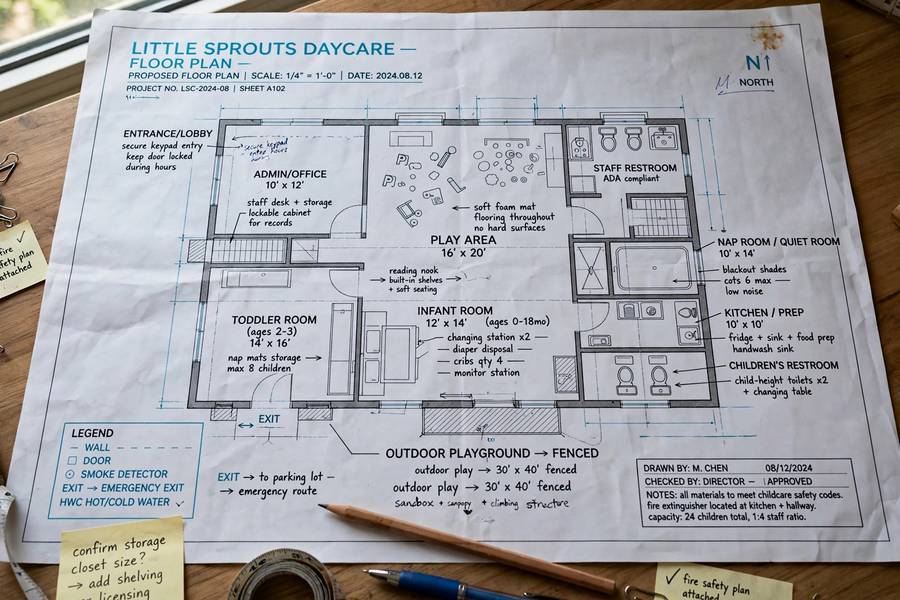
Facility. Address (or target area), square footage, indoor/outdoor space, capacity by age group, lease terms or purchase details. Include a floor plan sketch — it signals seriousness.
License status. Where you are in the licensing process, expected timeline, any conditions. If you are pre-license, say so honestly and show the timeline.
Section 3: Market Analysis
This section separates funded plans from rejected ones. You need:
Demand data. Number of children under 5 in your target zip codes (census data), local workforce participation rates, existing childcare capacity. The key calculation: unmet demand — families needing care minus licensed slots available. Your state’s childcare resource and referral agency often publishes exactly this gap analysis. Use it.
Competitor map. Every licensed provider within your draw area: their capacity, rates, ages served, and positioning. Visit them as a “parent.” Note their weaknesses honestly — long waitlists, poor reviews, limited hours. Your opportunity lives in their gaps.
Target parent profile. Who exactly enrolls: dual-income professionals, single parents, shift workers, university families? Each segment has different price sensitivity, schedule needs, and decision criteria. Name yours and explain why your program fits them.
Pricing analysis. Competitors’ rates by age group and schedule type, positioned against your planned rates. Justify your position — premium pricing needs a premium reason; discount pricing needs a cost structure that supports it.
Section 4: Organization and Management
Org chart. Even for a home daycare: owner, assistant, substitutes, contracted services (accountant, payroll). For centers: director, assistant director, lead teachers, aides, cook, with reporting lines.
Key personnel bios. Your childcare credentials, business experience, and why you are qualified to run this. Be honest about gaps and how you fill them (advisory board, experienced director hire, mentorship).
Staffing plan tied to ratios. Show headcount by role at 50%, 75%, and 100% enrollment, mapped to your state’s ratio requirements. This proves you understand that staffing is your cost engine.
Compensation philosophy. Wage ranges, benefits, retention strategy. Lenders know turnover kills daycares; showing you have thought about retention is a quiet differentiator.
Section 5: Services and Programs
Age groups and capacity. Exactly how many children in each age group, and the ratios you will staff to (at or better than state minimums — “better than minimum” is a marketing point).
Program description. Daily rhythm, curriculum approach, enrichment activities. Keep it concrete: “Reggio-inspired project work, daily outdoor time, weekly music” beats “holistic development.”
Schedule options. Full-time, part-time, drop-in, extended hours, summer programs. Each option is a revenue line — price them individually.
Differentiators. What you offer that the competitor map showed was missing. Extended hours, infant specialization, organic meals, parent app with photo updates — whatever your edge is, make it explicit.

Section 6: Marketing and Enrollment Strategy
Enrollment targets by month. Month 1: 30%, month 3: 50%, month 6: 70%, month 12: 85%. Show the ramp — lenders know you do not open full, and a plan that pretends otherwise loses credibility instantly.
Acquisition channels. Website and Google Business Profile, local parent groups, pediatrician referrals, employer partnerships, open houses, social media. Assign a budget and an expected enrollment contribution to each.
Retention strategy. Enrollment is only half the equation; keeping families is the other half. Parent communication systems, satisfaction surveys, referral incentives for current families.
Pricing strategy. Your rate card with the rationale — reference the pricing analysis and how to price daycare services to show the math holds.
Section 7: Financial Projections
The section that decides everything. Three years minimum, monthly for year one:
Startup costs. Itemized: licensing, renovations, equipment, deposits, initial marketing, working capital. Total it. This number must match your funding request.
Revenue projections. Enrollment ramp × rates × age-group mix, month by month. Show your occupancy assumptions explicitly — this is where most plans lie to themselves.
Operating expenses. Staffing (the big one, ratio-driven), rent, insurance, food, supplies, utilities, marketing, professional services. Monthly, with annual totals.
Cash flow statement. Monthly cash in vs cash out for year one. This reveals the working-capital trough — the deepest negative month tells you how much reserve you actually need.
Break-even analysis. At what enrollment percentage do revenues cover costs? For most daycares: 65–75%. If your break-even is 90%, your plan is fragile — say how you de-risk it.
Sensitivity analysis. Show what happens if enrollment runs 20% below plan, or if you must raise wages 10%. One scenario table proves you have thought about downside. Plans without downside scenarios read as fantasies.
Section 8: Funding Request
Amount and use of funds. “We are requesting $120,000: $45,000 build-out, $25,000 equipment, $15,000 deposits and fees, $35,000 working capital.” Every dollar assigned. Round numbers with no breakdown signal guesswork.
Terms you are seeking. Loan amount, preferred term, what you offer as collateral. Show you understand the lender’s side.
Repayment capacity. Debt service coverage ratio from your projections — can the business service this loan at 70% enrollment? At 60%? Lenders do this math themselves; doing it first builds trust.
Owner investment. How much of your own money is in. Lenders expect 10–20% owner equity minimum. Less than that reads as “not confident enough to risk my own money.”
Section 9: Operations Plan
Daily operations. Hours, drop-off/pickup procedures, daily schedule by age group, staffing assignments. Operational detail proves you have thought past the opening.
Health, safety, and compliance systems. How you maintain licensing compliance daily: checklists, training schedules, record-keeping systems, inspection readiness. This section reassures risk-averse lenders.
Emergency procedures. Evacuation plans, communication protocols, backup staffing. Brief but present — its absence is noticed.
Key milestones. License application → approval → build-out complete → staff hired → soft open → grand open, with dates. A dated milestone chart turns a dream into a project.
Section 10: Appendix
Resumes, floor plans, contractor quotes, letters of intent (landlord, key hires), market data printouts, sample parent contract, insurance quotes. The appendix is where claims go to be verified — reference it from the body (“see Appendix C for contractor quotes”) rather than dumping it unreferenced.
Mistakes That Get Plans Rejected
Fantasy enrollment. “We will be at 100% capacity in month two.” No lender believes this. Show the ramp.
Missing working capital. Plans that fund the build-out but not the operating trough. The business opens, then dies in month five. Lenders have seen this movie.
Ignoring ratio economics. Staffing plans that do not map to ratio requirements. If your state requires 1:4 for infants and you project infant revenue with 1:6 staffing, the plan is fiction.
No downside scenario. Only upside projections. Lenders underwrite downside; meet them there.
Generic market analysis. “The childcare market is $60 billion nationally.” Lenders care about your three zip codes, not the national market.
Founder does everything. A plan where the owner is director, teacher, cook, bookkeeper, and marketer is a burnout plan. Show the team, even if some roles are contracted.
Inconsistent numbers. The executive summary says $100,000; the financials say $130,000. Inconsistency destroys credibility faster than bad numbers — bad numbers can be discussed, sloppiness cannot.
Frequently Asked Questions
A daycare business plan needs 10 sections: executive summary, business description, market analysis, organization/management, services and programs, marketing and enrollment strategy, 3-year financial projections, funding request, operations plan, and appendix. Lenders focus on the financials — especially enrollment ramp, break-even point, and working capital.
Monthly for year one, annual for years two and three. Include startup costs itemized, revenue by enrollment ramp and age-group mix, ratio-driven staffing expenses, monthly cash flow showing the working-capital trough, break-even enrollment percentage, and at least one downside scenario.
Yes — even without a lender. The plan forces you to confront enrollment ramp, ratio-driven staffing costs, and working capital needs before they become crises. A leaner version (5–10 pages) suffices for self-funded home daycares; full plans are needed for loans or partners.
Most daycares break even at 65–75% enrollment. If your projections show break-even above 85%, the plan is fragile — reduce fixed costs, raise rates, or increase capacity. Show the break-even calculation explicitly; lenders will compute it themselves if you don’t.
The top reasons: unrealistic enrollment projections (claiming full capacity immediately), missing working capital for the pre-profit months, staffing plans that ignore ratio requirements, no downside scenario, and inconsistent numbers between sections. Specificity and honest downside planning overcome all of these.